Cotton farmers face a growing challenge: pests are developing resistance to Bt crops and insecticides, threatening decades of progress in pest control. Resistance can lead to major crop damage and financial losses, but it’s not inevitable. By using Integrated Pest Management (IPM) strategies, farmers can stay ahead. Here’s what you need to know:
- Key Warning Signs of Resistance: Unexpected crop damage, pest survival hotspots, or repeated control failures.
- IPM Tools: Combine scouting, biological controls, crop rotation, and chemical rotation to manage pest populations effectively.
- Bt Cotton Refuge: Planting non-Bt cotton near Bt fields helps preserve Bt effectiveness by slowing resistance development.
- Chemical Rotation: Use insecticides with different modes of action (IRAC group numbers) to prevent resistance.
- Scouting and Thresholds: Regular field monitoring ensures treatments are applied only when pest levels justify action.
Farmers must act now to maintain effective pest control and protect yields. This guide explains how to spot resistance, implement IPM practices, and safeguard pest management tools for the future.
BT crops, Pest Resistance and Management
sbb-itb-0e617ca
Identifying Resistance and Its Warning Signs
Resistance doesn’t happen overnight - it creeps in over time. Each generation of pests exposed to the same control method leaves behind survivors that are better adapted to withstand it. These survivors reproduce, and the cycle continues. As mentioned earlier, repeated use of a single control approach speeds up this process. Spotting the warning signs early is key to implementing effective pest management strategies later.
Common Warning Signs of Resistance
One of the earliest and most telling signs is unexpected crop damage in fields where a control method used to work well. For instance, if your Bt cotton is suddenly showing significant bollworm damage beyond your usual thresholds, or a spray that used to last 14 days is now failing after just 7, it’s time to dig deeper.
Here are some other signs to watch for:
- Survival hotspots: Pests thriving in specific areas of the field, even when treatments work elsewhere.
- Healthy larvae on Bt plants: Finding live, active larvae feeding normally on plants that should kill them.
- Rapid population rebound: Pest numbers climbing back much faster than usual after treatment, based on your historical records.
- Repeated control failure: Consistent failure of the same product across multiple applications, even under proper conditions.
"Field-evolved resistance has been documented in several pest species, including the pink bollworm (Pectinophora gossypiella), which has shown high levels of resistance to both Cry1Ac and Cry2Ab toxins." - Shanjun Zhu and Mengting Luo, Researchers, Field Crop
Globally, 11 pest species have now been confirmed to show resistance to various Bt toxins. This makes field monitoring more critical than ever. Catching these signs early can help determine if resistance is the real issue or if something else, like application errors, is at play.
Distinguishing Resistance from Poor Application
Before jumping to conclusions about resistance, it’s important to rule out application errors. Poor application can mimic resistance in many ways, but the underlying causes - and solutions - are completely different.
| Indicator | Likely True Resistance | Likely Poor Application |
|---|---|---|
| Field pattern | Survival hotspots scattered across the field | Streaks or edge effects tied to spray swaths |
| Pest appearance | Healthy, active pests shortly after treatment | Pests survive due to insufficient coverage or dose |
| Coverage | Pests found on well-covered upper leaves | Pests mainly in lower canopy or shadowed areas |
| Chemical history | Occurs after repeated use of the same chemical class | Can happen regardless of chemical history |
| Confirmation | Verified through laboratory bioassay | Resolved by fixing technique or equipment |
Before diagnosing resistance, check your equipment: ensure proper calibration, inspect nozzles, and confirm the spray solution’s pH. These simple steps can often resolve what looks like resistance.
"Growers are encouraged to report incidents of 'unexpected damage' in the field." - U.S. EPA
If resistance is confirmed, it’s time to rethink your management strategies. If treatments keep failing despite proper application, reach out to your seed supplier or local extension office. Laboratory bioassays are the only reliable way to confirm resistance and assess its extent.
IPM Strategies to Slow Resistance
Integrated Pest Management (IPM) is designed to manage pests in a way that keeps their populations below levels that cause economic harm. The goal isn’t to eliminate every pest but to use the right tools at the right time to maintain balance. This approach not only ensures effective pest control but also helps preserve the long-term usefulness of cotton pest management methods.
"The integrated pest management concept assumes that pests will be present to some degree and, at low levels, do not cause significant economic losses." - Texas A&M AgriLife Extension Entomology
Scouting and Economic Thresholds
Scouting is the cornerstone of any IPM program. Regular field monitoring - ideally once or twice a week - provides the data needed to make informed decisions. The primary aim is to determine whether pest populations have reached the economic threshold, the point at which the cost of potential crop damage outweighs the expense of treatment. Spraying too early not only wastes resources but also increases the risk of resistance.
Different pests require different tools for accurate sampling. For instance:
- Beat buckets are effective for plant bugs.
- Drop cloths work well for row-dwelling pests.
- Sweep nets are ideal for catching mobile adult pests.
Using the right tool ensures accurate pest counts, enabling timely and precise action. In Texas, adopting threshold-based management, combined with Bt traits and neonicotinoid seed treatments, has led to a two-thirds reduction in foliar insecticide use since 2000. At the same time, cotton yields in the state have increased by 50%.
By pairing this data with cultural and biological strategies, growers can reduce the risk of resistance even further.
Cultural and Biological Controls
"The first line of defense is to use effective agronomic practices and cultural methods to produce the crop in ways that are unfavorable for pest problems to develop." - Texas A&M AgriLife Extension Entomology
Cultural controls are often overlooked but can significantly reduce pest pressure. For example, timely stalk destruction after harvest removes overwintering sites for pests like the pink bollworm (Pectinophora gossypiella), cutting off their population before the next growing season. Other effective cultural practices include adjusting planting dates, rotating crops, and using resistant varieties. These methods disrupt pest life cycles without introducing additional chemical pressure, reducing the need for insecticides.
Biological controls are another key element. Natural predators like assassin bugs, lady beetles, lacewings, and spiders provide ongoing pest suppression without added costs. These beneficial insects can mean the difference between a manageable pest population and one that requires intervention.
Protecting Beneficial Insects
Protecting beneficial insects is just as important as managing pests. Broad-spectrum insecticides often kill both pests and their natural enemies, which can lead to pest resurgence - a phenomenon where pest populations bounce back stronger due to the absence of predators.
When chemical control is necessary, using selective insecticides that target specific pests while sparing beneficial insects can help maintain this balance. Scouting for predators is equally important. For example, the beat bucket method - sampling three plants per site across 34 locations per field - at first bloom and again 2–3 weeks later helps assess whether natural enemies are effectively controlling pests before resorting to sprays.
Chemical Rotation and Mode-of-Action Planning
Chemical rotation plays a critical role in Integrated Pest Management (IPM) by countering the resistance that can develop from repeated use of the same type of insecticide. Overusing a single chemical class allows pests with natural tolerance to survive and pass on those traits, eventually rendering the entire class ineffective. By rotating chemicals, farmers can limit this risk and maintain the effectiveness of their pest control tools.
"Reliance on insecticides that act the same way can cause pests to develop resistance to the entire class of insecticides." - Texas A&M AgriLife Extension
How Mode-of-Action Rotation Works
Every insecticide disrupts a specific biological function in a pest. The Insecticide Resistance Action Committee (IRAC) assigns a unique group number to each mode of action (MoA), which is clearly marked on product labels. This IRAC number, not the brand name, is the key detail farmers need to monitor.
Rotating between products with the same IRAC number isn’t effective rotation. True rotation means switching to a product with a different IRAC group number. For example, moving from a pyrethroid to an organophosphate like acephate ensures the pest's nervous system is targeted in a completely different way.
"The combination of insecticide rotations and tank mixtures with insecticides from different IRAC classes reduces the chance of selecting individual pests that are resistant to certain classes of insecticides." - Texas A&M AgriLife Extension
Tank mixing is another powerful tool. Proper mixing involves combining products from different IRAC classes, which attacks pests through multiple biological pathways. This makes it much harder for any single pest to survive and pass on resistance traits.
Spray Timing and Label Compliance
Timing matters just as much as the chemicals themselves. Spraying too early - before pest populations reach economic thresholds - creates unnecessary selection pressure. Every spray event gives resistant pests a chance to survive and reproduce. Instead, farmers should rely on regular scouting to determine when pest levels justify treatment.
Equally important is following product labels. Applying insecticides at sub-lethal doses to save money often backfires. Low doses allow resistant pests to survive and breed, accelerating resistance. Using the full label-recommended rate for the specific pest ensures maximum effectiveness and leaves fewer survivors to perpetuate resistance.
Best Practices vs. Misuse Patterns: A Side-by-Side Comparison
Here’s a quick look at how smart practices differ from common mistakes that speed up resistance:
| Practice | Best Practice | Misuse Pattern |
|---|---|---|
| Chemical Selection | Rotate between different IRAC group numbers for each application. | Switch between brand names with the same IRAC number. |
| Application Timing | Spray only when scouting shows pests exceed economic thresholds. | Apply on a fixed schedule, ignoring actual pest levels. |
| Tank Mixing | Combine products from different IRAC classes to attack pests via multiple pathways. | Mix products from the same IRAC class, offering no real diversity. |
| Rate Compliance | Use the full label-recommended rate for the target pest. | Apply sub-lethal doses to save money, promoting resistance. |
| Biological Control | Opt for selective insecticides that preserve beneficial species. | Use broad-spectrum chemicals unnecessarily, harming natural predators. |
Next, the discussion will move to Bt cotton refuge strategies and trait stewardship.
Bt Cotton Refuge and Trait Stewardship
Diversifying pest management strategies includes using genetic tools like Bt cotton refuges to delay resistance. Since its introduction in the mid-1990s, Bt cotton has transformed pest control. By 2020, 88% of all cotton planted in the U.S. was Bt cotton. However, widespread use comes with a challenge: pests can adapt and become resistant to Bt toxins, threatening the technology's longevity. Refuges are a crucial way to prevent this.
Refuge Requirements and Why They Matter
A refuge is a section of non-Bt cotton (or another non-Bt crop) planted near Bt fields. Its purpose? To maintain a population of Bt-susceptible insects that can mate with any resistant individuals surviving in Bt fields. This reduces the spread of resistance traits in the pest population.
This strategy works best when Bt plants produce toxins at a "high dose" - enough to kill insects with just one resistance gene. Only pests with two resistance genes survive, and those are extremely rare. Fangneng Huang from Louisiana State University Agricultural Center explains:
"The success in sustaining susceptibility in these major pests is associated with successful implementation of the 'high-dose/refuge' insecticide resistance management (IRM) strategy."
Proximity is critical. Refuges must be planted within 0.5 to 1 mile of Bt cotton fields to ensure insects from both areas can mate. This distance is based on how far adult pests typically travel.
Modern Bt cotton varieties often include multiple toxins (Cry1Ac, Cry2Ab, Vip3Aa) in a single plant, making it harder for pests to develop resistance. This approach, combined with refuges, provides a strong foundation for managing resistance and planning trait rotations.
Trait Rotation and Non-Bt Cotton Use
While pyramided traits are effective, they work best when paired with seasonal rotation or occasional planting of non-Bt cotton. Think of it as applying the same principle as rotating chemical insecticides: avoid relying on the same defense year after year.
In areas with low pest pressure, planting non-Bt cotton varieties can cut costs and act as a refuge. However, this decision should be guided by scouting data. If pest populations are low and economic thresholds aren't met, non-Bt cotton can be a sound choice.
Growers also need to report unexpected damage in Bt fields to their seed provider immediately. Early signs of resistance - like unusual pest survival - allow for quick action before the problem spreads.
Structured vs. Natural Refuges: A Comparison
There are two main types of refuges: structured and natural. The choice depends on your location, the Bt trait in use, and EPA guidelines. Here's a comparison:
| Feature | Structured Refuge | Natural Refuge |
|---|---|---|
| Definition | Non-Bt cotton planted in specific blocks, strips, or rows near Bt fields | Existing non-Bt crops (e.g., soybean, maize, peanut) and wild plants in the surrounding area |
| Management | Requires active planting and equal inputs (planting time, fertilizer, irrigation) | No active management by the grower |
| Primary Use | Mandatory for single-toxin Bt cotton; required in AZ, CA, NM, and West TX | Approved for pyramided traits like Bollgard II in some Southeastern states |
| Reliability | High, when growers follow guidelines | Variable; depends on local abundance of alternative hosts like soybean |
| Target Pests | Best for specialists like pink bollworm (Pectinophora gossypiella) | Suitable for generalists like cotton bollworm (H. zea) |
One success story of structured refuges: Between 1996 and 2005, a program in the southwestern U.S. combined Bt cotton, structured refuges, sterile insect releases, and IPM practices to eradicate pink bollworm from Arizona and restore Bt effectiveness.
Natural refuges, however, depend heavily on the local landscape. A study in Scientific Reports observed:
"Effectiveness of the natural resistance management refuge for Bt-cotton is dominated by local abundance of soybean and maize."
If soybean acreage in your area decreases, the effectiveness of natural refuges drops too. Monitoring these changes is essential. Combining Bt refuge strategies with chemical rotations and IPM creates a stronger defense against evolving pests.
Building a Seasonal Resistance-Management Plan
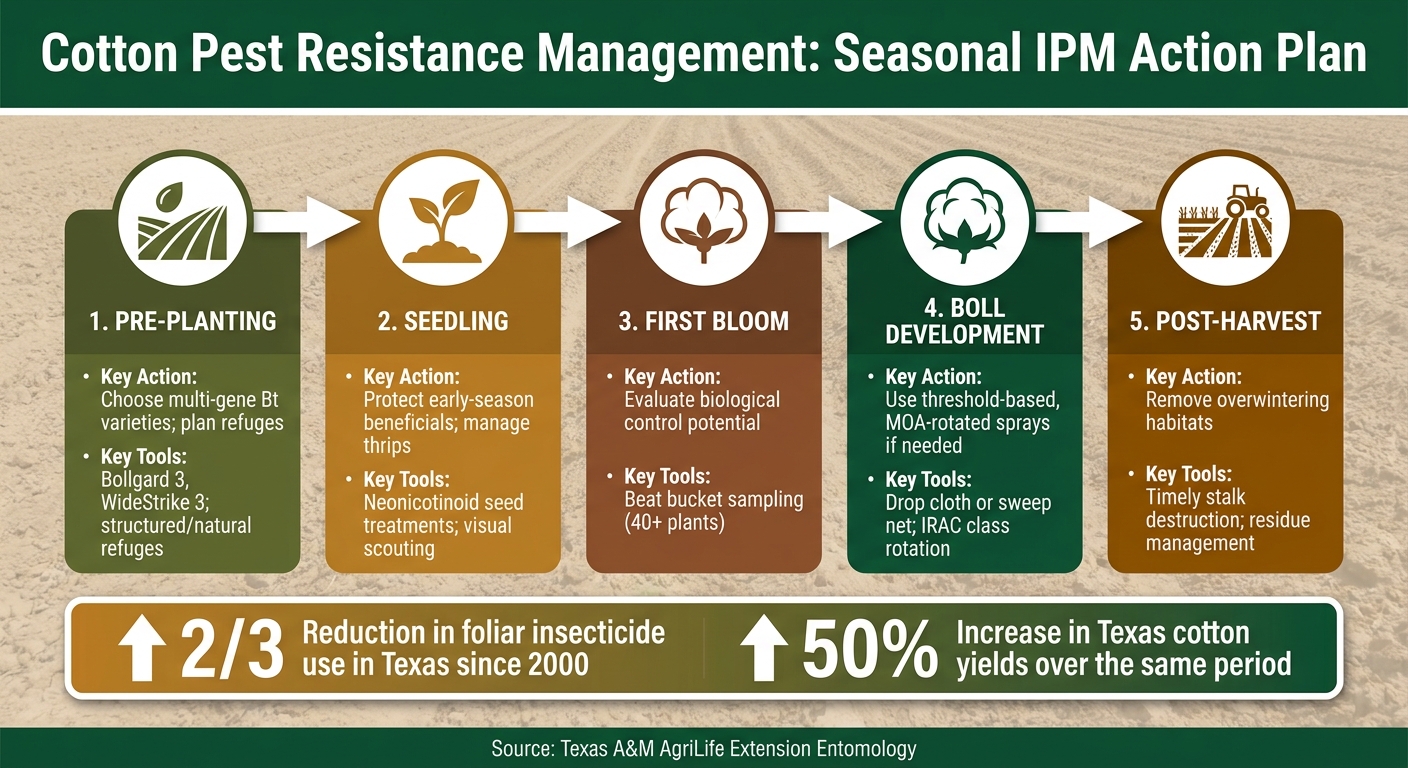
Cotton Pest Resistance Management: Seasonal IPM Action Plan
A resistance-management plan combines scouting, variety selection, chemical applications, and farming practices to keep pests in check throughout the season. It integrates diverse control methods and timely interventions into a cohesive strategy. As Texas A&M AgriLife Extension explains:
"The first line of defense is to use effective agronomic practices and cultural methods to produce the crop in ways that are unfavorable for pest problems to develop."
The idea is to layer multiple tools so no single pest-control method becomes over-relied upon. By incorporating Integrated Pest Management (IPM) and chemical rotation techniques, a seasonal plan ensures more effective and sustainable pest control.
Aligning Actions with Crop Growth Stages
For resistance management to be effective, actions must align with what’s occurring in the field. For instance, using broad-spectrum foliar sprays too early in the season can eliminate beneficial insects before they’ve had a chance to contribute to biological control. Instead, neonicotinoid seed treatments can manage early-season thrips while preserving key natural enemies like lady beetles, spiders, and lacewings.
At first bloom, the focus should pivot to monitoring predator populations. Beat bucket sampling during this stage - and again 2–3 weeks later - can help determine whether biological control is sufficient or if a foliar treatment is necessary. Shake at least 40 plants per sample to get a reliable assessment. When treatment thresholds are reached, IRAC mode-of-action (MOA) rotation is critical to prevent pests from developing resistance to a single insecticide class.
Step-by-Step Actions for Each Season
The table below highlights the key actions and tools for each stage of cotton growth:
| Crop Stage | Key Action | Key Tools |
|---|---|---|
| Pre-Planting | Choose multi-gene Bt varieties; plan refuges | Bollgard 3, WideStrike 3; structured/natural refuges |
| Seedling | Protect early-season beneficials; manage thrips | Neonicotinoid seed treatments; visual scouting |
| First Bloom | Evaluate biological control potential | Beat bucket sampling (40+ plants) |
| Boll Development | Use threshold-based, MOA-rotated sprays if needed | Drop cloth or sweep net; IRAC class rotation |
| Post-Harvest | Remove overwintering habitats | Timely stalk destruction; residue management |
Timely stalk destruction after harvest is particularly important, as it removes habitats that pests, including resistant individuals, might use to survive the winter. This approach was a cornerstone of the southwestern U.S. pink bollworm eradication program (1996–2005), alongside Bt cotton and sterile insect release methods.
Major Cotton Pests and How to Manage Resistance
Building on the earlier discussion of Bt refuge strategies, it’s important to dive deeper into how specific pests challenge these measures and what can be done to manage resistance effectively.
Key Pest Groups and Their Resistance Risks
Cotton pests pose varying levels of resistance risks, making it essential to prioritize management strategies based on the pest type.
Cotton bollworm (Helicoverpa zea) is one of the most pressing threats. A study of 95 strains (2016–2021) revealed widespread resistance to Cry1Ac, Cry1Fa, and Cry2Ab toxins across the mid-southern U.S. and Texas. Since bollworms have largely overcome these Cry-based Bt traits, newer technologies like Bollgard 3 and WideStrike 3, which incorporate the Vip3Aa toxin, have become the main defense. In fields where Cry resistance is common, Vip3Aa effectively functions as a stand-alone toxin:
"Vip3Aa effectively acts as a single toxin against H. zea larvae that are highly resistant to Cry toxins." - Yang et al.
Fall armyworm also poses a high resistance risk, particularly to Cry1F toxins, requiring close monitoring even in fields planted with advanced Bt varieties. On the other hand, whiteflies (Bemisia tabaci) and cotton aphids tend to develop resistance through enhanced metabolic detoxification mechanisms (P450 and GST genes). For these pests, preserving natural predators often proves more effective than relying on repeated chemical sprays. Overusing pyrethroids can worsen the issue by triggering secondary pest outbreaks, such as aphids and mites, due to the loss of beneficial predators.
Tobacco budworm is a notable exception, as it remains highly susceptible to current Bt traits. This susceptibility has been preserved through proper stewardship of transgenic traits. Thrips, an early-season pest, are usually managed effectively with neonicotinoid seed treatments when applied correctly.
The following table provides a quick overview of major pest groups, their resistance risks, and the best management practices.
Pest Groups and Best Practices: A Summary Table
| Pest Group | Major Species | Resistance Risk | Best Management Tactics |
|---|---|---|---|
| Caterpillars | Cotton Bollworm (H. zea) | Very High (Cry toxins & pyrethroids) | Use Vip3Aa traits (Bollgard 3, WideStrike 3); apply diamides (Prevathon, Besiege) or spinosyns (Blackhawk) when larvae exceed ¼ inch |
| Caterpillars | Fall Armyworm | High (Cry1F) | Monitor for Cry1F failure; rely on Vip3Aa traits; scout weekly |
| Sucking Pests | Whiteflies | High | Rotate IRAC chemical classes; protect natural enemies; avoid unnecessary broad-spectrum sprays |
| Sucking Pests | Cotton Aphid | Moderate to High | Conserve predators (lady beetles, lacewings); monitor neonicotinoid efficacy; avoid pyrethroids |
| Caterpillars | Tobacco Budworm | Low | Maintain Bt trait stewardship; current third-generation traits remain highly effective |
| Early Season | Thrips | Moderate | Neonicotinoid seed treatments; visual scouting for early damage |
Environmental factors like high temperatures, water stress, and soil salinity can reduce Bt protein levels in cotton plants, increasing the survival rate of resistant pests. During periods of heat stress, additional scouting and lower treatment thresholds may be necessary, even in fields planted with advanced Bt varieties.
Conclusion: Keeping Cotton Pest Control on Track
Cotton growers are already grappling with the pressing issue of pest resistance. Since 2000, Texas has seen a two-thirds reduction in foliar insecticide use, while cotton yields have surged by 50%. This progress showcases the impact of consistent and disciplined pest management practices.
The strategies outlined in this guide - scouting, chemical rotation, refuge maintenance, and pyramided traits - are most effective when used together as part of an integrated approach. However, declining scouting efforts, often due to reliance on transgenic technology, can obscure early warning signs of trait failure. Maintaining these interconnected strategies is key to building a long-term, effective pest management program.
"Rigorous resistance management measures are needed to preserve the efficacy of Vip3Aa against this highly adaptable pest." - Yang et al.
FAQs
How do I confirm resistance versus a spray problem?
To figure out whether you're facing resistance or a spray issue, start by checking if the product fails even when you’ve followed the label instructions carefully - this includes proper timing and application rates. If pests are still causing damage, resistance might be the problem. However, failure can also result from poor timing or insufficient coverage. Make it a habit to scout your fields regularly and reach out to your local extension office. They can provide updates on any reported resistance to specific chemistries or traits in your area.
What’s the simplest way to plan IRAC rotations all season?
To manage pests effectively and reduce the risk of resistance, consider breaking the season into distinct periods that align with each pest generation. During each period, use insecticides that share the same Mode of Action (MoA). However, as you move into the next period, switch to a different MoA group. This rotation strategy helps maintain the effectiveness of insecticides over time. For the best results, seek advice from local experts who can tailor recommendations to your region's specific pest challenges and crop growth stages.
How do I choose the right Bt refuge for my area?
Your choice of a Bt refuge depends largely on where you are in the U.S. In the southeastern states, many growers opt for natural refuges. These take advantage of existing weeds, wild plants, or other crops in the area to support pests like tobacco budworm and cotton bollworm. The best part? They don’t require any additional planting.
However, if you’re in a region where natural refuges aren’t permitted, you’ll need to go with a structured refuge. This means dedicating a specific portion of your land to non-Bt cotton.