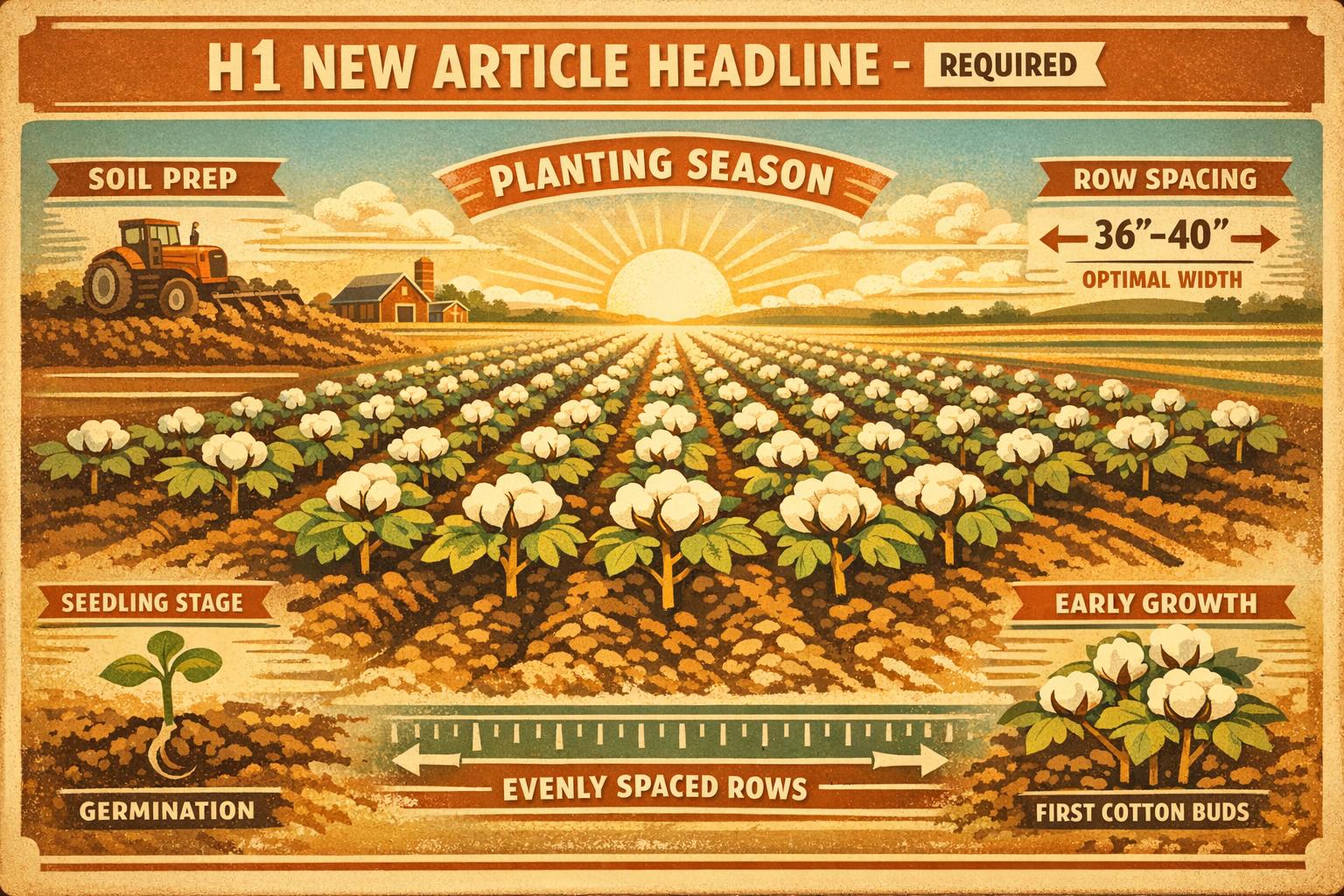
If I want better cotton stands, I need to plant more evenly, not just plant faster. The article’s core point is simple: automation helps cut skips, doubles, and depth swings, and that can mean better emergence, fewer replants, lower seed waste, and more profit per acre.
Here’s the short version:
- Stand counts still drive profit.
- Cotton can still pay at about 1 plant per foot, but long gaps - especially 3 row feet or more - can trim yield.
- In the Southeast, many fields start near 2.5 seeds per linear foot and aim for about 1.2 to 1.9 plants per foot.
- Planting too deep, too shallow, or at uneven depth can slow emergence by days, not hours.
- In many cases, 6.0 to 6.5 mph is near the upper end for keeping spacing and depth in line.
- The planter parts that matter most are seed meters, downforce control, GPS guidance, variable-rate seeding, and in-cab monitoring.
- A good post-plant check looks at stand count, emergence, skip/double rate, spacing, depth, seed use, and acres per day.
- A planter upgrade can pencil out when the per-acre cost is low and the field gains come from seed savings, fewer replant acres, and yield lift.
If I had to boil the article down even more, it would be this:
- Bad placement costs money.
- Automation helps keep placement more even across the field.
- The best upgrade is the one tied to my main stand-loss problem.
A short side-by-side helps show where each system fits:
| Upgrade | Main job | What it helps cut |
|---|---|---|
| GPS/autosteer | Keeps rows on line | Overlap, gaps, row drift |
| High-accuracy seed meters | Drops seed one at a time | Skips, doubles, seed waste |
| Active downforce | Holds depth more steady | Uneven emergence, weak stands |
| Variable-rate seeding | Changes population by zone | Over-seeding or under-seeding by soil area |
| In-cab monitor | Shows row data live | Late problem response |
Bottom line: if I want more even emergence and a stand that lands near target, planter accuracy is one of the first places I should look.
Planting Cotton With Some Big Upgrades
sbb-itb-0e617ca
Planting Problems That Cut Stand Counts and Raise Costs
Every acre of cotton starts with one thing: a seed placed in the soil the right way. When placement is off, the first sign is usually a stand count that's lower and less even than it should be. That leads to patchy fields, a higher cost per pound of lint, wasted seed and crop inputs in bare rows, and, in some cases, an expensive replant.
How Skips, Doubles, and Uneven Depth Appear in Cotton Fields
These issues tend to show up fast after emergence. Skips appear as bare sections of row, often 3 feet or more, with healthy plants on both sides and nothing in the middle. Doubles show up when two seedlings emerge within 2 to 3 inches of each other. They end up fighting for light, water, and nutrients, and one plant usually gets the upper hand. Uneven depth is less obvious at first glance, but you can spot it when plants in the same row are at very different stages - some already at the two-leaf stage while others are just breaking through the soil.
If you dig behind the row, the cause often becomes pretty clear: seeds were placed at uneven depths during the same pass. Too little downforce can leave seed shallow or partly uncovered. Too much can smear and compact the furrow, which slows emergence. Cotton is usually planted only 0.5 to 1.0 inch deep, so even small shifts in downforce can lead to major swings in placement.
The numbers make that plain. Research shows that moving seed depth from about 0.5 inch to 2.5 inches can drop maximum emergence from about 87% to 71%. It can also push 50% emergence from 4.9 days to 7.9 days. A difference that small on the planter can turn into a very uneven stand in the field. That's why planter accuracy has to be handled before the crop comes up, not after. These are exactly the kinds of mistakes automation is meant to reduce.
Why Planting Speed and Tight Windows Increase Risk
Cotton doesn't give growers much room to work with. The planting window is short, and soil temperature, moisture, and the calendar all push crews to cover more acres each day. That often leads to one choice: drive faster.
Here's the catch: speed tends to chip away at planting accuracy. As ground speed goes up, seed meters have less time to singulate seed well. At the same time, row units can start to bounce, which makes seed ricochet inside the delivery tube or miss the furrow. Studies on planter performance show that higher operating speeds increase both the miss index and the multiple index, even on planters that do a good job at lower speeds.
Technical guidance often puts 6.0 to 6.5 mph near the top end for keeping seed depth and spacing dependable in most field conditions. Push past that in rough ground or heavy residue, and planter accuracy can fall apart faster than the speed gain pays back. A field planted fast but with a poor stand still carries the full cost of seed, fuel, labor, and other inputs, yet it produces less lint. That's the gap automated planters are meant to close. The next step is tying those field problems to the planter systems built to cut them down.
Automated Planter Technologies That Fix These Problems
Automated cotton planters don't fix planting issues with one add-on. They work as a connected system. GPS guidance, seed meters, downforce, depth control, and in-cab monitors all work together to adjust seed placement in real time.
That matters because the problems mentioned earlier - skips, doubles, and uneven planting depth - don't happen in isolation. They show up row by row, second by second, as soil conditions change across the field. Automated systems feed live data into each row unit so it can respond on the fly. Older mechanical setups just couldn't do that.
GPS Guidance, Autosteer, and Row Placement Accuracy
RTK-level GPS autosteer keeps the planter locked onto pre-set AB lines with a very high level of repeatability. That may sound like a small thing, but it has a big effect in the field.
Even skilled operators drift. Manual steering can lead to row wander, uneven turns on headlands, and guess-row widths that shift more than they should. Those small misses chip away at planting efficiency. With autosteer holding the line, each pass stays parallel and properly spaced, whether you're planting 30-inch rows or 38–40-inch rows. The payoff is simple: fewer overlaps, fewer gaps, and tighter row placement.
Seed Metering, Singulation, Downforce, and Depth Control
Vacuum or electric-drive meters help hold singulation in the high 90s even as field conditions change. Sensors at the meter or inside the seed tube track each seed drop, flagging doubles or skips as they happen and sending alerts to the in-cab display. That kind of instant feedback wasn't available with mechanical systems.
Downforce control matters just as much in cotton. Cotton needs a tight depth window, so even a half-inch shift can throw off emergence. Active hydraulic or pneumatic downforce systems adjust each row unit as soil conditions change.
The risk here isn't minor. In one cotton study, too much downforce at a depth of about 1.5 inches cut emergence from 52% to 36–44%. That's a sharp drop. If you're trying to improve stand uniformity, getting downforce right is one of the clearest places to start.
Variable-Rate Seeding and In-Cab Monitoring
Variable-rate seeding changes population as the planter moves through the field based on a prescription map built from soil EC data, yield history, elevation, and irrigation coverage. In fields with clear and steady variability - like hilltops versus bottom ground, or dryland versus irrigated areas - it can trim input waste in lower-potential zones while increasing population where the crop can support it.
But there's a catch: variable-rate only works when the prescription is right. That's why meter accuracy, depth control, and GPS guidance come first. If those basics aren't in line, changing population by zone won't solve much. Variable-rate tends to work best after autosteer, depth, and singulation are already steady.
The in-cab monitor ties all of this together. It shows population, singulation percentage, downforce, and ride quality for each row in real time. It also logs that data by location so growers can compare it later with stand counts and yield maps.
During planting, operators should pay close attention to singulation and aim for the high 90s. They also need to respond to alerts for blocked seed tubes, downforce moving outside the target band, or rows falling off-population. Even then, the monitor doesn't replace field checks. Depth and trench closure still need to be checked by hand from time to time. The next step is seeing whether those planter settings lead to better emergence, stand count, and return on investment.
How Precision Planting Improves Emergence, Yield, and ROI
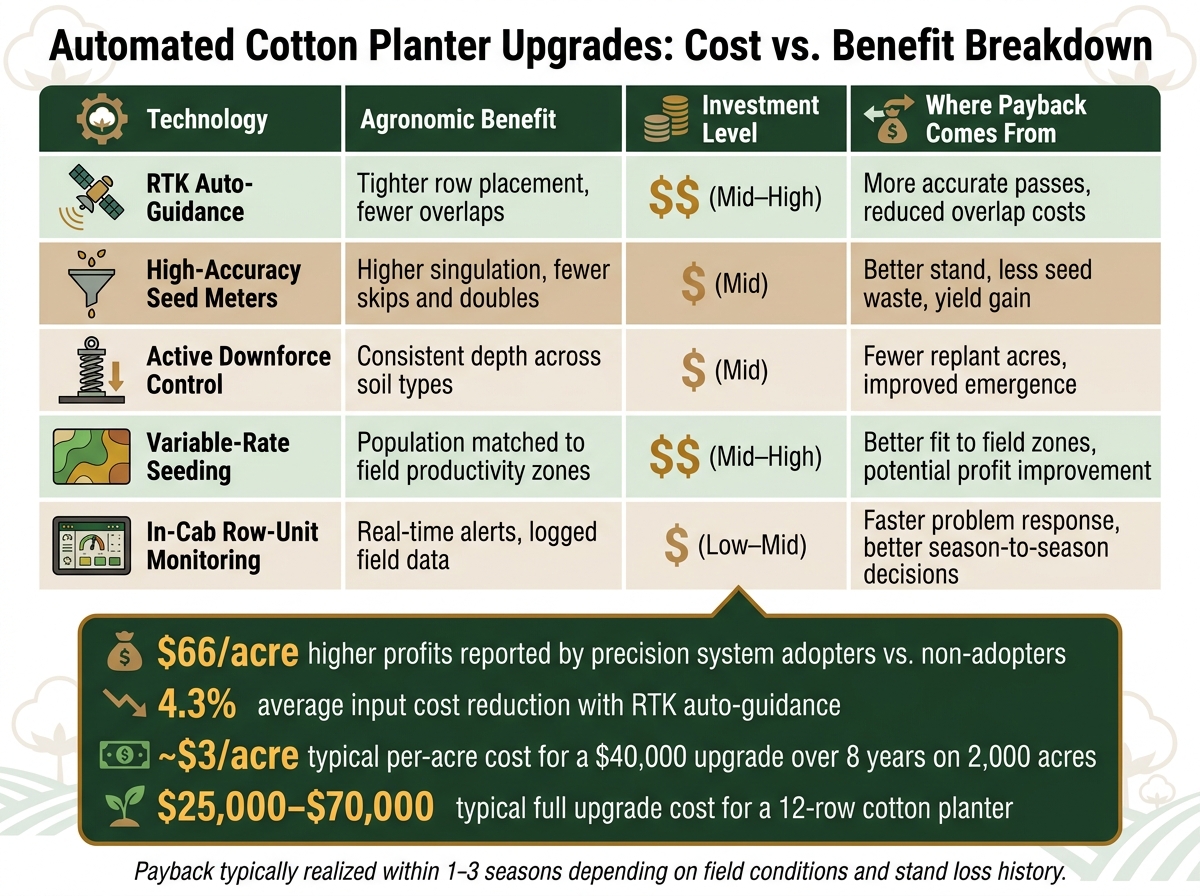
Automated Cotton Planter Upgrades: Cost vs. Benefit Comparison
When planter settings are dialed in, the results show up fast: better emergence, a stand count that lands where it should, and more money left at the end of the season.
The big win starts with emergence timing. Tighter emergence windows usually mean more even stands and better yield potential. In field trials with precision planters, 80–90% of plants often emerge within a 2–3 day window. That kind of uniformity matters. It makes it easier to line up fertilizer, irrigation, and spray timing with crop stage instead of managing a field that’s all over the map.
That’s why the first post-planting check matters so much.
Field Numbers Cotton Producers Should Track After Planting
Start with a plain stand count. Count plants in several 10-foot sections of row, then convert that number to plants per acre. In most U.S. cotton systems, the target is 35,000–45,000 plants per acre, based on row spacing and region. With precision planting, the goal is to land within 5–10% of that target on a steady basis.
Don’t stop at total plant count, though. You also want to track your effective stand. That means the plants that are strong and evenly spaced enough to carry bolls. In practice, this number often lines up with yield better than raw plant population.
Spacing uniformity tells a lot too. A good benchmark is 90–95% of plants falling within ±20% of your target spacing. If you’re seeing clusters in one spot and bare gaps in the next, that usually points to singulation issues or too much planting speed.
One of the smartest checks you can run is a speed comparison in your own fields. Look at stand counts planted at 4 mph, 5.5 mph, and 7+ mph. That gives you a field-tested speed limit based on your conditions, not a sales sheet number.
What to Include in an ROI Calculation
The ROI math is simpler than many growers expect.
Start with the yearly cost of the upgrade:
- Purchase price divided by useful life
- Plus annual maintenance
- Then divided by planted acres for a per-acre cost
For example, a $40,000 upgrade spread across 8 years with $1,000 in yearly maintenance comes out to about $3/acre on a 2,000-acre cotton farm.
Then stack that against the gains per acre. That can include seed savings from better singulation, fewer replant acres, and yield gains tied to stronger stands. Research on precision ag adoption shows that users of combined precision systems can see profits $66 per acre higher than non-adopters. RTK auto-guidance and similar systems have also shown average input cost cuts of 4.3%, with total savings reaching 20–30% when guidance is used with variable-rate tools and section control.
Here’s a side-by-side view of where the payback usually comes from:
| Technology | Agronomic Benefit | Typical Investment | Where Payback Comes From |
|---|---|---|---|
| RTK auto-guidance | Tighter row placement, fewer overlaps | Mid–High | More accurate passes and reduced overlap |
| High-accuracy seed meters (e.g., Precision Planting vSet/eSet) | Higher singulation, fewer skips and doubles | Mid | Better stand, less seed waste, yield gain |
| Active downforce control | Consistent depth across soil types | Mid | Fewer replant acres, improved emergence |
| Variable-rate seeding | Population matched to field productivity zones | Mid–High | Better fit to field zones and potential profit improvement |
| In-cab row-unit monitoring | Real-time alerts, logged field data | Low–Mid | Faster problem response and better season-to-season decisions |
If you’re deciding where to start, go after the upgrade tied to your biggest source of stand loss. For many producers, it takes 1–3 seasons to sort out the right mix of downforce, depth, and speed for their soils and varieties.
Top Upgrade Priorities and Next Steps for Cotton Operations
Which Planter Upgrades Tend to Deliver the Fastest Practical Value
If stand loss is the main issue, start with the planter controls that affect seed placement.
The fastest payback usually comes from improving the systems that place seed in the ground: metering, depth control, and row guidance. Precision meters tackle one of the biggest drivers of uneven stands, which is why metering is often the first smart move for stand uniformity. After that, automated downforce helps keep planting depth steady as field conditions shift.
A simple upgrade path helps keep spending in check:
- Install a monitor first so you can set a baseline for singulation, skips, doubles, downforce, and depth.
- Upgrade seed meters.
- Add automated downforce.
- Add guidance/autosteer, then electric drive or variable-rate control.
For a 12-row cotton planter, adding meters, downforce, seed delivery, and monitoring usually runs about $25,000 to $70,000, depending on the parts you choose. That price tag gets a lot easier to defend when it cuts replant acres, seed waste, and stand variation.
Using Local Gin Infrastructure to Support Planting Decisions
Planting timing doesn't just shape emergence. It also affects harvest flow.
Use cottongins.org to map nearby gin capacity when planting dates could affect acreage, crop maturity, and harvest scheduling. That local view can help you avoid bottlenecks later in the season.
Conclusion: Better Seed Placement Means Better Stands and Better Margins
Automated cotton planters can improve stand counts by cutting skips and doubles, keeping depth steadier, and placing rows more accurately. When emergence is more even, the crop is in a better spot for canopy development, lower seed waste, and fewer replant costs.
FAQs
Which planter upgrade should I start with first?
Start with GPS-guided autosteer and a properly calibrated planter. It’s a practical first move, easy to put to work, and it sets up later precision steps like variable-rate seeding and zone-based inputs.
By cutting overlaps and skips, autosteer helps make planting more consistent. It also supports better overall efficiency and a stronger return on investment.
How fast can I plant cotton without hurting stand quality?
There’s no one-speed-fits-all answer for every field. The target is seed singulation, steady depth, and even spacing.
Modern automated planters with hydraulic downforce and row-unit sensors can keep those results in place at higher speeds. But if you start seeing more skips, doubles, or uneven emergence, that’s usually a sign you’ve pushed past the best speed for your field conditions.
How do I know if planter automation is paying off?
Track the numbers that matter and compare them year over year. Start by checking emergence uniformity 7 to 14 days after planting, with close attention to skips and doubles. Then layer yield maps over input maps to see if yield variance stays below 10%.
It also helps to look at the business side with the same level of care. Review seed savings of $15 to $25 per acre, along with yield gains of 10% to 20% in variable fields, and see if those results line up with your 2- to 3-year ROI target.