I focus on cutting usable-fiber loss and waste cost - not just waste weight. Combing can remove 15%–25% of fiber as noil to meet yarn quality targets, so less waste isn’t always better.
My approach is to:
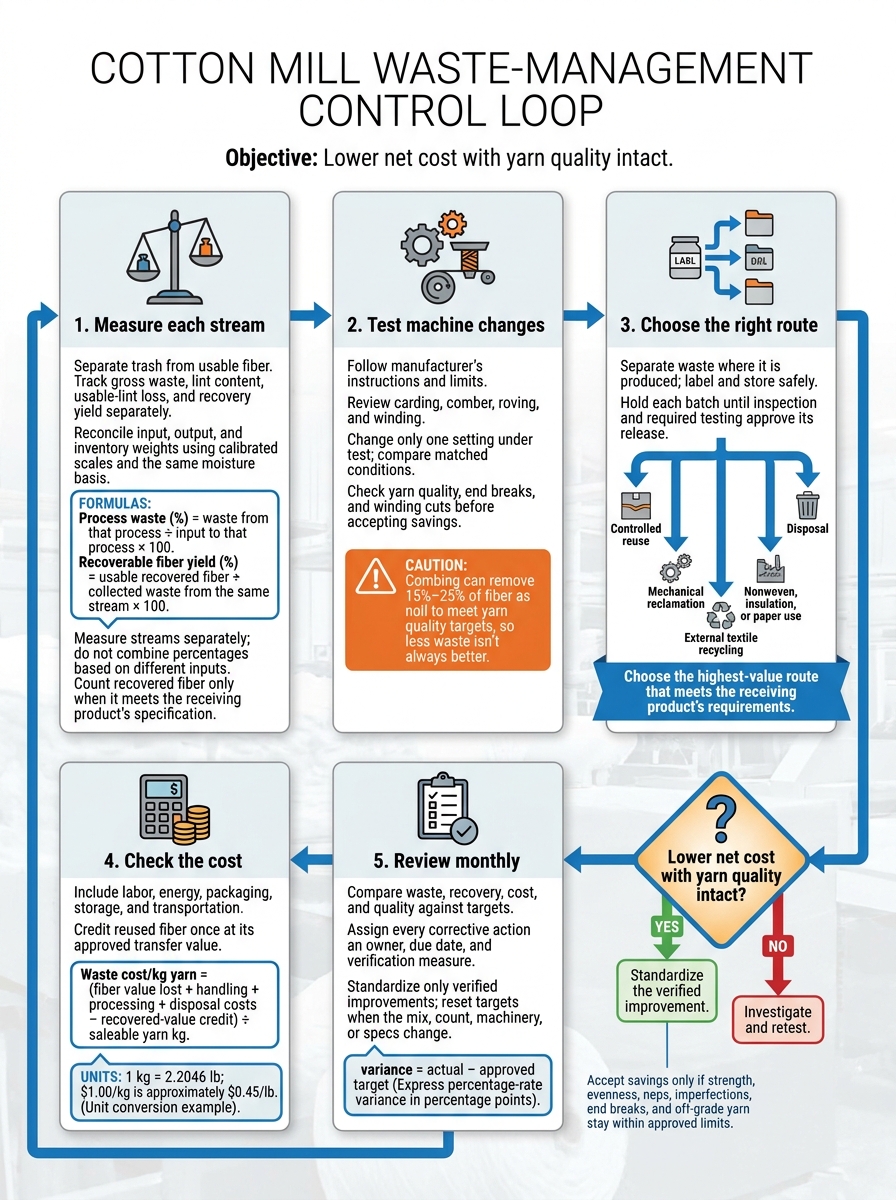
- Measure each stream: Separate trash from usable fiber, track recovery yield, and reconcile input, output, and inventory weights.
- Test machine changes: Follow the maker’s limits and check yarn quality, end breaks, and winding cuts before accepting savings.
- Choose the right route: Label and store waste safely, then approve it for reuse, reclamation, recycling, or disposal.
- Check the cost: Include fiber loss, handling, processing, and disposal, minus recovery credits, per kilogram of yarn.
- Review monthly: Assign owners, compare results with targets, and keep only verified improvements.
The rule I use: <u>lower net cost with yarn quality intact</u>. For U.S. reporting, track pounds alongside kilograms; $1.00/kg is about $0.45/lb.
Cotton Mill Waste Management: Measure, Recover, Verify
Reduce Waste with Machine Settings and Maintenance
Start with the processes that produce the most recoverable waste: carding, combing, roving, and winding. Use the waste map to connect setting changes with carding waste, comber noil, soft waste, and winding waste. Follow the machine manufacturer’s instructions first.
Check Carding Settings
At the card, use tighter flat-to-cylinder settings and adjust cylinder speed within the maker’s range to reduce neps and improve trash removal before combing. After each trial, measure nep count, trash removal, and yarn quality.
| Setting to review | What to adjust | What to track |
|---|---|---|
| Flat settings | Use tighter flat-to-cylinder settings | Nep count and trash removal |
| Cylinder speed | Adjust within the maker’s range | Nep count and yarn quality |
Control Comber Noil and Soft-Waste Losses
Adjust the comber to remove short fibers, neps, and trash without overcutting usable fiber. Check the noil rate against yarn quality after each change.
Use auto-leveling on drawing frames after combing to correct sliver thickness variations in real time.
Keep roving strong enough to feed cleanly, but open enough to draft without breaks. Track the end-break rate to see how each adjustment affects performance.
Once drafting is stable, focus on end breaks and winding losses.
Prevent End Breaks and Winding Waste
Track vibration, temperature, power draw, and end-break rate to spot faults early.
Set electronic yarn clearers on winding machines to remove thick places, thin places, and foreign fibers while keeping usable-yarn loss low. Monitor the clearer cut rate and winding end-break rate, balancing yarn quality against usable yield.
Keep documented calibration schedules for testing equipment.
sbb-itb-0e617ca
Measure Waste, Fiber Recovery, and Cost
After changing machine settings, check whether waste, recovery, and cost improved. Use calibrated scales and the same moisture basis after every change. This helps confirm that you reduced waste rather than moved losses to another process.
Record gross, tare, and net weights for each batch, along with the cotton mix, yarn specification, dates, and inventory changes. Report pounds (lb) for plant-floor use and kilograms (kg) for cost calculations; 1 kg = 2.2046 lb.
Calculate Process Waste and Fiber Recovery
Process waste (%) = waste from that process ÷ input to that process × 100.
Report each waste stream separately so you can compare process losses directly. Don’t combine percentages based on different inputs. Track gross waste, lint content, and usable-lint loss as separate measures.
Recoverable fiber yield (%) = usable recovered fiber ÷ collected waste from the same stream × 100.
Count recovered fiber only when it meets the receiving product’s specification. Measure each stream separately: fiber-rich waste and trash-heavy waste need different recovery paths. Record the remainder as trash, dust, short fiber, contamination, or unrecovered material, as appropriate.
Use a mass-balance worksheet for every batch or month:
Opening inventory + inputs = saleable yarn + waste + recovered material + closing inventory + unexplained loss.
Count each quantity only once. Recovered fiber held on-site belongs in closing inventory, not also in outgoing waste. Investigate unexplained differences instead of assigning them to waste.
These figures help you identify which streams justify recovery and which should go to disposal.
Calculate Waste Cost per Kilogram of Yarn
Waste cost/kg yarn = (fiber value lost + handling + processing + disposal costs − recovered-value credit) ÷ saleable yarn kg.
Include labor, energy, packaging, storage, and transportation. Specify the basis for fiber value: purchase, replacement, standard, or transfer price. Credit reused fiber once at its approved transfer value, and record the receiving batch.
Show dollars per pound alongside dollars per kilogram; $1.00/kg is approximately $0.45/lb. Use cost/kg to rank the biggest loss sources before changing settings or recovery routes.
Compare Baselines and Trial Results
Keep a monthly scorecard for input, waste, recovery, cost, quality, and variance versus target. Calculate variance = actual − approved target. Express percentage-rate variance in percentage points.
For trial comparisons, match the cotton mix, yarn count, twist, machine setup, volume, and period. Change only the setting under test, and account for inventory movements.
Accept savings only if strength, evenness, neps, imperfections, end breaks, and off-grade yarn stay within approved limits. Use the scorecard to decide which waste streams to label for reuse, reclamation, recycling, or disposal.
Separate Waste and Choose Recovery Routes
Once you’ve measured each waste stream, assign its route based on quality and recovery value. Start with the largest loss streams in the scorecard.
Label and Store Waste Safely
Separate waste where it’s produced, using a dedicated, labeled, covered container for each stream: blowroom droppings and trash, lint-rich card waste, comber noil, clean soft waste, hard yarn or roving waste, and floor sweepings. Keep white cotton apart from colored material and foreign fibers. Sorting by source and contamination helps each batch reach the right recovery route.
Label every container with the process, machine, lot or blend, date, shift, material type, color, net weight, and contamination status. Include a release status, such as awaiting laboratory test or approved for internal reuse. Use durable labels. Color coding should support written identification, not replace it.
Store containers dry, covered, and off the floor, away from oils, chemicals, and wet material. Before releasing a batch, check for mold, oil stains, metal, plastic, and foreign fibers. During storage inspections, record loose lint, dust buildup, damaged bags, blocked aisles, and ignition sources.
Keep waste within the area’s safe storage capacity. Follow applicable OSHA requirements, local fire codes, and site-specific hazard assessments. Clean, traceable storage protects recovery value and helps prevent avoidable disposal.
Compare Reuse, Reclamation, Recycling, and Disposal
Choose the highest-value route that meets the receiving product’s requirements. Clean mill waste is easier to route because you know its composition. But mechanical opening and shredding can shorten fibers and reduce strength, so use the least damaging route that meets the next product’s quality limits.
| Route | Material | Quality limits | Handling | Best end use and value |
|---|---|---|---|---|
| Controlled reuse | Soft waste, selected carding or draw-frame waste, sliver or roving ends, comber material | Must meet blend, strength, evenness, and contamination limits | Weigh, open, blend, and trial | Mill yarn; highest-value route |
| Mechanical reclamation | Hard yarn, roving, or compacted fiber waste | Remove foreign matter; opening may reduce length and strength | Specialized opening, cleaning, and dust control | Recovered fiber; moderate to high value, depending on yield |
| External textile recycling | Sorted hard waste, short fibers, or mixed grades unsuitable for mill yarn | Must meet composition, color, and buyer specifications | Bale, transport, sort, shred, and card | Coarse yarn or nonwovens; moderate value |
| Nonwoven, insulation, or paper use | Short fibers unsuitable for spinning | Must meet end-use contamination limits | Open, blend, form, bond, or pulp | Fiber products; moderate or lower value, with avoided disposal |
| Disposal | Oily, wet, moldy, chemically contaminated, or predominantly non-fibrous waste | Not fit for fiber recovery or production reuse | Segregate; use an approved contractor or applicable waste procedure | No fiber recovery; handling charges may apply |
Hold each batch until it passes inspection, trial testing, and any needed lab or pilot-spinning checks. Measure moisture, trash, oil or chemical contamination, color, fiber length, and blend identity. Approve only batches that pass; send the rest to a lower-value route or disposal.
For reusable fiber, run a controlled blend trial. Compare yarn count, strength, elongation, evenness, imperfections, hairiness, and end-break rate against the normal recipe. Add material gradually at a fixed trial blend percentage - uncontrolled additions cause quality variation. Approve the blend only after yarn and fabric testing.
Retest whenever the waste source, opening settings, contamination level, or blend ratio changes. Record the reason for every batch downgrade.
Conclusion: Assign Controls and Review Results
Once waste routes are set, make them part of a monthly control routine. Use one month of baseline data, broken down by product, yarn count, and shift, to set process targets. Investigate any unexplained variance.
Assign named owners for each task. Operators collect waste; supervisors verify shift weights; maintenance checks wear and suction faults; engineers approve changes and trials; quality tests fiber and yarn; and management reviews monthly results. Give every corrective action an owner, due date, and verification measure. Clear ownership keeps settings, handling, and recovery under control.
Controlled trials can cut waste, but each mill must validate the results on its own equipment.
Each month, bring production, maintenance, quality, and finance together to review waste, recovery, cost, and quality against targets. Standardize only verified improvements. Reset targets when the cotton mix, yarn count, machinery, or specs change. Success means lower avoidable lint loss and net cost, with quality intact.
FAQs
How do I set realistic waste targets for my mill?
Compare your current productivity metrics with industry benchmarks, such as SITRA standards. Then calculate your yarn realization baseline: yarn weight produced ÷ cotton weight consumed × 100.
Set targets that reflect operator skills, machine efficiency, and production hours. Track progress and use the data to adjust those targets. Set noil targets by yarn count to limit unnecessary fiber loss. Use historical process data to spot bottlenecks and coordinate batch blending to keep production consistent.
How much recovered fiber can I safely blend into yarn?
There’s no single safe percentage for soft waste. The limit depends on your quality requirements and yarn count. Mills typically blend it into coarser yarns or use it in nonwoven products - not premium, fine-count yarns.
Use bale management to balance fiber properties, and keep a close watch on yarn strength and uniformity. Too many short or recycled fibers can increase hairiness and lower yarn quality.
How long should I run a waste-reduction trial?
The provided sources don’t specify a required trial duration. Match your trial to your mill’s maintenance and audit schedule, such as weekly sliver hank audits or monthly lubrication and inspections.
Track yarn realization, noil percentage, and waste per ton consistently across these intervals. Then compare the results with your baseline to measure the effect of your adjustments.