If I blend cotton with the right second fiber, I can change strength, feel, drying, and cost all at once. But the blend only works if the fibers run well together in spinning.
Here’s the short version:
- Cotton-polyester is often used for more wear life, less wrinkling, and lower cost per pound than all-cotton yarn
- Cotton-viscose is picked for a softer feel, more drape, and high moisture absorbency
- Cotton-linen is used for airflow, a crisp hand, and warm-weather fabrics
- Low blend levels - often below 20% to 25% - can hurt yarn evenness instead of helping
- Blend control matters most at the blowroom and draw frame, where poor ratio control can lead to more yarn faults
- Fiber match matters too: staple length, fineness, crimp, and friction all affect drafting, yarn strength, and hairiness
- Mills often track CVm%, IPI, hairiness, CSP, HVI, and AFIS data to check whether a blend is running cleanly
If I had to boil it down even more, it’s this: the best cotton blend is not the one with the best story on paper. It’s the one that meets spec, fits the end use, and runs with low waste from lot to lot.
Quick comparison
| Blend | Main change | Common ratios | Common uses |
|---|---|---|---|
| Cotton-Polyester | More strength and wear life, faster drying | 65/35, 50/50, 35/65 | T-shirts, uniforms, sheeting, workwear |
| Cotton-Viscose | Softer hand, more drape, higher absorbency | 70/30 | Fashion basics, loungewear, summer knits |
| Cotton-Linen | More airflow, crisp feel, textured look | 60/40 | Summer shirting, home textiles |
| Tri-blend (cotton/polyester/viscose) | Mix of comfort, wear life, and drape | 50/25/25 | Lifestyle apparel, active basics |
So before I pick a ratio like 65/35 or 50/50, I’d look at two things first: what the fabric needs and whether the mill can spin that blend evenly.
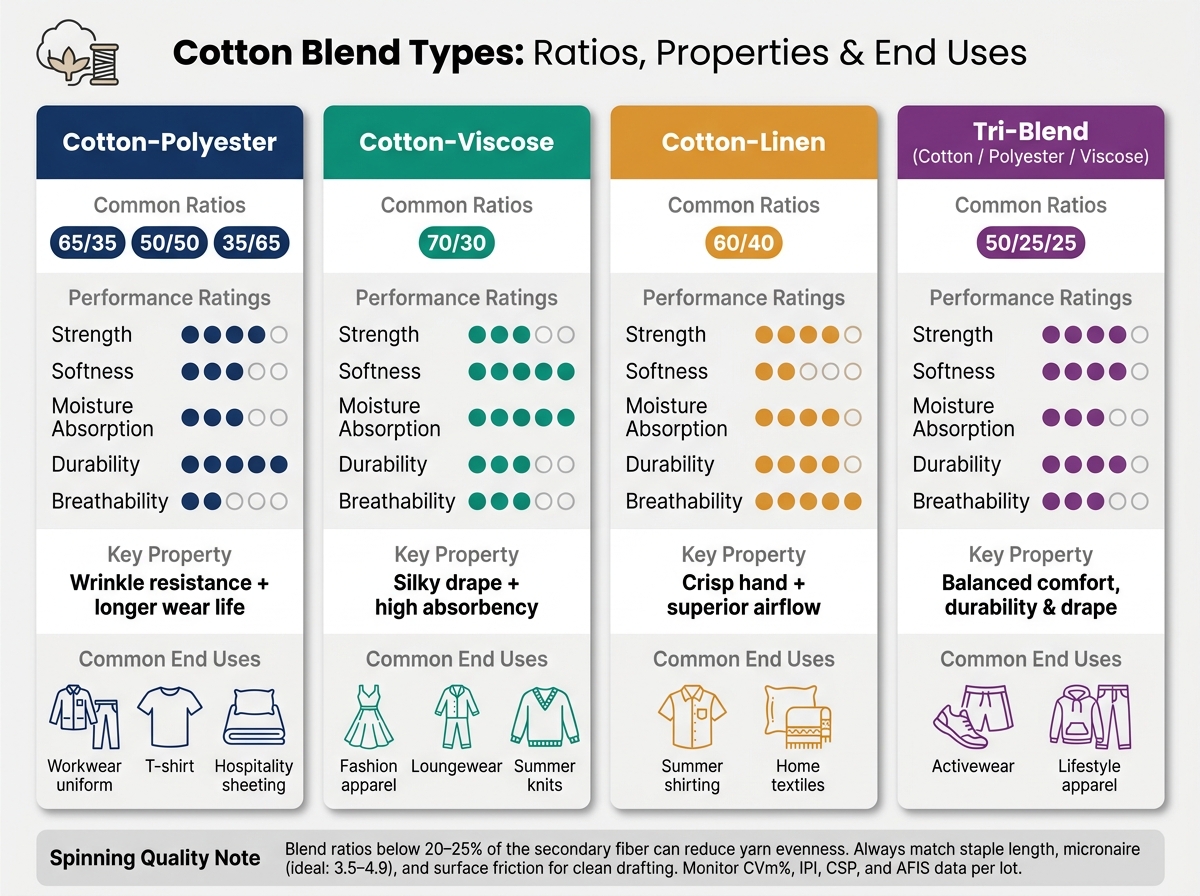
Cotton Blend Types: Ratios, Properties & End Uses Compared
What Cotton Blends Change in Yarn and Fabric Performance
Blends change a lot more than just fiber content on a label. They affect yarn strength, hand feel, moisture behavior, and how long the fabric holds up in use. The clearest way to see those tradeoffs is by looking at the blend itself.
| Fiber Blend | Strength | Softness | Moisture Control | Durability | Common U.S. End Uses |
|---|---|---|---|---|---|
| Cotton-Polyester | High | Moderate | Quicker drying | High | Workwear, uniforms, performance basics |
| Cotton-Viscose | Moderate | Very High | Very High (absorbent) | Moderate | Fashion apparel, loungewear, drape-heavy garments |
| Cotton-Linen | Moderate to High | Low (crisp) | High (breathable) | High | Summer suits, lightweight shirts, home textiles |
Strength, Uniformity, and Spinning Efficiency
Small blend percentages don’t always help. In fact, very low shares can make yarn quality worse, especially below about 20% to 25%.
Here’s the issue: when fibers have different staple lengths or fineness values, the drafting zone may not control them evenly. That can reduce uniformity, increase weight variation, and create thick and thin places in the yarn. Better raw-material control and carding settings can cut yarn weight variation by 15.5%.
That said, the outcome depends heavily on fiber compatibility and tight ratio control. If the fibers don’t work well together, the blend can cause more trouble than it solves.
Softness, Moisture Control, and Fabric Comfort
Cotton-viscose blends are a common pick for fashion apparel, loungewear, and drape-heavy garments. The reason is simple: they tend to feel very soft and absorb moisture well. If the goal is a fluid, easy-draping fabric with a smooth touch, this blend makes sense.
Cotton-polyester blends show up more often when quicker drying matters. That’s why they’re so common in basics people wear hard and wash often.
Durability, Shrinkage Control, and Service Life
Polyester adds abrasion resistance and wrinkle recovery, which helps explain why cotton-polyester blends are so common in workwear and uniforms. They’re built for repeat use, not just a nice feel off the rack.
Cotton-linen blends bring a different set of traits. They’re known for a crisp feel and a breathable hand, which makes them a strong match for summer apparel and home textiles.
Still, those gains depend on one thing: the fibers need to run evenly through spinning.
sbb-itb-0e617ca
Common Cotton Blend Types and Typical Ratios
Cotton blends help mills tune yarn performance for the job at hand. One ratio may work well for a soft T-shirt. Another may make more sense for sheets in a hotel or for work uniforms that take a beating. The table below shows common blend families, typical ratios, and where they often show up in the U.S. The next step is making sure those ratios run cleanly through spinning.
| Blend Type | Typical Ratio (Cotton/Other) | Key Property Changes | Representative U.S. Product Categories |
|---|---|---|---|
| Cotton-Polyester | 65/35 | High softness and absorbency with added durability | Premium T-shirts, retail shirting |
| Cotton-Polyester | 50/50 | Balanced strength, comfort, and drying time | T-shirts, budget shirting, hospitality sheeting |
| Cotton-Polyester | 35/65 | Maximum durability, high wrinkle resistance | Heavy-duty workwear, industrial uniforms |
| Cotton-Viscose | 70/30 | Enhanced drape, silk-like luster, increased moisture regain | Fashion basics, lightweight summer knits |
| Cotton-Linen | 60/40 | Distinctive slub texture, superior cooling, high breathability | Summer shirting, luxury home textiles |
| Tri-blend (cotton/polyester/viscose) | 50/25/25 | Optimized balance of comfort, durability, and natural feel | Performance lifestyle apparel, activewear basics |
Cotton-Polyester Blends: 65/35, 50/50, and 35/65
In cotton-polyester blends, small ratio changes can shift fabric behavior in a hurry. A 65/35 blend stays closer to cotton in feel, but adds more wear life. That makes it a common pick for premium T-shirts and retail shirting.
Move to 50/50, and the yarn lands in the middle. You get a more even mix of strength, comfort, and drying time, which is why this ratio shows up so often in everyday T-shirts, lower-cost shirting, and hospitality sheeting.
At 35/65, polyester starts to take over. Wrinkle resistance and strength go up, while softness and moisture absorption drop. That tradeoff fits heavy-duty workwear and industrial uniforms better than soft, casual apparel. There’s also a mill-side issue here: higher polyester content usually calls for tighter drafting control.
Cotton-Viscose and Cotton-Linen Blends
A 70/30 cotton-viscose blend gives the fabric more drape and higher moisture regain. In plain English, it tends to hang better and feel lighter on the body, which helps explain its use in fashion basics and lightweight summer knits.
Cotton-linen at 60/40 moves in a different direction. It gives up wrinkle resistance, but gains breathability and a crisp hand. That’s a good match for summer shirting and luxury home textiles, where airflow and texture often matter more than a smooth, wrinkle-free finish.
Multi-Fiber Blends for Balanced Performance
Sometimes a two-fiber blend just doesn’t hit the mark. Maybe the fabric needs more comfort without giving up wear life. Maybe it needs to dry faster but still feel natural. That’s where mills often turn to three-fiber blends.
A 50/25/25 cotton-polyester-viscose tri-blend pulls something different from each fiber: cotton for natural feel, polyester for durability, and viscose for drape and comfort. That mix can give mills a better balance across several performance needs at once, but it also asks for tighter process control.
Blend ratios matter on paper, but they only work in production when fiber properties and spinning settings line up.
Spinning Factors That Determine Blend Results
Once the blend ratio is set, the next step is simple to describe but hard to get right: do the fibers draft cleanly together?
Blend ratio is only half the job. What matters just as much is how those fibers behave on the machine. When they don’t run well together, the trouble shows up fast - more breaks, uneven yarn, and fabric that falls outside spec.
Fiber Compatibility: Staple Length, Fineness, Crimp, and Surface Friction
Cotton’s irregular shape behaves differently from smoother fibers. If fibers with mismatched staple lengths or fineness enter the same drafting zone, they don’t travel through the system at the same speed. You end up with two fiber-length groups moving through one draft, and that pushes up mass irregularity (CVm%) and nep counts.
When fibers don’t match well, mills usually see the same pattern: more breaks, less even yarn, and lower fabric performance.
Micronaire in the 3.5–4.9 range usually blends more cleanly. Lower values tend to increase nep formation and make drafting less stable. Surface friction also plays a big part. If two fibers have very different crimp or surface behavior, they can slip past each other unevenly. That often shows up as yarn that is hairier and less even .
A small amount of a poorly matched fiber can do more harm than good. Instead of smoothing out the blend, it can hurt yarn consistency.
Choosing Blend Ratios for Quality Targets and Machine Performance
One finding from spinning research catches a lot of people off guard: adding a small amount of a better fiber doesn’t always make the yarn better. At low percentages, that added fiber may not spread through the blend evenly. When that happens, CVm% and imperfection levels can go up. Mills that try to improve a blend little by little with small additions of high-grade cotton often see imperfection counts move the wrong way.
The process variables below have a direct effect on whether a blend runs cleanly and stays within spec.
| Variable | Primary Impact on Yarn | Test |
|---|---|---|
| Fiber length match | Drafting stability, uniformity | CVm%, Short Fiber Content (SFC) |
| Fineness / Micronaire | Yarn strength, nep formation | Tenacity, AFIS Nep Count |
| Blend ratio | Moisture management, elasticity | Recovery %, Moisture Wicking |
| Carding settings | Trash and nep removal | IPI (Imperfections Index) |
| Drafting conditions | Mass irregularity, fly | U% (Evenness), Hairiness (H) |
| Twist (TPI) | Packing density, strength | CSP (Count Strength Product) |
Quality Control and Testing for Blended Yarns
These tests show whether the blend is giving the end product the strength, evenness, and comfort it needs.
Mills use them to check more than spinning-frame output. The point is to confirm that the chosen blend will also perform in the final fabric. The standard quality checks are U% or CVm% for evenness, the Imperfections Index (IPI) for thin places, thick places, and neps, and hairiness (H). Taken together, these three measures show whether the blend is drafting cleanly. Count Strength Product (CSP) and tensile results then show whether the yarn can handle downstream processing and end use.
On the raw material side, HVI and AFIS reports should be standard for every fiber lot used in a blend. HVI covers staple length, micronaire, strength, and trash percentage. AFIS adds short-fiber and nep data, which matter even more when cotton is blended with a fiber that has very different surface friction . AFIS and carding checks can cut variation and help keep yarn more consistent.
For comfort-sensitive fabrics, mills may also include moisture-wicking checks in the test panel. That helps confirm that the blend is behaving the way the fabric needs it to in use.
Matching Blend Choices to Product Goals, Supply, and Mill Economics
Fiber compatibility and process settings are only part of the equation. Once a mill knows how a blend performs, the next step is more practical: Can the product support the extra cost or fiber tradeoff?
Choosing the Right Blend for Workwear, Basics, and Warm-Weather Products
Different products ask for different things, so the blend has to match the job.
- Workwear and uniforms: Cotton-polyester keeps material cost lower than 100% cotton while also giving strong abrasion resistance and longer wear life.
- Premium basics: Higher cotton preparation, such as combing for counts above Ne 40/1, can earn its keep when the product is sold on softness and a smooth hand.
- Warm-weather goods: Cotton-linen and cotton-viscose blends give up some wrinkle resistance in exchange for breathability and drape, which fits the end use.
That’s the tradeoff in plain terms. A work shirt, a soft premium tee, and a warm-weather top don’t need the same blend, and they shouldn’t be built like they do.
How Blend Strategy Affects Cost, Sourcing, and Consistency
After product fit, sourcing becomes the next big issue. A lower-cost blend only works on paper if the fiber supply stays steady.
Replacing part of the cotton with another fiber can change raw material spend, but the savings don’t show up automatically. Waste, spinning system choice, and fiber lot consistency all shape the final cost per pound of usable yarn. Blending multiple cotton bales helps smooth out variation in micronaire and staple length, which supports batch-to-batch consistency and helps keep raw material costs under control.
Bale selection and ginning quality also matter. They affect staple length and yarn strength, and that can decide whether a given blend ratio keeps working from one production run to the next.
Conclusion: When Blended Yarns Make Sense
The best blend is the one that meets the spec without adding avoidable waste or supply risk. It should match the product goal, run cleanly on the mill’s equipment, and stay consistent from run to run.
FAQs
How do I choose the right cotton blend ratio?
Choose the blend ratio based on the end use and what your spinning system can handle. Common options include 50/50 or 60/40 poly-cotton for open-end spinning, 60/40 for compact spinning, and 95/5 to 80/20 cotton-spandex when you need stretch and recovery.
Try not to go below 20%–25% of a superior fiber. If you do, consistency can slip. The ratio should also line up with micronaire targets, such as 4.0–4.6 for open-end rotors. Then test the blend with trial runs and fine-tune machine settings based on the results.
Why can small blend percentages hurt yarn quality?
Small blend percentages, especially below 20%–25%, can hurt yarn quality because they often work more like a disruption than an upgrade.
When you add a small share of a better fiber, it can throw the system off balance. You may end up with drafting instability, a bimodal length distribution, and poor fiber cohesion between the blend components. Add drafting mismatches and the dominant-parameter effect to the mix, and the result can be more unevenness, more imperfections, and more hairiness.
What tests show whether a cotton blend is spinning well?
Check the main quality metrics that show fiber compatibility and process stability:
- Yarn unevenness (U%)
- Imperfection index (IPI)
- Mass variation (CVm%)
- Hairiness (H-value)
Also keep an eye on high yarn breakage or too many ends-down. If tensile strength and elongation stay steady, and yarn diameter remains stable, that’s a strong sign the blend is mixing well and the spinning process is running as it should.