The Global Organic Textile Standard (GOTS) is a globally recognized certification for textiles made with organic fibers. It ensures strict guidelines for both environmental and social responsibility throughout the production process. Here’s what you need to know:
- Organic Content Requirements: Products labeled "Organic" must have at least 95% certified organic fibers, while "Made with Organic" requires a minimum of 70%.
- Chemical Safety: Prohibits harmful substances like formaldehyde, heavy metals, and carcinogenic dyes. Only approved inputs from the GOTS Positive List are allowed.
- Worker Protections: Aligns with International Labor Organization (ILO) standards, addressing fair wages, safe working conditions, and prohibiting child or forced labor.
- Audits and Traceability: Facilities undergo annual inspections, and transaction certificates ensure traceability from raw materials to finished goods.
- Version 8.0 Update (March 2026): Introduces enhanced supply chain accountability in line with OECD guidelines.
GOTS certification benefits businesses by building consumer trust, accessing premium markets, and adhering to global ethical standards. Certification costs range from $1,300 to $3,200 annually, plus additional fees for logo use and ongoing compliance checks. For cotton producers, the process starts at the ginning stage, ensuring alignment with organic farming certifications.
Whether you're a producer, manufacturer, or brand, GOTS certification is a clear path to meeting ethical production standards while gaining market recognition.
What is GOTS Certification? | Global Organic Textile Standard Explained | PQSmitra
sbb-itb-0e617ca
GOTS Certification Requirements
GOTS certification requires strict compliance with environmental and social standards at every stage of textile production. These standards create a framework to protect workers, consumers, and the environment from harmful practices.
Environmental Requirements
To achieve GOTS certification, products must meet rigorous environmental criteria. Organic fiber content is a key requirement. Products labeled "Organic" must include at least 95% certified organic fibers, while those labeled "Made with Organic" must contain a minimum of 70% certified organic fibers.
Chemical management is another critical area. Only GOTS-approved colorants and auxiliaries from the GOTS Positive List are allowed, ensuring safe and compliant inputs. The use of toxic heavy metals, formaldehyde, aromatic solvents, functional nanoparticles, and carcinogenic azo dyes is strictly prohibited. Even accessories like buttons and zippers must meet the Restricted Substances List or be certified under Standard 100 by Oeko-Tex.
Wastewater treatment is mandatory for all wet-processing facilities, such as those involved in dyeing or printing. These facilities must operate functional Effluent Treatment Plants (ETP) to properly treat discharged water. Additionally, chlorine-based bleaching processes are banned; only oxygen-based methods are permitted.
Entities are required to maintain a written environmental and chemical policy that monitors energy use, waste management, and emissions. Tools like the GOTS Monitor track water and energy usage per kilogram of textile output, helping manufacturers ensure compliance and manage costs. Physical separation systems must also be in place to clearly distinguish organic products from conventional ones during production.
These detailed measures reflect GOTS's dedication to ethical and sustainable textile production, offering manufacturers a clear path to compliance.
Labor and Social Requirements
Equally important are the social standards designed to safeguard worker rights and well-being. GOTS's labor criteria align with core International Labour Organization (ILO) conventions, addressing issues like forced labor, child labor, discrimination, and freedom of association. Workers are limited to 8-hour workdays and 48-hour workweeks, with voluntary overtime capped at 12 hours per week. Employees must also receive at least 24 consecutive hours of rest each week.
"GOTS sets a high industry benchmark, ensuring that the human rights of workers in GOTS Certified Entities are respected and upheld, thereby promoting a high bar of excellence within the industry." - Global Organic Textile Standard
Certified entities must go beyond minimum wage compliance by identifying the gap between current wages and a living wage, then developing a plan to close that gap. Occupational health and safety measures include regular risk assessments, safety training for all workers (including homeworkers), and robust fire safety and emergency access protocols. Confidential reporting systems are required to address gender-based violence and sexual harassment, ensuring workers can raise concerns without fear of retaliation.
If child labor is discovered, the entity must immediately remove the child from the workplace and help them access education. Special protections are also in place for vulnerable groups, including migrant workers, homeworkers, and pregnant women. These social criteria apply across the entire production chain, from the initial stages of fiber processing to final manufacturing and trimming.
These comprehensive requirements underline GOTS's commitment to ethical practices in the textile industry, setting clear standards for responsible production.
How to Get GOTS Certified
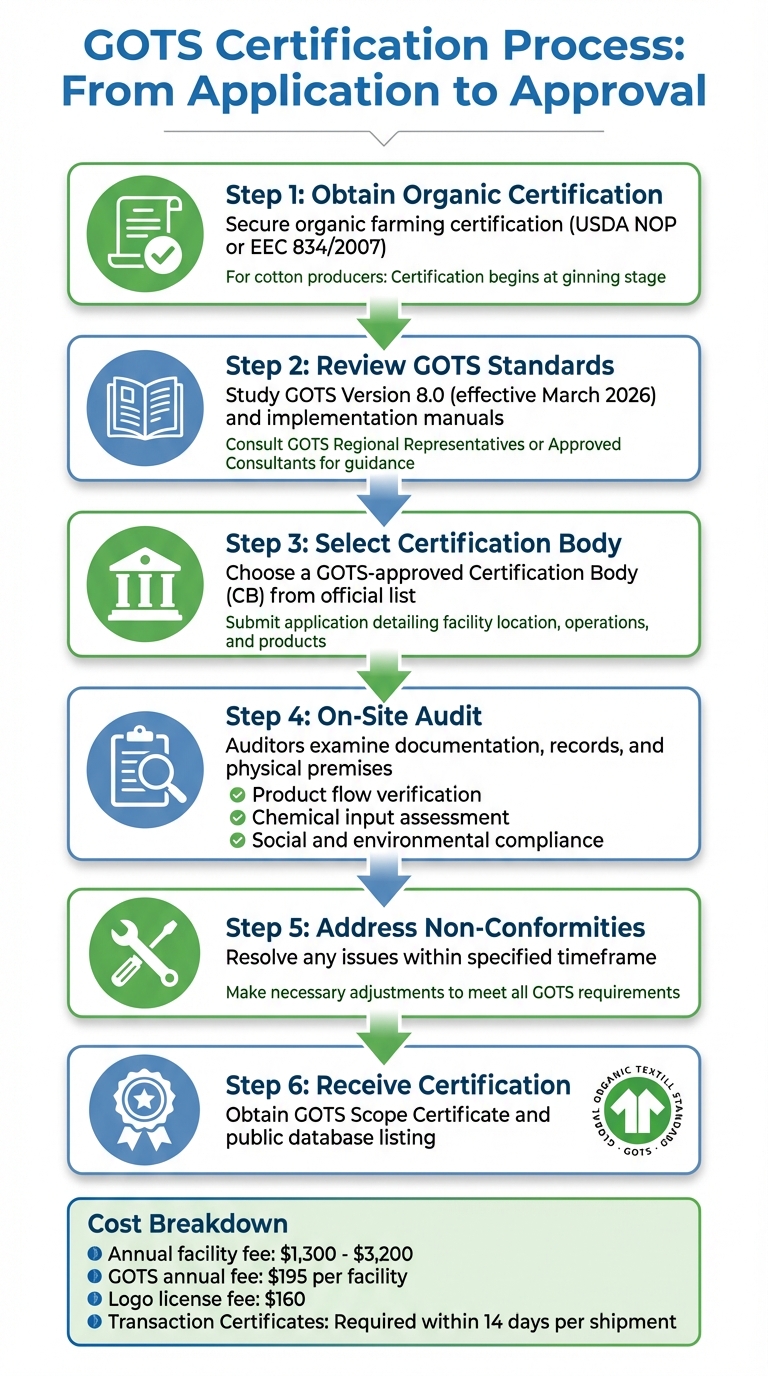
GOTS Certification Process: 6 Steps from Application to Approval
Certification Steps
To start the GOTS certification process, your operation must already hold organic certification. For cotton producers, this means securing organic farming certification first (such as USDA NOP or EEC 834/2007), as GOTS certification begins at the initial processing stage, typically at the ginning facility.
Begin by reviewing the latest GOTS Standard. The current version, 8.0 (effective March 2026), should be studied alongside the implementation manuals. If you're unsure about any requirements, reach out to GOTS Regional Representatives or Approved Consultants. Their guidance can help you identify the necessary documentation and areas of your operation that may need adjustments.
Next, choose a GOTS-approved Certification Body (CB) from the official list. These organizations handle your audit and issue the certification. Submit an application to your selected CB that outlines your facility's location, operations, and the products you manufacture.
The process includes an on-site audit, where auditors examine your documentation, records, and physical premises. They'll verify product flow through volume reconciliation, assess chemical inputs for their safety and biodegradability, and ensure compliance with GOTS social and environmental criteria. If any issues are found, you'll be given a specific timeframe to address them. Once all requirements are met, you'll receive a GOTS Scope Certificate, and your facility will be listed in the public GOTS database.
"The GOTS certification is more than just a label, it is a symbol of trust and transparency in the textile supply chain – from field to finished goods in stores." - GOTS
Certification costs typically range between $1,300 and $3,200 annually for a single facility, depending on its size and product range. Additional fees include an annual GOTS fee of $195 per facility and a $160 license fee for the right to use the GOTS logo. After certification, GOTS-approved bodies oversee ongoing compliance through regular inspections.
What Certification Bodies Do
Certification Bodies play a crucial role in maintaining the GOTS standard after your certification. These independent auditors conduct annual on-site inspections, ensuring the quality assurance system is upheld. They trace the flow of organic fibers through volume reconciliation, assess chemical inputs against GOTS requirements, and monitor social compliance according to International Labour Organization norms.
For every shipment, apply for a Transaction Certificate (TC), which the CB must issue within 14 days. GOTS allows TCs to be issued up to six months from the shipment date. This process ensures the chain of custody and traceability from raw fiber to finished goods. Even traders who don't modify products must obtain certification if their annual turnover in GOTS goods exceeds $21,500, as they play a key role in maintaining traceability.
Before purchasing from suppliers, commercial buyers should verify their claims by checking the GOTS Certified Suppliers Database for valid Scope Certificates. To safeguard the integrity of your goods, make the issuance of a Transaction Certificate for each shipment a contractual requirement.
GOTS for Cotton Producers and Textile Manufacturers
Getting Ready for Certification
For cotton producers, the journey toward GOTS certification begins at the ginning stage - where seeds are separated from bolls. Before entering the GOTS supply chain, ensure your farming practices are certified organic under standards like USDA NOP or EEC 834/2007. These certifications are essential for aligning with GOTS requirements and supporting ethical production practices.
A successful certification process hinges on establishing clear separation systems. This means creating dedicated storage and handling protocols for organic fibers while maintaining detailed records to preserve their organic status. You'll also need to provide documentation that proves input/output reconciliation for organic cotton.
Textile manufacturers involved in wet processing, such as dyeing or printing, need to ensure that all chemical inputs comply with the GOTS MRSL. Additionally, accessories must meet GOTS standards or align with Oeko-Tex Standard 100.
Another critical step is preparing for social audits. Organize personnel documentation and ensure your team understands the requirements. GOTS evaluates your adherence to social criteria, focusing on employee health, safety, and rights, regardless of whether organic production is currently underway.
Once you’ve aligned your operations with these standards, GOTS tools can help simplify and streamline the compliance process.
Resources for Meeting GOTS Standards
GOTS provides several tools to guide you through certification. A key requirement for cotton producers is the GOTS Farm-Gin Registry, which ensures transparency in the supply chain. Producers must register their harvest volumes and identify the gins they sell to. Additionally, raw cotton cannot travel more than 311 miles from the farm to the certified gin, which helps maintain supply chain integrity.
"Any raw cotton entering the GOTS supply chain needs to be duly registered by the producer farm project." - GOTS
Certified manufacturers can also benefit from the GOTS Monitor (Water/Energy) tool, which tracks water and energy usage per pound of textile output. This tool not only supports sustainability but can also lead to cost savings through better resource management. To find compliant supply chain partners, the GOTS Certified Suppliers Database is a valuable resource. This public directory connects you with certified gins, spinners, and processors.
For technical support, you can consult GOTS Regional Representatives for initial guidance or hire GOTS Approved Consultants for more in-depth help. These experts can assist with documentation, setting up separation systems, and addressing compliance gaps before your official audit.
Why Get GOTS Certified
Market Access and Consumer Confidence
Getting GOTS certified opens doors to global markets. As of 2024, 15,441 facilities in 87 countries hold this certification, with the number growing by 5.2% annually. This growth reflects the increasing demand for ethical and sustainable production practices.
GOTS certification provides a comprehensive "field to fashion" assurance by auditing every step of the process - from organic farming to finished products. This level of scrutiny builds trust with consumers, who can even verify your license number in the GOTS public database, ensuring transparency across the supply chain.
Additionally, being listed in the GOTS Certified Suppliers Database boosts your visibility. Brands and retailers frequently use this free resource to identify and verify sustainable partners, making it easier for them to connect with your business.
"GOTS certification is the gold standard for organic textiles because it's the only certification that covers the entire supply chain - from organic farming through chemical safety, worker rights, and environmental protection." - Design Delight Studio
This trust and transparency not only enhance your reputation but also reduce operational risks, which can lead to long-term market advantages.
Higher Prices and Lower Risks
Beyond market access, GOTS certification can help you secure premium pricing while reducing business risks.
Certified products often command higher prices, especially in markets that prioritize sustainability. For example, the "Organic" label, which requires at least 95% certified organic fibers, fetches the highest premiums. Meanwhile, the "Made with Organic" label (requiring at least 70% organic fibers) is ideal for performance blends, striking a balance between sustainability and functionality.
Certification also helps safeguard your operations. Annual audits and unannounced inspections ensure compliance, protecting you from supply chain scandals or operational lapses. Since GOTS aligns with OECD Guidance for Responsible Supply Chains, it also helps you meet international due diligence requirements, reducing your exposure to legal risks and fines.
Environmental and social criteria further lower liabilities. Wet processing facilities must treat wastewater, and harmful chemicals like heavy metals, formaldehyde, and PFAS are strictly prohibited. Social standards based on ILO and UN guidelines ensure your business avoids issues like child labor, forced labor, and unsafe working conditions.
On top of this, eco-friendly practices can reduce costs by improving resource efficiency, while reinforcing your dedication to ethical and sustainable production - values at the core of the GOTS mission.
Conclusion
GOTS certification weaves together strict environmental and social criteria to ensure textiles are produced ethically. It covers the entire journey - from organic farming to the finished product - making it a trusted standard for responsible textile production. With 15,441 certified facilities across 87 countries, GOTS demonstrates its global influence and commitment to worker protections.
But it’s not just about ethics. GOTS certification provides access to premium markets, strengthens consumer trust with transparent verification, and reduces risks through annual audits and stringent chemical controls. The March 2026 release of Version 8.0, which aligns with OECD Due Diligence Guidance, further highlights its role in ensuring supply chain accountability.
For cotton producers and manufacturers, the certification process begins at the gin. In countries like India, registration in the GOTS Farm to Gin Registry is mandatory to maintain traceability from farm to product. Every shipment must include Transaction Certificates to safeguard organic integrity throughout the supply chain. Tools like the GOTS Certified Suppliers Database and the Global Standard Academy provide free resources and training to simplify the certification journey.
GOTS certification not only validates sustainable practices but also pushes the entire industry forward. Whether you’re a farmer, gin operator, textile manufacturer, or fashion brand, this certification reflects a strong commitment to sustainability. With updates like the March 2026 Version 8.0 release - featuring enhanced accountability and circularity measures - it continues to evolve alongside industry demands.
For cotton gins aiming to align with GOTS standards, platforms like cottongins.org offer essential resources, directories, and tools to navigate the certification process and connect with the organic cotton network. These resources are invaluable for building strong supply chain connections and supporting sustainable practices.
FAQs
Is GOTS certification worth it for a small business?
GOTS certification offers small businesses in the ethical fashion industry a way to stand out by adhering to rigorous environmental and social standards. This certification can build trust with consumers who prioritize sustainable choices. That said, obtaining it isn't without challenges - it can be expensive and demand significant resources. For businesses that can manage the process, the potential rewards, such as a stronger brand reputation and entry into broader markets, often justify the effort. However, whether it's the right move depends on the specific goals and resources of the business.
What’s the difference between “Organic” and “Made with Organic” on GOTS labels?
The main difference comes down to the percentage of organic fibers in the product. “Made with Organic” means the product contains 70%–95% certified organic fibers, with the remaining portion made up of non-organic materials. On the other hand, “Organic” (or “100% Organic”) means that 95% or more of the fibers are organic. This labeling helps shoppers identify whether a product is entirely or only partially made with organic materials.
What are the most common reasons companies fail a GOTS audit?
Companies often struggle with GOTS audits due to falling short on meeting environmental criteria, difficulties in maintaining traceability, or incomplete documentation regarding the sourcing of organic fibers. Some frequent problems include not adhering to waste management standards, poor record-keeping practices, and insufficient transparency throughout the supply chain.