I use HVI cotton strength to screen lots - not to predict yarn performance on its own. A reading of 31 g/tex or higher falls in the “very strong” range, but I still check length, uniformity, short fiber content, maturity, and fineness before matching cotton to a spinning program.
My approach is simple:
- Compare reliable results. Use consistent sampling, conditioning, and test methods, and check bale-to-bale variation.
- Match the whole fiber profile. Choose cotton for your yarn count, customer requirements, and ring, rotor, or air-jet system - not strength alone.
- Test before committing. Run trials at the planned settings and compare yarn tenacity, unevenness, waste, and end breaks.
The rule I follow: <u>pay for proven spinning performance</u>, not just an impressive strength reading.
Testing cotton fiber quality
sbb-itb-0e617ca
What HVI Strength Tells You About Yarn Performance
When samples are conditioned and tested consistently, HVI bundle strength helps screen each lot’s spinning suitability - not determine it. Yarn count measures yarn linear density. Higher Ne values - or lower tex values - mean finer yarns, with fewer fibers sharing the load. That makes fiber strength more important.
Common HVI Strength Ratings
Treat these ranges as screening guides, not purchase limits. Set your limits based on yarn count, product requirements, and proven spinning performance.
| HVI strength (g/tex) | Classification | Likely spinning effects |
|---|---|---|
| 31 and above | Very strong | Supports high-tenacity yarns and high-speed processing |
| 29–30 | Strong | Supports fine counts and high-speed ring spinning |
| 26–28 | Average | Suits many medium-count commercial yarns |
| 24–25 | Intermediate | May require lower speeds or coarser counts |
| 23 and below | Weak | Greater risk of carding damage and end breaks |
How Strength Affects Yarn Tenacity and End Breaks
Yarn tenacity is yarn strength per unit of linear density. End breaks interrupt spinning when tension exceeds the yarn’s strength at a weak spot.
Stronger fibers generally support higher yarn tenacity. But a higher HVI strength reading alone doesn’t guarantee fewer breaks. When lots have similar strength but differ in length or maturity, check their performance with spinning trials at the intended yarn count.
Fiber Requirements for Ring, Rotor, and Air-Jet Spinning
Use the strength range to narrow your choice of spinning system and yarn count.
| Spinning system | Typical yarn strength | Key fiber requirements | Sensitivity to yarn count |
|---|---|---|---|
| Ring | Highest | High strength and length uniformity | High; fine counts must withstand ballooning tension |
| Rotor | Medium | Fineness and strength | Moderate; needs more fibers to offset lower alignment |
| Air-jet | Lowest | High strength, length, and low trash | Very high; needs strong fibers for wrapper integrity |
Match fiber strength to both yarn count and spinning system rather than using it as a standalone selection rule.
Check Strength Alongside Other Fiber Properties
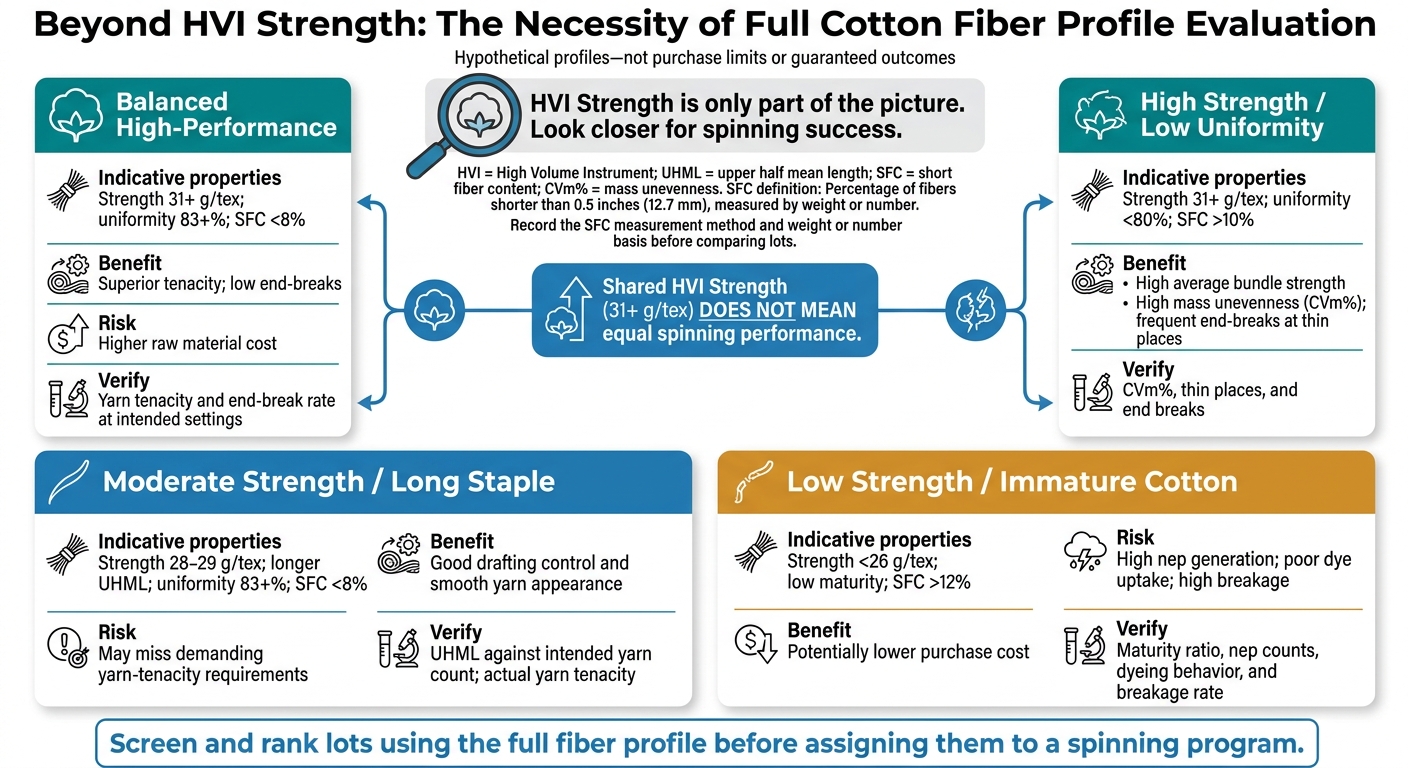
Cotton Fibre Profiles: Why Strength Alone Is Not Enough
Length, Uniformity, and Short Fiber Content
Fiber length, uniformity, and short fiber content help determine whether HVI strength translates into stable spinning. UHML and uniformity indicate how well fibers overlap and draft. Short fiber content (SFC) is the percentage of fibers shorter than 0.5 inches (12.7 mm), measured by weight or number.
Longer, more uniform fibers improve drafting and help preserve yarn strength. High SFC or low uniformity can offset strong HVI results by increasing CVm% and creating weak thin places. When strength is similar, favor higher uniformity and lower SFC for more stable processing and cleaner spinning.
Maturity, Micronaire, and Elongation
Maturity describes how fully the fiber cell wall developed. Immature fibers are more prone to neps and uneven dye uptake, and aggressive cleaning can create more neps. Micronaire reflects both fineness and maturity. It cannot distinguish a fine, mature fiber from a coarse, immature one. When nep counts or dyeing consistency matter, use a separate maturity measure, such as maturity ratio (MR).
Elongation (%) measures how much a fiber stretches before breaking. Together with strength and the energy needed to break the fiber, it helps show how fibers handle spinning stress. Check elongation alongside strength - the strongest bundle won't necessarily tolerate the most stress before failure.
This broader profile helps distinguish strong cotton that spins well from strong cotton that still breaks down during processing.
Comparing Balanced and High-Strength Fiber Profiles
Hypothetical profile Indicative properties Benefit Risk Verify Balanced High-Performance Strength 31+ g/tex; uniformity 83+%; SFC <8% Superior tenacity; low end-breaks Higher raw material cost Yarn tenacity and end-break rate at intended settings High Strength / Low Uniformity Strength 31+ g/tex; uniformity <80%; SFC >10% High average bundle strength High mass unevenness (CVm%); frequent end-breaks at thin places CVm%, thin places, and end breaks Moderate Strength / Long Staple Strength 28–29 g/tex; longer UHML; uniformity 83+%; SFC <8% Good drafting control and smooth yarn appearance May miss demanding yarn-tenacity requirements UHML against intended yarn count; actual yarn tenacity Low Strength / Immature Cotton Strength <26 g/tex; low maturity; SFC >12% Potentially lower purchase cost High nep generation; poor dye uptake; high breakage Maturity ratio, nep counts, dyeing behavior, and breakage rate
Screen and rank lots using the full fiber profile before assigning them to a spinning program.
Compare Cotton Lots and Match Them to Spinning Programs
After screening for strength, compare lots on the same basis before assigning them to a spinning program.
Build a Lot Comparison Sheet
Group lots by spinning system, then yarn count - for example, ring Ne 40+ or rotor Ne 10–20.
Use one row per lot to record bale IDs, customer specs, test dates, and bale-level results. Record the test method beside every value so results from different methods aren't treated as equivalent.
| Property | Preferred direction or target | Why it matters | Risk if ignored |
|---|---|---|---|
| Strength - HVI, g/tex | Meet the program minimum; assess premiums through trials | Meets tensile demand | Low yarn strength and higher breakage |
| UHML - HVI, in. or mm | Meet the count-specific length requirement | Meets count limit | Unsuitable yarn-count assignment |
| Uniformity - HVI, % | Higher, with consistent bale-level results | Limits drafting risk | Variable yarn quality despite an acceptable average |
| Short fiber content - supplemental AFIS or identified method | Lower; record number or weight basis | Limits waste and processing risk | Misleading comparisons across measurement bases |
| Micronaire - HVI | Customer range, not the highest value | Checks fineness-maturity balance | Unsuitable fiber selection |
| Maturity ratio - supplemental testing | Meet the agreed maturity requirement | Limits nep and dyeing risk | Hidden maturity problems |
| Elongation - HVI, where reported | Program-specific target | Adds context for break behavior | Overreliance on strength alone |
| Color - HVI Rd/+b | Customer specification and consistent shade | Supports shade control | Shading or banding |
| Trash - HVI | Low enough for available cleaning | Checks cleaning load and yield | Excess waste or damaging overcleaning |
| Moisture - record method and test conditions | Agreed testing and purchasing range | Allows comparable results and weight assessment | Biased comparisons or purchasing disputes |
Keep supplemental maturity and short-fiber measurements separate from standard HVI fields.
Screen Lots and Assign Spinning Programs
With the lot sheet complete, check each lot against the customer spec and intended spinning system.
First, confirm that sampling, conditioning, and test methods are comparable. Flag weak supporting properties and bale-to-bale variation. A passing average can hide uneven bales, so check the spread of individual results. Rank lots for ring, rotor, or air-jet use before accepting, blending, reassigning, or rejecting them.
Assign stronger, longer, more uniform cotton to fine-count or high-speed programs only when trash, maturity, and fineness also fit. For rotor spinning, favor uniformity and low trash. For air-jet spinning, favor fineness, maturity, and low trash. Blend for a consistent laydown - not just a higher average strength - and require trials for high-risk decisions.
Verify Lot Choices With Spinning Trials
Use controlled pilot or mill-scale trials to check how the chosen lot performs at the planned settings. Keep yarn count, twist, speed, and test conditions the same across trials.
Compare yarn tenacity, CVm%, imperfections, waste, and end breaks using the same test settings. For ring spinning, report breaks per 100 spindle-hours.
Conclusion: Screen for Strength, Then Verify Spinning Suitability
When screening and ranking cotton lots, treat HVI strength in g/tex as a screening tool - not a guarantee of yarn performance. Use it alongside the full fiber profile and mill conditions. Drafting, twist, humidity, blend, and yarn count all affect how much fiber strength carries through to the yarn.
Before buying or blending, screen with HVI strength, compare the full fiber profile, and verify spinning performance through controlled trials. Pay for proven spinning performance, not strength alone.
FAQs
How much HVI strength variation between bales is acceptable?
There’s no single, universally defined limit for acceptable HVI strength variation between bales. Consistent strength across the laydown helps mills maintain steady production speeds, reduce end-breaks, and produce uniform yarn.
Mills typically use bale pluckers to blend fibers from multiple bales, limiting the effects of bale-to-bale differences. By monitoring HVI data and choosing bales with compatible strength profiles, spinners can keep yarn quality consistent and fine-tune machinery settings.
Can blending stronger cotton reduce my total spinning costs?
Yes. Blending stronger cotton can help spinning machinery run at higher speeds without sacrificing quality, potentially cutting overall mill costs by 5% to 10%.
Stronger fibers also reduce yarn breaks, known as ends-down [2][3][4]. Fewer breaks mean fewer interruptions, less waste, and less hands-on work, helping mills produce yarn more efficiently and at a higher quality [5][3][4].
How can I tell whether end breaks come from cotton or machine settings?
Compare processing data with High Volume Instrument (HVI) fiber test results. If the cotton meets strength (27–29+ g/tex), length, and uniformity requirements but end breaks remain high, machine settings are the likely cause.
Try lowering speeds during opening, cleaning, and carding to reduce mechanical stress. Check for poor trash removal or overly aggressive cleaning. These issues can damage fibers or leave weak points that lead to yarn breakage.