Cotton farming is evolving to address rising costs, environmental concerns, and efficiency challenges. Key advancements include hybrid seeds with enhanced pest and weed resistance, CRISPR gene editing for precise trait improvements, and automation tools like robotic planters. These innovations aim to optimize yields, reduce resource use, and improve profitability. Here's what you need to know:
- Hybrid Seeds: By 2025, 96% of U.S. cotton acreage used genetically engineered seeds, offering features like herbicide tolerance and pest resistance.
- CRISPR Technology: Enables precise genetic edits to improve disease resistance, drought tolerance, and seed safety.
- Automation: Autonomous planting equipment reduces labor and soil compaction while improving planting precision.
- Data-Driven Tools: IoT and AI-powered systems provide real-time insights for better decision-making.
- Organic Seeds: New non-GM varieties support organic farming, with blockchain ensuring supply chain integrity.
These technologies are transforming cotton farming, making it more efficient, resilient, and aligned with changing consumer demands.
Cotton Seed Technology Adoption and Impact Statistics 2000-2025
2026 Beltwide - Wesley Porter, University of Georgia

Hybrid Cotton Seed Development
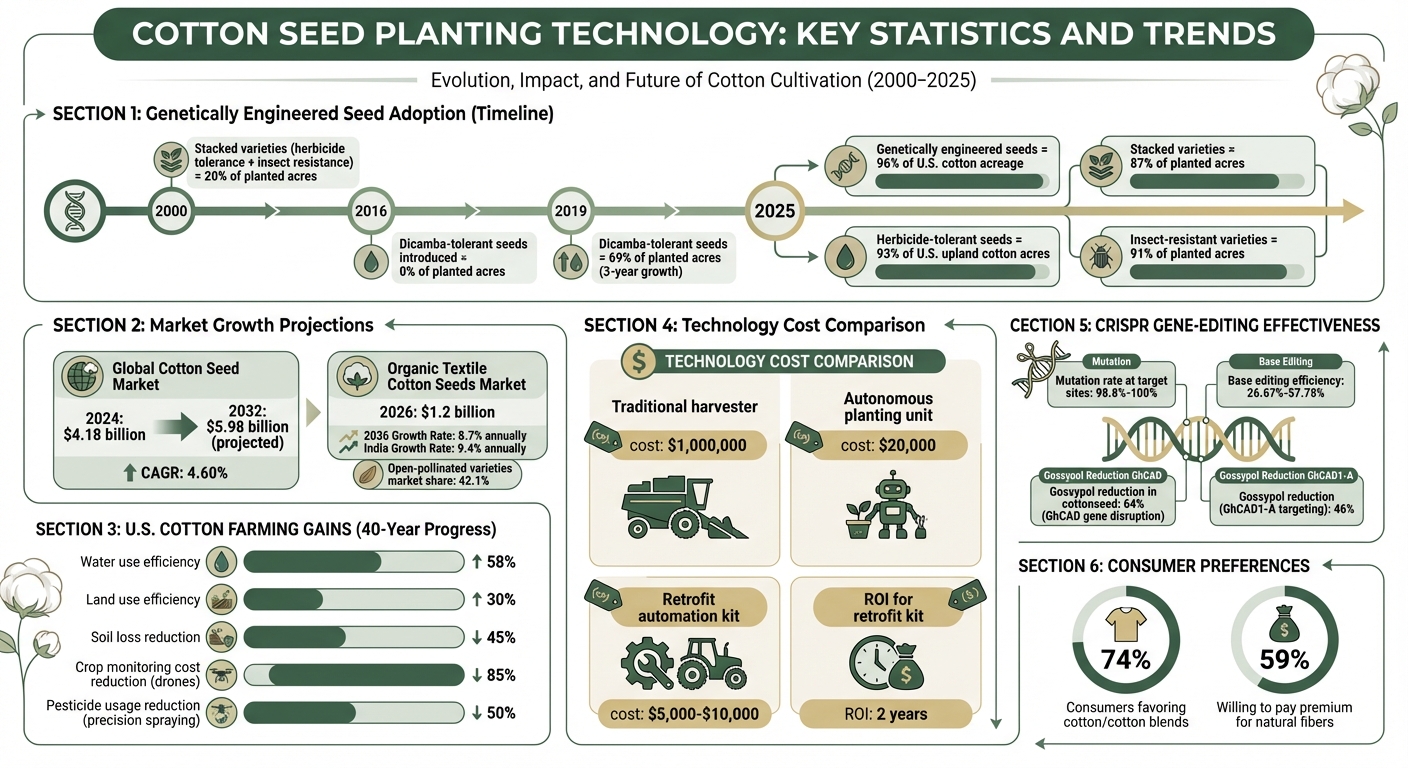
Hybrid cotton seeds are transforming the U.S. cotton industry by combining advanced traits into single seed varieties. The adoption of stacked varieties - those with both herbicide tolerance and insect resistance - has skyrocketed, covering 87% of planted acres by 2025, up from just 20% in 2000. Today, genetically engineered seeds dominate, accounting for 96% of U.S. cotton acreage. This shift highlights how these seeds are helping farmers tackle weeds, pests, and environmental challenges. Let’s dive into the traits and market trends driving this transformation.
Improved Traits in Hybrid Seeds
Modern hybrid seeds are packed with advanced features. For example, quad-stacked herbicide traits, such as Axant Flex, offer broader weed control options. In January 2025, BASF Agricultural Solutions launched six new FiberMax and Stoneville varieties. These varieties combine the quad-stacked herbicide traits with TwinLink Plus technology, which provides three-gene insect control against multiple pests. Among these, the ST 5931AXTP variety stands out with resistance to reniform and root-knot nematodes, along with strong tolerance to diseases like Fusarium and Verticillium wilt.
"At BASF, we know cotton farmers doing the Biggest Job on Earth need top-end genetics and leading traits to combat the many challenges that threaten yield potential." – Andrew Adams, Cotton Marketing Manager, BASF Agricultural Solutions
Breeding programs are also focusing on compact plant architecture to support high-density planting. These varieties, typically 31–47 inches tall, eliminate monopodial branches, making them better suited for mechanical harvesting. Lessons from international breeding efforts, such as India’s ICAR-Central Institute for Cotton Research, show the potential of high-density systems. Varieties like CSH 305 and CO 17 require fewer bolls - just five per plant compared to 28 in traditional setups - while maintaining shorter growth cycles of 120–130 days and achieving ginning percentages above 40%.
Market Growth of Hybrid Seeds
The adoption of hybrid seeds has gained remarkable momentum thanks to their technological advancements. Dicamba-tolerant cotton seeds, introduced in 2016, went from 0% to 69% of planted acres in just three years by 2019. By 2025, herbicide-tolerant seeds covered 93% of U.S. upland cotton acres, while 91% relied on insect-resistant varieties. This rapid growth reflects farmers’ need to combat herbicide-resistant weeds, leading to demand for seeds tolerant to multiple herbicides like glyphosate, glufosinate, and dicamba.
Globally, the cotton seed market is thriving. It’s projected to grow from $4.18 billion in 2024 to $5.98 billion by 2032, with a compound annual growth rate of 4.60%. Companies are responding to this demand with new innovations. In December 2023, Corteva introduced two new PhytoGen varieties, PHY 137 W3E1 and PHY 475 W3FE, designed to deliver high yields across diverse conditions. At the same time, breeding programs are prioritizing climate resilience, developing seeds that can withstand rain-fed conditions and high-heat environments.
Genetic Engineering and CRISPR Technologies
Gene-editing tools like CRISPR/Cas9 are reshaping cotton improvement. Unlike older genetic modification methods that randomly insert foreign DNA, CRISPR allows precise changes to the cotton genome. This precision targets specific genes to enhance traits like disease resistance, drought tolerance, and seed safety - all while easing public concerns compared to traditional approaches.
Genetically Modified Cotton Seed Adoption
Genetic engineering has had a noticeable impact on global cotton production. A standout example is Bt cotton, which was engineered for pest resistance and has delivered clear economic benefits. In the U.S., these engineered varieties have seen wide adoption. However, challenges persist, such as pests like the pink bollworm evolving resistance to these traits. This highlights the potential of CRISPR to refine genetic improvements further, offering advanced tools to counteract such resistance.
CRISPR and Gene-Editing Methods
CRISPR builds upon traditional genetic methods to tackle critical challenges in cotton farming. For instance, removing the Gh14-3-3d gene has been shown to improve resistance to Verticillium wilt, a severe fungal disease. Similarly, editing genes like GhRaf19 and members of the GhWRKY family enhances the plant’s ability to withstand drought and salinity.
Another breakthrough involves reducing seed toxicity. In September 2025, researchers used CRISPR/Cas9 to disrupt the GhCAD gene, achieving a 64% reduction in gossypol levels in cottonseeds. By specifically targeting the GhCAD1-A gene, they reduced seed gossypol by 46%, while ensuring the leaves retained enough gossypol for pest defense. This selective editing approach could transform cottonseed into a valuable nutritional resource, as it contains about 38% protein and 35% oil.
CRISPR is proving to be highly effective in cotton, with mutation rates between 98.8% and 100% at target sites and base editing efficiencies ranging from 26.67% to 57.78%. Cotton’s genome is complex, with redundant genes spread across its A and D subgenomes, but CRISPR’s ability to perform multiplex editing accelerates trait development far beyond what conventional breeding can achieve.
"CRISPR/Cas9 is considered as a promising method for introducing precise modifications in the genome of different plant species including the cotton." – Journal of Cotton Research
Additionally, under the USDA's SECURE rule, many CRISPR-edited plants bypass strict regulations if the genetic changes could also occur through traditional breeding, such as single base pair edits or deletions. The ability to create Cas9-free plants through genetic segregation further highlights CRISPR’s potential to bring improved crops to market faster and with fewer regulatory hurdles compared to older genetic modification techniques.
sbb-itb-0e617ca
Automation and Precision Planting
As hybrid and gene-edited seeds continue to evolve, automation is stepping in to refine the precision of cotton planting. Traditional farming equipment, with weights reaching up to 33 tons, often leads to soil compaction that restricts root growth. In contrast, smaller, autonomous robots not only reduce labor and fuel requirements but also operate effectively in wet conditions, extending the planting season.
Robotics and Automated Planting Equipment
The economics of robotic planting equipment are hard to ignore. While traditional harvesters can cost nearly $1,000,000, autonomous units are priced around $20,000. This affordability makes advanced technology accessible to farms of all sizes, encouraging widespread adoption of AI and machine learning across U.S. cotton farming.
In January 2022, John Deere showcased its first fully autonomous tractor at the Consumer Electronics Show, signaling a major step toward driverless planting and tillage. Universities are also pushing the envelope. At Clemson University, Dr. Joe Maja's team transformed a Husky robot into the "Husky Harvester", an autonomous utility tractor capable of navigating fields and pulling smart implements for various tasks. Similarly, at the University of Georgia, Glen Rains and his graduate students developed "Red Rover", an autonomous spider sprayer utilizing open-source software and under $1,000 worth of vision equipment.
Another exciting development is the concept of Multi-functional Intelligent Agricultural Robots (MIAR). These robots use interchangeable attachments to perform tasks like planting, weeding, and harvesting on a single autonomous platform. Research is also moving toward "swarm robotics", where multiple smaller, cost-effective units replace large, traditional machines. Equipped with machine vision and AI, these robots analyze real-time images to detect soil nutrient deficiencies or pest issues before planting even begins.
These technological advances are seamlessly merging with data-driven tools to optimize field operations.
IoT and Data-Driven Planting Methods
The integration of IoT technology is taking precision farming to the next level, delivering real-time insights from the field. Tools powered by AI and predictive analytics now help forecast growth stages using Degree Day 60 (DD60) models combined with live weather data. Modern farm machinery equipped with cellular modems transmits yield data instantly to management platforms, while RFID tags in cotton modules allow for sub-field level tracking from harvest to processing.
In October 2025, researchers from the Indian Institute of Technology Kharagpur and Virginia Tech, including Abhilash K. Chandel, developed an AI-enabled, automated variable-rate fertilizer applicator for cotton. Using a YOLOv7 recognition model on a Raspberry Pi microprocessor, the system accurately detected plants in real time. In lab trials at 1.0 km/h, it achieved perfect plant recognition with a MAPE of 6.15% for urea application, ensuring precise nutrient delivery while reducing waste.
Data-driven advancements have already shown measurable benefits. Over the past 40 years, U.S. cotton growers have improved irrigation water use efficiency by 58%, thanks to these technologies. In April 2025, Cotton Incorporated partnered with the SAS Institute to enhance the cotton ginning process. By linking field-level harvester data with ginning equipment through advanced analytics, they provided gins with precise estimates for optimal processing rates based on fiber characteristics, cutting both energy consumption and operational costs.
"Data-driven innovation is crucial for U.S. cotton growers to maintain profitability and long-term viability in the face of challenges like unpredictable weather and rising costs" – Dr. Ed Barnes
Organic Cotton Seed Development
Efforts in organic cotton seed breeding are gaining traction, with a focus on environmental care and farmer involvement. In September 2022, the "Seeding the Green Future" (SGF) project, a collaboration between FiBL Switzerland, RVSKVV University, and local partners, introduced the first non-GM cotton varieties tailored for organic farming. These included the Desi variety, RVJK-SGF-1, and the American Upland variety, RVJK-SGF-2, which demonstrated yield improvements of around 21% compared to benchmarks. Both varieties mature within 144–160 days and meet industrial fiber strength standards of 27–30 g/tex. These developments complement advancements in hybrid and gene-edited seeds, offering farmers more options.
"These varieties do not only improve agrobiodiversity and the livelihoods of smallholder farmers, but they also ensure their right to choose from Desi and American upland cotton without having any negative impact on productivity." – Amritbir Riar, Project Leader, FiBL Switzerland
The organic textile cotton seeds market, valued at $1.2 billion in 2026, is expected to grow at an annual rate of 8.7% through 2036, with India leading the way at 9.4% annual growth. Open-pollinated varieties dominate the market with a 42.1% share, allowing farmers to save seeds and cut input costs. Breeding efforts are increasingly focusing on Gossypium arboreum (Desi cotton), known for its unique leaf shapes and chromosome structure, which make cross-pollination with GM hybrids rare. This helps maintain organic purity. The growth of the organic seed market reflects a broader shift toward sustainable and tech-forward agricultural practices.
Organic and Stress-Tolerant Seed Varieties
Decentralized participatory breeding programs are taking seed development further, creating varieties that thrive without synthetic inputs. These programs utilize physical treatments and natural biological coatings to enhance germination, replacing synthetic fungicides. Researchers are also advancing drought-resistant varieties through genomic selection. For instance, a 2025 study at Tarim University analyzed 202 cotton lines and identified four drought-tolerant varieties, including J206-5 and jiumian20, using the entropy weight method. These varieties showed higher Superoxide Dismutase (SOD) activity and Proline content under stress, which supports breeding for climate-resilient organic seeds.
Cotton seeds, which are about 20% oil, are prone to lipid peroxidation during storage. Organic management addresses this issue using biological coatings that protect against cellular damage.
Traceability and Blockchain Integration
Blockchain technology is emerging as a tool to verify organic cotton seed authenticity and combat "greenwashing" in supply chains. By using a tamper-proof ledger, blockchain shifts from relying on central authorities ("institutional trust") to cryptographic and consensus-based mechanisms ("algorithmic trust") to ensure the integrity of seed sourcing.
"The decentralised and immutable nature of blockchain can help to reduce the risks of fraud, corruption, and tampering, while also empowering supply chain actors to make more informed and ethical decisions." – Springer Nature
To implement blockchain effectively, technical standards for data exchange, smart contracts, and platform interoperability must be developed. Challenges include creating these standards and addressing the digital divide. Stakeholders are actively engaging in regulatory sandboxes and pilot projects to define the technical and sustainability metrics needed for industry-wide certification frameworks.
Conclusion
The cotton seed planting industry is undergoing a transformation driven by automation, genetic advancements, and smarter resource management. For instance, drones equipped with predictive analytics have slashed crop monitoring expenses by 85%, while precision spraying has cut pesticide usage in half. Over the last four decades, U.S. cotton farmers have achieved remarkable milestones: a 58% improvement in water use efficiency, a 30% boost in land use efficiency, and a 45% reduction in soil loss. These strides highlight how adopting technology can lead to cost savings and better environmental practices.
When we look at the array of innovations, it’s clear they’re reshaping farming. Tools like CRISPR gene-editing, blockchain for traceability, and AI-driven field management are opening up new opportunities for growers to improve returns while lowering risks. Even retrofit kits, priced between $5,000 and $10,000, can pay for themselves in just two years. Testing these technologies on just 10% of acreage allows farmers to ease into adoption without taking on too much risk.
Beyond operational gains, these advancements align with changing consumer preferences. A growing number of buyers - 74% - favor cotton or cotton blends, and 59% are willing to pay a premium for natural fibers. As competition intensifies and climate-related challenges mount, embracing these technologies is becoming essential for long-term profitability.
FAQs
How does CRISPR technology enhance cotton seed traits?
CRISPR technology is revolutionizing cotton farming by enabling precise gene editing to improve essential traits in cottonseed. By focusing on specific genes, it can lower gossypol levels in cottonseed, making it safer for use as animal feed. Beyond that, it boosts fiber quality, stress tolerance, and oil content, helping farmers achieve higher yields and improve overall crop performance.
This breakthrough is reshaping how cotton is grown, paving the way for more efficient and sustainable farming practices that align with both environmental needs and market expectations.
What are the advantages of using autonomous planting equipment in cotton farming?
Autonomous planting equipment brings several advantages to cotton farming, starting with improved efficiency. These systems ensure seeds are placed at the right depth and spacing, which promotes better crop emergence and consistent yields. Plus, they operate faster than traditional methods, a huge help for farmers working against tight planting schedules - especially on expansive farms.
Another benefit is cost savings. By cutting down on the need for manual labor, these machines reduce labor expenses and ease the challenge of finding workers. Many of these systems are equipped with advanced tools like GPS, sensors, and AI, which fine-tune seed placement and resource use. This not only minimizes waste but also boosts productivity.
Incorporating autonomous planting equipment aligns with the broader shift toward precision agriculture. By adopting these technologies, farmers can work more efficiently, reduce environmental impact, and improve their bottom line.
How does blockchain improve the transparency and trustworthiness of organic cotton seed supply chains?
Blockchain technology is reshaping the way organic cotton seed supply chains operate by providing a secure and tamper-proof digital record of every step in the process. From sourcing seeds to their final distribution, each transaction is recorded and verified, which helps to combat fraud, counterfeiting, and contamination.
One of its standout features is real-time tracking. This allows seamless data sharing between farmers, seed producers, certifiers, and buyers, ensuring that only certified organic seeds are used throughout the supply chain. Additionally, blockchain leverages smart contracts to automate quality checks, reducing errors and boosting compliance. This not only builds trust among all stakeholders but also supports sustainable farming practices.