If cotton fields are too wet for ground rigs, drones can keep spraying on time and help protect yield.
From what I see in this article, the case is simple: drones help me spray cotton when timing is tight, soil is wet, and every missed day costs money. They can reach fields ground machines cannot, use 2 to 5 gallons per acre, hit 95%+ uniformity, and cover 400 to 600 acres per crew per day. In cotton, that matters most for insecticides, PGRs, defoliants, fungicides, and foliar nutrients.
Here’s the full takeaway in plain English:
- Wet fields delay ground rigs by 5 to 10 days
- Drone application runs about $14 to $20 per acre
- U.S. drone-sprayed acreage hit 10.3 million acres in 2024
- Drone spray efficiency reached 75.47% to 77.86%
- Ground sprayers averaged 58.88%
- Chemical rates may drop by 20% to 25% in some cases
- No wheel tracks means less plant and boll damage
- Scouting drones help me map stress, pests, and nutrient issues before spraying
- Late-season cotton can need two defoliant passes, often 7 days apart
- Cleaner defoliation can support harvest timing and bale quality
A big part of the story is not just spraying from the air. It’s also deciding where to spray first. RGB and multispectral scouting flights can spot field stress, build spray maps, and help limit treatment to the acres that need it.
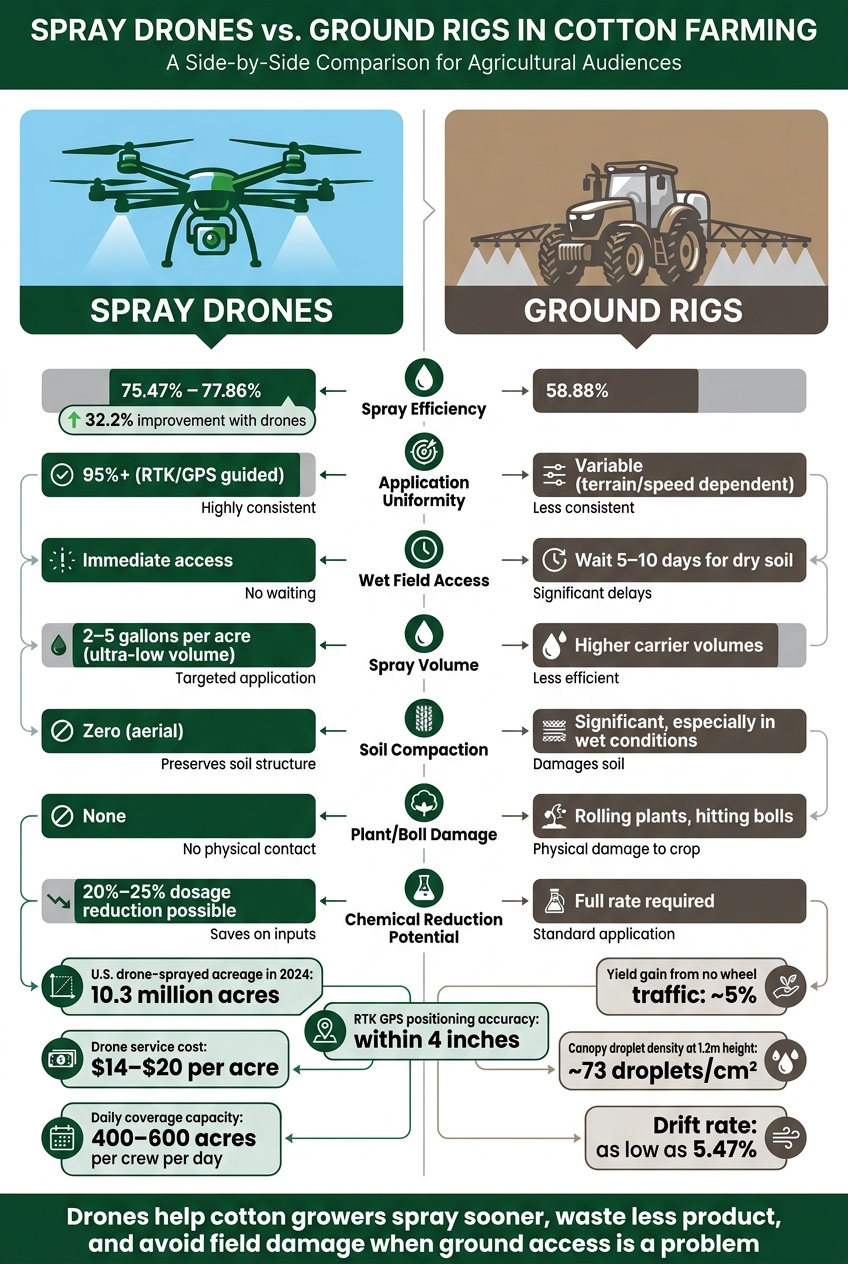
Spray Drones vs. Ground Rigs in Cotton: Key Performance Stats
A Season in the Sky: 100% Drone Spraying Success for Australian Cotton
sbb-itb-0e617ca
Quick Comparison
| Area | Spray Drones | Ground Rigs |
|---|---|---|
| Field access | Can work over wet fields | May wait 5 to 10 days for dry soil |
| Spray efficiency | 75.47%–77.86% | 58.88% |
| Uniformity | 95%+ with RTK guidance | Changes with speed and terrain |
| Canopy reach | Strong top-down coverage with rotor airflow | Harder in dense cotton |
| Plant impact | No wheel traffic | Can roll plants and hit bolls |
| Spray volume | 2–5 gpa | Higher carrier volume |
So if I had to sum it up in one line, it would be this: drones help cotton growers spray sooner, waste less product, and avoid field damage when ground access becomes a problem.
Why Getting Cotton Spraying Right Is Getting Harder
Cotton spray windows are tight. Miss them, and the fallout can show up fast: pest damage, patchy defoliation, and more trash at harvest. That pressure is a big reason drone spraying is moving from a niche option to a practical one.
Labor, Timing, and Field-Access Bottlenecks
In cotton, the most time-sensitive spray periods are June and July for pests and plant growth regulators (PGRs), then September and October for defoliants and boll openers. On paper, that sounds simple. In the field, it rarely is.
Late-season applications are often the hardest to line up, especially when fields stay wet and ground rigs can't get in. If growers have to wait for soil to dry, harvest-aid treatments can get pushed back by 5 to 10 days. That delay can leave behind more green material and more trash at harvest.
Dense canopies add another problem. This is one of the spots where drones tend to make the most sense, because they apply from above and can reach plant cover more directly. Once leaves start overlapping across nearby rows, ground sprays often struggle to hit the lower canopy. As a result, growers often need two harvest-aid passes, spaced 7 days apart, to get to clean-harvest targets. From there, the key job is simple: match the right spray job to the right acres.
Where Standard Application Methods Lose Efficiency
Large-volume ground rigs can create their own set of problems. They can roll plants, hit open bolls, waste spray, and cut into yield and fiber quality. And the efficiency gap is hard to ignore: boom sprayers average 58.88% pesticide utilization efficiency, while UAVs range from 75.47% to 77.86%.
Repeated ground passes also add soil compaction and often blanket-spray areas that don't need treatment in the first place.
That's where drones start to stand out. They can get into wet fields, avoid the plant damage that comes with ground traffic, and treat only the acres that call for a spray.
How Spray Drones Apply Cotton Inputs More Precisely
Once field access is handled, the next big edge is precision.
Spray drones place product more accurately through RTK-guided flight and steady, low-altitude spraying. That combination keeps passes lined up and coverage even across cotton rows. RTK GPS keeps positioning within about 4 inches, which cuts steering mistakes and missed strips. In practice, that leads to 95%+ application uniformity across the field.
The rotor downwash also helps in a way ground equipment often can't. Cotton canopies get dense fast, and overlapping leaves can block spray from reaching the middle and lower parts of the plant. Drone airflow pushes droplets deeper into the canopy, helping product reach the spots that matter most. At about 1.2 meters above the canopy, drones can hit a droplet density of about 73 droplets/cm² while keeping drift as low as 5.47%.
Top Uses in Cotton: Insecticides, Defoliants, Fungicides, and Foliar Nutrients
Drones fit well into the main spray jobs in cotton.
For insecticides, a Raichur study found that spraying at 1.2 meters let growers cut dosage by 25%, down to 469 g a.i./ha, while still getting statistically equivalent pest control, no phytotoxicity, and a yield of 23.80 q/ha.
Defoliant applications show perhaps the clearest timing edge. In dense cotton, a two-pass plan with a 7-day interval can improve defoliation. A Shihezi University study found that after the second application, drones reached defoliation rates above 93% and boll opening above 90%, without the crop damage tied to ground rigs. That has a direct effect on harvest timing and fiber quality at the gin.
The same idea carries over to fungicides and foliar nutrients. Instead of treating every acre the same way, drones help growers spray only the parts of the field that need attention.
Coverage, Drift Control, and Reduced Plant Loss
Drones usually spray at 2 to 5 gallons per acre (gpa) with ultra-low-volume application. In trial data, drone spray efficiency reached 75.47% to 77.86%, compared with 58.88% for boom sprayers. That's a 32.2% improvement.
Because placement is tighter, growers can also cut chemical dosages by 20% to 25% without giving up control.
Drift control comes down to a few practical choices:
- Centrifugal (rotary) nozzles make more even droplets for low-volume spraying
- Hydraulic nozzles may work better when drift control is the main goal
- Flying in the early morning or evening, when winds stay under 10 mph, helps keep product on target
There’s another layer to this. Better spray accuracy gets even better when application starts with stronger scouting.
Comparison Table: Spray Drones vs. Ground Rigs in Cotton
The difference is easiest to see side by side.
| Feature | Spray Drones | Ground Rigs |
|---|---|---|
| Spray Efficiency | 75.47%–77.86% | 58.88% |
| Application Uniformity | 95%+ (RTK/GPS) | Variable (terrain/speed dependent) |
| Canopy Penetration | High (rotor downwash) | Limited in dense canopies |
| Wet Field Access | Immediate | Must wait 5–10 days for dry soil |
| Soil Compaction | Zero (aerial) | Significant, especially in wet conditions |
| Plant/Boll Damage | None | Rolling plants, hitting bolls |
| Chemical Volume | 2–5 gpa (ULV) | Higher carrier volumes |
Using Scouting Drones to Make Better Spray Decisions
Scouting drones help turn field-to-field variation into better spray calls. With multispectral sensors, growers can spot early stress that often doesn't show up from the ground, including fungal disease, nutrient shortages, and pest pressure, before symptoms are easy to see from a pickup or tractor cab. The aim is straightforward: spray only the acres that need it, and do it before the problem spreads.
That shift matters. Instead of blanket applications across the whole field, scouting drones let growers use field stress data to build variable-rate prescriptions for insecticide timing, foliar nutrient placement, and defoliation timing.
From Field Images to Spray Maps
Seeing a problem from the air is only the first step. The next job is turning that image into something a sprayer can use. The workflow is pretty direct: fly the field, build a vegetation index map, split the field into stress zones, then confirm the cause of that stress on the ground before writing a prescription.
Mast Farms LLC in east Mississippi did exactly that on a 517-acre cotton field. The team flew the field, processed the imagery into zones, and loaded variable-rate Pix rates straight into the sprayer in about two hours. That faster zoning led to earlier treatment and less input waste.
When to Scout Cotton for Better Spray Timing
Timing can make or break the value of a scouting flight. At pinhead square, multispectral imagery can show nitrogen status early enough to guide variable-rate foliar applications. Nolan Parker, a Louisiana producer, cut nitrogen input by 50% - from 30 lbs. to 15 lbs. per acre - while still reaching 1,288 lbs./acre lint yield.
Later in the season, during squaring and bloom, which is roughly July through August, scouting flights can pinpoint pressure from Tarnished Plant Bug, Bollworm, and Aphid. In September and October, boll opening percentage and leaf senescence data help determine when defoliants should be applied. Post-storm scouting also plays a big role after any major weather event, especially when wet fields keep ground rigs out.
Comparison Table: RGB vs. Multispectral Scouting Drones
The sensor you choose should match the decision in front of you.
| Feature | RGB Scouting Drones | Multispectral Scouting Drones |
|---|---|---|
| Detection Capability | Visible stress, stand gaps, large weed patches | Early-stage stress, nutrient deficiencies, chlorophyll levels |
| Best Use Case | Stand counts, drainage issues, late-season defoliation timing | Variable-rate PGRs, early pest and disease spot-spraying, nitrogen management |
| Management Decisions Supported | Replanting, irrigation scheduling, basic spray maps | Variable-rate prescriptions for nutrients, PGRs, and defoliants |
In simple terms, RGB works well for issues you can already see, while multispectral is better for early stress and variable-rate prescriptions. That's where the payoff starts to show: earlier sprays, tighter targeting, and less waste.
Measuring the Payoff: Yield, Cost, Timing, and Bale Quality
Once scouting narrows the acres, drone spraying turns that field data into better timing, steadier yields, and cleaner bales. That’s where the payoff shows up: fewer delays, less waste, and a smoother path to harvest.
What Better Spraying Changes on the Farm and at the Gin
Drones remove wheel traffic from the field. That matters more than it may seem at first glance. With no tires running through cotton, growers can avoid compaction-related losses and may see cotton yield increase by about 5%.
Timing is another big part of the story. In the Mississippi Delta, wet soils can keep ground rigs out of the field for 5 to 10 days. Drones can still fly, which helps keep harvest-aid applications on schedule.
That timing carries through to the gin. Cleaner, more even defoliation can cut trash and help protect fiber quality. A 2024 study at Perrotis College found that drone-applied harvest aids at 50% of the recommended rate produced higher ROI than conventional ground spraying while maintaining fiber quality.
Per-Acre Decision Framework
Of course, none of this matters unless the per-acre math pencils out.
Drone spraying services usually cost $14 to $20 per acre, and bigger fields often get lower per-acre pricing.
| Factor | What to Compare |
|---|---|
| Service cost | $14–$20 per acre for drone application |
| Net per-acre cost after product savings | 25%–50% dosage reduction may be possible with drones |
| Yield protection | About 5% gain from removing wheel-track damage |
| Timing advantage | 5 to 10 days faster defoliation in wet conditions |
| Wet-field access | Can work on wet, soft soils when ground rigs cannot |
| No wheel-track or boll damage | No wheel tracks, rolled plants, or knocked-off bolls |
The case gets strongest in defoliation and harvest-aid timing. If ground access is hit-or-miss, a few lost days can affect harvest flow and fiber quality at the gin. In that kind of setup, drones aren’t just a nice option. They can change the economics of the pass.
Conclusion: Better Aerial Spraying for Stronger Cotton Returns
Drones address cotton’s hardest spray issues: timing, access, and waste. Scouting narrows the target, and aerial application puts the treatment where it needs to go.
FAQs
When do spray drones make the most sense in cotton?
Spray drones make the most sense when ground equipment just isn't a good fit. That's often the case in September and October, when growers need to apply defoliants and boll openers but soft Delta soils can keep ground rigs parked.
They also help cut down on soil compaction and crop damage that can come with ground sprayers. And when pests show up in hard-to-reach fields, drones give growers a faster, more flexible way to respond.
What cotton applications are best suited for drones?
Drones work best in cotton when the job calls for targeted, even coverage.
That usually includes:
- Pesticides, especially insecticides for sucking insect pests
- Harvest aids such as defoliants and boll openers
- Foliar nutrients and growth regulators
What should growers check before hiring a drone spraying service?
Before you hire a drone spraying service for cotton, make sure the operator has the required FAA certifications, state pesticide applicator licenses, and any aerial classifications the job calls for. Ask for copies before you book. It’s a simple step, but it can save a lot of trouble later.
You’ll also want to check a few nuts-and-bolts details:
- Liability insurance
- Cotton-specific experience
- Drift control near neighboring crops
- Fleet size
- Turnaround times
- Scheduling, especially during peak defoliation windows
In short, paperwork matters, but so does field-readiness. A service might look good on paper and still struggle when timing gets tight and every acre counts.