Drone spraying is transforming pest control for cotton growers by slashing costs, increasing efficiency, and reducing crop damage. Here's how:
- Cost Savings: Drone spraying reduces pesticide use by up to 25%, saving growers around 30% per acre compared to conventional methods. For a 1,000-acre farm, this can mean $12,000 saved per spray cycle.
- Efficiency: Drones achieve pesticide utilization rates of 75–78%, compared to just 59% with ground rigs. They also cover 400–600 acres daily, speeding up pest control efforts.
- Crop Protection: Operating above the crop eliminates soil compaction and mechanical damage, which can improve yields by around 5%.
- Precision: Rotor downwash ensures better penetration into dense canopies, targeting hard-to-reach pests in lower layers.
Spray drone cotton defoliant application.
sbb-itb-0e617ca
Why Drones Fit Cotton Pest Management
Cotton's tall, dense growth, fast-moving pests, and narrow treatment windows create challenges that traditional ground equipment often can't handle. When ground conditions aren't suitable, growers risk missing critical opportunities to protect their crops.
Common Cotton Pest Control Problems
Mature cotton fields come with unique challenges for traditional sprayers. Dense canopies with overlapping leaves make it difficult for pesticides to penetrate to the lower layers, where pests like aphids and spider mites often hide. Ground equipment can also physically damage the plants, rolling them, breaking branches, or knocking off bolls, which further reduces yields.
Timing is another critical factor. Pests like thrips move between the lower canopy and flower whorls depending on the time of day, making it crucial to target them precisely. Additionally, during September and October, the soft Delta soils can prevent ground equipment from accessing fields altogether, leaving pests unchecked and causing more crop damage over time.
Overuse of large-volume pesticide spraying has also led to resistance issues. Thrips, for example, have developed resistance to the insecticide imidacloprid due to repeated high-volume applications that fail to reach their intended targets.
These challenges highlight the need for a solution that combines precision, speed, and adaptability. Drones meet these demands head-on.
How Drones Improve Cotton Spraying
Drones bypass many of the limitations of traditional methods by operating above the crop. The downwash from their rotors creates a cone-shaped vortex, pushing droplets deep into the lower canopy, reaching areas that conventional sprayers often miss. High-powered drone models, like the DJI T60, achieve 54.09%–56.04% canopy penetration compared to just 44.76% with less powerful units.
Drones also use 2–5 gallons per acre (GPA) of pesticide with pinpoint accuracy, avoiding any direct contact with the crop. This not only protects the plants but also reduces chemical usage by up to 25%. Flying at a height of 1.5 meters above the canopy minimizes spray drift to just 7.9%, compared to 20% at 2 meters. This precision ensures effective pest control while contributing to the 30% cost savings mentioned later.
| Challenge | Drone Solution |
|---|---|
| Dense canopy blocking coverage | Rotor downwash pushes droplets into lower canopy layers |
| Wet or soft soil blocking access | Aerial application eliminates ground contact |
| Mechanical crop damage | Non-contact spraying protects branches and bolls |
| Short pest treatment windows | Fast deployment covers 400–600 acres daily |
| Pesticide waste and resistance | Low-volume (2–5 GPA) precision spraying |
How Drone Spraying Can Cut Costs by 30%
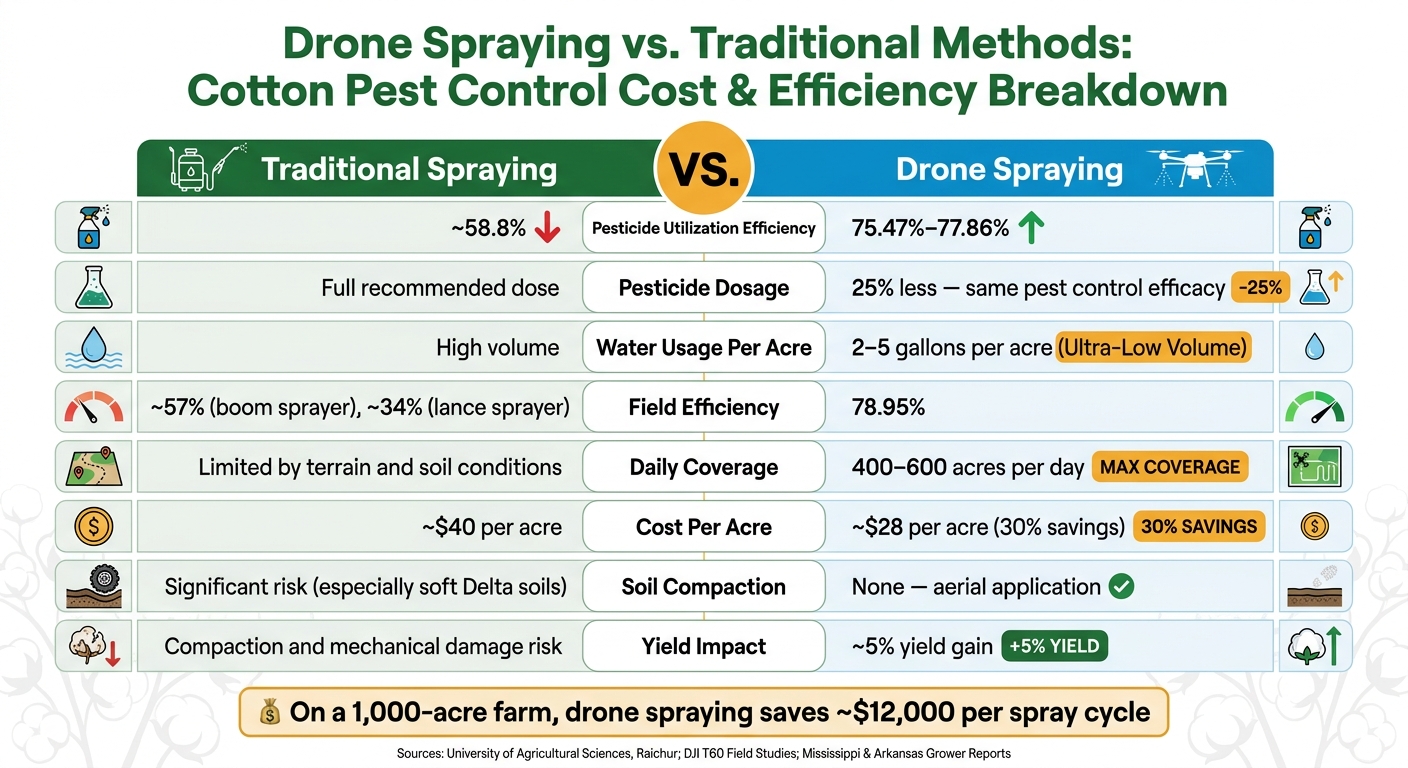
Drone Spraying vs. Traditional Methods: Cotton Pest Control Cost & Efficiency Breakdown
The 30% cost savings come from several small but impactful efficiencies throughout the spray season. Reduced chemical usage, fewer labor hours, less water hauling, and quicker field access all add up, significantly lowering per-acre expenses.
Main Cost-Saving Areas
Drone spraying turns operational efficiencies into direct financial benefits. One of the biggest savings comes from pesticide costs. Research from the University of Agricultural Sciences in Raichur shows that using drones to apply a pesticide dose reduced by 25% achieves the same pest control and yield as the full recommended dose applied by traditional power sprayers. This means less spending on chemicals without compromising results. Drones also boast a pesticide utilization efficiency of 75.47% to 77.86%, minimizing waste and improving field performance.
Water usage also drops dramatically. Drones operate at ultra-low volume (ULV) rates, requiring just 2–5 gallons of water per acre. This reduces the need for sourcing, transporting, and managing large amounts of water on-site.
Labor costs are another area of savings. Drone crews can cover 400–600 acres per day, with a field efficiency of 78.95%. This is 1.38 times more efficient than tractor-mounted boom sprayers and 2.31 times better than lance sprayers. Fewer passes, smaller crews, and shorter operation times all contribute to lower labor expenses.
As A. G. Sreenivas from the University of Agricultural Sciences notes:
"The study clearly depicted that there is a scope to reduce the pesticide dosage when used with drone-mounted sprayers without compromising pest reduction and yield levels."
Another often-overlooked benefit is yield protection. Ground rigs can compact soil and damage plants, especially in softer soils like those in Mississippi and Arkansas. Drones eliminate soil compaction entirely, which can lead to an estimated 5% yield gain - a savings realized during harvest rather than at the supply store.
What the 30% Savings Looks Like
Drone spraying for cotton typically costs $14–$20 per acre (excluding chemical costs), with bulk contracts lowering rates to $12 per acre. For a grower spending $40 per acre, a 30% reduction brings the cost down to about $28 per acre. On a 1,000-acre farm, this translates to a savings of $12,000 per spray cycle, all while maintaining pest control and yield.
| Cost Category | Traditional Method | Drone Spraying |
|---|---|---|
| Pesticide volume | Full dose | 25% less, same efficacy |
| Utilization efficiency | Low efficiency | 75.47%–77.86% |
| Water per acre | High volume | 2–5 GPA (ULV) |
| Field efficiency | ~57% (boom), ~34% (lance) | 78.95% |
| Yield impact | Compaction risk | ~5% gain (no compaction) |
Drone Spraying Workflow for Cotton Fields
Boost the effectiveness of drone spraying by following a structured process - from pre-flight checks to reviewing results after application. Each step plays a key role in ensuring efficient pest control and cost management.
Field Checks and Pest Scouting
Before deploying drones, thorough field scouting is essential. Growers typically use a five-point sampling pattern to measure pest density and pinpoint hotspots. For pests like thrips, scouts examine 10–50 cotton flowers per sampling point, transferring pests to yellow sticky traps for an accurate count.
Timing is everything. Thrips are most active inside cotton flowers during the early evening, making this the prime time for scouting. Environmental conditions like wind speed and humidity also matter - winds over 7 mph can interfere with the drone’s downwash, reducing spray coverage quality.
To ensure effective application, place water-sensitive paper (WSP) at various canopy levels before spraying. This helps verify that the drone’s rotor wind reaches all target zones, minimizing waste and allowing for fine-tuning of flight settings.
Once pest hotspots and environmental factors are assessed, adjust flight plans to match field conditions.
Flight Planning and Spray Rate Setup
After confirming pest pressure, set up flight parameters tailored to the type of application. Here’s a quick guide:
| Application Type | Flight Height | Flight Speed | Spray Volume |
|---|---|---|---|
| Sucking Pests | ~1.2 m above canopy | ~3.0 m/s | ~102.6 L/ha |
| Defoliants (Pass 1) | 1.5–2.5 m above canopy | 2.5–5.0 m/s | 17.6–48 L/ha |
| Defoliants (Pass 2) | ~2.5 m above canopy | ~5.0 m/s | 30 L/ha |
| General ULV | Varies | Varies | 2–5 gpa |
For nozzle selection, flat-fan nozzles like model 11003 are a solid choice. They produce medium-to-coarse droplets, which help reduce drift while maintaining good coverage. Always check pesticide labels to confirm they allow aerial or ULV applications before mixing chemicals. Adding spray adjuvants can improve droplet spread and ensure uniform distribution.
When defoliating cotton, a two-pass approach often delivers the best results. The first pass applies thidiazuron, followed by a second pass 7–8 days later using a thidiazuron + diuron mixture. Aim to spray in the early morning or evening when wind speeds are typically below 10 mph for better results.
Spraying and Results Review
Once flight parameters are set, execute the spray and monitor its performance. Pay attention to droplet penetration within the canopy. Larger drones like the DJI T60, known for their strong wind fields, can achieve penetration rates of 54.09–56.04% into the middle and lower canopy layers - critical for dense cotton fields where pests often hide lower on plants.
After spraying, collect the water-sensitive papers to evaluate droplet density, coverage, and uniformity across different canopy levels. If coverage in the lower canopy is lacking, adjust flight height or speed for future passes. Sticky trap counts taken 5–7 days after application will provide insight into pest control success and help determine if additional treatment is necessary.
Pros, Limits, and Adoption Needs
Pros and Limits Compared
Drone spraying brings a lot to the table for cotton pest management, but it’s not without its challenges. Here's how it stacks up against traditional ground boom sprayers:
| Factor | Drone Spraying | Ground Boom Sprayer |
|---|---|---|
| Precision | High - 95%+ GPS accuracy | Variable, terrain-dependent |
| Crop Damage | None - operates above the canopy | Causes rolling, crushing, and branch pulling |
| Chemical Use | Potential for 25–30% dosage reduction | Standard label rates |
| Pesticide Efficiency | 75–78% utilization rate | Around 58.8% utilization |
| Payload Size | Small - requires frequent refills | Large tanks with higher capacity |
| Weather Sensitivity | High - winds over 10 mph pose issues | Tolerates moderate wind better |
| Soil Compaction | None | Significant risk, especially on soft soils |
| Human Chemical Exposure | None | Low (enclosed cab provides protection) |
| Training Required | FAA Part 107 & Part 137 certifications | Standard equipment licensing |
While drones excel in precision and reducing crop damage, they do have some drawbacks. For instance, their small payloads mean more frequent refills, and they’re highly sensitive to wind conditions. Another consideration is the lack of tank agitation in spray drones, which can lead to pesticide settling and nozzle clogs. To avoid this, growers should test every new tank mix for homogeneity by letting it sit for 8–10 minutes before use.
Balancing these pros and limits is critical for growers looking to optimize costs and improve precision in cotton pest control.
What Growers Need Before Starting
Switching to drone spraying can save both time and resources, but making it work requires careful planning. Here’s what growers need to address before diving in.
First up is regulatory compliance. Operators must secure FAA Part 107 and Part 137 certifications. These certifications go beyond standard camera drone rules, requiring focused study and testing.
Next is the cost of equipment. A spray drone setup will set you back $30,000 to $50,000 per unit. For those not ready to invest, hiring a certified service operator is an option. Rates typically range from $14–$20 per acre (you provide the chemicals), with discounts available for fields over 500 acres. Don’t forget to get specialized drone insurance to protect your investment and cover liability risks.
Operational logistics are also key. A single drone crew can manage 400–600 acres per day. However, large-scale operations will need a mobile station for quick battery changes and chemical refills to minimize downtime. Physical inspections of fields are a must before every flight - satellite imagery won’t spot power lines, poles, or trees that could lead to a crash.
Finally, field suitability should guide your decision. Drone spraying is especially effective in areas where ground rigs struggle, such as soft Delta soils during September and October defoliation. In states like Mississippi and Arkansas, growers report completing defoliant applications 5 to 10 days faster than waiting for dry conditions to use ground equipment.
Conclusion: Making Drone Spraying Work in Cotton
Drone spraying is proving to be a game-changer for cotton growers. By shifting from boom sprayers to drones, pesticide efficiency jumps from about 59% to an impressive 75–78%, delivering a 32.2% improvement in effectiveness. What’s more, drones can access fields that are too wet for traditional equipment, ensuring timely treatments and protecting yields.
The financial upside is just as compelling. Research shows that pesticide dosages can be reduced by 25% without compromising pest control. Plus, drones prevent soil compaction and speed up defoliant applications, completing the process 5–10 days faster than conventional methods.
To harness these advantages, pilots must secure FAA Part 107 and Part 137 certifications. Selecting the right equipment is equally important - heavier multi-rotor drones are ideal for dense canopies, flying at heights of 1.2–1.5 meters. Timing also matters, with early morning or evening flights recommended when wind speeds are below 10 mph.
"The study clearly depicted that there is a scope to reduce the pesticide dosage when used with drone-mounted sprayers without compromising pest reduction and yield levels." - Journal of Biosystems Engineering
For those hesitant to invest in their own drones, hiring a certified operator at $14–$20 per acre (with the grower providing the chemicals) is an affordable way to explore this technology. These advancements highlight how drones are reshaping cotton farming, blending precision with efficiency to redefine pest management strategies.
FAQs
Is drone spraying worth it for smaller cotton farms?
Yes, drone spraying can work well for smaller cotton farms, depending on the size and needs of your operation. While owning a drone makes the most financial sense for farms covering at least 980 acres per year, smaller farms can still benefit by hiring custom operators. Drones are especially useful for handling fragmented or irregularly shaped fields, avoiding soil compaction and crop damage, and ensuring timely applications - even when fields are too wet for traditional equipment to operate.
What wind and weather limits can stop a drone spray job?
Drone spraying works best when wind speeds are below 10 mph to ensure pesticides are applied accurately and to minimize drift. The ideal times for spraying are early morning or evening, as these periods typically offer calmer conditions. It's best to avoid spraying between 11:00 a.m. and 6:00 p.m., especially during high temperatures. Keeping an eye on local weather is crucial since both wind and temperature play a big role in how droplets settle and the likelihood of them drifting off-target.
What permits do I need to spray pesticides with a drone in the U.S.?
To legally spray pesticides with a drone in the U.S., you’ll need to meet several federal and state requirements. First, you must hold an FAA Part 107 Remote Pilot Certificate and a Part 137 Agricultural Aircraft Operator Certificate. If your drone weighs more than 55 pounds, a Section 44807 exemption is necessary, and you might also need a third-class medical certificate.
On the state level, you’ll need a commercial pesticide applicator license and must register both your business and equipment with your state’s agricultural agency. Be sure to review local laws and regulations, as they may have additional requirements specific to your area.