Cotton transportation costs are rising due to longer hauls, fuel prices, and labor shortages. These challenges also increase the risk of fiber damage, leading to financial losses. Protecting cotton quality while reducing costs requires smarter logistics, such as:
- Route Optimization: Software can cut fuel use by 15–25% by reducing trip distances and avoiding delays.
- Real-Time Tracking: Ensures cotton stays safe during transit by monitoring conditions and improving accountability.
- Moisture-Resistant Packaging: Prevents damage from humidity and protects fibers during long journeys.
- Efficient Handling Tools: Transport calculators and gin codes streamline operations, lowering costs and improving efficiency.
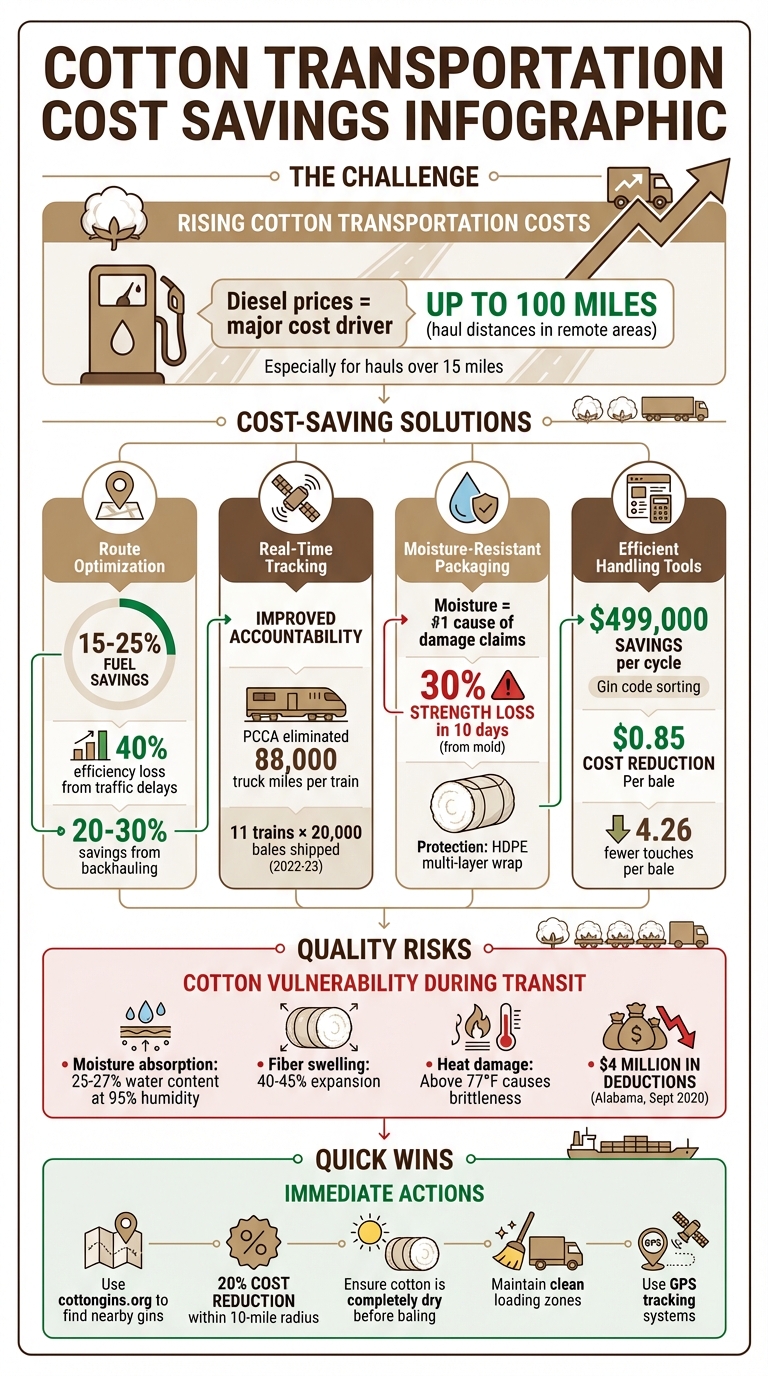
Cotton Transportation Cost Savings: Key Strategies and Statistics
Why Cotton Transportation Costs Keep Rising
Transportation costs for cotton are climbing due to rising fuel prices, inefficient logistics, and the delicate nature of the crop. While most cotton only requires short trips from the field to the gin, some operations in remote areas face hauls of up to 100 miles. These longer distances drive up fuel use and labor costs, pushing producers to carefully weigh their options when choosing a gin.
Fuel costs play a major role. Diesel prices have a direct impact on transportation expenses, especially for hauls over 15 miles. Inefficient routing can further inflate costs by forcing unnecessary or redundant trips. Even short hauls can become expensive without proper logistical planning.
The type of vehicle used also affects costs. For shorter distances, module trucks are sufficient, but longer hauls often require semi-tractor trailers to maximize efficiency. For smaller operations, switching between these vehicles adds logistical challenges and expenses.
Protecting cotton quality during transport adds another layer of cost. Cotton's sensitivity to moisture, contamination, and temperature requires extra precautions like tarps, specialized trailers, and careful handling. These measures are crucial to avoid fiber damage, which can lead to product downgrades and financial losses.
How Long-Distance Hauling Affects Cotton Quality
Cotton fibers are highly vulnerable during transit. Because cotton is hygroscopic, it readily absorbs moisture from the air. At 95% relative humidity, its water content can rise to 25%–27%, even without feeling damp. This moisture can cause fibers to swell by 40%–45%, leading to discoloration, decay, and mold.
Temperature extremes also threaten cotton's integrity. Heat above 77°F (25°C) can dry out fibers, making them brittle and less elastic. On the other hand, exposure to mold like Stachybotrys sporium can reduce cotton's strength by 30% in just 10 days.
Mechanical issues during transport are another concern. Cotton bales are compressed and secured with steel straps, but if these straps break in transit, increased oxygen exposure raises the risk of spontaneous combustion. Properly securing the cargo and preventing damage from chafing are critical safety steps.
Contamination is yet another risk. Cotton fibers are sensitive to odors from fuels like diesel and kerosene, as well as physical contaminants such as dust, rust, and plastic . For example, in September 2020, Alabama cotton growers faced $4 million in quality deductions due to seed coat fragments - damage linked to Hurricane Sally's high humidity, rain, and heat during harvest and transport. Steven Brown, an Extension Specialist at Auburn University, pointed out:
"Good quality ensures that a bale of cotton will always have a market".
What's Driving Up Logistics Costs in U.S. Cotton
Logistical inefficiencies are another major factor driving up costs. For farms in remote areas, deciding whether to transport cotton to a closer gin or a more distant one with higher capacity is a key financial decision.
Without tools like GPS tracking or GIS software to plan efficient routes, trucks may take longer paths or make unnecessary trips, especially when operating near capacity. This lack of optimization wastes both time and fuel.
Labor shortages also add to expenses. Transporting cotton modules requires skilled drivers, and the shortage of qualified operators has led to higher wages. On top of this, protective measures like tarps and specialized trailers increase logistical complexity and costs.
Since about 80% of U.S. cotton is exported, transportation involves not just domestic trucking but also long-distance maritime and land shipping. Each stage of this supply chain introduces new risks for damage and additional expenses. Addressing these inefficiencies is key to reducing costs, whether through better route planning, improved labor management, or smarter logistics overall.
sbb-itb-0e617ca
How to Improve Cotton Transportation Logistics
Smart logistics planning can make a big difference in cutting transportation costs while protecting cotton fibers. With rising costs and the need to maintain cotton's quality, technology offers practical ways to address these challenges. By reducing wasted trips, cutting down idle time, and streamlining the journey from field to market, cotton operations can achieve major efficiency improvements.
Route Planning Software Cuts Fuel and Time
Route optimization software uses advanced algorithms to find the most efficient routes between fields and gins. For instance, it can shorten a 150-mile trip to 120 miles, saving 15–25% on fuel costs. Real-time traffic updates help drivers avoid delays, which is especially important since sitting in traffic can lower a truck’s fuel efficiency by up to 40%. Features like optimized stop sequences and backhauling (avoiding empty return trips) can save an additional 20–30% on fuel.
A great example of this in action is the Plains Cotton Cooperative Association (PCCA) rail project at their Altus, Oklahoma facility. In November 2020, Vice President of Warehouse Operations Jay Cowart and Warehouse Administrative Manager Kelly Waller spearheaded a project using internal container tracking software. This initiative eliminated over 88,000 truck miles per train. During the 2022–23 fiscal year, PCCA shipped 11 trains, each carrying nearly 20,000 bales of cotton. Jay Cowart highlighted the benefits:
"The train project gives cotton grown in our region a direct route to the ports on the U.S. West Coast and by extension, Asia. This improves the efficiency of the supply chain for our grower-owners' cotton".
When choosing route planning software, look for features like dynamic re-routing, which adjusts directions instantly in response to weather or delays. Syncing the software with gin schedules can also cut idle time at loading docks. Many systems include fleet management tools to monitor driver behavior, which can boost fuel efficiency by another 15–20%. Combined with advanced tracking systems, these tools help ensure cotton stays safe and intact during transit.
Real-Time Tracking Systems Protect Cotton in Transit
Real-time tracking systems provide critical visibility, enabling quick actions to protect cotton quality during transportation. At PCCA’s Altus facility, their tracking software made the loading and unloading of trains carrying approximately 20,000 bales much more efficient. By allowing staff to monitor container movements in real time, the system improved accountability and reduced the chances of cotton being exposed to harmful conditions. As Jay Cowart explained:
"The vision for the new train software system was to increase accountability and streamline operational flow. Employees involved in train operations are able to track the containers in the yard for a more efficient loading and unloading process".
Tracking systems are essential for precise inventory management and for meeting industry standards. For export operations, these tools ensure the smooth and timely movement of cotton through every stage of the supply chain, from trucks to ships. When paired with updated procedures and thorough employee training, tracking systems can significantly enhance overall efficiency.
Better Packaging Methods for Cotton Transport
Alongside smarter routing and tracking systems, improved packaging methods play a key role in protecting cotton quality while cutting shipping costs. Using lightweight, durable materials can reduce freight expenses and shield cotton from environmental factors like rain, dust, and UV rays. Since shipping costs depend on both weight and volume, lighter packaging materials directly impact transportation efficiency. Modern solutions meet these needs while ensuring the cotton’s fibers remain intact.
Lightweight Materials That Protect Cotton
High-Density Polyethylene (HDPE) bale wrap stands out for its lightweight nature and strong protective qualities. With its multi-layer design, HDPE creates a reliable barrier against environmental damage without adding extra weight. Unlike heavier traditional materials like cotton cloth or burlap, HDPE is waterproof, dustproof, and highly resistant to tearing, ensuring durability even during rough handling.
Other choices include flexible polyethylene or polypropylene films and specially designed corrugated materials. These options conform to the shape of cotton bales, providing solid protection while keeping weight to a minimum. The reduced weight allows for more bales per truckload, decreasing the number of trips and saving fuel. For added resilience, materials with UV-resistant additives are ideal, especially for outdoor storage or transport in open trailers. These advancements not only lighten the load but also protect against moisture and UV exposure, ensuring the cotton arrives in top condition.
Moisture-Resistant Packaging to Prevent Damage
Moisture is one of the leading causes of cotton damage claims. Cotton’s natural ability to absorb moisture can weaken its fibers and cause swelling, which may damage bale strapping or even container walls. Prolonged exposure to humid conditions can lead to mold growth, such as Stachybotrys sporium, which can reduce fiber strength by up to 30% in just 10 days.
Moisture-resistant packaging helps prevent these issues by creating a barrier against condensation and cargo sweat. Multi-layer HDPE wraps not only block water but also offer UV protection, making them suitable for outdoor storage. For long sea voyages, industrial-grade desiccants like silica gel or clay can be placed inside containers to absorb water vapor before it condenses.
It’s also crucial to ensure that cotton lint is completely dry before baling to avoid internal mold growth. Storing bales on dry pallets and leaving air gaps between the cargo and container walls can further reduce the risk of condensation. Regularly inspecting bale covers and quickly repairing any damage ensures the cotton stays protected throughout its journey. By combining advanced packaging techniques with efficient logistics, cotton producers can lower costs and maintain fiber quality from the field to the final destination.
Cotton Industry Tools That Reduce Transportation Costs
Specialized tools in the cotton industry are making it easier to cut transportation costs by improving how truckloads are managed and simplifying bale handling. These tools, including calculators and software systems, rely on real-time data to optimize truckloads, reduce excess trips, and ensure smoother handling from the gin to the warehouse. They work hand-in-hand with other logistical strategies, offering data-driven insights to fine-tune operations.
Cotton Module Transport Calculators
Cotton module transport calculators help gins navigate a tricky balance: deciding whether the cost of hauling modules from farther distances is worth it to maintain efficient operations. Gins face high fixed costs - like staffing, taxes, and equipment investments - that need to be spread across processed bales. In some cases, traveling farther for modules can actually lower the cost per bale by ensuring the gin operates at full capacity.
A decision-making tool developed by Texas A&M engineers uses "percent utilization" (%U) and four key factors - gin capacity (bales per hour), average bales per module, bales per distance range, and module truck fuel costs - to evaluate whether longer hauls make financial sense.
"The model helps gins determine when longer hauls reduce per bale costs." – Cotton Incorporated
This tool is most effective for gins operating at over 70% capacity. Advanced software like GinLogistics™ builds on this by automating transportation decisions. It recommends optimal dray options and allows users to manage bale transfers with drag-and-drop features to balance loads more effectively. These tools help gins achieve a cost-efficient balance while maintaining operational quality.
Using Gin Codes to Sort Bales More Efficiently
Gin codes simplify handling and transportation costs in warehouses by offering an immediate way to organize bales. Unlike quality metrics like micronaire or leaf grade, which take days or weeks for USDA classification, gin codes are available as soon as bales arrive at the warehouse. This early information allows warehouses to sort bales strategically from the outset.
Instead of placing bales in sequential order, warehouses that sort by gin code can reduce the number of "touches" - or instances where bales are moved to access others. A study conducted in February 2024 by Jessica Richard and Eric A. DeVuyst at Oklahoma State University modeled bale movements in a cotton warehouse in Altus, Oklahoma, using 2016 crop data. By adopting a gin code-based sorting strategy, they identified a potential $499,000 savings per cycle in handling costs. This approach reduced the average touches per bale by 4.26, translating to a cost savings of $0.85 per bale.
The idea is simple: bales from the same gin tend to follow similar handling patterns. Grouping them together minimizes retrieval time and effort. When combined with logistics software that tracks Permanent Bale Identification (PBI) data - covering details like moisture, variety, and weight - this strategy reduces errors and speeds up sorting. By improving efficiency, this method streamlines the entire supply chain, cutting down on unnecessary handling at the gin.
Conclusion
Cutting cotton transport costs while maintaining fiber quality is possible with the right strategies. Tools like route planning software, real-time tracking systems, moisture-resistant packaging, and specialized industry solutions work together to protect your cotton and reduce expenses.
Start by evaluating your current logistics setup. Platforms like cottongins.org can help you identify nearby gins - reducing transportation costs by as much as 20% when working within a 10-mile radius. For international shipping, explore direct rail-to-port systems, such as the one implemented by PCCA in Altus, Oklahoma, to streamline operations and preserve quality during transit.
Protecting your cotton’s integrity is essential. Ensure the cotton is completely dry before baling, and always use intact, moisture-resistant packaging - since moisture is the leading cause of cotton insurance claims. Maintain clean loading zones, stack bales evenly, and avoid co-loading with materials that could cause contamination.
Leverage technology to improve efficiency. GPS tracking and real-time monitoring systems can cut down delays and improve operational accountability. Use cotton module transport calculators to assess when longer hauls make sense financially, based on your gin's capacity and utilization rates. Sorting bales by gin code can also reduce handling, lowering costs and increasing savings. Finally, ensure all documentation, like Phytosanitary and Fumigation Certificates, is accurate and ready to avoid customs delays and unnecessary expenses.
FAQs
What’s the fastest way to cut cotton hauling costs?
The fastest way to cut down on cotton hauling costs is by leveraging route planning software and using intermodal transport - like pairing trucking with rail. These strategies help bypass crowded ports and reduce travel distances, which saves both time and money while keeping operations efficient.
How can I prevent moisture and mold damage during transport?
To keep cotton safe from moisture and mold during transport, it's crucial to maintain moisture levels below 12% right from harvest. Use moisture-protected bale covers and desiccants, particularly for longer journeys. Avoid loading cotton when it's raining or during periods of high humidity, as these conditions can lead to damage. Regularly check bale temperatures to catch any issues early. Ensuring proper packaging, adding effective moisture barriers, and carefully planning routes to minimize exposure to humid environments are all essential steps to maintaining cotton quality during transit.
When does hauling farther to a gin actually lower cost per bale?
Transporting seed cotton farther to a gin can actually lower the cost per bale - if the savings from moving larger volumes outweigh the extra transportation expenses. This is often true for distances beyond 15 miles, particularly when using efficient options like semi-trailer trucks. These trucks can haul more seed cotton per trip, making them a cost-effective choice. Key factors such as fuel efficiency and the truck's load capacity are crucial in ensuring these savings are achieved without compromising quality.