- Tracking Tools: PBI tags, DNA markers, blockchain, and digital platforms help trace cotton origin and production.
- Regulations: U.S. Customs mandates custody records; the EU enforces due diligence standards.
- Benefits: Mills optimize yarn quality; farmers improve efficiency; brands ensure sourcing confidence.
- Challenges: Complex supply chains and digital adoption gaps require hybrid solutions combining physical and digital tracking.
- Industry Standards: Programs like the U.S. Cotton Trust Protocol verify origin and sustainability metrics.
Traceability isn't just compliance - it's about improving processes and meeting market demands.
Trust, Traceability, and the Future of U.S. Cotton with Daren Abney
sbb-itb-0e617ca
Cotton Supply Chain Stages and Traceability Points
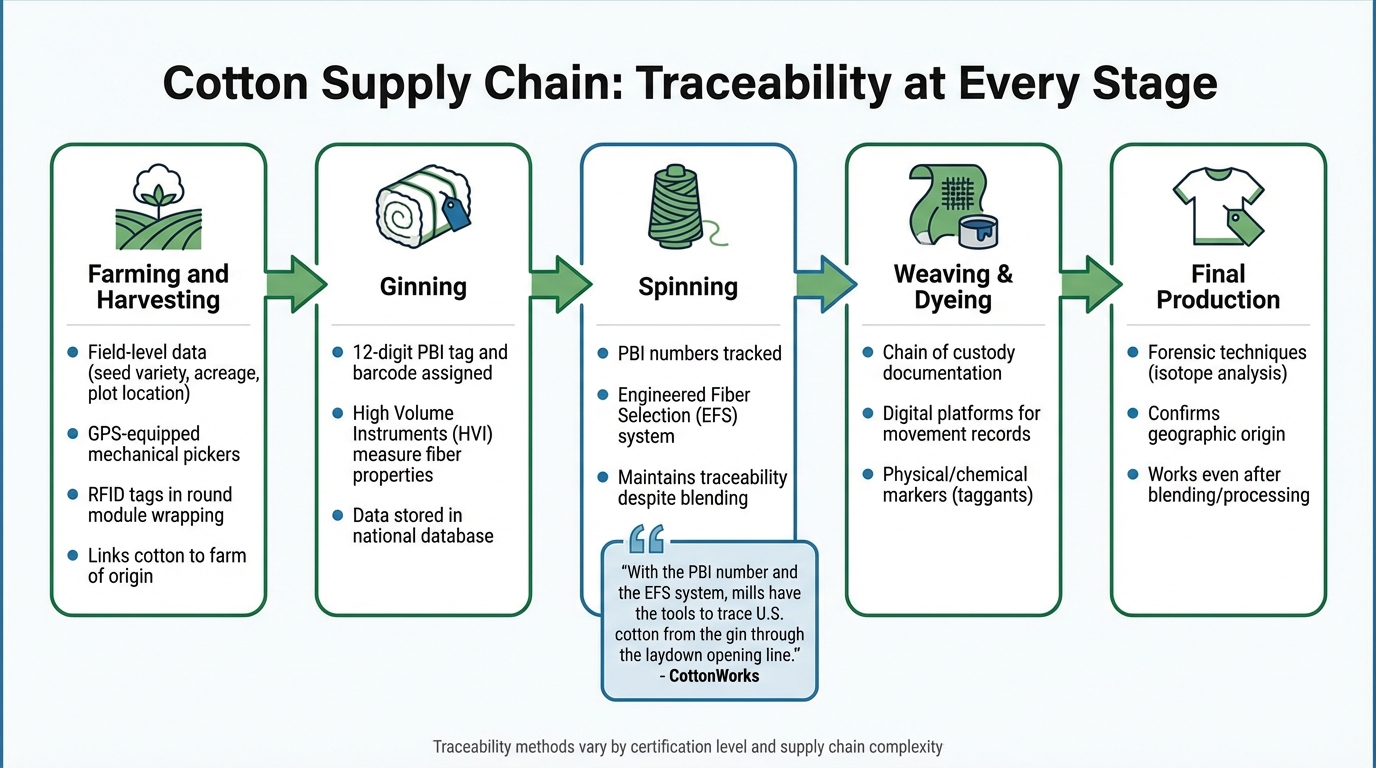
Cotton Supply Chain Traceability Process from Farm to Finished Product
The journey of cotton from field to finished product involves several stages, each requiring distinct tracking methods to ensure transparency. Capturing accurate data at every step is key to achieving effective traceability. Here's how tracking is managed throughout the cotton supply chain.
Farming and Harvesting
Traceability starts right in the field, where farmers collect field-level data that serves as the foundation for tracking. This includes details like seed variety, acreage, and plot location. Harvesting often involves mechanical pickers equipped with GPS, which record both the location and yield data. After harvesting, the cotton is packed into modules for transport to the gin. Many round modules now come with embedded RFID tags in their wrapping, directly linking the cotton back to the farm it came from.
Ginning and Spinning
At the ginning stage, cotton bales are assigned a unique 12-digit PBI tag and barcode. Key fiber properties are then measured using High Volume Instruments (HVI), with the data stored in a national database. During spinning, where cotton is frequently blended, mills use tools like the Engineered Fiber Selection (EFS) system alongside PBI numbers to maintain traceability. CottonWorks explains:
"With the PBI number and the EFS system, mills have the tools to trace U.S. cotton from the gin through the laydown opening line."
These systems ensure that even as cotton transitions into yarn, its origin and quality remain traceable.
Weaving, Dyeing, and Final Production
As cotton moves through weaving, dyeing, and garment production, tracking becomes more complex. Fiber identity often gets obscured during these processes, making chain of custody documentation critical. Many companies rely on digital platforms to manage detailed records of movement and processing at each step. To further verify origin, some use physical or chemical markers (taggants) embedded in the fibers. Additionally, forensic techniques like isotope analysis can confirm the geographic origin of cotton, even after significant blending or processing.
Tools and Technologies for Cotton Traceability
The cotton industry is embracing a range of cutting-edge technologies to track the journey of cotton from its origin to the final product. These tools are crucial for meeting regulatory requirements and ensuring supply chain transparency. Below, we explore three key technologies that are shaping cotton traceability efforts.
DNA Tagging and Molecular Markers
DNA tagging involves applying synthetic DNA sequences to cotton fibers right at the source. These markers are invisible and designed to endure the rigorous chemical and mechanical processes used in textile manufacturing, such as bleaching, dyeing, and washing. Providers like Haelixa and Applied DNA Sciences offer solutions that create a unique forensic fingerprint, enabling verification at any point along the supply chain.
The verification process involves testing yarn, fabric, or finished garments in a lab to confirm the presence of the DNA marker. Testing costs range from $100 to $200 per sample. The application itself is cost-effective, averaging $0.02 per pound of lint cotton in commercial projects, such as those by Louis Dreyfus Company for Pima cotton. Leading brands like Lacoste, H&M, Bestseller, and Kering have already adopted DNA-based technology to ensure material authenticity from fiber to finished product.
"Leveraging digital and physical traceability together reduces the risk for manufacturers and brands. Testing for our markers in the supply chain provides forensic proof of the value chain." - Abdelkader Amouche, Commercial Director, Haelixa
Blockchain-Based Platforms
Blockchain technology offers a secure, decentralized digital ledger to record every transaction and data point as cotton progresses through the supply chain. Once data is entered, it cannot be altered, ensuring its integrity. Platforms like TextileGenesis and Bext360 provide real-time access to verified data for all participants, from farmers to brands.
The U.S. Cotton Trust Protocol uses its Protocol Consumption Management Solution (PCMS) in conjunction with TextileGenesis to securely transmit validated fiber shipment data, including PBI numbers, to brands such as H&M and Lenzing. In May 2023, BASF implemented its e3 Sustainable Cotton Program, combining PBI tags with blockchain to track U.S.-grown cotton from farm to consumer, complete with third-party sustainability verification.
However, blockchain's reliability hinges on the accuracy of the data entered at each stage. Dr. Tanveer Hussain from The Textile Think Tank highlights its potential:
"Cotton traceability can help improve the sustainability, quality, and authenticity of cotton products, as well as enhance the transparency and accountability of the value chain actors."
Digital Traceability Platforms
Digital platforms streamline data collection, verification, and reporting across the entire cotton supply chain. For instance, CottonConnect's TraceBale system tracks cotton from farm to finished product, pairing digital data with physical markers like DNA tags to provide both forensic and digital proof of origin. These systems use automated tools to cross-check data with external databases, such as those from the USDA/FAS, and leverage AI to minimize human error and fraud.
The combination of physical markers and digital platforms offers a comprehensive solution. As Alison Ward, CEO of CottonConnect, puts it:
"The DNA marker is helping deliver an integrated platform that is the future for retailers seeking traceability solutions."
This hybrid approach ensures both physical product authenticity and the reliability of digital records, reducing risks of fraud or mislabeling at every stage of the supply chain.
Industry Standards and Regulations
Regulations and standards in the cotton industry are constantly evolving, emphasizing transparency, accountability, and compliance throughout the supply chain.
U.S. Cotton Trust Protocol
The U.S. Cotton Trust Protocol is a voluntary program designed to promote sustainability at the field level. It stands out as the first initiative to offer article-level traceability for American cotton. Through its Protocol Consumption Management Solution (PCMS), the program tracks two fiber categories:
- U.S. Cotton: Provides country-level tracking with verified origin.
- Protocol Cotton: Offers farm-level data from growers actively working to improve environmental practices.
To ensure authenticity, the program cross-checks PBI (Permanent Bale Identification) numbers against USDA/FAS databases, mapping the entire production chain.
"The Trust Protocol is the first cotton fiber program to offer article-level traceability, enabling our members to follow the journey of U.S. Cotton and Protocol Cotton to finished product." – U.S. Cotton Trust Protocol
The program also measures progress across six key sustainability metrics: land use, soil carbon, soil conservation, water management, greenhouse gas emissions, and energy efficiency. These metrics are assessed using the Fieldprint Calculator (developed by Field to Market) and verified through third-party audits. Notably, participating growers have achieved an 89% reduction in soil erosion since 2015, while energy use intensity remains 28% below the 2015 baseline.
In the 2024/25 season, 40 brands successfully tracked around 1.1 million tons of Trust Protocol fiber. Carhartt, Inc. joined the program in June 2024 to align with its responsible sourcing goals. Similarly, European brands like Engelbert Strauss and KIABI utilized the traceability tools in 2025 to ensure sustainable sourcing.
| Feature | U.S. Cotton Tracking | Protocol Cotton Tracking |
|---|---|---|
| Traceability Level | Country-level traceability | Farm-level data and tracking |
| Focus | Quality and low contamination | Environmental improvements |
| Verification | Verified origin | Externally verified metrics |
| Platform | PCMS | PCMS |
These voluntary efforts complement the regulatory frameworks that govern cotton production.
Key Compliance Frameworks
Beyond voluntary programs, regulatory mandates demand strict traceability across the supply chain. For instance, the Uyghur Forced Labor Prevention Act (UFLPA), effective since June 2022, requires that all cotton entering the United States is free from forced labor. To comply, businesses must maintain meticulous records to verify the origin of every bale. This level of visibility is critical for reducing risks and meeting legal obligations.
In response to the growing demand for traceable and environmentally responsible cotton, the Trust Protocol introduced its Regenerative Cotton Pilot program in 2025. This initiative tracks and recognizes verified regenerative practices, helping businesses meet compliance requirements while also supporting marketing claims about sustainability.
For cotton gins, adhering to these standards often means investing in advanced tracking systems and documentation processes. However, these efforts do more than ensure legal compliance - they also open doors to premium markets where responsible sourcing and transparency are increasingly valued.
Challenges and Solutions for Cotton Gins
Fragmented Supply Chains
Cotton supply chains are notoriously complex, often involving at least seven transfers across continents. This creates a significant challenge for traceability, as cotton from various sources frequently gets mixed during processing. Tracking its origin becomes increasingly difficult under such conditions.
A practical way to address this issue is by implementing Hard Identity Preserved (HIP) models. These models ensure certified cotton remains completely separate from non-certified cotton throughout every stage of the supply chain, including the ginning process. U.S. gins already have a strong foundation to build on, thanks to the PBI system. This infrastructure helps maintain data accuracy and integrity. For example, harvesting systems equipped with round modules and embedded RFID tags allow gins to log identification data into secure databases before processing even begins. This approach provides a reliable framework for maintaining traceability.
Digital Gaps and Adoption Barriers
One of the most significant challenges lies in the adoption of digital systems, particularly among farmers and ginners. Nick Gordon, Traceability Programme Officer at Better Cotton, highlights the issue:
"The gaps are greatest at the early stages of the supply chain, among cotton farms and ginners, for example. Yet it's precisely at these stages that we need the most accurate data".
Fortunately, U.S. gins have a head start. The PBI system is already integrated into their operations, making the transition to more advanced digital traceability less daunting. Katie O'Riordan, CEO of Kinset, explains the importance of streamlining this process:
"Our role is to structure and connect that data so it can sit alongside physical verification where it adds value, without slowing teams down or forcing them to rebuild their systems from the ground up".
A hybrid approach combining digital tracking with physical verification methods, such as isotope analysis, offers a robust solution to these challenges. This combination ensures accurate proof of origin and helps bridge the digital gaps that currently hinder the supply chain. By adopting these methods, gins can achieve better operational efficiency and gain a competitive edge in the market.
Benefits of Traceability for Cotton Gins
Addressing these challenges brings tangible rewards. For starters, gins can achieve more accurate inventory management and better data reliability using AI-based verification systems. Considering that roughly 75% of U.S. cotton is exported to over 35 countries, standardized traceability through the PBI system is now a critical requirement for global trade.
Traceability also helps mitigate risks such as supply chain fraud and accidental sourcing from restricted regions. This ensures compliance with U.S. import laws, particularly those related to forced labor restrictions. Moreover, adhering to strict traceability standards allows gins to differentiate themselves in the market and secure premium pricing for their products.
Accurate sourcing data offers additional advantages, such as improved supplier performance management and better production optimization by identifying bottlenecks. Furthermore, linking digital records to each bale simplifies quality verification processes and speeds up communication with buyers. These benefits make traceability not just a compliance measure but also a strategic asset for gins looking to thrive in a competitive marketplace.
Key Takeaways for Adopting Cotton Supply Chain Traceability
To establish effective traceability in the cotton supply chain, start by recording module IDs in your database before processing. After ginning, label every bale with a Permanent Bale Identification (PBI) tag. This 12-digit barcode system serves as the backbone for tracking cotton, enabling you to log key quality metrics securely in centralized databases. Once these basics are in place, you can explore more advanced strategies for certified fibers.
For gins handling certified cotton, using a Hard Identity Preserved (HIP) model is critical to ensure certified cotton remains separate from non-certified batches. Incorporating RFID technology into round module wrapping allows you to automatically record farm-of-origin data when modules arrive at the gin. This approach minimizes errors and speeds up the traceability process.
Modern traceability also relies heavily on digital platforms. Systems like blockchain or specialized traceability software can automate record-keeping and streamline the transfer of documentation to merchants and spinning mills. Before committing to specific technologies - such as DNA markers, isotopes, or digital tracking - request demonstrations to confirm they can endure the ginning and manufacturing processes. These tools not only enhance traceability but also support broader compliance and quality assurance goals.
"Traceability is no longer a buzzword – it is a business necessity. Consumers, regulators, and investors demand to know where products come from and under which conditions they were made."
- Regenerative Cotton Standard
Maintaining detailed custody records for all tier suppliers is essential to help brand partners meet U.S. Customs and Border Protection requirements. Adopting standards like the "Responsible Business for Gins Code of Conduct" ensures your traceability practices align with global sustainability and labor regulations. With around 75% of U.S. cotton exported to over 35 countries, standardized traceability practices are more than just regulatory requirements - they're key to staying competitive. By implementing these measures, cotton gins can meet compliance needs while boosting market positioning and supporting sustainability efforts.
FAQs
Which traceability tool is best for my gin?
The best traceability tool for your gin will depend on what you're looking to achieve. TraceBale offers a comprehensive solution, tracking everything from the farm to the finished product. It provides near real-time updates, giving you clear visibility into your supply chain. On the other hand, the U.S. Cotton Trust Protocol specializes in article-level traceability for U.S. cotton, ensuring you can verify its origin and sustainability. Both tools are great for meeting compliance and transparency goals, but TraceBale might be your go-to if you need deeper insights into your supply chain.
What records are required for U.S. Customs compliance?
For U.S. Customs compliance, it's crucial to keep precise records, including phytosanitary certificates, HS codes, Certificates of Origin, and thorough documentation detailing the cotton's origin. Additionally, ensure you use accurate classification codes, such as the 10-digit HTS code. This helps ensure proper classification and minimizes the risk of delays or penalties.
How can I prove origin when cotton is blended?
Tracing the origin of blended cotton involves a mix of physical and digital verification techniques. On the physical side, methods like chain of custody models, segregation, and mass balance practices help maintain control over the cotton's journey. Meanwhile, digital tools such as blockchain and digital passports provide secure, tamper-resistant records. Additionally, DNA markers can identify the source of cotton even after blending. By combining these approaches, companies can improve traceability and meet both regulatory requirements and market expectations for transparency.