Cotton shipment tracking is all about ensuring your product moves efficiently from farm to gin while maintaining quality and reducing costs. Here's what you need to know:
- Why It Matters: Inefficiencies in tracking can lead to higher costs, delays, and quality issues. Short hauls average $60 per load, while long hauls cost $90, making accurate tracking essential to protect margins.
- Common Challenges: Issues like fragmented data, manual processes, and logistical bottlenecks often disrupt the supply chain.
- Solutions:
- Use RFID tags for unique module identification and better traceability.
- Leverage GPS for real-time location tracking and route optimization.
- Adopt centralized platforms to streamline data and improve communication.
- Automate processes to reduce human error and speed up operations.
- Implement Permanent Bale Identification (PBI) tags to link cotton bales with USDA classing data.
Building a Systematic Tracking Framework
Module Identification and Documentation
Tracking shipments effectively begins with assigning each modern round module a unique ID. This is achieved using four embedded RFID tags and an external tag, replacing outdated methods like spray paint and paper tags, which are prone to fading, tearing, or being misread.
Each module ID is linked to detailed metadata, including client name, farm location, field number, cotton variety, harvest date, and GPS coordinates. These details, captured via GPS receivers, create a digital "fingerprint" for the cotton, ensuring traceability through every stage of processing. In 2018, the American Society of Agricultural and Biological Engineers (ASABE) established an electronic module numbering standard to ensure RFID compatibility across different equipment brands.
When the modules reach the gin, the tracking system shifts to using Permanent Bale Identification (PBI). This system assigns a 12-digit identifier to each bale, made up of a 5-digit USDA gin code and a 7-digit bale number. This setup allows for the identification of up to 10 million unique bales. Although USDA regulations allow bale numbers to be reused after five years, it’s generally better to continue the sequence indefinitely to avoid duplication errors that could disrupt classing services.
Once these unique IDs are established, digital tools take over to streamline data collection and enhance accuracy in the field.
Using Digital Tools for Field Data Capture
After assigning unique IDs, real-time data capture in the field ensures immediate and accurate tracking. Mobile and in-cab systems eliminate the delays and errors associated with paper-based methods. For instance, John Deere's Harvest Identification (Cotton Pro) system automatically records key details - such as module serial numbers, GPS locations, harvest dates, cotton variety, and moisture levels - directly from the harvester cab during the wrapping process. Harvesters equipped with RFID readers can document production on the go.
Field supervisors and custom pickers can also use mobile apps paired with Bluetooth RFID scanners to scan modules directly in the field. This on-the-spot verification ensures inventory accuracy before transport. Ownership and location data are linked to each module immediately, reducing the risk of mix-ups during hauling. The collected data is then wirelessly transferred via harvest identification (HID) files to centralized cloud platforms. These platforms allow gins and advisors to access up-to-date, accurate information instantly, keeping the entire supply chain on the same page.
sbb-itb-0e617ca
Using Technology for Real-Time Tracking
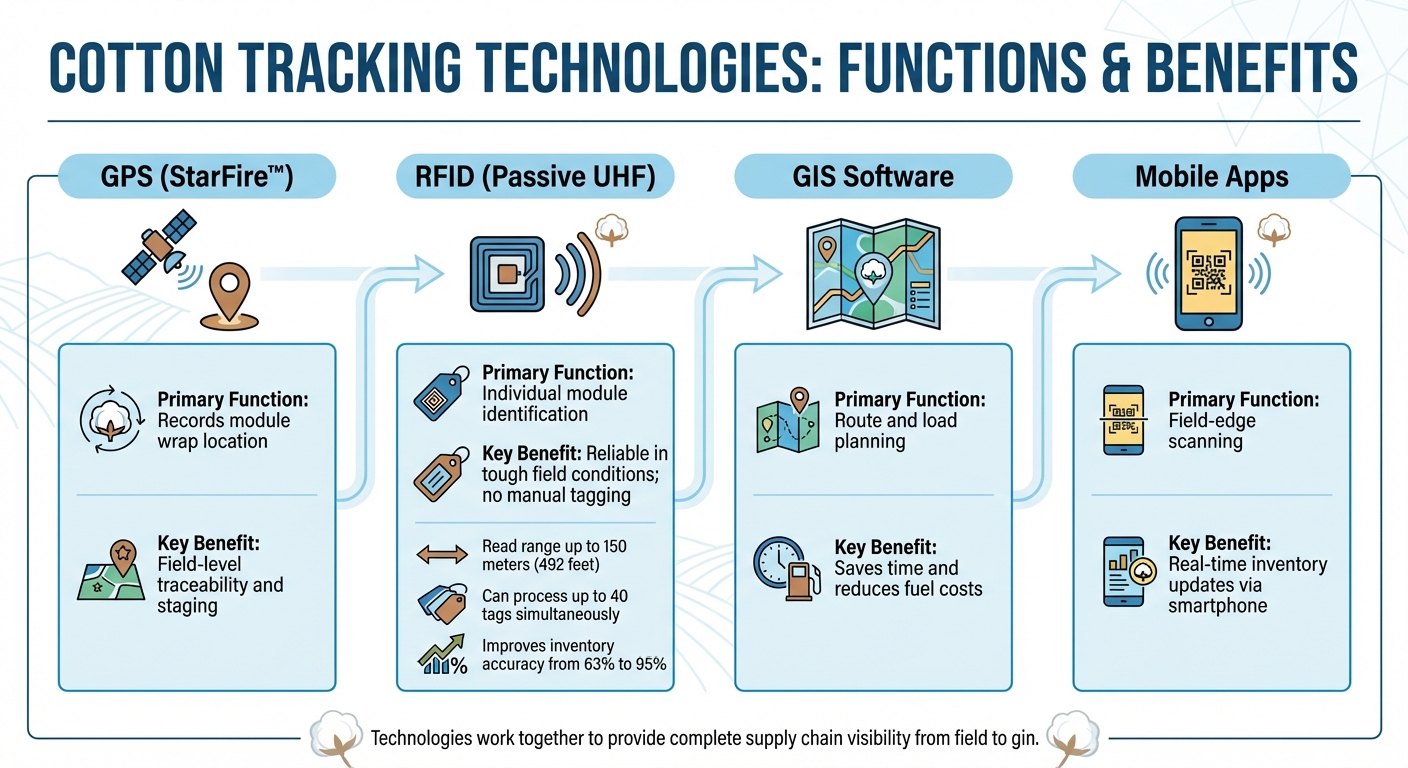
Cotton Tracking Technologies Comparison: GPS, RFID, GIS, and Mobile Apps
GPS Tracking for Location Visibility
GPS technology plays a crucial role in ensuring real-time visibility of cotton modules throughout the logistics chain. For instance, the John Deere StarFire™ Receiver pinpoints the exact latitude and longitude where each module is wrapped in the field. This creates a detailed digital map of your cotton inventory, even before it leaves the field.
During transport, GPS units installed on module movers and semi-tractor trailers provide live tracking, enabling route optimization and reducing delays. This is especially beneficial for farms located farther than the usual 10-mile radius from the gin. Using semi-tractor trailers for these longer trips can lead to noticeable savings in both fuel and labor costs.
Producers and ginners also utilize Geographic Information System (GIS) software to streamline operations. Tools like tCotton provide interactive maps that display exactly where cotton is staged in the field and how much is ready for pickup. This not only helps in scheduling efficient routes but also ensures smooth integration with RFID data for a more connected supply chain.
While GPS systems confirm the location of modules, combining them with RFID technologies ensures accurate identification, offering a complete view of the supply chain.
Barcode and RFID Integration
RFID tags are already attached to cotton modules for unique identification, enabling automated tracking at various checkpoints such as paddock exits, weighbridges, storage yards, and gin entry points. Unlike barcodes, which require scanning tags one at a time, RFID readers can process up to 40 tags simultaneously. Ultra-High Frequency (UHF) RFID tags are particularly effective, offering a read range of up to 150 meters (about 492 feet) and functioning even in challenging conditions like dirt, moisture, or debris.
For on-the-spot verification, supervisors use smartphone apps paired with Bluetooth RFID scanners. These tools validate module identities and instantly update inventory records with GPS location data. The USDA-ARS gin lab supports the industry with free, open-source tools like the "RFIDModule Scan" Android app and the "RFIDGinDataManagement" database. Implementing RFID tracking can significantly improve inventory accuracy - from 63% to 95% - while eliminating errors common in manual data entry.
When RFID identification is combined with real-time GPS data, it creates a streamlined tracking system that resolves many of the logistical challenges faced in cotton production and transport.
| Technology | Primary Function | Key Benefit |
|---|---|---|
| GPS (StarFire™) | Records module wrap location | Field-level traceability and staging |
| RFID (Passive UHF) | Individual module identification | Reliable in tough field conditions; no manual tagging |
| GIS Software | Route and load planning | Saves time and reduces fuel costs |
| Mobile Apps | Field-edge scanning | Real-time inventory updates via smartphone |
Maintaining Traceability Throughout the Supply Chain
Permanent Bale Identification (PBI) Tags
Every cotton bale leaving your gin must have a Permanent Bale Identification (PBI) tag with a unique 12-digit identifier. This identifier includes a 5-digit gin code issued by the USDA and a 7-digit bale number you assign yourself. This system ensures large-scale production without the risk of duplicate numbers.
The physical durability of the tag is just as important as its unique number. Tags should be between 0.013 and 0.015 inches thick, printed with permanent UV Black Ink, and use a strong adhesive. Place the primary tag on the crown side between the first and third strap, and attach a matching safety tag on the opposite side for added security. These measures help the tags endure the tough conditions of shipping and storage throughout the supply chain.
"The success of the PBI system is based on the principle that all numbers will be unique across multiple years." - National Cotton Council
Although the USDA allows PBI numbers to repeat after five years, it’s a good idea to keep your numbering sequence ongoing. This avoids accidental duplication of active numbers and prevents limiting your annual production to the volume from a previous year. If duplicate numbers are found, the USDA will suspend classing services until the issue is resolved.
Durable tagging is only part of the equation - consistent and accurate data logging is equally crucial for maintaining traceability.
Data Logging and USDA Compliance
To complement the PBI tagging system, precise record-keeping begins when modules arrive at your gin. Logging each module ID ensures a seamless trace from farm to bale. Once ginned, the PBI number links each bale to fiber quality data stored in the USDA AMS Cotton and Tobacco Program's National Database. This meticulous tracking not only supports compliance but also improves operational efficiency by addressing gaps in data visibility.
Your PBI tags should feature Code 128 subset C barcodes with a check digit to reduce scanning errors. Before ordering new tags, submit your gin code, tag quantities, and sequence numbers to the USDA Director of the Grading Division for verification. To prevent mismatched tag numbers, package PBI tags and USDA classing coupon cards together in the same box. By following these steps, you ensure that merchants, warehouses, and spinning mills can easily access quality data and trace bales from your gin to the mill’s opening line.
Improving Efficiency with Centralized Platforms
Integrating Data Across the Supply Chain
Once traceability is established using PBI tags and proper logging, the next step is consolidating all data into a centralized platform. This approach doesn't just unify information - it also improves shipment tracking and streamlines communication. By connecting every stage of the process - farm registrations, GPS tracking, bale identification, and USDA classing - a centralized system eliminates the need for juggling spreadsheets, paper records, and constant back-and-forth phone calls among ginners, traders, and logistics teams.
Platforms like TraceBale offer a practical solution by linking farm groups, ginners, spinners, and brands through a bottom-up data model. Instead of each party maintaining separate records, real-time visibility becomes possible with RFID and GPS integration. This means you can track cotton modules from the field to the warehouse without the inefficiencies of manual systems. For example, when bale data is automatically sent to the USDA and live classing results are returned, this information is instantly available to traders and producers. The result? Quicker transactions and fewer delays waiting for quality reports.
"Breaking down these organisational silos and allowing data to flow between teams has many benefits for the entire business, including: Improved collaboration, Improved efficiency, Better traceability, Better decision-making, [and] Enhanced risk management." - Gen10
These platforms also simplify logistics. They can recommend drayage options, create digital dray tickets for truckers, and keep everyone updated on dispatch and transport schedules. Automated notifications ensure transparency for pending transactions, contract statuses, and invoices.
By centralizing data, you set the stage for automation, which takes efficiency to the next level.
Reducing Errors with Automation
Building on the foundation of centralized data, automation tackles one of the biggest challenges: human error. Mistakes like typos, number transpositions, and formatting inconsistencies are common in manual data entry. Automation solves this issue by capturing data at the source and reusing it throughout the system. For instance, when modules arrive, RFID technology inventories them at speeds of up to 5 mph, automatically recording farm, field, and supplier data. No retyping is necessary.
Digital platforms use features like auto-populated fields to maintain data accuracy. They can extract information from PDFs and standardized files, significantly reducing transcription errors. This same data is then used to automatically generate essential documents, such as shipping papers, recap reports, packing lists, and invoices, without requiring additional manual input. GinLogistics, a platform developed to address specific ginning needs, even includes a dray manager that prints tickets directly at the gin, ensuring bales are ready for immediate dispatch.
Automation also acts as a safeguard against costly errors. For example, systems can flag mismatches between bale allocations and contract quality specifications, preventing shipments that don’t meet buyer requirements. Since ownership details are entered only once - when modules are received - you avoid discrepancies caused by repeated data entry at different stages. This single-entry method, paired with automated document creation, ensures smoother and faster processing across the board.
Inventory Reconciliation and Issue Resolution
Steps to Reconcile Inventory Records
Keeping your inventory records accurate starts with regular reconciliation between digital records and physical counts. Begin by gathering recent data, such as sales, purchase orders, returns, and transfers from your ERP system. Then, conduct a physical count using tools like barcode scanners or RFID to reduce errors. Once you have the physical count, compare it to your digital records to spot discrepancies like missing stock, extra items, or incorrect quantities.
If discrepancies arise, investigate them immediately. Look into potential issues such as unrecorded returns, damaged bales, supplier shipment mistakes, or weight changes caused by moisture. For U.S. cotton, cross-check Permanent Bale Identification (PBI) numbers with the USDA/FAS database to verify accuracy and origin. After identifying the root cause, update your digital records and log all adjustments accordingly. Tools like the eCotton Warehouse System can simplify this process by automatically comparing internal software records with Electronic Warehouse Receipt (EWR) provider systems, flagging mismatches without manual input.
"Inventory reconciliation isn't just about numbers, it's about ensuring your business can operate efficiently, fulfill orders confidently, and scale without losing control of your stock."
- Bhoomi Singh, Sumtracker
Once you've identified the discrepancies, focus on targeted solutions to resolve the issues and prevent them from happening again.
Resolving Discrepancies and Preventing Future Errors
Promptly addressing discrepancies is essential to maintaining smooth operations. When you uncover a variance, don’t just fix the numbers - dig deeper to find the root cause. This could stem from clerical mistakes, theft, or even moisture-related weight changes. For context, the U.S. saw an average inventory shrink rate of 1.4% in 2021, resulting in nearly $94.5 billion in losses. In the cotton industry, contamination or poor handling can lower crop value by 15-20%. To avoid weight-related disputes, ensure baled cotton is stored at moisture levels between 6.5% and 8%.
Adopting cycle counting can help you catch errors early without the need for disruptive annual counts. Pay extra attention to high-value or fast-moving Category A bales by increasing the frequency of checks. Standardize your workflows with clear, written procedures for receiving cotton, fulfilling orders, and processing returns to reduce manual entry errors. Mobile scanning tools in the warehouse can also help ensure that the bales being loaded onto trucks match the digital shipping orders perfectly. Additionally, train your staff on the importance of proper tracking and data accuracy.
"Traceability cannot be retrofitted reliably. Once cotton has been blended or processed without tracking, no certificate can restore lost information."
Conclusion: Key Takeaways for Ginners & Traders
Efficient cotton shipment tracking relies on a mix of practical strategies and modern technology. Here's a quick rundown of the key points to keep in mind.
Recap of Best Practices
Start tracking cotton as soon as it leaves the field. Use RFID tags and barcodes to avoid manual errors and ensure each module has a unique identifier. Smooth coordination between harvest crews, transport teams, and gin operators is essential to keep the process running without delays.
How Technology Supports Long-Term Success
Digital tools like GPS systems and centralized platforms offer real-time tracking and better route optimization, reducing delays and ensuring a seamless chain-of-custody from the field to storage. These tools also simplify supply chain management by consolidating mass balance and transaction data, which helps avoid bottlenecks. Beyond operational efficiency, technology is becoming increasingly vital for meeting traceability and carbon insetting requirements as regulations tighten .
"Traceability is no longer about telling a good story. It is about proving that the story is accurate."
- SzoneierFabrics
Modern equipment and automation also help lower per-bale processing costs while maintaining cotton quality. With global cotton production hitting around 25 million tonnes (110 million bales) annually , adopting traceability systems early - before blending or processing - ensures you retain critical data. This positions your operation to thrive in a marketplace where transparency is more important than ever.
FAQs
What’s the best way to start tracking modules in the field?
The best way to keep tabs on cotton modules in the field is by leveraging RFID technology. Here's how it works: RFID tags are attached to each cotton module during harvest, giving every module a unique ID. Then, RFID scanners come into play, capturing details like location, weight, and other key data in real time. By syncing this information with inventory management software, you can streamline tracking and make monitoring across the supply chain much easier.
How do I connect module IDs to PBI bale IDs without errors?
To correctly link module IDs to PBI bale IDs, follow these guidelines:
- Locate the 12-digit PBI number on the bale tag. This number should include a 5-digit gin code and a 7-digit bale number for proper identification.
- Attach the PBI tag securely to the narrow side of the bale. Avoid placing it on flat surfaces or areas covered by bagging material.
- Double-check that the PBI barcode aligns with the module ID in your tracking system before proceeding with shipping or processing.
What data should a centralized tracking platform capture first?
A centralized tracking platform should focus on gathering data related to harvesting, transportation, and ginning activities. Critical aspects include module creation, bale quality testing, and the early stages of logistics. By ensuring clear visibility into the cotton's journey and quality from the farm to the gin, this data lays the groundwork for efficient tracking and smoother operations.