The U.S. cotton export supply chain is a detailed process connecting farms to textile mills worldwide. Around 75% of U.S. cotton is exported annually to over 35 countries, making it a key part of the agricultural economy. Here's a quick breakdown of the six main steps:
- Harvesting: Cotton is picked using mechanical harvesters (spindle pickers or stripper harvesters) and compressed into modules (rectangular or round) weighing up to 25,000 pounds for storage and transport.
- Transport to Gin and Ginning: Modules are taken to gins, where cotton is dried, cleaned, and separated into lint and seeds. The lint is compressed into 500-pound bales.
- Baling and Quality Testing: Bales are wrapped, tagged with a 12-digit Permanent Bale Identification (PBI) number, and tested for fiber quality using USDA’s High Volume Instrument (HVI) system.
- Warehousing and Storage: Bales are stored in licensed warehouses under strict guidelines to maintain quality and prevent contamination.
- Inland Transportation: Cotton bales are shipped via truck or rail to export hubs like ports in Houston, Los Angeles, or Savannah.
- Containerization and Export: Bales are packed into containers (78–83 bales per container) and shipped overseas, ensuring compliance with export regulations like filing through the Automated Export System (AES).
Each step ensures the cotton meets international quality standards, maintains its value, and reaches global markets efficiently. This process involves farmers, ginners, merchants, and logistics providers working together to deliver high-quality cotton to textile mills worldwide.
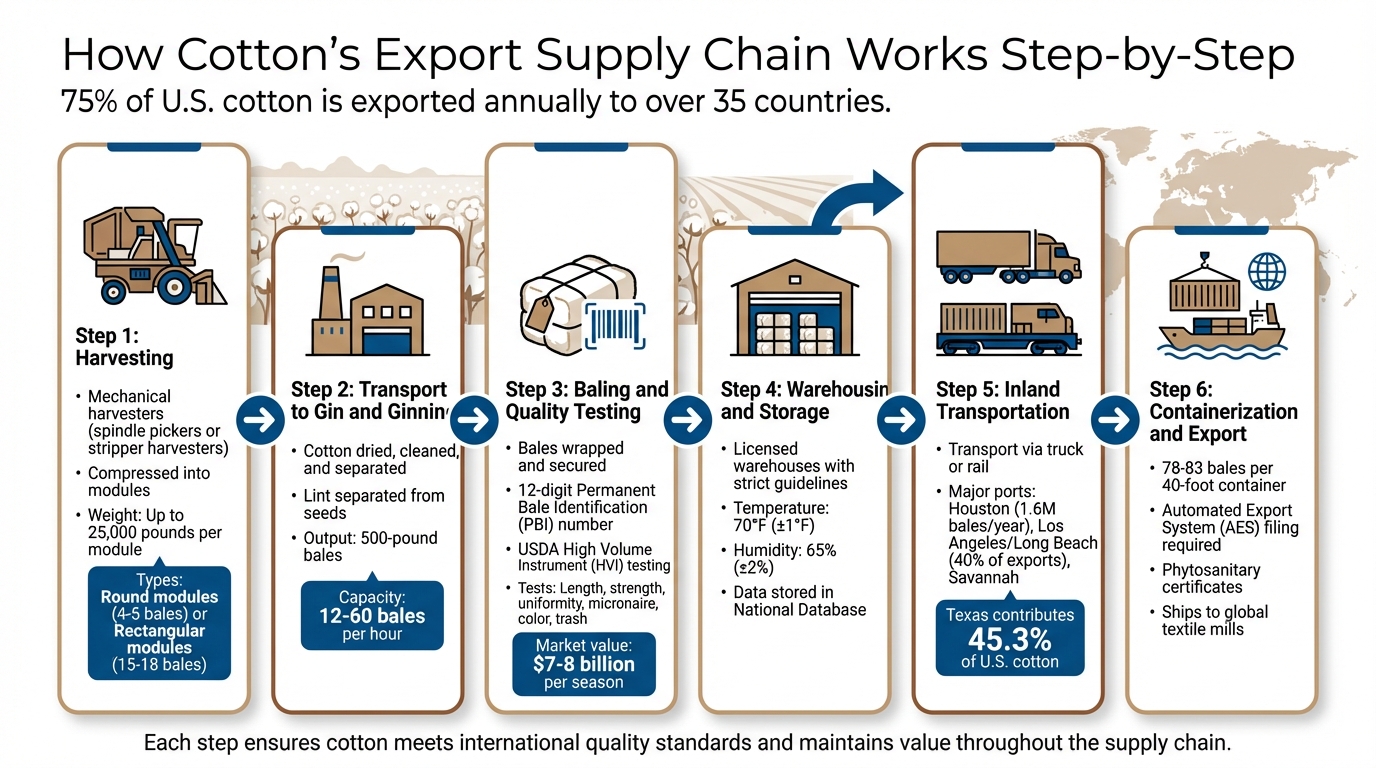
U.S. Cotton Export Supply Chain: 6-Step Process from Farm to Global Markets
Global Cotton Trade Overview | Cotton Bale Export Market, Prices & Textile Industry Demand
sbb-itb-0e617ca
Step 1: Harvesting and Module Formation
Cotton harvesting in the U.S. spans from July in South Texas to October in the northern regions, aligning with the critical need to gather the crop before adverse weather affects fiber quality or yield. Timing is everything - rain or strong winds can quickly damage the harvest.
Farmers rely on two main types of mechanical harvesters across the Cotton Belt. Spindle pickers use rotating, barbed spindles to gently pull lint from open bolls, leaving the plant largely intact. On the other hand, stripper harvesters, more common in Texas and Oklahoma, use rollers or mechanical brushes to strip the entire boll from the plant. While strippers work faster, they also collect more debris like burs and stems, which requires additional cleaning later. Once harvested, the cotton is promptly prepared for storage to maintain its quality.
After harvesting, seed cotton is compressed into modules, which are large, dense units designed to shield the crop from weather exposure. A single module can weigh as much as 25,000 pounds. Newer harvesting systems with on-board module builders create round modules, each holding 4 to 5 bales of cotton. In contrast, rectangular modules - introduced in 1972 - are larger, storing 15 to 18 bales. Today, nearly all U.S. seed cotton is stored in modules before it heads to the gin.
"Handling and storing seed-cotton in modules clearly benefits both growers and ginners by de-coupling the harvesting from ginning processes." - Cotton.org
To ensure quality is preserved, modules are covered to protect them from rain and wind while they wait in the field or are transported to the gin. Modern round modules often include RFID tags embedded in the wrapping material for tracking, and all modules are assigned identification numbers to monitor their journey from farm to gin. Properly constructed modules not only prevent contamination but also minimize physical losses, keeping the cotton in top condition until it’s processed.
Step 2: Transport to Cotton Gin and Ginning Process
After modules are prepared, specialized trucks transport them to the gin, ensuring fiber quality is preserved and the supply chain remains efficient.
"Modules allow the cotton to be stored without losing yield or quality prior to ginning." - National Cotton Council
Timely transport is essential, as delays can impact fiber integrity. Farmers often rely on resources like cottongins.org to find nearby gins, which helps minimize transport time and maintain quality. Proximity to a gin is a key factor, as it reduces delays and safeguards the cotton's condition. Most gins process around 12 bales per hour, but modern high-capacity gins can handle up to 60 bales per hour.
Once the cotton arrives, module feeders equipped with spiked rollers break apart the compressed modules and feed the cotton into the ginning system. These feeders, whether stationary or self-propelled, use conveyors or track-guided systems to ensure smooth unloading. This synchronized process can boost capacity by 10% to 25%.
The ginning process involves three main steps. First, the cotton is dried to reduce moisture content, making it easier to process and helping maintain fiber quality. Next, cleaning equipment removes foreign materials like burs, dirt, stems, and leaves before the cotton reaches the gin stand. Finally, at the gin stand, circular saws separate the lint from the seeds. Closely spaced ribs block the seeds, while air blasts or rotating brushes remove the lint from the saw teeth. Each finished bale weighs around 500 pounds.
"The cotton is first dried to lower moisture, then cleaned of burs, dirt, stems, and leaves. These operations facilitate processing and improve fiber quality." - National Cotton Council
Step 3: Baling and Quality Assessment
After the ginning process separates lint from seeds, the clean cotton is transported via air to a condenser and then pressed using hydraulic equipment. Each standard U.S. bale weighs 500 pounds and measures approximately 54–55 inches in length, 20–21 inches in width, with a maximum thickness of 33 inches. The pressing process compacts the cotton to a density of at least 28 pounds per cubic foot, resulting in a bale with a volume of about 17 cubic feet. Once compressed, the bale is stabilized and prepared for quality assessment.
To secure the cotton, workers use strapping made of PET plastic or high-tensile steel and wrap the bale in protective bagging. This bagging is designed to be clean, durable, and fully cover both ends of the bale, shielding it from dirt, moisture, and potential contaminants like sisal fibers. The industry is gradually transitioning away from woven polypropylene bagging and wire ties. By 2031, woven polypropylene will no longer qualify for USDA loan programs, and wire ties will be limited to export-only use.
"Bale packaging is critical to protecting and preserving the quality of the ginned lint during shipping and storage before consumption at the textile mill."
– Joe W. Thomas, Christopher D. Delhom, and Lauren Krogman
Once the bale is secured and wrapped, it moves on to quality testing and identification. Each bale receives a PBI barcode for tracking purposes. During this stage, fiber samples are collected for grading by the USDA Agricultural Marketing Service. The USDA employs High Volume Instrument (HVI) testing to evaluate fiber characteristics such as length, strength, uniformity, micronaire, color, and trash content. Certified classers also visually inspect the samples for contaminants like bark, grass, or plastic. This combination of automated and manual testing ensures that every bale meets the demanding quality standards required by international buyers. These grading services play a pivotal role in marketing around $7–$8 billion worth of raw cotton each season.
To maintain consistent testing conditions, USDA classification labs are kept at 70°F (±1°F) and 65% relative humidity (±2%). The resulting data is stored in a National Database, which spinning mills worldwide rely on to source cotton with the precise properties needed for consistent yarn production. This standardized grading system, established under the Universal Cotton Standards Agreement of 1923, continues to provide U.S. cotton with a strong edge in global markets.
Step 4: Warehousing, Storage, and Testing
After bales are classified and tagged, they move into licensed warehouses, where proper storage plays a key role in preserving the quality of cotton fibers. The Joint Cotton Industry Bale Packaging Committee (JCIBPC), established in 1968, sets the rules for how bales should be packaged, handled, and stored during this phase. These standards are designed to protect cotton from environmental damage, physical wear, and contamination, ensuring its quality is maintained for weeks or even months in storage.
"The mission of the JCIBPC is to 'Preserve the quality of U.S. cotton fiber for mill consumption through the development of standards for cotton bales, including safe and environmentally-friendly materials, methods and systems for packaging, handling and tagging.'"
– Joint Cotton Industry Bale Packaging Committee
Warehouse operators adhere to strict protocols to avoid contamination. For instance, updated guidelines for the 2025-2026 crop year prohibit the use of paper hang tags and small gauge wires, eliminating potential contaminants that could harm textile machinery. Only JCIBPC-approved bagging and tie materials are allowed, and if a bale is opened for sampling, it must be resealed with approved materials before it can be shipped to mills or export terminals. These measures are essential for maintaining the quality of the cotton until it undergoes further testing and shipment.
While in storage, additional quality checks are conducted. The USDA Quality Assurance Division ensures that cotton meets specific standards, especially for bales intended for futures contracts on platforms like the InterContinental Exchange (ICE). Cotton owners looking to trade their bales on futures markets must submit a "Request for Cotton #2 Classing" through eCOPS to verify compliance with exchange requirements. The USDA Quality Assurance lab is an ICA Bremen Certified Laboratory, which means it adheres to international testing standards.
Additionally, classification data for the current and previous four crop years is stored in the National Cotton Database. This resource allows buyers to access detailed fiber characteristics, helping U.S. cotton maintain its competitive position in the global market.
Step 5: Inland Transportation to Export Ports
Once cotton bales pass quality testing, they are transported from warehouses to export hubs. The choice of transportation depends on the distance and the market destination. Flatbed trucks are typically used for short distances and shipments heading to Mexico, while intermodal rail handles long-distance transport of containerized cotton to maritime ports.
For shipments to Mexico, flatbed trailers deliver bales to border warehouses in places like Laredo and Hidalgo. Between 2009 and 2010, Laredo processed around 900,000–1.1 million bales, while Hidalgo handled approximately 296,000 bales. On the other hand, shipments destined for Asia take a different route. These bales are sent to inland export facilities in the Dallas/Fort Worth area, loaded into containers, and then transported by rail to ports on the West Coast.
Major U.S. export ports play a critical role in this process. The Port of Houston, for example, handled an average of 1.6 million bales annually between 2007 and 2010, shipping cotton to countries like Turkey, South America, Pakistan, and India. Los Angeles and Long Beach ports manage over 40% of all U.S. cotton exports, primarily serving Asian markets. Additionally, Savannah, Georgia, acts as a significant gateway for international shipments. These ports rely on a combination of highway and rail systems to receive cotton from production areas, with Texas alone contributing 45.3% of the nation’s cotton in 2010.
"The mode of transportation has a direct impact on the cost, efficiency, and reliability of moving export products to overseas markets."
– Jolanda Prozzi, Research Scientist, Texas A&M Transportation Institute
However, the transportation process is not without its challenges. Issues such as driver shortages, limited availability of chassis and containers, and poorly maintained rural roads can delay shipments. Empty backhauls, where trucks or containers return without cargo, further drive up supply chain costs. To mitigate these problems, the industry has adopted automation in the Bales Made Available for Shipment (BMAS) reporting system. This advancement has improved tracking efficiency and helped maintain a reputation for timely deliveries.
Step 6: Containerization, Export Compliance, and Shipping
With the cotton now at export ports, the final step is all about preparing it for international shipment. This process kicks off with containerization, where every bale undergoes a thorough inspection to ensure it meets transport standards.
Each bale must be covered with bagging that protects at least three-fourths of its surface, including both ends. The bagging material needs to weigh at least 7.7 ounces per square yard. If the bagging is damaged, it must be patched using approved materials, but avoid fastening it with hog rings, metal staples, or similar items. A standard 40-foot container can typically hold around 78 bales from Gulf Area origins or 83 bales from West Coast origins. Once packed, the cotton moves into the export compliance phase to ensure it meets all regulatory requirements.
For shipments valued over $2,500 per Schedule B number - or if an export license is needed - exporters must file Electronic Export Information (EEI) through the Automated Export System (AES). This filing, required at least 24 hours before loading for vessel shipments, generates an Internal Transaction Number (ITN), which serves as proof of compliance and must be provided to the carrier. The U.S. Principal Party in Interest (USPPI) - usually the seller or manufacturer - must determine if an export license is required under the Export Administration Regulations and check foreign buyers against the Consolidated Screening List to ensure they are not restricted parties.
Freight forwarders handle the final shipping logistics, which include managing key documents like the Intermodal Bill of Lading and obtaining phytosanitary certificates from USDA-APHIS. Exporters must also stay on top of destination-specific requirements; for example, China mandates Zika disinsection certificates for cotton shipments. Before loading, containers or ship holds must be swept clean of debris, free of oil residue, and equipped with proper fire safety systems, such as carbon dioxide or overhead water sprinklers.
Here’s a quick guide to AES filing deadlines based on the transportation method:
| Method of Transportation | AES Filing Timeframe |
|---|---|
| Vessel | 24 hours before loading at the U.S. port |
| Truck | 1 hour before reaching the U.S. border |
| Air | 2 hours before the scheduled departure |
| Rail | 2 hours before arriving at the U.S. border |
All shipping documents and records must be kept for at least five years from the export date, though certain shipments may require retention for up to seven years under State Department rules. This documentation ensures accountability and compliance, safeguarding both exporters and buyers in the global cotton trade.
Conclusion
The cotton export supply chain demands precision at every step, from harvesting and ginning to warehousing, transportation, and containerization. Each phase plays a critical role in delivering the high-quality cotton that global markets expect.
A major cornerstone of this process is quality control. High Volume Instrument (HVI) testing and standardized classification methods are vital tools for maintaining consistency and fostering trust with buyers. As the National Cotton Council highlights, "The averages of the measurements for micronaire, length, length uniformity, and strength for the bales collectively within a module provide a better statistical representation of each of the bale's individual measurements". These methods not only establish market value but also ensure fair and transparent transactions.
Efficient logistics are equally important in keeping the supply chain running smoothly. From gins to export ports, intermodal connections ensure cotton moves seamlessly. Proper documentation, such as phytosanitary certificates and bills of lading, helps clear customs efficiently, ensuring timely delivery to international buyers.
Technology also plays a key role in modernizing the supply chain. Platforms like cottongins.org simplify operations by connecting exporters with essential tools and resources. By using automated reporting systems, electronic warehouse receipts, and USDA Foreign Agricultural Service market reports, exporters can manage the complexities of the supply chain with greater ease and accuracy.
FAQs
What factors most affect cotton quality from harvest to export?
Cotton quality depends on a variety of factors that come into play during harvesting and export. These include:
- Harvesting practices: The timing of the harvest and weather conditions play a big role in maintaining fiber quality. Poor timing or adverse weather can damage the crop.
- Ginning processes: Efficiently removing contaminants while keeping the fiber intact is crucial to preserve the cotton's integrity.
- Baling and packaging: Proper baling and secure packaging help protect the cotton from physical damage during transit.
- Transportation and handling: Careful handling is essential to prevent contamination that could compromise quality.
- Storage conditions: Cotton must be stored in environments free of excess moisture and pests to maintain its condition.
- Quality testing: Rigorous testing ensures the fibers meet the required standards for export.
By managing each of these stages carefully, exporters can deliver high-quality cotton that meets market expectations.
How can exporters reduce delays getting bales from warehouses to ports?
Exporters can cut down on delays by using advanced tracking tools like IoT and blockchain. These technologies improve supply chain visibility and help ensure better coordination. Combining different transportation modes, such as rail and truck, can also help avoid congested routes and keep shipments moving efficiently.
On top of that, efficient storage practices and digital inventory systems play a big role in reducing handling mistakes. Choosing the right ports and negotiating dependable shipping schedules can tackle issues like port congestion and container shortages.
Ultimately, staying ahead with careful planning and integrating the right tech solutions are essential for keeping exports on schedule.
What export documents are required before cotton can ship overseas?
When shipping cotton across borders, having the right paperwork is essential to avoid delays and meet regulations. Key documents include:
- Commercial Invoice: This outlines the transaction details, including the buyer, seller, and the value of the shipment.
- Bill of Lading: Acts as proof of shipment and details the transport arrangements.
- Certificate of Origin: Verifies where the cotton was produced, which is often required for customs clearance.
- Phytosanitary Certificate: Confirms the cotton meets the importing country's plant health standards.
Depending on the destination, you might also need additional documents like fumigation certificates or special permits. For U.S. exporters, USDA inspection certificates and proper customs filings are critical to ensure everything runs smoothly and complies with regulations. Accurate documentation can make all the difference in avoiding unnecessary hiccups during shipment.