Biopesticides are becoming a go-to solution for cotton farmers dealing with pest resistance, stricter pesticide regulations, and the demand for low-residue cotton. Unlike synthetic pesticides, biopesticides are derived from natural sources like bacteria, fungi, and plants, offering targeted pest control while preserving beneficial insects and soil health. They’re a critical part of Integrated Pest Management (IPM) strategies, helping farmers reduce chemical use, improve yields, and meet export standards.
Key Takeaways:
- What They Are: Biopesticides include microbial agents (Bacillus thuringiensis, Beauveria bassiana), plant-based extracts (neem), and advanced technologies like RNAi-based products.
- Why Use Them: They address pest resistance, have minimal residues, and are safer for pollinators and the environment. U.S. cotton growers using IPM strategies have cut pesticide sprays from 11 to fewer than 2 per season.
- ROI Potential: Though more expensive upfront, biopesticides can deliver higher yields and improved fiber quality. For example, Beauveria bassiana has shown a 1:6 cost-benefit ratio.
To maximize their effectiveness, apply biopesticides early in the season, monitor pest levels closely, and combine them with synthetic pesticides or Bt cotton traits as part of a broader pest management plan.
Mod-08 Lec-40 IPM in Cotton
sbb-itb-0e617ca
Core Benefits of Biopesticides in Cotton Farming
Biopesticides bring a range of advantages to cotton farming, from meeting stringent regulations to improving crop health and addressing pest resistance challenges.
Regulatory and Environmental Advantages
Biopesticides break down naturally, leaving minimal residues, which makes it easier for cotton growers to meet strict Maximum Residue Limits (MRLs) required by international markets. They also come with zero-day pre-harvest intervals (PHI) and shorter field re-entry times compared to most synthetic pesticides. This provides growers with much-needed flexibility, especially during the critical pre-harvest period.
On the environmental front, the impact is impressive. Pamela G. Marrone, CEO of Invasive Species Corporation, highlights this:
"Biopesticides have advantages and can be and are being measured compared to chemical pesticides, with reductions of greenhouse gas emissions of 80%–90% compared to chemical pesticides."
Moreover, biopesticides are less disruptive to pollinators and other beneficial insects, helping to maintain biodiversity within cotton fields. These combined regulatory and environmental benefits contribute to healthier plants and better yields for farmers.
Crop Health and Yield Gains
Biopesticides go beyond pest control - they actively enhance plant health. For instance, microbial biopesticides like Beauveria bassiana can colonize cotton plants internally, offering long-term protection against pests such as Aphis gossypii. Some microbial products even support root growth and improve nutrient absorption.
In addition, biopesticides activate a plant's natural defense systems, including systemic acquired resistance (SAR) and induced systemic resistance (ISR), making cotton plants more resilient to both pathogens and herbivores. Field trials with B. bassiana have shown a strong return on investment, with a cost-benefit ratio of approximately 1:6.04 - meaning farmers can earn over $6 for every $1 spent.
By strengthening plant health and improving pest control, biopesticides help ensure higher yields and more robust crops.
Resistance Management in Integrated Programs
One of the standout benefits of biopesticides is their ability to slow the development of pest resistance. Unlike synthetic pesticides that often target a single mechanism in a pest's nervous system, biopesticides use multiple strategies, such as mating disruption, growth regulation, or boosting plant defenses. This makes it harder for pests to adapt and develop resistance.
"...biopesticides offer the potential for... delay in the development of resistance by pests and pathogens to chemicals."
Integrating biopesticides into pest management programs - either by rotating them with synthetic chemicals or mixing them in tank applications - can extend the effectiveness of conventional pesticides. Over time, this approach not only sustains pest control but also enhances economic returns, making a strong case for their inclusion in modern farming practices.
Types of Biopesticides Used in Cotton Farming
Biopesticides are an essential tool in cotton farming, offering targeted pest control while minimizing environmental impact. They come in various forms, each with a specific mode of action to address different pest challenges.
Microbial Biopesticides
Microbial biopesticides rely on living organisms - such as bacteria, fungi, or viruses - to combat pests. In cotton farming, the most commonly used microbial biopesticides include:
- Bacillus thuringiensis (Bt): This soil bacterium produces proteins (Cry proteins) that are toxic to caterpillars when ingested. Bt has evolved from single-gene products like Bollgard to advanced three-gene stacks such as Bollgard 3 and WideStrike 3, which target a wider range of pests, including fall armyworm and beet armyworm. Bt cotton has significantly benefited farmers since its introduction in 1996. For instance, Texas growers have reduced foliar insecticide use by 66% while boosting yields by 50% as of 2025.
- Beauveria bassiana (Fungal): This fungus infects pests by penetrating their outer shell (cuticle) and spreading internally, releasing toxins like beauvericin. Lab studies have shown that strain SZ-26 of B. bassiana can cause 83%–100% mortality in onion thrips within 4–7 days at a concentration of 1 × 10⁷ conidia/mL. Field trials report a cost-benefit ratio of 1:6.04, meaning farmers can earn over $6 for every $1 invested.
- Baculoviruses: These viruses attack caterpillars (lepidopterous larvae) by causing systemic tissue breakdown after ingestion. They are highly specific, sparing beneficial insects and other non-target organisms.
Outside of microbial options, farmers also turn to botanical and biochemical biopesticides for natural pest management.
Botanical and Biochemical Biopesticides
Botanical biopesticides are derived from plant-based compounds. Neem, with its active ingredient azadirachtin, is a widely used option. It serves as a growth regulator and feeding deterrent, disrupting pests' ability to molt and reproduce. This makes it effective against the sucking and chewing pests commonly found in cotton fields.
Another standout is Spinosad, a refined microbial toxin derived from Saccharopolyspora spinosa. It targets thrips and caterpillars effectively. Additionally, insecticidal soaps and mineral oils provide low-cost solutions for controlling soft-bodied pests like aphids and spider mites without harming natural predators.
As Shimat V. Joseph from the University of California explains:
"Biopesticides also play an important role in insecticide resistance management (IRM) to address resistance issues associated with synthetic pesticides."
Here’s a quick overview of biopesticide categories and the pests they target in cotton farming:
| Biopesticide Category | Active Ingredient Examples | Target Cotton Pests |
|---|---|---|
| Microbial (Bacterial) | Bacillus thuringiensis (Bt) | Bollworms, Budworms, Armyworms, Loopers |
| Microbial (Fungal) | Beauveria bassiana | Aphids, Spider Mites, Bollworms, S. litura |
| Microbial (Viral) | NPV, Granuloviruses | Lepidopterous larvae (Caterpillars) |
| Botanical | Neem (Azadirachtin), Pyrethrins | Sucking pests, Mites, various insects |
| Biochemical/Toxins | Spinosad, Avermectins | Thrips, Caterpillars, Mites |
| Natural Materials | Insecticidal soaps, Mineral oils | Aphids, Whiteflies, Spider Mites |
In addition to these established options, cutting-edge advancements are introducing next-generation biopesticides.
Next-Generation Biopesticides
Emerging biopesticides are redefining pest control by incorporating advanced technologies. One example is RNAi-based products, which work by silencing specific genes in pests, disrupting critical biological processes without affecting beneficial insects or non-target species. In 2024, Greenlight Biosciences became the first company to register an RNAi-based biopesticide with the EPA, marking a major step forward in biological pest control. These products are especially valuable in integrated pest management (IPM) programs, helping to address resistance issues and maintain high yields.
Another innovation is RinoTec™, a bioinsecticide derived from Burkholderia rinojensis A396. This product, which won the EPA's Presidential Green Chemistry Challenge Award in 2024, leverages genomic optimization and fermentation improvements to achieve a 150-fold increase in pesticidal metabolite concentration. This results in greater effectiveness at lower application rates. These advancements are positioning next-generation biopesticides as indispensable tools for large-scale cotton farming.
Application Strategies for Cotton Farmers
Timing and Application Windows
Getting the timing right is crucial when using biopesticides. Unlike synthetic insecticides, which deliver rapid knockdown effects, biopesticides work preventatively by disrupting pest feeding and reproduction cycles.
"Biopesticides... are not highly effective when used to knockdown pests at an EIL [Economic Injury Level]. [They] should be applied early in the season before the pests build up." - Pamela G. Marrone, Invasive Species Corporation
To stay ahead of pest outbreaks, scout your fields at least once or twice a week and apply biopesticides before pest populations reach the economic threshold. For mid- and late-season caterpillar pests, it’s best to sample at first bloom and then again 2–3 weeks later. This schedule helps you gather the data needed to act at the right time. For foliar applications, late afternoon (around 3–4 p.m.) is ideal, as this minimizes UV degradation of the product.
Biopesticides are particularly useful late in the season because they have a zero-day pre-harvest interval and no residue restrictions. If pest pressure is high, you can first use a synthetic contact insecticide for immediate control, and then follow up with biopesticides to manage residual pest activity.
Once timing is nailed down, focusing on proper dosage and mixing techniques will help you get the most out of your biopesticides.
Dosage, Coverage, and Tank-Mixing
Instead of following a fixed schedule, base your dosage on real-time scouting data. During periods of peak pest pressure, scout every 3–4 days and target early-instar larvae, which are more vulnerable to biopesticides .
Two common mistakes to avoid when applying biopesticides are using excessive water volumes, which can dilute the active ingredients, and choosing adjuvants that reduce microbial efficacy. For tank-mixing, rotate products with different IRAC mode-of-action numbers - such as Biologicals, Spinosyns, and Diamides - to delay resistance and improve overall pest control. If you suspect resistance is causing a field failure, switch to a different product class rather than reapplying the same one.
| Product | Active Ingredient | Field Dosage | Target Pest |
|---|---|---|---|
| Eco-Bb® | Beauveria bassiana | ~8.5 oz/acre | Cotton Bollworm |
| Bolldex® | Nucleopolyhedrovirus | ~2.9 fl oz/acre | Cotton Bollworm |
| Delfin® | Bacillus thuringiensis | ~7.1 oz/acre | Cotton Bollworm |
Fitting Biopesticides into Your Whole-Farm System
To maximize pest control and maintain crop health, biopesticides should be integrated into your overall farm management strategy. For Bt cotton fields, biopesticides are particularly useful when pest levels exceed thresholds, especially for bollworm and fall armyworm. Many large-scale U.S. cotton farms now combine biopesticides with multi-gene Bt traits to strengthen their pest management systems.
Another benefit of biopesticides is their ability to preserve beneficial insects like lady beetles, lacewings, and spiders. These natural predators provide ongoing pest suppression at no additional cost. Pairing biopesticides with cultural practices - such as fall stalk destruction and tillage - can disrupt overwintering pupae, creating a layered approach where each method supports the others.
"Testing biopesticides and integrating them into IPM programs based on their unique modes of action will help increase the confidence in their use to the benefit of IPM programs, growers' return on investment, human and nontarget safety, and the environment." - Pamela G. Marrone, Invasive Species Corporation
As harvest approaches, replacing chemical applications with biopesticides keeps residues off your cotton fiber, ensuring better access to export markets. These strategies not only improve biopesticide effectiveness but also boost your return on investment by reducing chemical use and protecting beneficial insect populations.
Calculating the ROI of Biopesticides in Cotton
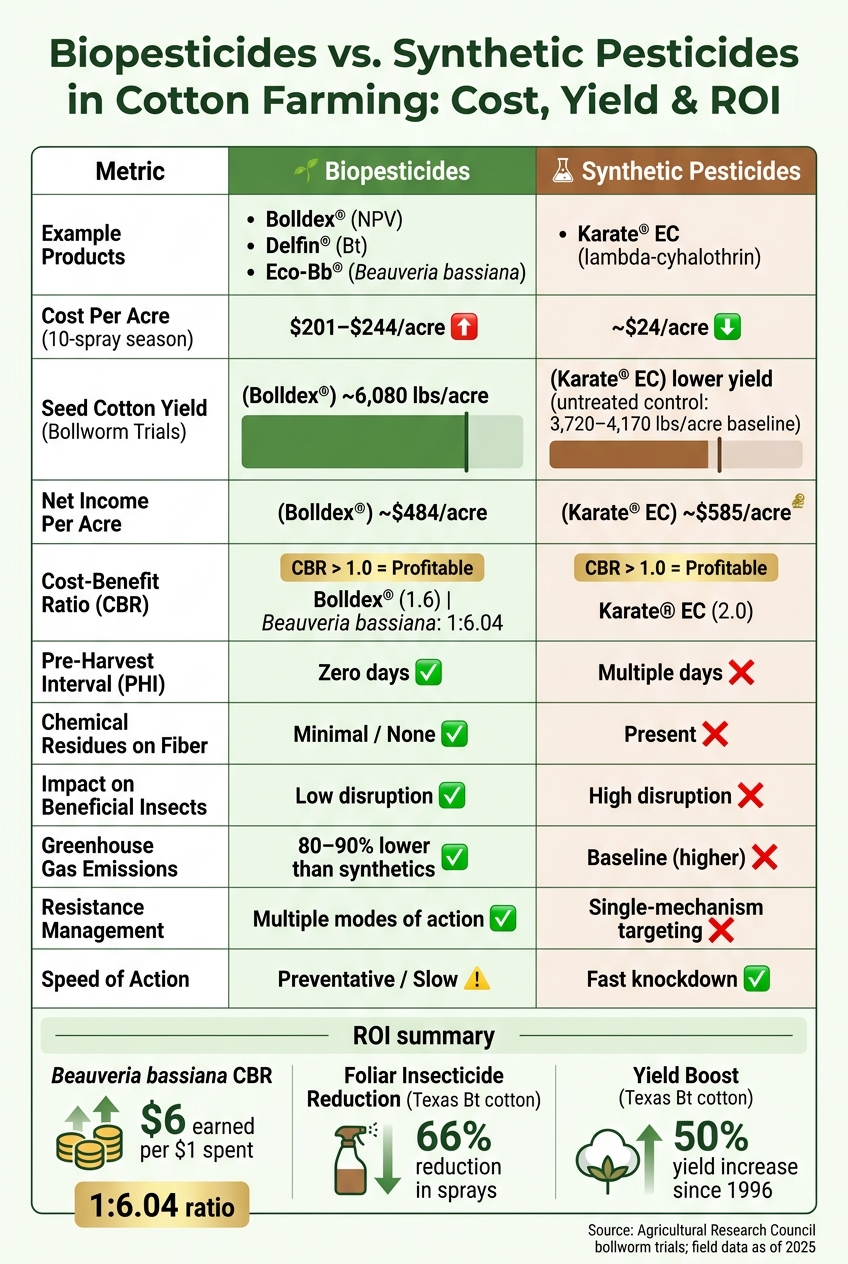
Biopesticides vs. Synthetic Pesticides in Cotton Farming: ROI & Performance
Breaking Down the Costs
Biopesticides often come with higher upfront costs compared to traditional synthetic pesticides. For instance, in field trials, Delfin® (Bacillus thuringiensis) was priced at about $244 per acre for a full 10-spray season, while Bolldex® (nucleopolyhedrovirus) cost around $201 per acre. In comparison, a conventional pesticide like Karate® EC (lambda-cyhalothrin) cost significantly less - roughly $24 per acre for the same number of applications.
But product cost is just one piece of the puzzle. To calculate ROI accurately, you also need to account for expenses like scouting fees and labor for spraying. On the plus side, biopesticides provide flexibility in scheduling and reduce residue concerns, making it easier for growers to meet export standards. These factors, combined with potential yield and quality improvements, help balance the initial investment.
Yield and Fiber Quality Benefits
While biopesticides may have higher initial costs, the payoff often comes in the form of better yields and improved fiber quality. For growers, the key is ensuring these benefits outweigh the added expense. In bollworm trials conducted by the Agricultural Research Council in South Africa, plots treated with Bolldex® yielded approximately 6,080 lbs of seed cotton per acre - the highest yield among all treatments. By comparison, untreated control plots produced an average of 3,720 to 4,170 lbs per acre.
"Biopesticides have the potential to control yield loss without compromising the quality of the crop." - Lawrence N. Malinga, Agricultural Research Council
Beyond boosting yields, biopesticides also help reduce chemical residues on fiber. This can make cotton more marketable and even command a quality premium. As Pamela G. Marrone, Founder of Invasive Species Corporation, explains:
"Integrated programs can increase growers' bottom lines with better yields and quality, which is what is driving the growth and adoption of biopesticides by conventional growers."
A Step-by-Step ROI Calculation
To assess profitability, two simple formulas come into play:
- Net Return = Total Revenue – Total Cost of Production
- Cost-Benefit Ratio (CBR) = Total Revenue ÷ Total Cost of Production
A CBR greater than 1.0 indicates profitability, with 1.0 being the break-even point. In South African bollworm trials, Karate® EC achieved a net income of about $585 per acre with a CBR of 2.0. By comparison, Bolldex® delivered a net income of $484 per acre and a CBR of 1.6. While Bolldex® had higher input costs, it still proved profitable and delivered the highest yield among the tested options.
These results highlight that biopesticides might not always win on input costs alone. But when you factor in their broader value - like yield protection, better fiber quality, resistance management, and scheduling flexibility - the economic gap with synthetic pesticides begins to close. As Scott H. Graham from the Alabama Cooperative Extension System puts it:
"When it comes to cotton insect control, you can save money or you can save cotton, but it is hard to do both."
To calculate your own ROI, add up costs for pest control products, labor, and scouting fees. Then, compare this total to the combined benefits of yield gains (multiplied by market price), quality premiums, and long-term savings from delayed resistance. Evaluating these factors over multiple growing seasons can give you a clearer picture of how biopesticides deliver value. When you include benefits like resistance management and timing flexibility, the comprehensive value of biopesticide programs becomes evident.
Conclusion and Key Takeaways
Recap of Biopesticide Benefits
Biopesticides bring a range of advantages to cotton growers. When incorporated into an integrated pest management program, they help increase seed cotton yields, reduce chemical residues, and cut down greenhouse gas emissions, all while meeting strict export regulations. Their zero-day pre-harvest intervals also provide much-needed flexibility during critical harvest periods.
While options like Bolldex® come with higher upfront costs compared to conventional pesticides like Karate® EC, the benefits - such as better yield protection, enhanced fiber quality, and long-term resistance management - make them a worthwhile investment. Industry projections even suggest that by 2040, biopesticides could rival the chemical pesticide market in size, highlighting a significant industry shift.
It’s important to approach biopesticides with the understanding that they’re not a direct replacement for synthetic pesticides. They perform best when used as part of a broader Integrated Pest Management (IPM) strategy. This means rotating or tank-mixing them with conventional products, applying them early - before pest populations surge - and focusing on overall marketable yield rather than just immediate pest knockdown. By integrating biopesticides, growers can meet environmental and regulatory goals while also strengthening their economic outcomes.
Final Advice for Cotton Growers
To make the most of biopesticides, start by piloting their use on a portion of your acreage. Track how they impact yield and fiber quality over at least two growing seasons. For UV-sensitive products, apply them in the late afternoon to improve effectiveness, and make your first application early - don’t wait for pest populations to spike.
Additionally, leverage resources like cottongins.org to ensure your pest management practices align with ginning quality standards and market needs. Biopesticides improve fiber quality by reducing residues and maintaining boll integrity, which directly impacts how your cotton performs at the gin and its downstream market value. Connecting field practices with ginning outcomes is where the long-term return on investment becomes clear. By prioritizing these strategies, you’ll position your operation for both immediate and future success.
FAQs
Which cotton pests do biopesticides control best?
Biopesticides work effectively against pests such as Helicoverpa armigera (commonly known as the cotton bollworm), beet armyworm, aphids, and other harmful insects. Among these, Beauveria bassiana stands out for its ability to target Helicoverpa armigera, making it an important resource for managing pests in cotton crops.
How do I know when to spray biopesticides in cotton?
To get the best results from biopesticides, it's crucial to monitor pest populations closely and apply treatments when they reach damaging levels. For instance, if you notice severe leaf curling or honeydew buildup on older cotton plants, it might be time to target aphids. Similarly, when dealing with pests like the cotton bollworm, biopesticides like Beauveria bassiana or Bacillus thuringiensis should be applied when their activity threatens to cause economic harm. Regular scouting plays a key role in identifying these critical moments for treatment.
How can I calculate ROI for biopesticides on my farm?
To figure out the ROI for biopesticides, you can rely on research-backed tools like ROI calculators. These tools let you plug in variables such as costs, market prices, and expected yields to get an estimate of net benefits and breakeven points. By doing this, you can assess whether using biopesticides makes financial sense for your cotton farming operation. Be sure to use trusted tools specifically designed for agricultural inputs to ensure the results align with your farm's unique needs.