Yarn count measures the thickness or thinness of yarn by comparing its length to its weight. It’s a critical factor in the cotton industry, influencing fabric quality, production costs, and pricing. Different systems like the English Cotton Count (Ne) and Metric Count (Nm) are used to define yarn count, with Ne being the standard in the U.S. and Nm commonly used internationally.
Key points:
- Higher yarn count = finer, thinner yarn (ideal for lightweight fabrics).
- Lower yarn count = coarser, thicker yarn (better for heavy textiles).
- English Cotton Count (Ne): Measures 840-yard hanks per pound.
- Metric Count (Nm): Measures 1,000 meters of yarn per kilogram.
Yarn count also depends on fiber characteristics like length, strength, and fineness. Tools like High Volume Instrument (HVI) testing ensure accurate measurements, helping farmers, gins, and manufacturers maintain quality and maximize profits. Understanding yarn count is essential for matching cotton to its intended use and achieving premium market value.
What Is Yarn Count?
Definition and Purpose
Yarn count refers to a numerical measurement that describes the thickness or thinness of a yarn, technically called its linear density. Essentially, it quantifies how much yarn length corresponds to a fixed weight. This measurement is crucial for planning production and estimating costs. For cotton processors and textile manufacturers, yarn count plays a vital role in determining the fabric's quality, weight, and end-use.
In simple terms, a higher yarn count means a finer yarn, ideal for lightweight fabrics, while a lower count indicates a coarser yarn, better suited for heavier textiles. With this in mind, let’s explore how yarn count is measured in cotton using different systems.
Direct vs. Indirect Yarn Count Systems
Yarn count is measured using two main systems: direct and indirect.
The indirect system measures the length of yarn produced from a fixed weight. In this system, a higher count signifies a finer yarn, while a lower count indicates a coarser one. This method is traditionally used for cotton, with the English Cotton Count (Ne) being a common standard.
The direct system, on the other hand, focuses on the weight of yarn for a fixed length. Here, a higher count represents a thicker, heavier yarn. While this system is less common for raw cotton yarn, it is often applied to materials like man-made filaments, jute, and silk.
Here’s a quick comparison of the two systems:
| Feature | Direct System | Indirect System |
|---|---|---|
| Measurement Basis | Fixed length, variable weight | Fixed weight, variable length |
| Higher Number Means | Thicker, heavier yarn | Finer, thinner yarn |
| Common Applications | Man-made filaments, jute, silk | Cotton, wool, linen |
| Cotton Industry Use | Rarely used | Standard (e.g., Ne, Nm) |
In the cotton industry, the indirect system is the go-to choice. This is because it aligns with the natural characteristics of cotton fibers during spinning. Since the properties of cotton fibers are largely determined by nature, the yarn count and quality are inherently tied to the fiber's natural traits.
Next, we’ll dive into the specific yarn count systems commonly used in the cotton industry.
Textile Yarn Count: Indirect System
Common Yarn Count Systems for Cotton
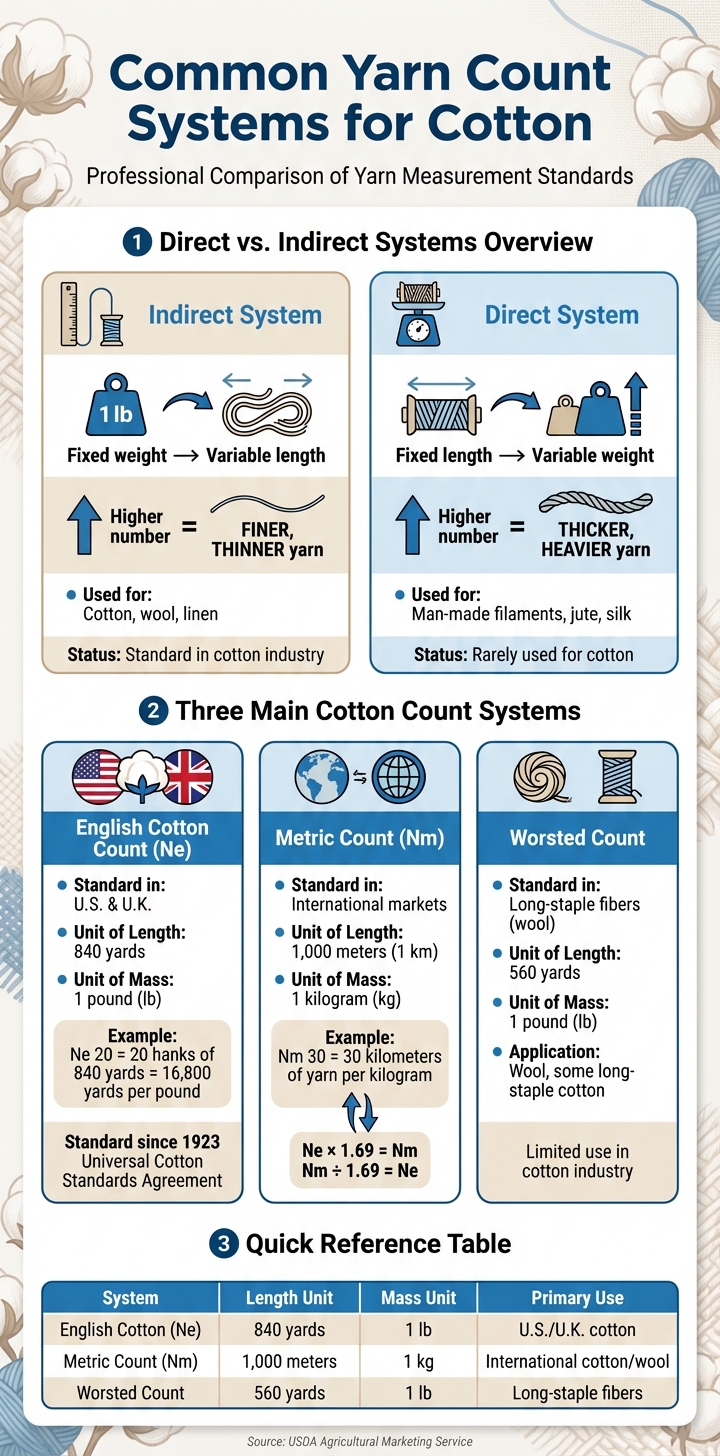
Yarn Count Systems Comparison: English Cotton Count vs Metric Count vs Direct Systems
In the cotton industry, three main yarn count systems are widely used, each tailored to specific units and markets. Whether you're a gin operator or a textile manufacturer, understanding these systems is key to navigating cotton processing effectively. Here's a closer look at each one.
English Cotton Count (Ne)
The English Cotton Count (Ne) is the standard measurement system in the U.S. and U.K., defining the number of 840-yard hanks in a pound of yarn. For instance, an Ne 20 yarn means 20 hanks of 840 yards each weigh one pound. In total, this equates to 16,800 yards of yarn per pound.
This system has been a cornerstone of U.S. cotton standards since the Universal Cotton Standards Agreement of 1923. The USDA's Agricultural Marketing Service oversees its production and distribution, making Ne the primary tool for evaluating cotton quality in American classing offices. Its dominance ensures consistency in domestic cotton transactions and assessments.
Metric Count (Nm)
The Metric Count (Nm) is the go-to system for international trade, measuring the number of 1,000-meter (1-kilometer) lengths of yarn per kilogram. For example, an Nm 30 yarn means 30 kilometers of yarn weigh exactly one kilogram. This system is also used in the wool and hemp spinning industries, making it versatile and essential in global markets.
To convert between Ne and Nm, multiply Ne by 1.69 to get Nm, or divide Nm by 1.69 to get Ne. This conversion is vital for international trade, ensuring accuracy and avoiding misunderstandings when U.S. cotton is sold globally.
Worsted Count
The Worsted Count system measures the number of 560-yard hanks per pound. While primarily used for longer-staple fibers like wool, it occasionally applies to specific long-staple cotton fibers or cotton-wool blends. However, most cotton operations rely on Ne or Nm for routine measurements.
| Count System | Unit of Length | Unit of Mass | Primary Application |
|---|---|---|---|
| English Cotton (Ne) | 840 Yards | 1 Pound (lb) | Standard in U.S./U.K. cotton industry |
| Metric Count (Nm) | 1,000 Meters (1 km) | 1 Kilogram (kg) | International cotton/wool markets |
| Worsted Count | 560 Yards | 1 Pound (lb) | Long-staple fibers; limited cotton use |
These systems provide the foundation for accurate and consistent decisions in cotton processing, ensuring quality and clarity across the industry.
How to Measure and Calculate Yarn Count
Measuring yarn count accurately requires careful sampling, the right tools, and precise calculations. The process begins with preparing a sample, weighing it, and applying the correct formula based on the yarn count system you’re using.
Tools for Measuring Yarn Count
To start, a wrap reel is used to prepare a 120-yard sample, commonly called a lea, for cotton measurements. Once wound, the sample is weighed using an analytical balance, which measures in grains (1 grain equals 0.0647989 grams). Another tool, the Knowles Balance, uses a hexagonal scale with counterweights for quick and efficient measurements.
For shorter yarn samples, specialized tools come in handy. The Quadrant Balance can measure samples as short as 8 or 40 yards, with a pointer indicating the yarn count directly on the scale. Similarly, the Stubb Yarn Balance, also known as a pocket balance, is a portable option. It uses a template to cut yarn to a fixed length, and the count is determined by the number of threads needed to balance the beam.
In modern setups, electronic yarn count systems like the TY361 or DigiCOUNT i9 are becoming standard. These systems feature electronic balances with an accuracy of 0.001g and capacities between 200g and 400g. They can automatically calculate counts in multiple formats (Ne, Nm, Tex, Denier) and provide statistical data such as the coefficient of variation (CV) and standard deviation (SD). Additionally, they connect to PCs for automated reporting. For instance, the TESTEX Yarn Count Tester TY361 has received a top rating of 5/5 based on four reviews.
Once the measurements are complete, these tools make it easier to apply the proper formulas and convert the data into standardized yarn counts.
Yarn Count Calculation Formulas
After measuring the weight and length of the yarn, specific formulas help calculate the yarn count.
For the English Cotton Count (Ne), the formula is simple:
Ne = (Length in yards) / (840 × Weight in pounds).
For example, if 8,400 yards of yarn weigh one pound, the count is Ne 10 (8,400 ÷ 840). When using an analytical balance that measures in grains, the formula becomes:
Ne = 1,000 / (Weight of 120 yards in grains).
For the Metric Count (Nm), the formula is:
Nm = (Length in meters) / (Weight in grams).
If you have 30,000 meters of yarn weighing 1,000 grams (1 kilogram), the count is Nm 30. To convert between Ne and Nm, multiply Ne by 1.69 or divide Nm by 1.69.
When dealing with plied yarns, the calculation changes slightly. For example, a label reading 8/2 Ne indicates two strands of 8-count yarn twisted together. This doubles the weight and halves the length per pound, resulting in an effective count of Ne 4.
Comparison of Yarn Count Systems
| System | Type | Formula | Primary Application |
|---|---|---|---|
| English Cotton (Ne) | Indirect | Ne = (Length in yards) / (840 × Weight in lbs) | Cotton, bamboo, Tencel |
| Metric Count (Nm) | Indirect | Nm = (Length in meters) / (Weight in grams) | Universal (all fiber types) |
| Worsted Count | Indirect | Worsted = (Length in yards) / (560 × Weight in lbs) | Worsted wool |
| Tex | Direct | Tex = (Weight in grams / Length in meters) × 1,000 | Synthetics, general industry |
| Denier | Direct | Denier = (Weight in grams / Length in meters) × 9,000 | Synthetic filaments, silk |
The key distinction between indirect and direct systems lies in how they interpret higher numbers. In indirect systems like Ne and Nm, a higher count means the yarn is thinner. Conversely, in direct systems such as Tex and Denier, a higher count indicates a thicker yarn. For industries requiring high efficiency, electronic systems can automate calculations and generate statistics like average count and standard deviation, saving time and effort.
sbb-itb-0e617ca
Why Yarn Count Matters in Cotton Production
Yarn count plays a key role in fabric quality, ginning efficiency, and the pricing of cotton bales. Understanding its impact helps farmers, gin operators, and buyers make smarter decisions throughout the production process.
Effect on Fabric Quality
Yarn count directly influences whether a fabric feels fine and smooth or coarse and rough. Finer fibers result in higher yarn counts, which lead to smoother, more refined fabrics. For instance, American Pima cotton, known for its extra-long fibers (ranging from 1 1/4 to 1 9/16 inches), can achieve higher yarn counts compared to Upland cotton, which has shorter fibers (7/8 to 15/16 inches).
To manage these natural fiber variations, mills increasingly use Engineered Fiber Selection (EFS) software alongside High Volume Instrument (HVI) data. This combination helps align fiber properties with specific yarn count goals, ultimately boosting fabric performance. These distinctions in fiber quality make proper ginning practices essential to preserving fiber integrity.
Effect on Ginning Operations
The ginning process is critical for maintaining the fiber characteristics that determine yarn count. During ginning, fibers are separated from seeds and plant material, but the challenge is to do so without damaging their natural length or strength.
To fine-tune the process, gins rely on HVI testing to measure key attributes like fiber length, strength, and micronaire (a measure of fineness). These insights guide adjustments in cleaning and processing to protect fiber quality. During peak harvest times, USDA classing processes large volumes of cotton, while the Permanent Bale Identification (PBI) system ensures fiber quality can be tracked from the field through every stage of production. How well this process is managed can significantly affect market pricing.
Effect on Market Value and Pricing
Yarn count is a major factor in determining the price buyers are willing to pay for cotton. Higher yarn counts signal better fiber quality, which commands premium prices. This is particularly evident with American Pima cotton, which is priced higher than standard Upland cotton due to its superior spinning potential.
"Providing cotton quality results quickly gives producers and buyers access to crucial information at the time of sale." - Cotton Incorporated
USDA classification data is central to pricing, as it measures critical fiber properties like length, strength, and micronaire. Producers use this data to secure price support, while buyers calculate costs based on the expected yarn yield per pound.
| Cotton Type | Fiber Length | Yarn Count Potential | Market Position |
|---|---|---|---|
| American Upland | 7/8 to 15/16 inches | Standard counts | 95% of U.S. production; used in general textiles |
| American Pima | 1 1/4 to 1 9/16 inches | High counts | Premium pricing; used in luxury fabrics |
With over 100 million individual fibers in a single pound of cotton, even small differences in fiber quality can lead to noticeable variations in yarn count - and, by extension, market value. Accurate classification and measurement are essential to maximizing returns across the cotton supply chain.
How Cotton Farmers and Gin Operators Use Yarn Count
Yarn count plays a pivotal role in the day-to-day decisions of cotton farmers and gin operators, influencing everything from fiber selection to bale pricing. By aligning fiber properties with specific yarn count needs, producers can enhance both the quality of their output and their profitability. Let’s dive into how fiber selection, industry standards, and bale valuation are shaped by yarn count strategies.
Selecting Fibers for Specific Uses
Cotton farmers and gin operators carefully assess staple length and micronaire to match fibers with the desired yarn count and end-use textile applications. For instance:
- Long-staple fibers (30–40 mm) are ideal for creating fine, high-quality yarns used in luxury fabrics and hosiery.
- Medium-staple fibers (25–33 mm) dominate global production, making up about 90%, and are commonly used for general apparel and home furnishings.
- Short-staple fibers (10–25 mm) tend to be coarser and harder to process, making them suitable for lower-grade or industrial applications.
Farmers aiming for optimal yarn count in American Upland cotton typically target a micronaire range of 3.8 to 4.2. Ginning methods are then tailored to preserve fiber quality: roller ginning is preferred for long-staple cotton, while saw ginning is used for standard Upland cotton. Once fibers are selected, the next step is ensuring they meet established benchmarks for quality.
Meeting Industry Standards
To ensure cotton meets Universal Cotton Standards, producers rely on the USDA AMS classification system. Each bale undergoes High Volume Instrument (HVI) testing, which measures key fiber properties like micronaire, length, strength, and uniformity - factors that directly influence yarn count potential.
The Permanent Bale Identification (PBI) system links these classification results to individual bales. This allows buyers and textile mills to confirm that the fiber profiles align with their specific yarn count needs. For specialized applications, operators can also request "Spinning Potentials" tests, which cost $110.00 per test, to determine the finest yarn count a cotton lot can achieve without breakage.
Determining Bale Value
Yarn count data significantly impacts how cotton bales are valued financially. Gin operators use fiber classification results - particularly staple length and micronaire - to position their cotton competitively and secure the best prices for growers. This data is also essential for growers participating in the USDA price support program.
Even bale bagging must adhere to yarn count standards. For instance, bagging specifications require at least 120 warp and 78 weft yarns per 12 inches at a weight of 7.7 oz/yd². These standards ensure the bale is adequately protected without compromising the cotton's quality or market value. With each pound of cotton containing over 100 million individual fibers, maintaining strict quality controls throughout the ginning process is crucial for achieving premium prices at sale.
Conclusion: What You Need to Know About Yarn Count
Yarn count plays a crucial role in both quality control and pricing within the cotton industry. To make smart production decisions, it's essential to understand the English Cotton Count (Ne) system, which measures fineness based on the number of 840-yard hanks per pound. This knowledge connects production standards with market outcomes.
Every stage of production is influenced by yarn count. Finer fibers create stronger yarns, which impact fabric properties like weight, thickness, strength, and air permeability. For gin operators, adhering to proper yarn count standards ensures efficient processing, as fiber fineness affects spinning speeds and equipment settings.
Accurate yarn count data is key to staying competitive in the market. Tools like the USDA's High Volume Instrument (HVI) testing provide precise fiber measurements that buyers and manufacturers rely on to make informed decisions. With over 100 million fibers in a single pound of cotton, precise yarn count measurements help differentiate high-quality cotton from lower-grade options.
Yarn count is closely tied to pricing and market potential. By aligning staple length, micronaire, and yarn count, as outlined, you can ensure superior quality, streamline operations, and secure premium pricing in the competitive global cotton market.
FAQs
What is yarn count, and how does it impact the quality and feel of cotton fabrics?
Yarn count measures the thickness of yarn and is crucial in defining the quality and texture of cotton fabrics. In the English numbering system, yarn count refers to the number of yards of yarn that weigh one pound. Simply put, the higher the yarn count, the finer and thinner the yarn; the lower the count, the thicker and coarser it is.
Finer yarns with higher counts produce fabrics that are lightweight, soft, and smooth - perfect for breathable, luxurious clothing. On the flip side, thicker yarns with lower counts create heavier, sturdier fabrics with a textured finish, making them ideal for items like denim or upholstery. Choosing the right yarn count allows manufacturers to craft fabrics tailored to specific uses and market preferences.
What are the most common tools used to measure yarn count accurately in the cotton industry?
Accurately measuring yarn count often relies on precision electronic balances equipped with software designed to calculate counts in systems like Tex, Ne, or Nm. These tools make it easy to weigh a specific length of yarn and quickly determine its count.
Commonly used instruments include yarn count testers with highly accurate scales (e.g., ±0.001 g) and built-in calculators for quick results. Such devices are essential for cotton farmers, gin operators, and textile manufacturers who need consistent quality and precise measurements. Some advanced models even come with touch-screen displays and additional features, like the ability to measure fabric mass, meeting more specialized needs. These tools are essential for upholding industry standards and addressing market expectations.
Why is yarn count important for cotton pricing and product quality?
Yarn count is a key factor in determining both the quality and market value of cotton products. Essentially, it measures how fine or thick a yarn is. Higher yarn counts mean finer, lighter yarns, while lower counts correspond to thicker, heavier yarns. These differences significantly impact fabric characteristics like softness, breathability, and drape - qualities that directly shape customer preferences and influence pricing.
Since cotton fiber accounts for roughly 70% of a yarn's total cost, changes in yarn count have a direct effect on how much raw cotton is needed and the overall production expenses. Finer yarns are typically more expensive because they’re used to create high-end, premium fabrics. On the other hand, coarser yarns cost less but are associated with lower-quality products. For cotton farmers, gin operators, and textile manufacturers, a solid grasp of yarn count is essential for accurate pricing, smarter contract negotiations, and meeting market expectations.