If I had to sum up 2026 in one line, it would be this: cotton policy can help with cash flow, but it does not fix weak cotton prices.
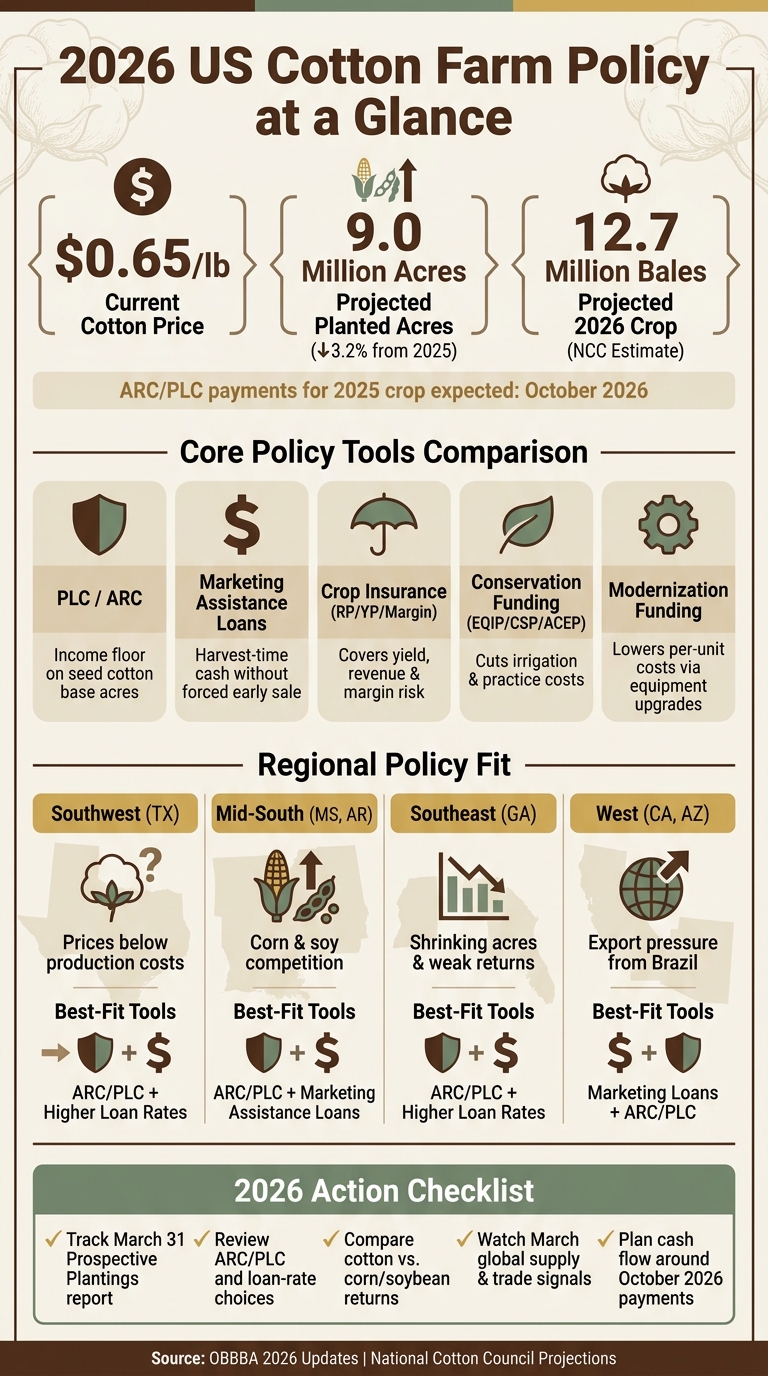
Right now, I see three numbers driving most 2026 decisions: cotton near $0.65 per pound, planted acres at 9.0 million, and ARC/PLC payments for the 2025 crop expected in October 2026. That means I’d look at my support programs, insurance, and cost-cutting plans together, not one at a time.
Here’s the short version:
- PLC and ARC help set an income floor on seed cotton base acres
- Marketing Assistance Loans can give me harvest-time cash without forcing an early sale
- Crop insurance covers yield, revenue, and margin risk that farm programs do not
- EQIP, CSP, ACEP, and state water programs may help cut farm spending on irrigation and practice changes
- Gin and farm upgrade funding may help lower per-unit costs when acres are down
- Region matters because Texas, the Mid-South, the Southeast, and the West are each facing different return pressure
The big takeaway: if prices stay in the mid-60s to low-70s cents per pound, I’d plan around support timing, compare cotton against corn and soybeans, and be careful with capital spending.
2026 US Cotton Farm Policy: Key Programs, Numbers & Regional Fit
2026 Cotton Market Outlook & Farm Program Update
sbb-itb-0e617ca
Quick Comparison
| Area | What I’d use it for in 2026 | Main point |
|---|---|---|
| PLC / ARC | Income support | Helps when prices or county revenue are weak |
| Marketing Assistance Loans | Short-term cash flow | Lets me delay sales in a weak market |
| Crop insurance | Yield, revenue, or margin risk | Covers losses farm programs do not |
| Conservation funding | Irrigation and practice costs | May lower out-of-pocket spending |
| Modernization funding | Farm and gin equipment upgrades | May lower unit costs over time |
If I were planning now, I’d treat 2026 as a year to protect cash, check every support option on file, and make planting choices with local returns in mind.
Seed Cotton Support Programs: How Subsidies and Loan Tools Affect 2026 Farm Income
For 2026, seed cotton support tools matter because they shape cash flow, downside protection, and marketing timing. The big issue is simple: when does the money show up, and what kind of risk does each tool help cover?
PLC and ARC Rules for Seed Cotton in the 2026 Crop Year
PLC works better as a price-floor tool when prices stay weak. ARC tends to fit counties with bigger yield or revenue swings. Since both programs are tied to base acres and program yields on file with FSA, growers should check those FSA base-acre and program-yield records before payments are figured.
Payments tied to the 2025 crop year are set to arrive in October 2026. That timing can help with high input costs, debt payments, and even early purchases for the 2027 crop. The OBBBA also updated reference prices and loan rates for 2026, so it makes sense to review the PLC-versus-ARC choice with projected prices around $0.65 to $0.72 per pound.
That kind of price support does more when it’s paired with cash at harvest.
Marketing Assistance Loans and Cotton Competitiveness Provisions
Marketing Assistance Loans (MALs) are the short-term cash tool that works alongside PLC and ARC, which serve more as income-floor programs. With a MAL, a grower can borrow against harvested cotton at the loan rate instead of selling into weak harvest-time prices. That can make storage and later sales easier to manage. For 2026, the OBBBA increased loan rates, which gives MALs more weight as a cash-flow tool.
PLC vs. ARC vs. Marketing Assistance Loans: Side-by-Side Comparison
| Program | Primary Function in 2026 | Impact on Decisions |
|---|---|---|
| PLC | Price-floor protection when market prices fall below reference levels | Supports long-term farm income when prices stay low |
| ARC (County) | Revenue protection at the county level | Best for areas with more yield or revenue swings |
| Marketing Assistance Loans | Short-term liquidity and downside price protection | Can make storage and delayed marketing more workable |
PLC, ARC, and MALs help protect income and cash flow. Crop insurance fills a different role by covering the yield and revenue risk those programs do not.
Crop Insurance in 2026: Revenue, Yield, and Margin Protection for Cotton
After income-support tools, crop insurance is the next line of defense. It covers yield, revenue, and margin risk that subsidy programs don't. ARC/PLC and marketing loans can help with cash flow, but in 2026, high input costs and interest rates still put pressure on margins.
Main Cotton Insurance Options and Where They Fit
The main cotton insurance options are RP, YP, SCO, STAX, and margin coverage. RP and YP are the base policies. SCO and STAX add area-level protection. And in 2026, margin coverage stands out more than usual.
The best fit depends on the risk your farm can't carry on its own. Is the bigger threat a weather loss? A drop in price? Or input costs that stay stubbornly high? That's why this isn't just a risk call. It's also a cost call.
Margin Coverage Option: Why Protecting Operating Costs Matters
Margin coverage protects net income, not just yield. That matters in 2026 because cotton prices are sitting below many farms' operating costs.
At that point, the issue isn't yield by itself. It's whether the policy helps protect profit.
Traditional Cotton Insurance vs. Margin-Based Coverage: Side-by-Side Comparison
| Feature | Revenue Protection / Yield Protection | Margin-Based Coverage |
|---|---|---|
| Main focus | Yield risk and, with RP, price risk | Operating margin and the cost-price squeeze |
| Best use case | Weather losses or price declines | Tight margins when input costs stay high |
| What it helps protect | Crop revenue | Profitability when costs and prices move against the farm |
| Role in 2026 planning | Core coverage for many acres | Better when costs stay high |
The choice comes down to one thing: which risk can the farm least afford to absorb - weather, price, or operating cost. Once insurance is in place, the next step is looking at whether conservation and modernization funding can cut risk and lower the farm's cost base.
Conservation and Modernization Funding: Water Efficiency, Precision Ag, and Gin Upgrades
With income and insurance tools covered, the next lever is cutting per-acre costs and getting more out of every acre.
EQIP, CSP, ACEP, and Climate-Smart Incentives for Cotton Acres
EQIP, CSP, ACEP, and climate-smart programs each cover a different part of the job. The simplest way to compare them is by what they pay for: cost-share, stewardship, land protection, or irrigation efficiency.
EQIP is often the go-to option for on-farm practice changes. CSP tends to fit operations that already have stewardship systems in place and want support to keep them going. ACEP is focused on land protection through easements. State, regional, and climate-smart programs can be a better match when the main goal is water use, drought response, or irrigation upgrades.
Used together where allowed, these programs can cut out-of-pocket spending on conservation work that also helps a farm stay competitive.
Modernization Funding for Farms and Gins
Modernization funding matters even more when planted acreage is down. When there are fewer acres to spread costs across, every efficiency gain counts.
For farms and gins, the point is pretty simple: better efficiency can lower unit costs when margins are thin. The main investment targets usually include:
- precision ag equipment
- variable-rate irrigation controls
- field automation
- energy-saving systems
- gin upgrades such as automation, better throughput, and energy-efficiency improvements
Grants and tax-credit programs tied to these upgrades can cut upfront capital needs and shorten payback periods. That can make a big difference for operations dealing with water limits, labor costs, or gin bottlenecks that are already eating into margins.
Conservation Programs and Innovation Funding: Side-by-Side Comparisons
Table 1: Conservation Programs Compared
| Program | Best Use in 2026 |
|---|---|
| EQIP | Cost-share for on-farm conservation practices |
| CSP | Support for existing stewardship systems |
| ACEP | Land protection through easements |
| State or regional water programs | Local irrigation and drought support |
Table 2: Modernization and Innovation Funding Compared
| Funding Type | Main Use | Business Effect |
|---|---|---|
| Modernization incentives | Equipment and facility upgrades | Higher gin throughput, lower unit costs |
| Conservation funding | Conservation planning and practice changes | Improved water efficiency |
| Grants/tax incentives | Precision ag, irrigation, and gin upgrades | Lower upfront cost on targeted investments |
| State or regional water programs | Local resource improvements | More tailored support for area-specific needs |
The best fit comes down to region, water supply, and the kind of operation involved.
Regional Impacts and 2026 Action Steps for Cotton Producers and Gins
How Policy Effects Differ Across the Cotton Belt
Once farms and gins line up support, insurance, and investment tools, region becomes the deciding factor. The same program can help one operation and do far less for another. It all comes down to local crop economics and the crops cotton is competing with acre by acre.
When cotton returns stay weak, acres tend to move to corn, soybeans, or other options.
In Texas, prices below production costs are pushing acreage down, which makes ARC/PLC and higher loan rates the main sources of cash support. In the Mid-South, especially Mississippi and Arkansas, the pull away from cotton is even stronger because corn and soybeans are posting better returns. In the Southeast, including Georgia, the OBBBA safety net can help ease cash-flow pressure as planted acres fall. In California and Arizona, Brazil’s lower-cost cotton is putting pressure on export pricing.
That means farms in each part of the Cotton Belt may need a different policy mix, not the same playbook.
Best-Fit Policy Bundles by Farm Profile or Region
The table below connects those regional pressures to the policy tools that may fit best in 2026.
| Farm or Region | Main Challenge | Best-Fit Policy Tools | Likely 2026 Benefit |
|---|---|---|---|
| Southwest (TX) | Prices below production costs | ARC/PLC + higher loan rates | Income support in a low-price market |
| Mid-South (MS, AR) | Better returns from corn and soybeans | ARC/PLC + marketing assistance loans | Cash flow while comparing crop returns |
| Southeast (GA) | Shrinking acres and weak returns | ARC/PLC + higher loan rates | Short-term cash support |
| West (CA, AZ) | Export pressure from lower-cost competition | Marketing assistance loans + ARC/PLC | Liquidity support in a more competitive market |
Conclusion: Key 2026 Policy Changes and What to Do Next
Region and market outlook should shape 2026 acreage, marketing, and cash-flow plans. No single 2026 program fixes cotton’s margin squeeze. U.S. growers are projected to plant 9.0 million acres of cotton in 2026, down 3.2% from 2025, and the National Cotton Council projects a 12.7 million-bale crop. If that supply outlook holds and demand stays steady, prices may remain in the mid-60s to low-70s cents per pound.
Before planting plans are locked in, producers and gins should focus on a short list of decision points:
- Track the March 31 Prospective Plantings report
- Review ARC/PLC and loan-rate choices
- Compare cotton returns with corn and soybeans before planting
- Watch March global supply and trade signals
- Plan cash flow around expected October 2026 payments
Those signals should guide program elections, acreage choices, and capital planning while there’s still time to adjust.
FAQs
Which is better for my farm: PLC or ARC?
It depends on your farm’s risk profile and local conditions.
PLC is usually the better fit if you want protection against long stretches of low national market prices. It’s built to help when prices stay down for a while.
ARC often makes more sense if your farm deals with yield swings. That’s because it covers revenue shortfalls linked to both price changes and yield changes.
If you want to compare the two side by side, university-provided online decision tools can help you run the numbers for your own operation.
Can I use crop insurance with ARC, PLC, or marketing loans?
Yes. Standard crop insurance, including Revenue Protection and Yield Protection, can be used with ARC, PLC, and marketing loans.
The rules change with supplemental coverage:
- Farms enrolled in PLC can buy SCO
- Farms enrolled in ARC cannot buy SCO
- Upland cotton producers with seed cotton base acres in ARC or PLC cannot use STAX on those acres
- SCO and STAX can't be used on the same acreage
What should I review before making 2026 cotton planting decisions?
Before you lock in your 2026 cotton planting plans, take a close look at a few items that can change the numbers in a big way.
- PLC vs. ARC enrollment, plus any carryover tied to missed deadlines
- Your crop insurance plan, including APH and choices like Revenue Protection, SCO, or STAX
- County-level yield and revenue data with your local FSA office and insurance agent
- Gin capacity, local basis, and any FSA paperwork you’ll need