Twist insertion is what transforms loose cotton fibers into strong, usable yarn through rotation. This process binds fibers together, directly impacting yarn's strength, flexibility, and durability. Key metrics like Turns Per Inch (TPI) and Twist Multiplier (TM) help optimize twist levels for maximum performance.
Here’s what you need to know:
- Twist increases strength: Higher twist levels improve fiber cohesion and tensile strength.
- Over-twisting weakens yarn: Excessive twist can damage fibers, reduce elasticity, and create defects like snarling and cracking.
- Balance is key: Weaving yarns need higher twist for durability, while knitting yarns benefit from lower twist for softness and stretch.
- Practical tips for manufacturers: Monitor twist settings closely to align with fabric goals, whether for strength, comfort, or moisture-wicking.
Twist levels significantly impact yarn quality and performance, and fine-tuning these parameters ensures better results for various textile applications.
Yarn Manufacturing: Twist and Ply
sbb-itb-0e617ca
How Twist Levels Affect Yarn Strength and Performance
Cotton Yarn Twist Levels: Impact on Strength, Elasticity, and Performance Metrics
The twist level in cotton yarn plays a crucial role in determining how the fibers perform under stress. Manufacturers rely on this relationship to fine-tune twist parameters for their products. Let’s explore how varying twist levels influence the strength and other performance characteristics of cotton yarn.
Tensile Strength and Fiber Cohesion
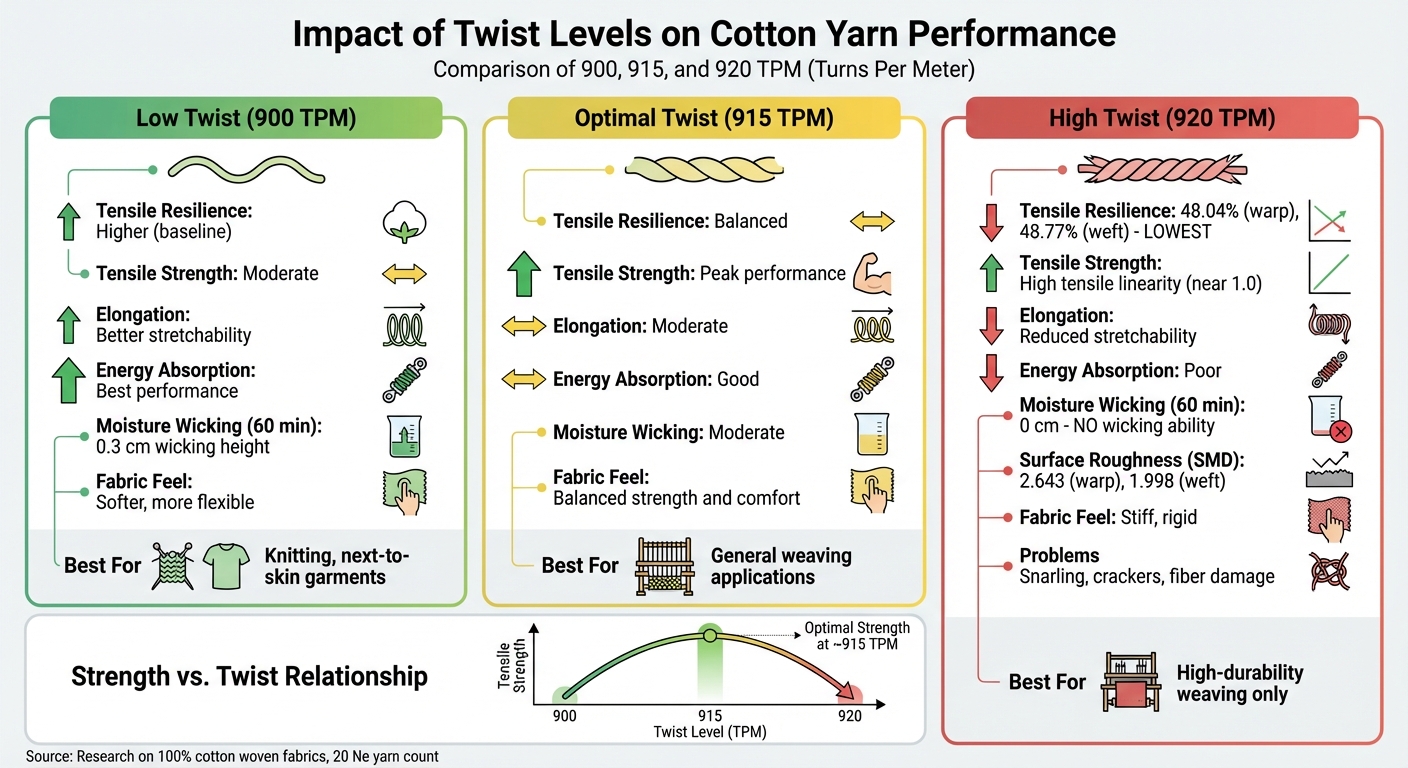
Increasing the twist in yarn tightly packs the fibers together, improving cohesion and resulting in greater tensile strength. For example, research on 100% cotton woven fabrics showed that raising the weft yarn twist from 900 to 920 TPM significantly enhanced tensile linearity, nearing a value of 1. However, this improvement in strength comes at a cost. Fabrics with 920 TPM twists exhibited the lowest tensile resilience - 48.04% in the warp direction and 48.77% in the weft direction - indicating a reduced ability to bounce back after stretching.
Effects on Elongation and Elasticity
Twist levels also impact how much yarn can stretch and its elasticity. There’s a trade-off here: as twist increases, fibers are packed more tightly, leaving less room for movement. This reduces both elongation and the fabric's ability to absorb energy. Fabrics made from yarns with lower twist levels, such as 900 TPM, have better energy absorption and stretchability. On the other hand, higher twist yarns create firmer fabrics with greater bending and shear rigidity, which can negatively affect drape and comfort. Striking the right balance in twist calibration is essential to meet the specific demands of different textile applications. This ensures that the yarn’s strength, elasticity, and other attributes align with its intended use.
Optimal Twist Levels for Cotton Yarn
Recommended Twist Multiplier for Strength and Durability
The strength and durability of cotton yarn depend heavily on achieving the right twist, which is calculated using the Twist Multiplier (TM). This metric helps manufacturers determine the ideal twist level that enhances yarn strength without over-twisting. Factors like fiber fineness and length play a significant role in calculating the TM. Industry charts provide guidelines to match these fiber properties with the twist required for maximum tensile strength. For instance, finer fibers often need adjustments to their twist settings. During the roving stage, specific formulas - based on drafting force and fiber cohesion - help establish the twist necessary to maintain structural integrity. These calculations align with established industry standards to ensure consistent quality across production lines.
Industry Standards for Cotton Yarn Counts
When it comes to different yarn counts, standardized systems help define the appropriate twist levels. One such system, the Universal Percent Twist System, has long been a reference point. It evaluates factors like drafting force to determine accurate twist parameters. However, physical irregularities in the yarn can lead to uneven twist distribution, creating weak spots or inconsistencies that may affect the final product. By addressing these variations during the spinning process, manufacturers can minimize defects and produce yarn with more uniform quality.
Problems with Over-Twisting Cotton Yarn
While finding the right twist level can enhance performance, going too far with twisting creates serious issues.
Strength Loss and Fiber Damage
Adding twist to cotton yarn can initially improve its strength, but pushing beyond the ideal point introduces significant problems. Over-twisting leads to snarling - those frustrating tangled kinks that make yarn more prone to breaking - and creates "crackers", which are spring-like shapes that form due to excessive fiber stress. These issues weaken the yarn's breaking strength because the internal stresses damage the fibers themselves. The signs? Manufacturers often notice more end breaks, uneven fabric surfaces, and inconsistent dye shades. All of this reduces elasticity and compromises the yarn's overall performance.
Trade-Offs Between Twist and Elasticity
Excessive twisting doesn’t just harm the fibers - it also takes a toll on elasticity. Studies on 100% cotton woven fabrics show that higher twist levels significantly limit the yarn's ability to stretch and recover. For example, fabrics twisted to 920 TPM (turns per meter) exhibited poor tensile resilience - just 48.04% in the warp and 48.77% in the weft - and completely lost their ability to wick moisture. The result? Stiff, uncomfortable fabrics.
This over-twisting also reduces tensile energy, which directly affects how soft and flexible the fabric feels. Stiffness increases, recovery from deformation worsens, and moisture-wicking capabilities disappear. Surface quality takes a hit too, with roughness levels (measured as SMD) rising to 2.643 in the warp and 1.998 in the weft for 920 TPM samples. To strike a balance between structural strength and elasticity, maintaining the right twist level is absolutely essential.
Practical Applications and Recommendations
Choosing Twist Levels for Weaving and Knitting
The role of twist in yarn properties directly influences its practical applications, making precise twist control essential. The twist level you choose should align with how the yarn will be used. For weaving, higher twist levels - around 915–920 TPM for 20 Ne cotton - are ideal because they provide the strength needed to endure loom tension and create sturdy fabrics. On the other hand, knitting and next-to-skin garments benefit from lower twist levels, approximately 900 TPM, which enhance softness and stretchability.
A study conducted in April 2019, using 100% cotton fabrics from Bahir Dar Textile Share Company, revealed how twist levels impact comfort. Increasing the twist from 900 TPM to 920 TPM reduced the 60-minute wicking height from 0.3 cm to 0 cm. This demonstrates how even slight adjustments in twist levels can significantly affect moisture management and overall comfort. For manufacturers, fine-tuning these levels is key to balancing durability and comfort across different textile applications.
Balancing Strength and Performance
Striking a balance between durability and comfort starts with understanding your end goals. For performance apparel, higher twist levels create a more porous structure, which improves breathability. However, lower twist settings maintain larger capillary spaces, enabling better moisture-wicking properties. While higher TPM values enhance strength, they can also affect the fabric's resilience and surface texture.
Producers must carefully monitor TPM settings on ring spinning frames, as even minor deviations can lead to inconsistencies in fabric feel and performance. By aligning twist parameters with specific textile objectives, manufacturers can avoid costly errors caused by over- or under-twisting. This precision ensures the fabric meets both functional and aesthetic expectations.
Conclusion
Finding the ideal twist level is all about striking a balance - enough to enhance fiber cohesion and maximize yarn strength, but not so much that it leads to over-twisting and fiber damage. The relationship between twist and yarn tenacity forms a parabolic curve: strength improves as twist increases, peaks at an optimal point, and then drops off when excessive twist weakens the fibers due to the obliquity effect. This balance is key to producing cotton yarn that meets durability and performance standards.
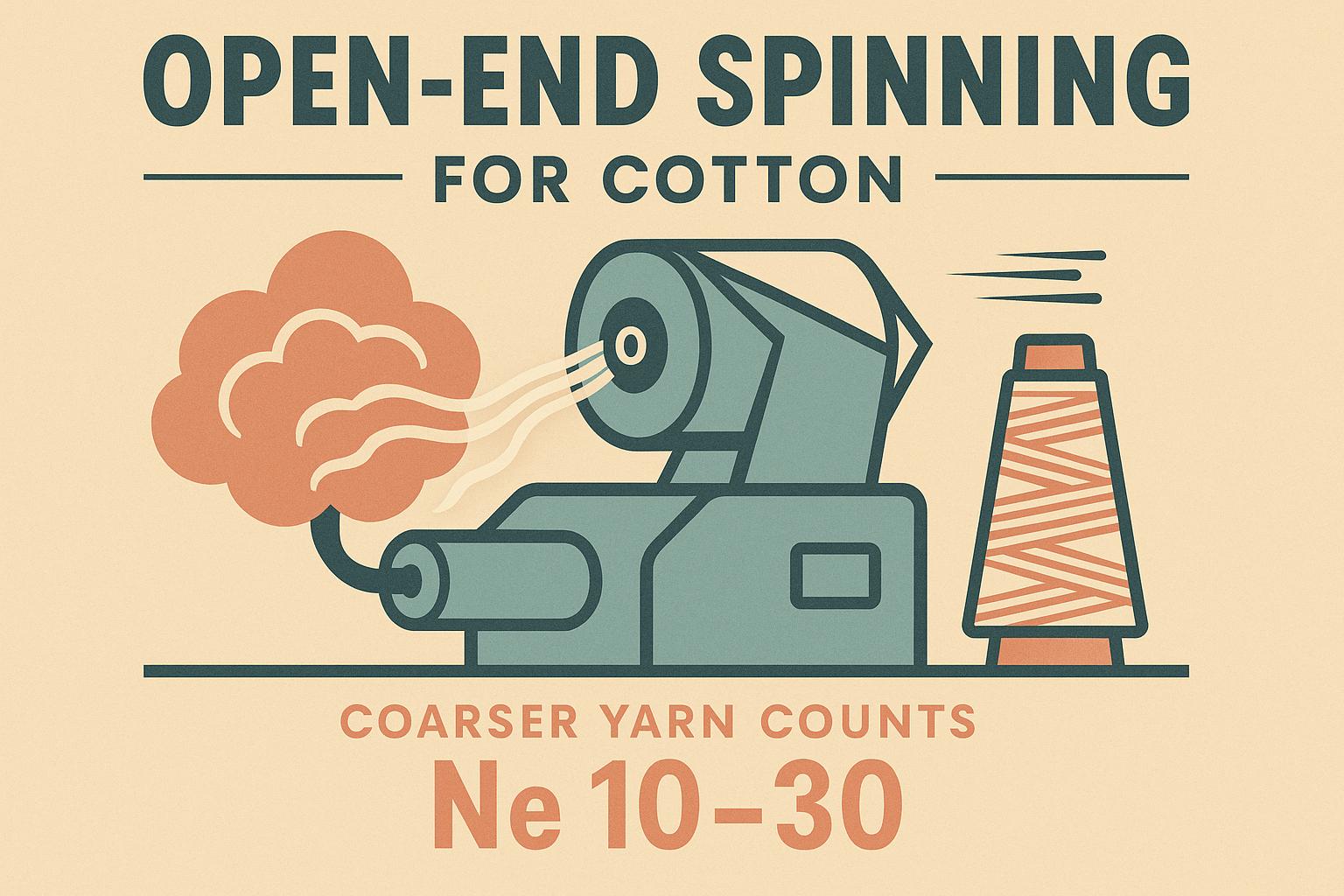
Spinning technology significantly influences yarn quality. For instance, aerodynamic compact spinning systems deliver cotton yarns with much higher tenacity - 18.52 cN/tex for 30 Ne yarn - compared to the 12.85 cN/tex achieved through open-end rotor spinning. Compact spinning excels because it integrates fibers more effectively, achieving superior strength with lower twist levels. In contrast, rotor spinning relies on higher twist multipliers to counter its structural limitations.
For cotton gin operators, the message is straightforward: fiber quality directly affects twist efficiency. Maintaining fiber length and reducing short fiber content during ginning enables manufacturers to achieve the desired strength with less twist. This results in softer yarns and faster production speeds. Textile manufacturers, on the other hand, must consistently track metrics like tenacity, elongation at break, hairiness, and mass variation (CVm) to ensure that twist parameters align with their specific needs.
The choice of twist levels also depends on the intended application. Weaving requires higher twist levels to endure the tension and abrasion of the loom, while knitting benefits from lower twist levels for improved softness and stretch. By aligning spinning systems and twist parameters with production goals, manufacturers can avoid costly errors like under- or over-twisting, all while enhancing yarn quality and optimizing efficiency.
FAQs
How do I find the best twist for my yarn count?
To find the ideal twist for your yarn count, you need to strike a balance between durability and overall quality. A helpful tool for this is the twist multiplier, which connects the number of turns per inch to the yarn's diameter. By adjusting and experimenting with various twist factors, you can observe how they impact both the yarn's strength and its diameter. Using testing methods - like measuring breaking strength or analyzing twist angles - can provide valuable insights to help you pinpoint the perfect twist for your yarn.
What shop-floor signs indicate yarn is over-twisted?
Signs of over-twisted yarn on the shop floor can manifest in a few noticeable ways. You might see increased irregularity in the yarn, a greater chance of breakage, and a twist angle that looks visibly excessive. These issues are often detectable through a close visual inspection of the yarn's appearance and its twist pattern.
How does fiber quality change the twist needed for strength?
Fiber quality plays a crucial role in determining the amount of twist needed for yarn to achieve optimal strength. High-quality fibers - those that are longer, cleaner, and more uniform - naturally possess strong properties, so they require less twist. On the other hand, lower-quality fibers - which tend to be shorter and more irregular - need additional twist to enhance their durability.
Finding the right balance is essential. If the twist is too loose, the yarn becomes weak. But if it’s over-twisted, the fibers experience unnecessary stress, which can also compromise strength. Adjusting the twist to match the fiber quality is the key to achieving better performance in the final product.