The traveller, a small C-shaped component in ring spinning, plays a critical role in cotton yarn production. It twists fibers into yarn, winds it onto the bobbin, and maintains tension - all while enduring extreme forces and temperatures. Choosing the right traveller weight, material, and surface finish directly affects yarn quality, including strength, uniformity, and hairiness. Regular maintenance, proper alignment, and attention to environmental conditions like humidity and heat are key to optimizing performance. For high-speed or delicate yarns, specialized travellers with coatings like chromium or ceramic offer better durability and smoother operation. Understanding these factors can improve efficiency and reduce breakage during production.
How Travelers Work in Ring Spinning
How the Traveler Moves Around the Ring
The traveler doesn’t have its own power source. Instead, it’s pulled along the ring’s track by the yarn itself. Each time the traveler completes a full revolution, one turn of twist is added to the fiber strand.
R. Senthil Kumar from the Indian Textile Journal explains it like this:
In ring spinning, the energy to drive the twisting mechanism is derived from the bobbin, but the level of twist is controlled by the traveller.
The traveler’s weight plays a big role in managing yarn tension. A heavier traveler increases tension, which helps stabilize the yarn balloon and ensures surface fibers are tightly bound. However, this added weight also means the traveler experiences intense contact pressure against the ring - sometimes as high as 35 N/mm². This pressure creates friction, which can generate heat ranging from 300°C (572°F) to 500°C (932°F).
This movement and interaction highlight the traveler’s essential role in the spinning process, working in harmony with other components.
How the Traveler Works with Other Components
The traveler’s motion is not just about twisting fibers - it’s also about working in sync with the spindle, ring, and bobbin to ensure yarn quality and production efficiency.
The traveler acts as the link between these components. While the bobbin rotates at the same speed as the spindle, the traveler moves slightly slower due to friction with the ring. This speed difference allows the yarn to wind onto the bobbin. As Dipak Baraiya from Maharaja Saiyajirao University points out:
Length wound up on the bobbin corresponds to the difference in peripheral speeds of the spindle and traveller.
The ring plays its part by guiding the traveler while enduring significant contact pressure. To avoid wear and tear, the ring’s surface is made harder than the traveler, which is designed to be replaceable. Meanwhile, the bobbin gathers the twisted yarn as the traveler maintains control over the winding rate and yarn tension.
This intricate coordination happens at incredible speeds. Standard travelers operate at 22 m/sec (70 ft/sec), while high-speed travelers can reach up to 35 m/sec (120 ft/sec). Pushing beyond these speeds risks causing thermal damage or even micro-welding between the traveler and the ring, potentially halting production.
sbb-itb-0e617ca
Traveller Properties That Affect Yarn Quality
Material and Surface Finish
The material and surface finish of a traveller play a key role in yarn quality and equipment durability. Steel is the standard choice for cotton spinning, but it has limitations, particularly at high speeds where it can suffer thermal damage. On the other hand, high-purity ceramic travellers offer better resistance to wear and heat, making them ideal for high-speed operations. These ceramic options are also lighter, which reduces friction and enables smoother performance at higher speeds.
Surface treatments like chromium or diamond coatings add another layer of performance by lowering friction and helping dissipate heat. This prevents micro-welding between the ring and traveller, a common issue that can disrupt production. As noted by Dilek Çukul from Anadolu University:
The results revealed that the surface treatment of the travellers had a significant effect on the hairiness of the yarn.
Another important consideration is the hardness balance between the traveller and the ring. The traveller should always be softer than the ring to ensure it wears out first, as replacing a traveller is far less costly than replacing the ring.
These factors - material selection, surface treatment, and hardness - directly influence yarn characteristics like uniformity and hairiness, which are explored further below.
Effects on Yarn Uniformity and Hairiness
Traveller weight, combined with material and surface finish, is crucial for controlling yarn uniformity and hairiness. Heavier travellers increase yarn tension, which improves fiber binding and overall strength. For instance, a study conducted at Almeda Textile Factory in July 2023 found that using a 35 mg traveller resulted in a yarn strength of 19.7 cN/Tex and an unevenness of 12.9%.
However, heavier is not always better. While increased weight can reduce thin spots and improve strength in coarser yarns, it may also increase hairiness in finer yarn counts, such as 80 Ne cotton. This makes it essential to match the traveller weight to the specific yarn count and fiber type.
Surface finish also plays a major role in maintaining consistent yarn tension. A smooth, coated traveller ensures even contact, while worn surfaces can lead to uneven yarn. For example, chromium-coated travellers are particularly effective at reducing yarn hairiness because they maintain a smooth contact surface even under the high stresses of fast spinning.
Rings & Ring Travellers ( Part - 1 )
Choosing the Right Traveller for Your Spinning Setup
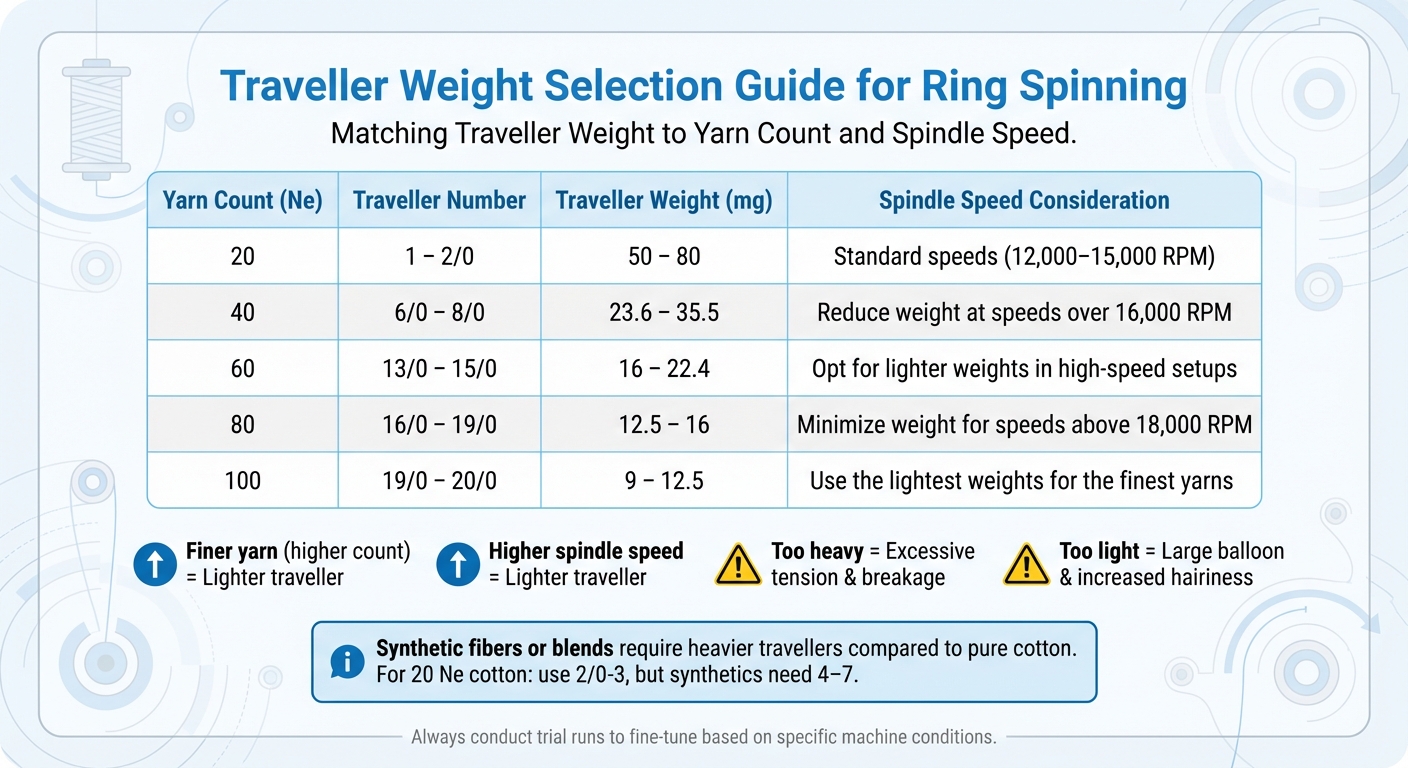
Ring Spinning Traveller Weight Guide by Yarn Count and Spindle Speed
When it comes to spinning, selecting the right traveller is just as important as understanding its mechanics and materials. The key lies in balancing weight and adapting to the conditions in which you're working.
Matching Traveller Weight to Spindle Speed
The weight of your traveller plays a crucial role in maintaining the right tension during spinning. Here's the general rule: as yarn count increases (finer yarn), the traveller weight should decrease. Similarly, higher spindle speeds call for lighter travellers to offset the increased centrifugal force.
Why does this matter? A traveller that's too heavy creates excessive tension, leading to more yarn breakage. On the other hand, a traveller that's too light allows an oversized yarn balloon to form, which can also result in breakage and increased hairiness. Friction is another factor - because it increases with the cube of spindle RPM, even small speed adjustments can significantly impact heat generation and performance.
Here’s a quick guide to help you match the traveller weight with yarn count and spindle speed:
| Yarn Count (Ne) | Traveller Number (Indirect System) | Traveller Weight (mg) | Spindle Speed Consideration |
|---|---|---|---|
| 20 | 1 – 2/0 | 50 – 80 | Standard speeds (12,000–15,000 RPM) |
| 40 | 6/0 – 8/0 | 23.6 – 35.5 | Reduce weight at speeds over 16,000 RPM |
| 60 | 13/0 – 15/0 | 16 – 22.4 | Opt for lighter weights in high-speed setups |
| 80 | 16/0 – 19/0 | 12.5 – 16 | Minimize weight for speeds above 18,000 RPM |
| 100 | 19/0 – 20/0 | 9 – 12.5 | Use the lightest weights for the finest yarns |
Trial runs are essential to fine-tune these adjustments based on your machine’s specific conditions, like ring diameter and bobbin lift. If you're working with synthetic fibers or blends, you’ll likely need heavier travellers compared to those used for pure cotton. For instance, while a 20 Ne cotton yarn might use traveller numbers between 2/0 and 3, synthetics can require numbers ranging from 4 to 7.
Once you’ve nailed down the right weight, it’s time to consider how environmental factors can influence traveller performance.
Adjusting for Temperature and Humidity
Environmental conditions, particularly temperature and humidity, play a big role in how well your traveller performs. At the contact point between the traveller and the ring, temperatures can soar to 220°C–300°C (428°F–572°F). These temperatures rise exponentially with spindle speed. Additionally, environmental factors impact the fiber’s natural lubrication, which is critical for smooth spinning.
For synthetic fibers or low-wax cotton, which naturally offer less lubrication, it’s a good idea to use travellers with special surface finishes like chromium or ceramic coatings. These coatings help reduce friction and manage heat, especially at spindle speeds of 15,000–25,000 RPM [[10]](http://spinningarticles.freehostia.com/Influence of Ring Traveller Weight.htm).
Before testing yarn quality, always condition your samples for at least 24 hours under standard conditions (around 21°C/70°F and 63–65% relative humidity). High humidity levels can increase friction during spinning, sometimes requiring adjustments in traveller weight or coating choice to maintain consistent tension [[10]](http://spinningarticles.freehostia.com/Influence of Ring Traveller Weight.htm).
Maintaining Travelers for Better Performance
Proper maintenance of travelers is essential to extend their lifespan, maintain consistent yarn quality, and minimize downtime. In ring spinning, the contact pressures at the traveler-ring interface can reach up to 35 N/mm², while friction-generated temperatures range from 572°F to 932°F. These extreme conditions make regular maintenance a non-negotiable aspect of the process.
Cleaning and Lubrication
Modern travelers are coated with materials like Chrome, Nickel, Diamond, or Silver, which act as dry lubricants to reduce friction and protect the ring [[10]](http://spinningarticles.freehostia.com/Influence of Ring Traveller Weight.htm). Preserving these coatings is crucial. Always follow the manufacturer's run-in procedures, which help establish a smooth running track and create a lubricating film. This process also prevents micro-welding at the contact point between the traveler and the ring. Additionally, natural oils found in cotton fibers can contribute extra lubrication, further reducing friction and prolonging the traveler's life.
Regular cleaning is just as important. A strict replacement schedule based on running time is necessary because worn or "burnt" travelers can increase yarn hairiness and damage ring tracks. Inspections should focus on identifying surface scratches or deformations in the coating, as these wear patterns can significantly impact yarn quality.
Ring Rail and Alignment Checks
Beyond lubrication, ensuring precise alignment of the ring is critical to avoid uneven wear. Rings must be perfectly centered relative to the spindle and maintained in a horizontal position. Misalignment can lead to uneven pressure distribution, causing micro-welding on the running track and dramatically shortening ring life. Regular centering checks help prevent uneven heat and pressure distribution, ensuring smooth operation.
The relationship between the ring and bobbin tube diameters also hinges on proper alignment, which is vital for controlling yarn tension and balloon size. Poor alignment disrupts this balance, leading to operational inefficiencies.
"The correct selection and maintenance of ring and traveller is essential in deciding the productivity and quality of the process as well as product." - R Senthil Kumar, Indian Textile Journal
Controlling Yarn Tension and Traveler Flutter
Managing yarn tension and minimizing traveler flutter are equally important for ensuring uniformity and strength in the yarn. Flutter happens when excessive speed or improper traveler weight causes vibrations or jumps, leading to higher end-breakage rates and thermal stress. Given that centrifugal force can reach up to 8,000 times the traveler's weight, even small imbalances can result in significant issues.
Balloon size plays a key role here. A traveler that is too light creates a large, unstable balloon, increasing flutter and breakage. On the other hand, a traveler that's too heavy raises tension excessively, which can also lead to problems. Since the friction work between the ring and traveler increases as the cube of the spindle RPM, even minor speed adjustments can have a dramatic effect on heat generation and stability.
To minimize flutter, ensure that rings are properly run-in to establish a smooth running track. For high-speed applications, plasma-sprayed coatings like WC-Co-Cr on rings can help maintain a consistent friction coefficient over time. Additionally, the traveler's profile matters - flat profiles often provide better stability for certain yarn counts compared to half-round designs [[10]](http://spinningarticles.freehostia.com/Influence of Ring Traveller Weight.htm).
Types of Travellers and Their Uses
Choosing the right traveller is essential for optimizing your spinning process. Factors like your spinning setup, the type of fibers being processed, and your production goals all play a role in selecting the most suitable design. Different traveller types are crafted to address specific challenges, such as reducing yarn hairiness in compact spinning or dealing with tough synthetic fibers that can wear down standard options. Here's a closer look at how certain traveller designs are tailored for compact spinning and delicate fibers, highlighting their diverse applications in yarn production.
Travellers for Compact Spinning
Compact spinning requires travellers that can handle high speeds while keeping yarn hairiness to a minimum. ONYX travellers are a standout choice here. They offer smoother gliding, allowing spindle speeds to increase by up to 1,000 rpm, and they last 50% longer than standard travellers. Their low bow height ensures stable operation, helping maintain proper yarn flow.
For those using ORBIT rings, SFB travellers are a great match. These have a larger contact surface compared to traditional C-shaped designs, which helps dissipate heat more effectively and provides better stability at high speeds. Additionally, compacted wire travellers - featuring closely arranged flattened wires - reduce contact pressure, directly addressing the issue of yarn hairiness that often occurs in compact spinning.
Travellers for Delicate Fibers
When working with delicate materials like silk, cashmere, or premium cotton blends, durability and gentle handling are key. Diamond-coated travellers are specifically designed for these fibers, offering excellent wear resistance while minimizing abrasion that could damage the yarn. The diamond coating ensures that even the most fragile fibers are protected during the spinning process.
For tougher synthetic fibers like viscose, polyester, or dyed materials, standard travellers often develop cutting marks that shorten their lifespan. To counter this, STARLETplus travellers are engineered to resist such marks, while CARBO travellers provide smooth gliding for synthetic blends. In humid conditions, STARLET travellers with nickel coatings offer low friction and additional protection against fiber damage.
"Processing aggressive fibers can lead to cutting marks in the yarn path. The time it takes for such cutting marks to appear sets the benchmark for traveler quality." - Rieter
For extreme durability, ZIRKON travellers with ceramic coatings can last over 1,000 hours, significantly reducing downtime and replacement costs. Similarly, PYRIT-treated travellers boast lifespans up to three times longer than standard options, making them a cost-efficient choice for mills with extended production cycles.
Conclusion
The traveller might be the smallest part of your ring spinning setup, but its role in yarn quality and production efficiency is anything but minor. It’s responsible for imparting twist, guiding the yarn, and withstanding forces up to 8,000 times its own weight - making it a key player in your spinning operations. Knowing how this component works helps you make smarter decisions that directly impact your production outcomes.
Choosing the right traveller is critical. Factors like matching its weight to the yarn count, selecting the right surface coating for your fiber type, and accounting for spindle speeds all play a role in reducing end-breakage rates, controlling yarn hairiness, and improving tensile strength. Heat management is just as important - friction can generate temperatures between 572°F and 932°F (300°C to 500°C). Using travellers with proper coatings and heat dissipation properties prevents issues like thermal damage and micro-welding. Conventional travellers operate around 70 ft/sec (22 m/sec), but high-speed versions can reach up to 120 ft/sec (35 m/sec) with proper care.
Regular maintenance is non-negotiable for keeping travellers at peak performance. Worn surfaces can significantly increase yarn hairiness, while routine lubrication and alignment checks help maintain smooth operation. By focusing on precise selection, effective heat management, and consistent upkeep, you can see measurable improvements in both yarn quality and overall efficiency. Mastering these essentials ensures your spinning setup operates at its best.
FAQs
How do I know my traveler is the wrong weight?
Signs that a traveler weight might be incorrect include increased yarn hairiness, inconsistent quality, or frequent breakages. If the weight is too low, you might notice weak yarn and more hairiness. On the other hand, if the weight is too high, it can cause problems like overheating, damage to the yarn, or too much friction.
To avoid these issues, select the right traveler weight by considering factors like the yarn count, the fiber's characteristics, and your machine's specific settings. This ensures smoother operation and helps prevent unnecessary wear or tension problems.
What traveler coating should I use for my cotton and speed?
For high-speed spinning, using a traveler coated with MoS2 dry lubrication is ideal. This coating minimizes heat and wear, improves overall performance, and reduces maintenance demands - especially when operating at speeds exceeding 25,000 RPM.
How often should I replace travellers to prevent yarn defects?
Travellers in ring spinning need regular replacement to prevent yarn defects. The frequency of replacement depends on factors like wear and heat buildup during operation. Watch for signs of wear, such as deformation or increased yarn hairiness, and replace them as necessary. Consistent inspection and maintenance are essential for keeping performance high and preserving yarn quality.