A U.S. cotton gin can spend 20% to 25% of its budget on energy, and most of that cost comes from dryers, fans, and air movement. If I wanted to cut cost per bale, I’d start with three things: fix air leaks and duct problems, tighten dryer moisture control, and use grants and rebates before buying equipment.
Here’s the short version:
- Fans and conveying often use 50% to 65% of electric power
- Material handling has been measured at 25.9 kWh per bale, or 58% of total electricity use
- Drying can use about 200,000 BTU per bale
- Poor dryer setup can leave first-stage dryer efficiency as low as 15% to 21%
- Moisture controls have reported 30% to 50% fuel savings
- Automation and monitoring have shown 18% to 22% better efficiency
- USDA REAP may cover up to 50% of eligible project cost, with grant-and-loan support up to 75%
What I’d focus on first:
- Set a baseline with kWh per bale, fuel per bale, peak kW, and throughput
- Fix waste first by repairing leaks, lowering static pressure, and cutting idle run time
- Add controls next with VFDs, feed control, and inline moisture sensors
- Do larger dryer work later like heat recovery during the offseason
- Line up funding early through REAP, utility rebates, state programs, and tax treatment
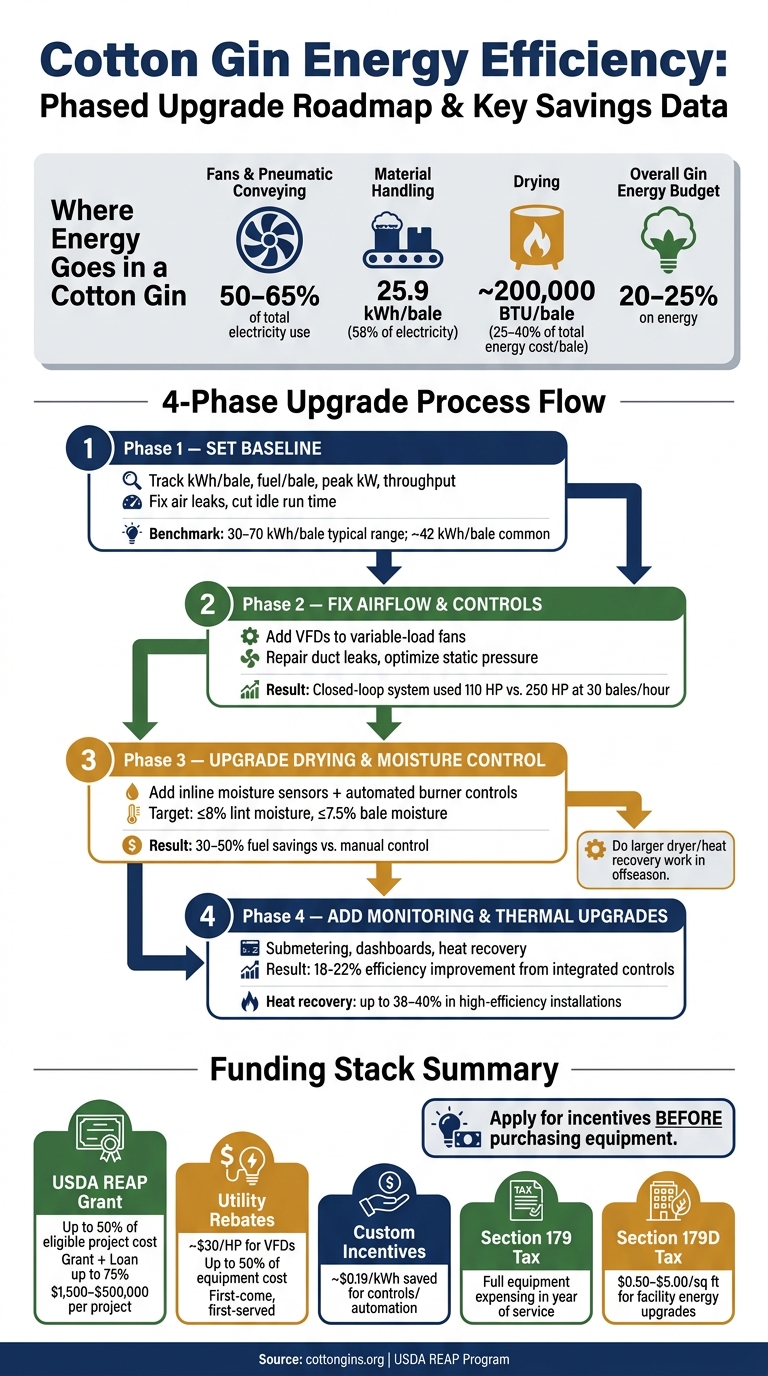
Cotton Gin Energy Efficiency: Phased Upgrade Roadmap & Key Savings Data
Quick Comparison
| Area | Main issue | What to do first | Reported upside |
|---|---|---|---|
| Fans and conveying | High electric load, poor fan efficiency, air restrictions | Repair leaks, clean up duct runs, check fan sizing, add VFDs where load changes | Lower kWh per bale; in one test, a closed-loop system used 110 HP vs. 250 HP at 30 bales/hour |
| Drying | High fuel use, overdrying, weak burner control | Add inline moisture sensing, improve burner control, shut off unneeded burners | 30% to 50% fuel savings from automated moisture control |
| Monitoring and controls | Hard to spot waste with whole-site bills only | Add submetering, dashboards, and system-level tracking | 18% to 22% better efficiency in reported control-system results |
| Project funding | Upfront cost | Apply before purchase; keep audit, quotes, specs, and savings data | REAP grants up to 50% of eligible cost; utility and state support may add more |
If I had to sum up the whole article in one line, it would be this: measure first, fix airflow and drying second, then use incentives to cut the project bill.
sbb-itb-0e617ca
Where cotton gins use the most energy
Drying, fans, and conveying: the biggest energy draws
Pneumatic conveying fans and seed cotton dryers use most of the energy in a gin.
On the electrical side, material handling and pneumatic conveying make up about 50–60% of total electricity use. In some high-capacity gins, fans account for around two-thirds of the total operating load. And there’s a simple reason for that: every restriction in the air path makes the fans work harder. If the system is fighting elbows, buildup, poor duct design, or other bottlenecks, power use climbs fast. That problem gets worse when fan efficiency is poor. Many existing fans run below 50% efficiency, which means a lot of power goes to waste.
Dryers are the other big load. Seed cotton drying makes up about 25–40% of total energy costs per bale. Fuel-use efficiency in commercial gins has ranged from 3% to 38%, with first-stage dryers averaging about 21%. That’s a wide spread, and it shows how much dryer setup and control matter.
Dryer performance also affects fan demand. When cotton is over-dried, it gets lighter and fluffier. That means conveying fans have to move more air to push the same amount of material. So poor dryer control doesn’t just add to the fuel bill. It also pushes up the electricity bill at the same time.
Before changing equipment, measure the current load.
Setting a baseline before making upgrades
Once you know where the load comes from, the next step is to set a baseline. Most incentive programs ask for pre-project energy data. Just as important, those numbers show where the biggest problems are.
Track:
- kWh per bale
- Fuel per bale
- Peak kW
- Seasonal throughput
Many U.S. saw-type gins fall in the 30–70 kWh per bale range, with about 42 kWh per bale being common. If your gin is running above that range, air systems and drying systems are often the main cause.
Start with the records you already have: monthly utility bills, fuel delivery records, and run-time logs for major equipment. If your gin uses a PLC or other automation system, it may already store motor run times. That can save a lot of manual work.
It also helps to log incoming seed cotton moisture and post-drying lint moisture by lot or module. That link between moisture conditions and fuel use makes the picture much clearer. Instead of guessing, you can show exactly when drying demand went up and what it cost. That makes it easier to justify motor, fan, dryer, or control changes with hard numbers.
A baseline also helps sort out what should come first: scheduling changes, airflow fixes, or dryer control updates. From there, the best upgrade targets usually become pretty clear - motors, fans, dryers, or controls.
Energy-efficient equipment and system upgrades
With a baseline set, the next move is pretty simple: go after the biggest loads first.
In most gins, the best places to start are motors and air systems, drying and moisture control, and automation tied to energy monitoring. Those areas tend to produce measurable savings without turning the whole plant upside down.
High-efficiency motors, VFDs, and air system improvements
Fans and air systems are usually the top electrical target.
Motor replacement makes sense when a motor is mis-sized, near failure, or overheating on a regular basis. The key is to size the motor for the job it actually does, not just the nameplate rating.
VFDs can cut energy use by slowing fan speed to match demand instead of choking airflow with dampers. That said, they aren't right for every setup. If equipment has to run at one fixed speed all the time, a VFD is often a poor fit. They also need close review for harmonics, motor cooling at low speeds, and control-system compatibility.
Air-side fixes are often the low-hanging fruit. Leaks, restrictions, long duct runs, and high static pressure all push fan power up. Clean those up first. The payoff can be dramatic. In one test, a closed-loop pneumatic conveying system delivered the same conveying performance at 110 horsepower versus 250 horsepower for a conventional open system running at 30 bales per hour.
| Upgrade Type | Best Use Case | Relative Cost | Likely Savings Range |
|---|---|---|---|
| Premium-efficiency motor replacement | Mis-sized, end-of-life, or frequently failing motors on fans and conveyors | Low–Medium | Moderate; highest when correcting significant mis-sizing |
| VFD retrofit on fans/blowers | Variable-torque loads with long run times currently throttled by dampers | Medium | High where speed reduction is feasible |
| Air system leak repair and duct optimization | Systems with known leaks, excessive bends, or high static pressure | Low | Fast payback; savings compound across all connected fans |
Once airflow losses are trimmed, drying controls often become the next place to focus.
Drying upgrades, moisture control, and heat recovery
Drying is where fuel spend tends to pile up, and the gap between average and well-tuned systems can be large.
A good first step is better burner control and better sensor placement. Sensors placed closer to the point of control react faster than periodic manual checks. That lets the system pull burner output down in real time when incoming moisture drops, instead of continuing to dry harder than needed.
Inline moisture sensors paired with automated burner controls help cut overdrying and lower fuel use. The target is ≤8% lint moisture and ≤7.5% bale moisture. Even simple operating changes can help. For example, shutting off second-stage burners when drying isn't needed can save fuel without any capital cost.
Results from automated moisture-control systems have been strong. Systems using integrated inline sensors at incoming, post-drying, and bale stages have reported 30–50% fuel savings compared with manual control. IoT-enabled moisture sensor networks have also shown 15–20% reductions in drying energy by tightening exit-moisture control and cutting overdrying.
Heat recovery usually makes the most sense after combustion tuning, insulation work, and moisture control are already handled. Exhaust recirculation is often simpler and lower cost. Heat exchangers give tighter control, but they need more space, more engineering, and more upkeep. Tests of heat recovery from gin waste incineration systems have shown 10–15% overall heat recovery efficiency in some cases, while high-efficiency installations reached 38–40% heat recovery, or about 400,000 Btu per bale. The tradeoffs are pretty clear: added pressure drop, fouling, and the need to handle moisture carryover safely.
| System | Fuel Savings Potential | Installation Complexity | Maintenance Considerations |
|---|---|---|---|
| Conventional drying (manual control) | Baseline | None | Standard burner and dryer upkeep |
| Moisture-control upgrade (inline sensors + automated burner controls) | 30–50% fuel reduction vs. manual control | Low–Medium; can phase in during downtime | Sensor calibration; software updates |
| Drying + heat recovery (exhaust recirculation or heat exchanger) | 10–15% in some tests; up to 38–40% in high-efficiency installations | Medium–High; requires engineering and space | Fouling management; pressure drop monitoring; periodic cleaning |
After drying is dialed in, automation helps keep those savings from slipping during the season.
Automation and energy monitoring tools
Automation helps by keeping airflow, feed rate, and drying closer to target from start to finish. Reported results from automated control systems for cotton ginning show 18–22% higher efficiency, along with lower energy use and better clean fiber yield, when factors like cotton flow, air pressure, and drum speed are managed in real time.
Submetering is what turns monitoring from a nice idea into something managers can use. Instead of looking only at whole-facility utility bills, track electricity, fuel, runtime, peak demand, throughput, and moisture by system. That system-level view matters in cotton gins because crop moisture and operating schedules can shift a lot from one year to the next.
Dashboards and trend tracking make those numbers easier to act on. They help with maintenance planning and capital budgeting because managers can work from measured data, not rough guesses, when deciding what to upgrade next.
| Operation Mode | Capital Intensity | Performance Visibility | Expected Operational Benefits |
|---|---|---|---|
| Manual operation | Low | Low | Baseline; high variability in throughput and energy use |
| Partial automation (automated feed control or fan speed control) | Medium | Medium | Reduced idle time; more consistent throughput; moderate energy savings |
| Integrated controls with energy monitoring (submetering + dashboards + automated process control) | Medium–High | High; real-time and trend data by system | 18–22% efficiency improvement; verified savings; faster identification of degrading equipment |
Once the highest-load systems are addressed, the next step is cutting project cost with grants, rebates, and tax incentives.
Policy incentives and funding that can lower project costs
Once you've picked the best upgrade projects, the next step is simple: figure out how to pay for them.
This is where incentives can make a big difference. After you know which systems use the most energy, you can focus on the upgrades that matter most and then reduce cost with a mix of grants, rebates, state programs, and tax incentives when program rules let you stack them.
USDA REAP, utility rebates, and state efficiency programs
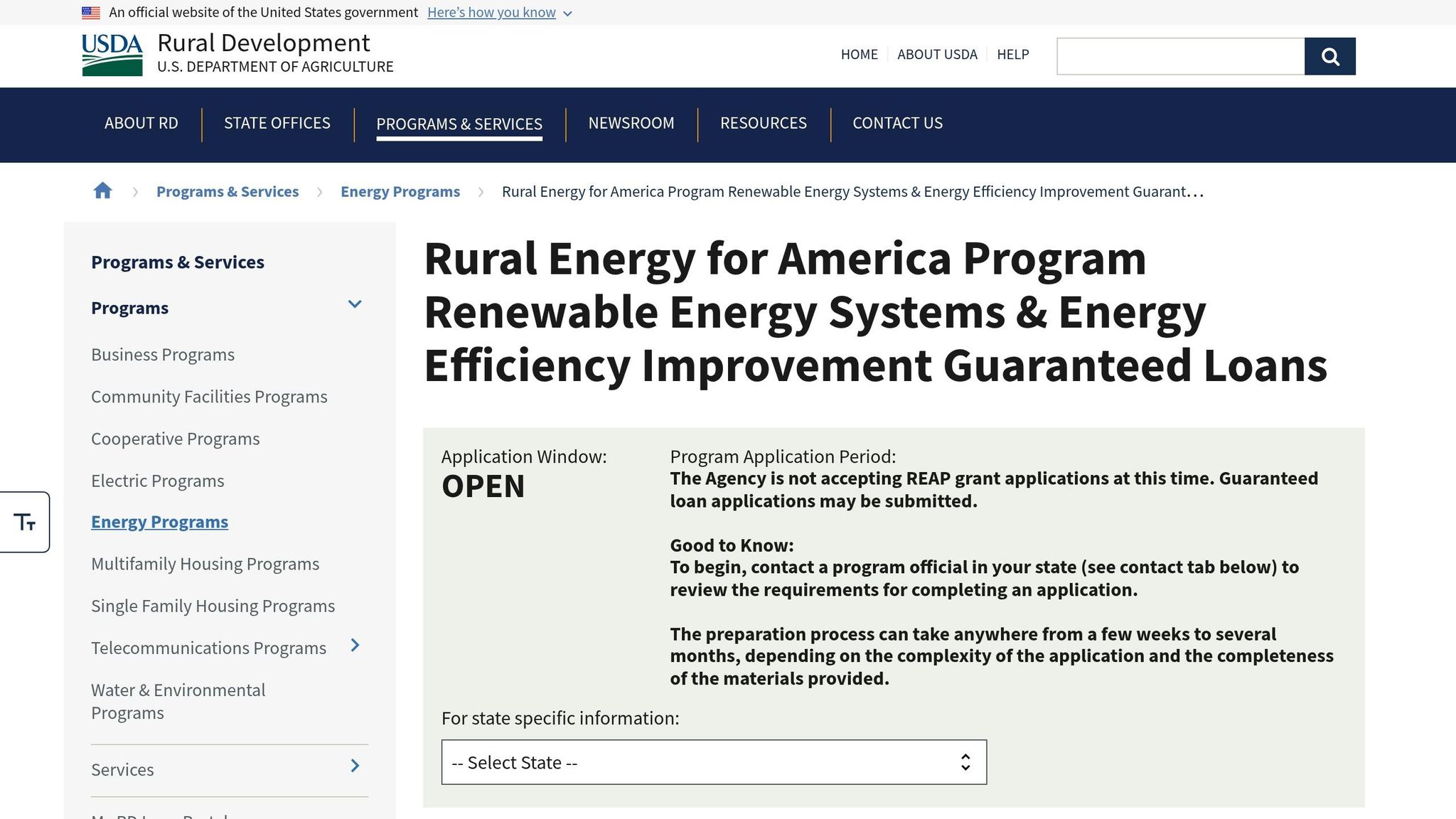
USDA's Rural Energy for America Program (REAP) is one of the main federal funding sources for cotton gins making energy-efficiency improvements. Eligible agricultural producers and rural small businesses in places with populations of 50,000 or fewer can receive grants covering up to 50% of total eligible project costs. Combined grant and loan guarantee support can reach up to 75%. Grant amounts for energy-efficiency projects usually range from about $1,500 to $500,000 per project.
REAP isn't just paperwork. It requires documented savings backed by an energy assessment or audit. That audit also affects the scoring of the REAP application, so it helps to have it done by a qualified professional, such as a certified energy auditor or licensed professional engineer.
Utility rebates are often easier and faster to access, but they usually cover a smaller share of the project. Electric cooperatives and investor-owned utilities often offer prescriptive rebates for premium-efficiency motors, VFDs, fans, and controls. Rebates often run around $30 per HP for VFDs, or a few hundred to several thousand dollars per drive. Many programs cap rebates at about 50% of equipment cost, and a lot of them are first come, first served. So timing matters. Reaching out to your utility's efficiency staff early can help you avoid missing out.
Custom incentives may also be available. For controls and automation, some programs pay about $0.19 per kWh saved.
State programs can add one more layer of support. Depending on the state, you may find:
- Matching funds
- Low-interest loans
- Technical assistance
- Audit support through extension services or state-backed audit programs
Some of these can stack with REAP and utility rebates. The safest move is to contact your state energy office before you lock in project scope. That gives you a clearer picture of what's open, what deadlines apply, and what can be combined.
Tax incentives and project documentation
After grants and rebates, tax treatment can lower what's left.
Tax incentives don't work like rebates, but they can still cut net project cost. Section 179 lets farms and businesses expense the full purchase price of qualifying equipment in the year it is placed in service instead of depreciating it over time, subject to annual dollar limits.
Section 179D can reduce taxes on qualifying facility energy upgrades. Deductions range from about $0.50 to $5.00 per square foot, depending on the level of energy savings achieved and whether prevailing wage and apprenticeship rules are met. The Inflation Reduction Act also updated or expanded several energy-related credits and deductions.
Because tax rules can get messy fast, work with a qualified tax professional before claiming any incentive.
Good documentation is what keeps the whole funding package from falling apart. Keep:
- The audit
- Vendor quotes
- Equipment specs
- Project timeline
- Post-installation photos
- Serial numbers
Utility rebates often require pre-approval before purchase, and some also require commissioning reports. For tax filing, keep all financial records, depreciation schedules, and credit calculations prepared by your tax professional. Across every funding source, before-and-after energy records are what prove the project worked. That can include monthly utility bills, submeter data, or monitored kWh for key systems.
Matching gin upgrades to the right incentive source
Use the table below to match each upgrade with the most likely funding source.
| Gin Upgrade Type | USDA REAP | Utility Rebates | State Programs | Tax Incentives |
|---|---|---|---|---|
| High-efficiency motors | Strong fit – needs audit, specs, and savings documentation | Common – per motor or per HP, with efficiency criteria | Likely – agricultural or industrial efficiency funds | Likely – Section 179 expensing or accelerated depreciation |
| VFDs on fans/conveyors | Strong fit – documented load reduction required | Very common – per drive or per controlled HP | Likely – support for controls and industrial efficiency | Likely – accelerated depreciation or deductions |
| Moisture-control systems | Strong fit – process energy savings documented in an audit | Possible – custom incentives may apply | Strong fit – agricultural energy and process programs | Possible – depends on equipment classification and current law |
| Drying system upgrades | Strong fit – fuel or energy savings documented in an audit | Possible – custom incentives may apply | Strong fit – agricultural processing energy programs | Possible – confirm classification with a tax professional |
| Heat recovery systems | Strong fit – custom-engineered projects need detailed documentation | Possible – custom utility incentives for complex projects | Likely – process heat and efficiency programs | Possible – depends on equipment type and tax law |
| Monitoring and automation tools | Eligible when tied to documented energy savings | Possible – custom incentives for controls with measured kW/kWh savings | Possible – technical assistance or related programs may apply | Likely – business equipment treatment may apply |
Build the funding package before you finalize project scope. A practical sequence looks like this: start with an energy audit, get utility pre-approval for qualifying items, then submit REAP and state program applications with full documentation of expected rebates and tax treatment disclosed. That order can help you avoid program conflicts and makes it easier to claim each dollar you're allowed to claim.
Putting it into action: a phased upgrade plan and key takeaways
A practical sequence for evaluating and scheduling projects
Once you've spotted the biggest chances to cut energy use, the next step is to turn them into a phased work plan.
A common mistake in ginning is going straight to big-ticket projects before getting a clear read on where energy is being used. That usually leads to wasted money and weak results. The smarter move is to start with quick fixes, then build toward larger upgrades.
Phase 1 is about setting your baseline. Pull together at least 12 months of utility bills and production data, work out your energy use per bale, and get an energy audit that focuses on your biggest loads: fans, pneumatic conveying, and dryers. Start by fixing air leaks and cutting idle-run waste. Run equipment only when it's needed.
Phase 2 shifts to controls and motor loads. Add VFDs to fans with changing load demand, tighten moisture control, and add automatic feed control. In most cases, this work can be done during short maintenance windows without causing much disruption to ginning.
After controls are dialed in, move on to the higher-cost thermal work.
Phase 3 should cover dryer retrofits, heat recovery, and process changes during offseason shutdowns, after the earlier phases show where savings are still left. It also helps to line up these upgrades with normal equipment replacement cycles so you don't scrap usable equipment too soon.
Incentives should be built into this process from the start. Submit REAP, utility rebate, and state program applications before you lock in the final scope. That sequence keeps more funding paths open and makes the payback case easier to support.
How cottongins.org supports industry visibility and peer learning
Sharing retrofit results helps other gins learn faster and avoid starting from scratch. cottongins.org gives gin operators a place to share retrofit results and learn from peers.
Key takeaways
The playbook is straightforward: fix waste first, add controls next, and then take on bigger thermal projects.
- Drying and air systems drive most gin energy use. Those two areas should be the starting point for any efficiency plan.
- High-efficiency motors, VFDs, moisture control, heat recovery, and automation matter most here. They tend to work better when added in sequence instead of all at once.
- Incentives can cut payback time. USDA REAP grants, utility rebates, state programs, and tax incentives can lower net project cost. In some cases, you can stack them if program rules allow it and your documentation is in order.
- A phased plan with clear documentation helps with both project selection and funding. Baseline data, vendor quotes, and before-and-after records make projects easier to fund.
FAQs
How do I know which upgrade to do first?
Start by setting measurable goals and collecting baseline data on energy, water, and waste. That gives you a clear starting point. It also makes it much easier to track progress over time instead of guessing.
Next, run an energy audit to find where you're losing money through waste and to estimate possible savings. An audit can also help support incentive applications, which may lower upfront costs.
Focus on simple operational fixes first. In many cases, the basics do a lot of the heavy lifting:
- Regular maintenance
- Better drying and precleaning
- Cleaner incoming seed cotton
After that, use a cost-benefit analysis to compare bigger upgrades like high-efficiency motors, VFDs, and automation. That way, you're not just buying new equipment because it sounds good. You're matching each upgrade to expected savings, cost, and payback.
Are VFDs a good fit for every gin fan?
Not always. VFDs can work very well for many cotton gin fans, especially in pneumatic conveying systems. Those systems use about half of a gin’s electricity, so even a modest drop in power use can matter.
During peak operations, VFDs can lower energy use. One Texas gin reported a 15%–20% drop in motor power use and a 19% reduction in annual electricity costs.
That said, they’re not an automatic fit for every operation. Operators need to balance the upfront cost and training time with their production scale and energy use.
What documents do I need for REAP or rebates?
For USDA Rural Energy for America Program (REAP) grants, you usually need documents that prove two things: energy savings and eligibility.
A professional energy audit plays a big role here. It helps pinpoint where energy is being wasted, sets a baseline for current use, and shows the projected savings from your planned upgrade.
Local agricultural extension offices can help too. They can confirm the latest program requirements and guide you through the application paperwork, which can save you a lot of hassle.