Cotton gin robotics is less about replacing people and more about removing slow, risky, repeat jobs. In many plants, the first gains come from three areas: steadier line control, less manual bale handling, and better plastic detection before lint is damaged.
If I had to boil this article down to the plain answer, it would be this:
- Start with the bottleneck. Fix feeding, drying, pressing, bale movement, or contamination based on what hurts output most.
- Use automation where rules are clear. Bale wrapping, weighing, routing, moisture checks, and camera-based plastic spotting fit this well.
- Keep people on judgment calls. Crews still handle jams, odd cotton conditions, root-cause checks, and maintenance.
- Expect the first payback from labor, safety, throughput, and lint protection.
- Do the prep work first. Clear lanes, data links, electrical capacity, camera placement, and service plans matter as much as the hardware.
A few numbers make the case plain:
- Some upgraded gins can move from 20 to 60 bales per hour with the same crew size.
- A cotton bale weighs about 500 lb, so automating bale movement can cut strain and forklift exposure.
- A USDA-linked plastic removal setup reported 89.44% detection and ejection efficiency in tests.
- One moisture system cut bale-to-bale moisture swings from ±2.5% to ±0.8%.
- Automated bale packaging has been tied to about $63,000 per season in labor savings at one gin.
What matters most is not the robot itself. It is whether the system helps you hold flow, protect fiber, and keep the plant moving during a short harvest window. That is where this article keeps its focus.
Before you spend on new equipment, I’d look at one simple question: Where does your gin lose the most time, labor, or quality today? That answer should guide the first move.
Exploring New Cotton Gin Technology at White Oak Gin in Missouri
sbb-itb-0e617ca
Ginning Line Automation and Process Control
On a continuous line, automation helps keep throughput, moisture, and lint quality steady.
Module Feeding, Routing, and Flow Control
Modules don't come in the same condition every time. One may be dense and damp. The next may be lighter and full of trash. Without active control, gin stands swing from starved to overloaded, and performance drops fast.
Optical through-beam sensors in the seed-cotton hopper track fill level. The PLC then slows down or speeds up the module-feeder floor to keep the load steady. Some systems also look at motor power draw on inclines and dispersing cylinders to fine-tune feed rate.
That kind of feeder control cuts plugging, wear, and throughput swings. And that matters downstream, because the press house runs best when lint supply stays even.
Adjusting Drying and Cleaning Based on Cotton Condition
Drying has to hit the right window. Too much drying increases short fiber and static. Too little hurts cleaning and storage.
Inline moisture sensors at the feed hopper and dryer exits can hold exit moisture in the target range: about 6%–7% for seed-cotton cleaning and ginning, 5%–6% for lint cleaning, and 6%–8% before the press and storage. Commercial systems can automate dryer temperature and track bale moisture.
Moisture signals and motor-current data can also help the line make smarter decisions. If cotton is already dry and clean, the system can bypass extra cleaning. If saw-cylinder load starts to climb, it can slow the feed rate. Once cleaning stays stable, the press can run on a more predictable schedule.
Press Timing and Bale Preparation Coordination
Press delays often point to upstream flow problems.
Automated press coordination uses sensors at the lint feeder, tramper foot, and bale pusher to sync lint delivery with press cycles. The control system watches lint-collector levels and ram position, then adjusts lint condenser and feed conveyor speeds to match each stage of the press cycle. Bale weight and density depend on that steady lint flow. When enough lint mass is available, the press cycle starts automatically, which cuts idle time and keeps bale weights uniform.
That steady output feeds straight into the bale-handling systems covered next.
Robotic Bale Handling and Material Movement
Once the press cycle is steady, bale robotics tackles the next big pain point: moving bales. A standard 500 lb cotton bale is heavy, bulky, and awkward, especially during peak season. Taking people out of that step is one of the clearest ways for a gin to cut labor costs, lower workers' compensation exposure, and reduce injury risk when volume is at its highest.
Conveying, Bagging, Bundling, and Bale Transfer
An automated bale line moves each bale from the press to staging without manual handling. From there, the system can sample, weigh, bag, and label the bale in sequence. A short conveyor or bale cart picks up the bale and moves it along a floor-level track. Then a tilting table sets the bale in position for bagging or wrapping, which cuts down on workers having to tip 500 lb bales by hand.
An integrated automatic sampler pulls top and bottom samples as the bale enters the line and sends that data straight into the gin's data system. After bagging, the bale moves onto a scale platform, where its weight is recorded and passed to bale tracking and management software for slip and label generation. A discharge conveyor then stands the bale upright in front of a bale pusher, which moves it into a set pickup zone for forklift handling.
The payoff is pretty simple: automated baggers and bale-transfer systems can reduce final-handling labor and move bales out faster. At the same time, that conveyor-and-data flow helps support downstream quality tracking.
Autonomous Movement Tools in the Yard and Plant
For repeat trips between the press house, staging lanes, and storage, AGVs and autonomous forklifts with bale clamps make sense on fixed routes. This isn't just theory. In spinning mills, the SERVObale system uses AGVs instead of forklifts to place bales at bale openers. It reported large drops in labor workload and machine downtime, with no mis-deliveries because the vehicles stayed on precise routes. A gin yard has the same basic setup: fixed paths and repeat movement, which makes autonomous carriers easier to run with consistency.
Safety matters here, especially when autonomous vehicles share space with people and standard forklifts. Still, the record is better than many assume. Across more than 30 years, OSHA recorded only six AGV-related fatalities, and most were linked to improper use rather than system failure. Laser scanners build protective and warning zones around each vehicle. Infrastructure-assisted AGVs that use outside coordination tools can move through intersections about 30% faster while avoiding collisions, so smart traffic design helps both safety and throughput.
For that to work, the plant layout needs a few things in place:
- Clearly marked lanes
- Restricted zones
- Consistent worker training for interaction with autonomous equipment
What a Gin Needs Before Installing Bale Robotics
Vendors now sell integrated bale-handling systems that link ginning machinery, weigh scales, conveyors, and management software from press to dispatch. But none of that runs well unless the gin is ready for it.
In practice, readiness comes down to six concrete requirements: clear lanes and steady bale flow from the press; a press console that can sequence bale-handling operations and respond to signals such as bale ready, jam, or emergency stop; properly sized electrical feeders, panels, and motor protection for conveyors, rams, samplers, and autonomous vehicles; data integration through industrial Ethernet networks and standardized bale ID schemes so each bale can be tracked end to end; maintenance access; and operator training.
If you strip it down, the checklist is straightforward: clear lanes, steady bale flow, enough electrical capacity, solid data integration, room for maintenance, and trained operators. Those same control and data links also get the gin ready for vision-based inspection.
Machine Vision, Contamination Detection, and Quality Inspection
Once the control network is set up, cameras and sensors can spot contamination and monitor bale quality in real time. After bale handling is automated, contamination and moisture control usually become the next big pressure points for quality.
Machine Vision at the Module Feeder and Feeder Apron
Plastic from round-module wraps, twine, and other foreign material is easiest to catch early, before it breaks apart and spreads through the lint stream. That makes the module feeder and feeder apron strong inspection points, because the cotton is spread out enough for cameras and lighting to do their job.
At the module feeder, fixed cameras watch the dispersing cylinders inside the cabinet. The feeder floor pauses for a moment so the cameras can get a clear look at the cylinders, while LED lighting creates even contrast that helps plastic stand out against the metal background. If the software flags contamination, the system can log the event, trigger an alarm or HMI alert, and tag the module as high-risk in the gin's control network.
At the feeder apron, cameras mounted above or beside the apron scan the cotton sheet in real time. The system pinpoints where the contaminant sits across the apron, then fires air knives to push the flagged tuft into a waste chute before it reaches the gin stand. USDA ARS research describes this camera-and-air-knife setup as the VIPR system, which reported a cumulative detection and ejection efficiency of 89.44% across three units in tests using five types of plastic module wrap.
Manual Inspection, Operator Alerts, and Automated Removal: A Side-by-Side Look
These three methods trade speed, labor, and leftover contamination risk in different ways.
| Approach | Detection point | Response speed | Labor demand | Remaining contamination risk |
|---|---|---|---|---|
| Manual inspection | Outside the module feeder, with limited views inside the hood or feeder | Slow; depends on operator walking, noticing, and reacting | High; requires frequent checks | High; plastic is easily missed until it shreds in lint |
| Operator-alert camera system | Module feeder dispersing cylinders or feeder hood, using still images or live video | Moderate; alerts prompt crew to stop and clean | Medium; crew responds to alerts instead of constant patrolling | Medium; much early plastic is caught, but events can be missed when staff are busy |
| Automated removal system | Feeder apron just before the gin stand, where cotton is highly dispersed | Fast; detects contamination and fires air jets in milliseconds | Low during normal running; maintenance and calibration still matter | Low but not zero; small fragments can still slip through |
A module-feeder contamination sensor tested in Australian gins detected 6 of 7 contamination events, for a reported recognition factor of 86%. That gives gins a clear step up from manual checks alone and can serve as an early-warning option before moving to fully automated removal.
Sensors That Support Bale Quality and Yield Control
Contamination detection protects the lint stream. Quality sensors help keep bales more consistent.
| Signal source | Contribution to lint quality | Role in bale consistency | Impact on yield management |
|---|---|---|---|
| Moisture sensors | Help keep bale moisture within safe limits and reduce overdrying | Allow dryer and conditioner adjustments so bales stay within safe moisture limits at press-out | Reduced bale-to-bale moisture variability from ±2.5% to ±0.8% in one RF-based system; a seed-cotton moisture monitoring system reduced overdrying incidents by approximately 20% in several U.S. gins. |
| Trash/color sensors | Indicate leaf, bark, trash, and color/yellowness that affect classing results | Support more consistent cleaning across different lots | Help balance cleaning intensity against fiber loss |
| Bale cameras | Allow visual verification of stains, plastic pieces, or packaging problems before shipping | Provide documentation and traceability for specific bales and lots | Help identify recurring defects tied to certain fields, shifts, or equipment |
| Press-pressure data | Indicates whether bales are being compressed uniformly | Supports consistent density across bales | Works with weight and moisture data to confirm bales meet contract specs |
Sensors placed before and after dryers, in the lint stream, and at the press give the control system enough data to adjust drying automatically and trigger alarms if bale moisture rises above safe thresholds. Trash and color sensors, bale cameras, and press-pressure data add another layer of detail, especially when all signals feed into one data environment so operators can trace quality issues back to specific modules, lots, or shifts.
Costs, Benefits, and a Practical Adoption Plan
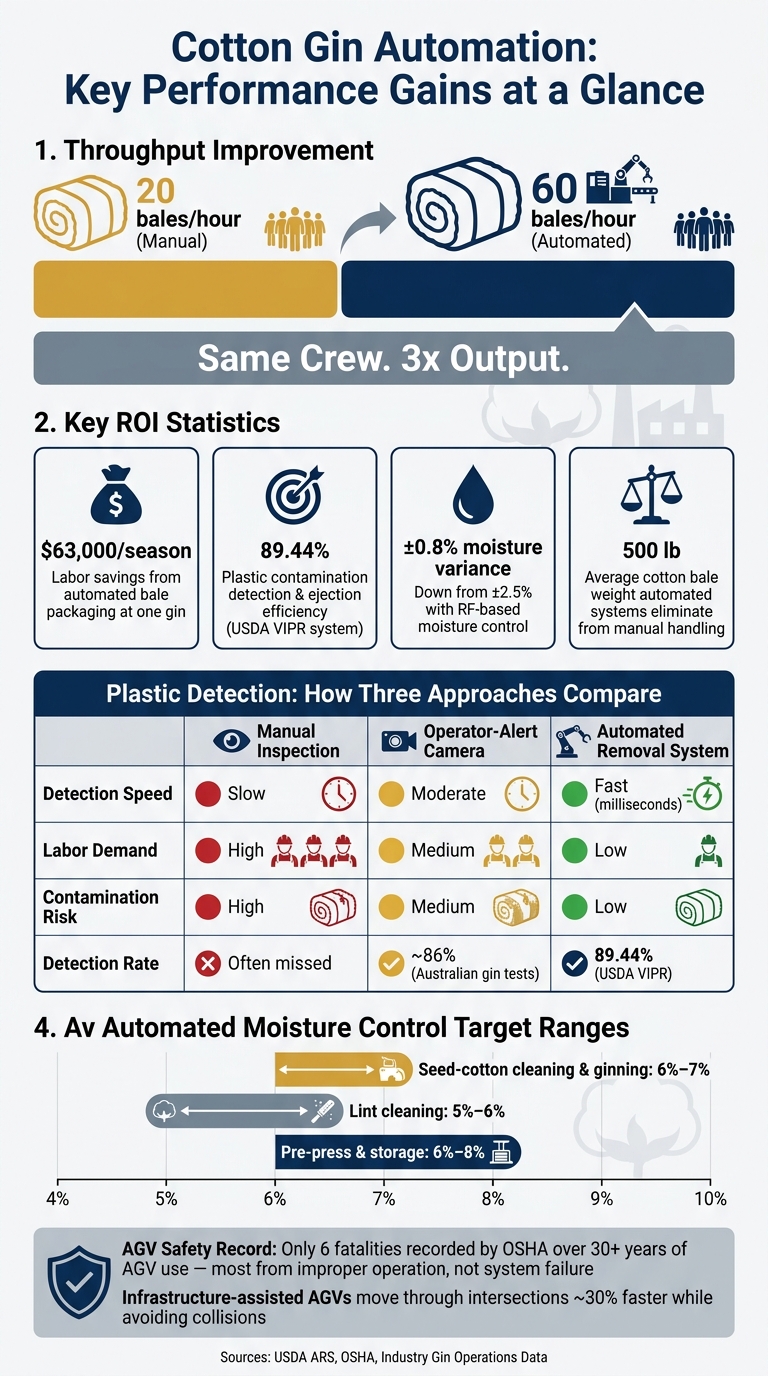
Cotton Gin Automation: Manual vs. Automated Performance Metrics
Where U.S. Cotton Operations See Returns First
After a line is automated, the first thing most operators want to know is simple: where does the money come back first?
In U.S. cotton gins, the early payback tends to show up in three places: labor, contamination control, and throughput. Automated bale packaging can save nearly $63,000 per season at one gin, while machine vision helps protect quality premiums on contaminated bales. That matters because even one bad bale can eat into margins fast.
Throughput is another early win. Some automated gin setups now handle up to 60 bales per hour, compared with 20 bales per hour that the same crew size once managed. That's not a small bump. It's the kind of jump that changes how a plant moves through peak season.
Safety gains are just as direct, and they're usually easier to document. Automation in bale packaging and yard movement cuts worker exposure to forklift traffic and manual bale handling, which can reduce liability and workers' compensation risk. Machine vision also removes most visible plastic contamination, helping protect growers from losing quality premiums on affected bales.
Common Retrofit Challenges and Operating Limits
Retrofitting robotics into an existing gin is rarely plug-and-play. Older plants, in particular, often run into space and layout issues around presses, conveyors, and bale storage. If the footprint is tight, even a good system can be hard to fit without reworking part of the line.
Sensor and camera placement also takes care. Detection windows are short, so equipment has to be positioned with precision. A camera that's slightly off can miss what it's supposed to catch.
Then there's the day-to-day plant environment. Dust, lint, and vibration don't go away just because a system is automated. Lens fouling and vibration-related misalignment can chip away at accuracy over time, which is why air purges, protective housings, and vibration-damping mounts are part of the job, not extras.
Vision systems help, but they aren't perfect. Black, clear, and white plastic are still harder to detect, so the system lowers risk without removing it fully. And because most installs happen in the off-season, crews usually have a short window for commissioning and training.
Key Points for Planning Your Next Step
Start with the bottleneck, not the tool. If feeding is the weak spot, begin there. If bale handling is slowing the plant down, fix that first. If contamination is costing premiums, make that the target. The best first project is the one tied to the biggest operating problem, not the newest piece of equipment.
It also helps to check whether material flow is steady enough to support automated detection or handling. If the flow is inconsistent, even a good system can struggle.
Plan for upkeep from the start. That means setting aside budget and staff time for calibration and maintenance, not just the install. One trained maintenance lead or a service partner should own that work and keep vision systems and robotic handlers performing at spec through the full season.
FAQs
Where should a gin start with robotics?
Start with a cost-benefit analysis and a phased plan that supports long-term goals without slowing day-to-day output.
A smart place to begin is with modular, scalable upgrades that fit into your current setup, such as:
- automated bale handling and feeder systems
- contamination detection sensors at key points
- modern control panels with real-time monitoring and remote troubleshooting
It also makes sense to put workforce training near the top of the list and make sure any new system works well with existing equipment.
How much maintenance do robotic systems need?
Robotic systems in cotton gins still need regular maintenance. The difference is where the work goes: away from hands-on manual labor and toward more specialized technical upkeep.
That usually means work like:
- sensor calibration and alignment
- camera lens cleaning or replacement
- environmental control management
- software updates
- troubleshooting
Predictive maintenance can also help track performance and cut down on unexpected failures.
Can older cotton gins be retrofitted for automation?
Yes. Older cotton gins can often be retrofitted with modular automation upgrades instead of replacing the entire system.
That can mean adding remote monitoring, touch-screen controls, load sensing, smart hydraulic units, and safety tools like fire detection sensors.
Some facilities may also need updates to their network, sensors, and control systems. But a phased approach can improve throughput, fiber quality, and operating costs without forcing a full rip-and-replace job.