Here’s the short answer: RFID wins for tracking cotton in motion. Blockchain wins for proving custody across companies. If you need both physical bale data and audit records, use both.
If I had to boil the article down to one point, it’s this: these tools solve different problems. RFID helps you identify modules and bales as they move through the field, gin, and yard. Blockchain helps you show buyers, mills, and regulators who had the cotton at each step.
In 2026, that difference matters more because the pressure is higher:
- UFLPA scrutiny means cotton claims need data, not paper alone
- 90% of brands studied by Oritain had exposure to cotton tied to restricted origins in 2025
- 87% of U.S. firms said they were tracing cotton, which shows that tracing and proving are not the same thing
- The U.S. Cotton Trust Protocol reported a 413% year-over-year increase in brand uptake
- Some retailers, like Lindex, have set fiber-level traceability targets by 2028
So if you’re deciding between the two, I’d look at four simple questions:
- Do you need to track physical movement?
- Do you need to prove chain of custody to outside parties?
- What can your budget support: hardware, software, or both?
- Will your partners actually use the same system?
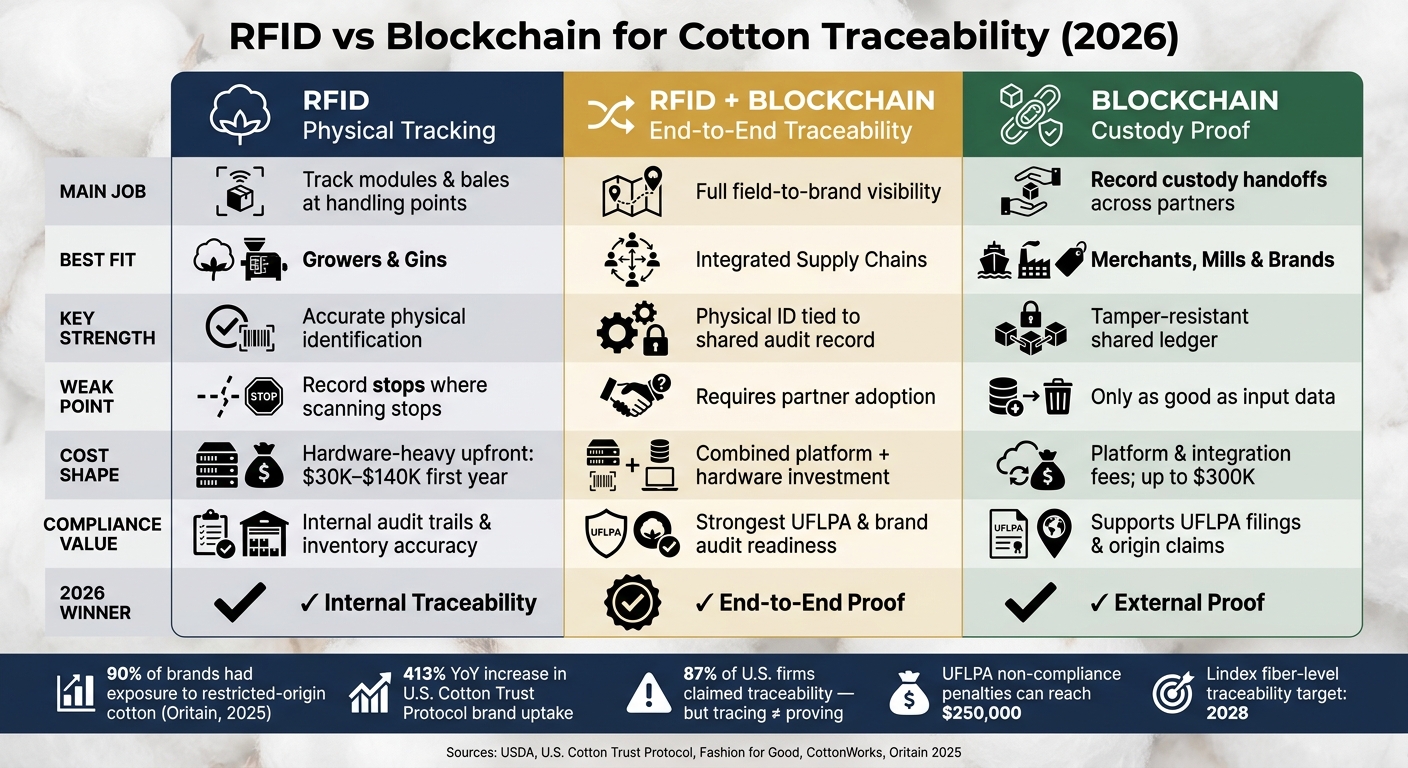
RFID vs Blockchain for Cotton Traceability: Side-by-Side Comparison 2026
Quick comparison
| Criteria | RFID | Blockchain |
|---|---|---|
| Main job | Track modules and bales at handling points | Record custody handoffs across partners |
| Best fit | Growers and gins | Merchants, mills, and brands |
| Strength | Accurate physical identification | Shared, tamper-resistant audit record |
| Weak point | Stops where scanning stops | Depends on correct input data |
| Cost shape | More upfront hardware cost | More platform and integration cost |
| 2026 winner by use case | Internal traceability | External proof |
| Best overall setup | RFID + blockchain together | RFID + blockchain together |
I’d sum it up like this: if your problem is yard flow, intake, and bale linkage, start with RFID. If your problem is buyer proof, UFLPA files, and shared audit trails, start with blockchain. If you need end-to-end traceability, neither one is enough alone.
That’s the frame for the rest of the article.
sbb-itb-0e617ca
RFID for Cotton Module and Bale Tracking
How RFID Works from Field Pickup to Gin Yard
Modern round module wraps for John Deere module-builders come with at least four passive RFID tags tied to a single module ID. John Deere's Harvest Identification (HID) logs that ID along with grower, farm, field, variety, date, and GPS details before the module even leaves the field.
From there, the data keeps moving. Handheld readers log the module ID, location, and ownership inside gin or grower systems. Truck-mounted readers add truck, driver, load, and location details, which creates an electronic manifest. Fixed readers then confirm when the load reaches the gin gate or scale bridge, and feeder scans connect module IDs to bale records and quality data.
The Electronic Module Management (EMM) system pulls those scan events into one central database, including the module serial number, GPS origin, grower, gin ID, operator, and timestamp. Cotton Incorporated and USDA-ARS have shown that this setup can replace paper tags and paint marks.
Where RFID Delivers the Most Practical Value
RFID tends to shine at the points where speed and accuracy matter most. At gin intake, fixed readers identify incoming modules without making the truck stop, which cuts delays, bad reads, and billing disputes. In the gin yard, staff can use location-based inventory lists to search by grower or field and find staged modules fast, instead of walking lots by hand. At the module feeder, automated scans confirm that the right modules are ginned in the right order, which helps with lot segregation and inventory control.
That speed is the big draw. The catch is simple: the record usually stays inside the local system unless another platform passes it along.
When module IDs connect to bale IDs, gins can trace fiber quality back to specific fields, support identity-preserved programs, and answer audit requests faster. For cost, a mid-sized gin may spend $25,000 to $50,000 on readers and software, while broader setups can run from $50,000 to $300,000, depending on scope. In many cases, that cost is balanced by fewer mis-billed loads, less manual reconciliation, and cleaner data for downstream buyers. Put plainly, it helps intake flow better, keeps inventory tighter, and makes audits less of a scramble.
Still, RFID has limits. If downstream partners don't scan, the custody record ends where RFID ends. Missed scans, damaged wraps, dusty conditions, or uneven procedures can leave holes in the record, and manual fixes don't always close those holes. On top of that, RFID data usually sits in local or vendor systems, so it doesn't give you tamper-evident, shared record integrity.
| Factor | RFID Strength | RFID Limitation |
|---|---|---|
| Operational value | Fast module ID from field to feeder; location-based yard visibility; automated intake without manual scanning | Requires readers at every control point; missed scans create gaps |
| Bale linkage | Module-to-bale genealogy through gin software | Stops at the gin unless downstream partners also scan |
| Cost profile | Low-cost embedded tags; reader and software is the main spend | Setup still requires capital outlay |
That makes RFID strong for data capture, but not enough by itself for shared proof of custody. RFID records the physical event. Blockchain starts to matter when that event needs to be checked and trusted across multiple parties.
Blockchain for Cotton Chain-of-Custody Verification
How Blockchain Supports Proof of Origin and Custody Records
RFID records the physical event. Blockchain keeps the shared custody proof.
In cotton supply chains, blockchain creates a shared record of handoffs across growers, gins, merchants, mills, and brands. Each entry logs a custody event, such as bale creation, gin intake, lot transfer, shipment, or certificate issuance. Teams can also attach certificates and shipping records to back origin and organic claims.
A good example is the U.S. Cotton Trust Protocol's partnership with TextileGenesis. That setup tracks cotton through blockchain so third parties can audit bale movement from truck arrival through retail.
Where Blockchain Adds Value and Where It Depends on Other Systems
Blockchain is strongest when several supply chain partners need to look at the same custody record. Instead of relying on one company's database, multiple parties can review the same ledger.
But here's the catch: blockchain only protects the record after data goes in. It does not prove the input was right in the first place. If a gin logs the wrong bale weight, or a merchant fails to record a lot transfer, the ledger keeps those mistakes just as neatly as correct data. As CottonWorks notes, chain of custody is the chronological custody record across the supply chain. That record is only as good as the scans and system entries feeding it.
That is why cotton pilots usually pair blockchain with physical ID tools. The Fashion for Good Organic Cotton Traceability Pilot traced 75 metric tonnes of organic cotton from farms toward retail by combining blockchain with on-product markers and NFC tags. In that pilot, the markers were used to check the material itself, while the blockchain logged custody events at each stage. Without those physical tracers, the blockchain record alone would not confirm that the fiber was actually what it claimed to be.
Put simply, blockchain makes verification stronger, but it still leans on clean upstream data.
| What Blockchain Does Well | Where It Depends on Upstream Capture | How It Supports Compliance Claims |
|---|---|---|
| Immutable transaction history across partners. | Needs accurate entry from gins, mills, merchants, and ERPs. | Supports audit trails for origin and due-diligence claims. |
| Shared visibility without single-party control. | Cannot verify that a bale or certificate was truthful at entry. | Helps satisfy chain-of-custody documentation requirements. |
| Links cotton to digital claims via NFC, QR, or DNA markers. | Still needs physical ID methods to bind material to the ledger. | Strengthens origin, organic, and custody continuity claims. |
| Enables retrospective auditing. | Audit quality depends on the first recorded input. | Useful for brand reporting and regulatory inquiries. |
RFID vs Blockchain: Cost, Accuracy, Scale, and Integration
Side-by-Side Tradeoffs for Cotton Operations
RFID records physical movement. Blockchain keeps a shared record of custody. That basic difference shapes everything else.
And it explains a common problem in cotton operations: the tool that fits the process on paper isn't always the one that makes the most sense for the business.
| Category | RFID | Blockchain |
|---|---|---|
| Bale and module tracking | Automatically identifies module IDs at each handling point. | Does not track physical bales directly; relies on upstream IDs from RFID, QR codes, or bale tags. |
| Chain-of-custody verification | Limited to sites with readers installed; does not confirm ownership or certification status. | Provides a tamper-resistant record of custody handoffs across multiple partners. |
| Data accuracy | Strong for physical location and identity when readers are properly installed. | Only as accurate as the data entered; cannot correct a wrong input or missed scan. |
| Gin and warehouse integration | Deep integration with gin management systems, yard inventory, and bale genealogy. | Sits on top of existing systems and depends on disciplined data entry. |
| Scalability | Scales well for high-volume internal operations; adding sites means replicating hardware. | Scales well across partner networks without adding physical infrastructure. |
| Compliance readiness | Supports internal audit trails and inventory accuracy, but limited for standalone origin claims. | Helps support UFLPA documentation and brand-level origin audits. |
One point matters more than it may seem at first glance: per-bale blockchain tracking gets expensive fast. Because of that, most systems log lot-level or shipment-level events instead of tracking each bale one by one.
Cost and ROI by Operation Type
Once the job of each system is clear, cost tends to settle the debate.
RFID comes with a bigger upfront bill because it depends on hardware. Passive UHF tags usually cost $0.05 to $0.50 each, based on volume and durability. If a mid-size gin installs fixed readers at intake, at the press, and at warehouse doors, then adds handheld units for yard work, first-year costs often land between $30,000 and $140,000. That figure includes tags, readers, software integration, and training. After that, annual recurring costs usually sit around 15% to 25% of the initial hardware and software spend.
For gins running 20,000 to 50,000 bales per season, tag costs are usually manageable. The return tends to come from less manual tagging and faster yard flow. In plain terms, the gain is speed and labor savings.
Blockchain doesn't require a dedicated spend on physical tags, but the platform bill can still be heavy. Subscription fees and integration work add up. A full gin platform with module-to-bale genealogy, warehouse reconciliation, and portals can cost $130,000 to $300,000 for initial implementation. In many cases, blockchain modules sit on top of that setup instead of replacing it.
For merchants and brands, the payoff is less about daily handling and more about lowering compliance risk. UFLPA exposure changes the math. Audit-ready chain-of-custody records can justify the subscription cost, especially when penalties for non-compliant shipments can reach $250,000.
The fit changes by operator:
- Growers usually get the most direct return from RFID.
- Gins use RFID for the heavy operational work, while blockchain adds the cross-party audit record that merchants and brands now ask for.
- Merchants and downstream textile partners tend to get the most value from blockchain as the audit layer, especially when RFID feeds it clean upstream data.
The verdict below applies these tradeoffs to growers, gins, merchants, and downstream partners.
Verdict: When RFID Wins, When Blockchain Wins, and When Both Win Together
The choice comes down to one thing: do you need internal control or shared proof? Put simply, RFID wins at physical capture. Blockchain wins at shared proof.
RFID wins when the main problem is physical flow. If your bottleneck is capture, movement, or logistics, RFID is the better fit.
Blockchain wins when trust between parties is the issue. It helps prove origin to a brand, support regulatory and ESG reporting, and share chain-of-custody records with downstream partners. It doesn't replace physical tracking. It makes the record easier for others to check.
Both win together when the goal is end-to-end traceability. In that setup, RFID records the physical event, and blockchain stores it as a shared record.
That tradeoff looks a little different for each group.
| Deployment | Market Access | Audit Readiness | Proof of Origin |
|---|---|---|---|
| Best for internal traceability | Best for domestic operations | Moderate | Strong for internal origin proof |
| Best for shared custody proof | Strong where buyers require shared provenance records | Strong for multi-party auditability | Only as strong as upstream data |
| Best for end-to-end traceability | Better for buyers, certifiers, and mills | Strong end-to-end | Strongest - physical ID tied to a shared chain-of-custody record |
Best Choice by Stakeholder
Growers tend to get the clearest return from RFID. Harvest logistics, like automatic capture of module IDs during formation and pickup, is exactly the kind of job RFID does well.
Gins usually need both. RFID handles intake and yard flow. Blockchain adds the shared audit record that merchants and brands want.
Merchants and mills often get more from blockchain. Their main concern is proving custody, not tracking movement.
Integrated supply chains get the most from using both together. RFID supplies cleaner upstream data, and blockchain makes that data shareable and auditable across each tier.
Once that fit is clear, the next move is simple: map it to your current workflow and the partners you trade with.
Next Steps for Planning a Traceability Upgrade
Start with the bottleneck. If the issue is physical movement, look at RFID. If the issue is external proof, look at blockchain.
Then check which trading partners need shared records from you. That's usually the clearest sign that a combined stack should be part of the plan.
FAQs
Can RFID work without blockchain?
Yes. RFID can work on its own as a traceability tool. It gives each module and bale its own tag and logs checkpoint activity automatically, which helps improve inventory accuracy and cut manual mistakes.
RFID also tightens the link between the physical item and its digital record, along with day-to-day tracking data. Blockchain is optional. It can add a tamper-resistant shared ledger and permissions-based access, but it still relies on accurate data being entered in the first place.
Who should use both systems together?
Using both works best for producers, gins, and supply-chain partners that need fast, accurate bale and module capture plus a tamper-resistant, audit-ready chain of custody.
Here’s the simple way to think about it: use RFID to improve day-to-day bale tracking and cut manual mistakes. Then use blockchain to record and verify those events as permanent, standardized documentation with permission-based sharing.
That combination becomes even more useful when cotton is blended, when there are more handoffs across the supply chain, or when fraud risk goes up. It also helps when buyers, brands, or partners need stronger proof of origin.
How do I choose the right starting point?
Start by fixing identification and data accuracy at the gin. Record module IDs before processing, label every bale with a Permanent Bale Identification (PBI) tag, and move to a centralized digital inventory system instead of spreadsheets.
If you want automation and real-time module visibility, add RFID first. Then add blockchain-based recordkeeping for audit readiness, with both physical and digital checks so bad data doesn’t get locked in for good.