Conventional cotton farming is draining resources, costing billions in soil erosion, and threatening fertile land. Regenerative organic cotton flips the script by restoring soil health, cutting carbon emissions, and improving profitability for farmers. Here’s a quick breakdown:
- Water Use: Regenerative practices improve soil's water retention, reducing irrigation needs.
- Soil Health: Techniques like no-till farming and composting rebuild soil structure and increase organic matter.
- Carbon Storage: Cotton fields can store up to 3 metric tons of CO₂ per hectare annually.
- Farmer Benefits: Lower input costs and access to premium markets boost profits.
- Biodiversity: Crop rotation and pollinator habitats reduce pests without synthetic pesticides.
Farmers adopting these methods see economic gains alongside environmental recovery. Certification programs like Regenerative Organic Certified® ensure these practices meet rigorous standards, while tools like cottongins.org make supply chain connections easier. The shift to regenerative cotton is already showing results, with U.S. farms cutting greenhouse gas emissions by 25% and water use by 58% over four decades.
Regenerative organic cotton isn’t just about farming - it’s about creating long-term solutions for soil, farmers, and the planet.
6 Principles of Regenerative Farming – Explained by an Organic Cotton Farmer
sbb-itb-0e617ca
Core Principles of Regenerative Organic Cotton Farming
Regenerative organic cotton farming revolves around five key principles: low-disturbance tillage, year-round living roots, continuous soil cover, diverse ecosystems, and targeted livestock integration. These principles work together to enhance soil health, boost biodiversity, and improve carbon management.
Improving Soil Health Through Better Farming Practices
No-till farming minimizes soil disruption by reducing plowing, which helps maintain the natural structure of the soil and protects vital microorganisms and soil aggregates. Pairing no-till methods with cover crops - like cereal rye, wheat, or clover - planted between cotton cycles can cut soil erosion by 70%, save $47 per acre, and increase net income by $100 per acre.
Composting and biological nutrient recycling are other vital practices. These methods enrich the soil without relying on synthetic fertilizers, cutting nitrogen fertilizer requirements by 15%–30%. They also increase soil organic carbon by 8% and improve water-stable aggregates by 15%. This creates a self-sustaining system that supports the soil year after year.
These soil-focused strategies also foster biodiversity, which is essential for long-term sustainability.
Increasing Biodiversity in Cotton Fields
Biodiversity plays a central role in regenerative farming. As Arif Makhdum, Agriculture Advisor and Global Regenerative Lead at CottonConnect, explains:
"Without biodiversity, thinking of soil health is just a dream. We try to improve soil health with the help of biodiversity - retaining habitat and increasing productivity".
Multi-species crop rotations are a key strategy. For instance, rotating cotton with nitrogen-fixing crops like peanuts or soybeans, or with corn, naturally disrupts pest cycles and replenishes soil nutrients. This approach also supports a balanced ecosystem where beneficial insects and birds help control pests, reducing or eliminating the need for chemical pesticides. Such biodiversity not only protects crops but also strengthens the overall health and profitability of farms.
Efforts to enhance biodiversity extend beyond the fields. Within the U.S. Cotton Trust Protocol, 78% of growers are adopting practices to improve soil health and biodiversity, while 67% are actively creating pollinator habitats to support bees, butterflies, and other beneficial species. Additionally, certain cover crops like cereal rye release natural compounds that suppress weed growth, acting as a "natural herbicide" for the next cotton crop.
Reducing Carbon Footprints with Regenerative Farming
Regenerative practices turn cotton fields into carbon sinks, capturing CO₂ from the atmosphere and storing it in the soil. Techniques like cover cropping, composting, and minimal tillage increase soil organic matter and help retain carbon in the ground. Thanks to these methods, U.S. cropland soils, including cotton fields, now store over 8.8 million tons of additional carbon annually.
Over the past 40 years, U.S. cotton farmers using these practices have achieved remarkable results: greenhouse gas emissions have dropped by 25%, water use has decreased by 58%, and soil loss has been reduced by 45%. This transformation not only addresses environmental challenges but also builds resilience against extreme weather. Dr. Christine Morgan, Chief Scientific Officer at the Soil Health Institute, highlights this dual benefit:
"Soil health is a win-win for the farmer. It not only provides the opportunity to pull more carbon into the soil, but it also provides the opportunity to help the farmer adapt to the effects of climate change".
Benefits of Regenerative Organic Cotton for Farmers and the Environment
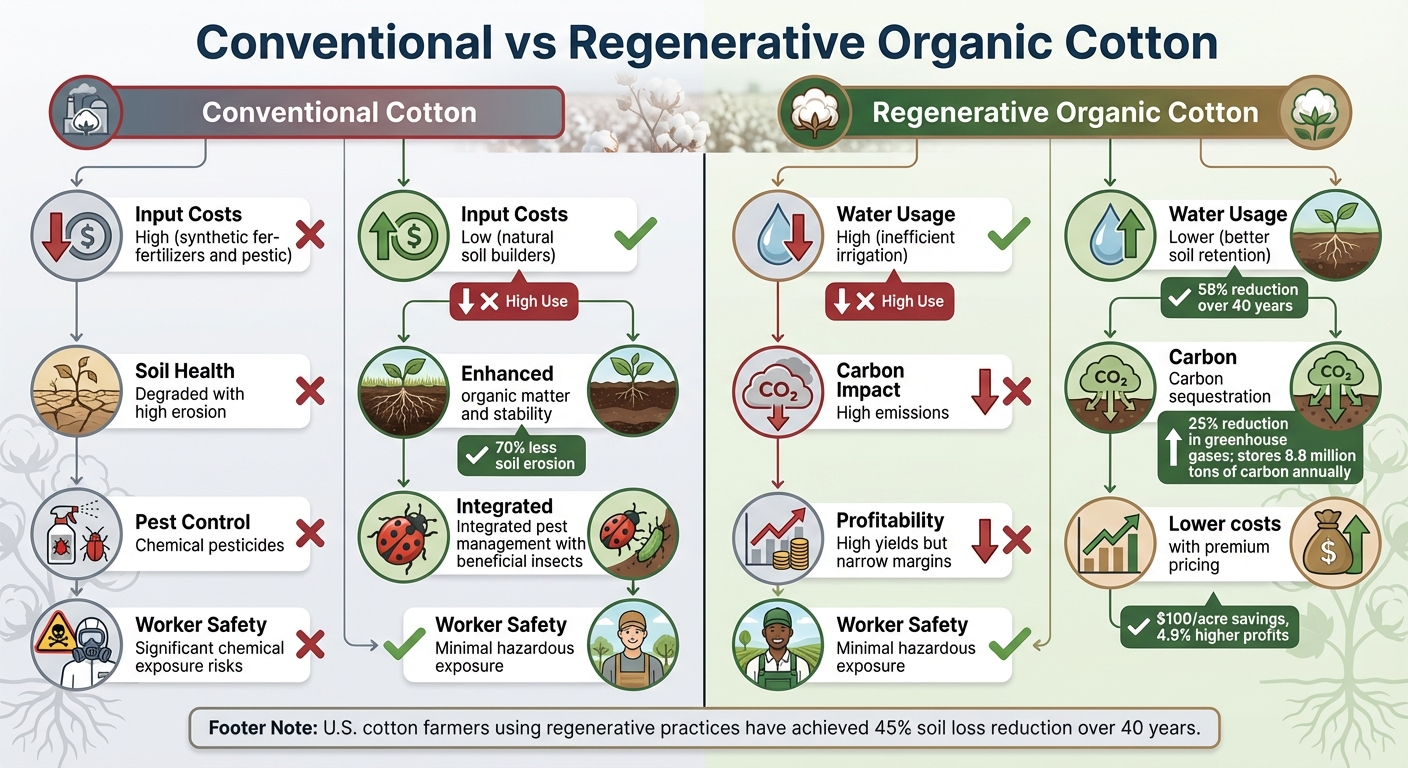
Conventional vs Regenerative Organic Cotton Farming Comparison
Economic Advantages: Lower Costs and Higher Profits
Regenerative organic cotton farming offers a win-win for farmers by lowering expenses and boosting profits. By adopting practices like no-till farming and using cover crops, growers can save about $100 per acre on input costs. These savings come from replacing costly synthetic fertilizers and pesticides with natural methods that nurture the soil.
Take the example of 391 farmers in Maharashtra, India, who joined the Cotton Connect REEL Regenerative Organic Cotton program during the 2023–2024 season. They saw 4.9% higher profits compared to conventional cotton growers. Even with minor yield differences, reduced input costs and access to premium markets drove their profitability.
Consumer preferences also play a key role. A survey reveals that 71% of global consumers are willing to pay more for sustainable clothing, with 70% favoring natural fibers like cotton. This demand helps farmers secure better prices for certified regenerative organic cotton. Meanwhile, initiatives like the U.S. Climate Smart Cotton Program aim to pump $290 million into growers’ pockets over five years through grants and direct incentives.
Beyond immediate financial benefits, regenerative practices build resilience. Healthier soils retain moisture better, enabling farms to withstand extreme weather. For example, Indian farmers in the Better Cotton program cut irrigation water use by 29% and reduced production costs by 15% per hectare between 2015 and 2022, all while maintaining yields 200 kg above the national average.
These financial gains pave the way for equally impactful environmental improvements.
Environmental Benefits: Healthier Soil and Ecosystems
Regenerative farming doesn’t just grow cotton - it revitalizes entire ecosystems. During the 2023–2024 season, 67% of Climate Beneficial™ cotton growers saw soil aggregate stability improve, with some farms reporting increases as high as 124%. Soil microbial activity rose by up to 139%, and active carbon levels increased by 115%. This healthier soil acts like a sponge, soaking up excess water during heavy rains and releasing it slowly during dry periods.
Water conservation is another key outcome. Over time, regenerative methods significantly reduce water usage and soil erosion. Plus, these practices can slash supply-chain carbon emissions by about 60% compared to conventional cotton farming. The benefits extend beyond the soil, safeguarding water resources and promoting biodiversity.
Biodiversity thrives under regenerative management. Crop rotations and pollinator habitats attract beneficial insects that naturally control pests, reducing the need for chemicals. A 2020 study in Arkansas showed that combining no-till farming with cover crops led to 70% less soil erosion and a 1.6% increase in lint yield. This self-sustaining system strengthens soil health by fostering diverse life forms.
Farmers like Cannon Michael, President of Bowles Farming Company in California, have seen these benefits firsthand. Through the Climate Beneficial™ Verification program, his farm integrated cover crops and livestock, improving soil aggregate stability by 67% and increasing organic matter and carbon by up to 20%. Even during a heat dome that caused conventional yields to plummet by 70%, his regenerative fields maintained normal production levels.
These outcomes highlight just how transformative regenerative practices can be when compared to conventional methods.
Comparison: Conventional vs. Regenerative Organic Cotton
| Metric | Conventional Cotton | Regenerative Organic Cotton |
|---|---|---|
| Input Costs | High (synthetic fertilizers and pesticides) | Low (natural soil builders) |
| Water Usage | High (inefficient irrigation) | Lower (better soil retention) |
| Soil Health | Degraded with high erosion | Enhanced organic matter and stability |
| Carbon Impact | High emissions | Carbon sequestration |
| Pest Control | Chemical pesticides | Integrated pest management with beneficial insects |
| Profitability | High yields but narrow margins | Lower costs with premium pricing |
| Worker Safety | Significant chemical exposure risks | Minimal hazardous exposure |
The Role of Regenerative Organic Certified™ Standards
Regenerative organic cotton is transforming farming practices, and certification standards play a critical role in building trust and adding value in the marketplace.
Understanding the Certification Process
The Regenerative Organic Certified® (ROC™) standard takes organic farming to the next level by focusing on three key pillars: Soil Health, Animal Welfare, and Social Fairness. To apply, farms must already hold an organic certification, such as USDA Organic, and submit detailed documentation, including a Regenerative Organic System Plan (ROSP), an Organic System Plan (OSP), operation maps, and current certification reports. Fees for certification applications vary, starting at $350 for small farms with fewer than five parcels and reaching $1,000 for cooperatives.
"Regenerative Organic Certified® is the most rigorous, high-bar certification that exists for food, fiber, and personal care products."
– Regenerative Organic Alliance
Farmers are required to implement specific practices like cover cropping, crop rotation, reduced tillage, and composting. Soil testing is mandatory within the first year of certification, and farms are audited annually, with unannounced inspections to ensure compliance. Certification is offered at three levels - Bronze, Silver, and Gold - each requiring a different percentage of land to meet ROC™ standards.
For brands, the certification process is relatively quick, taking about two weeks from application to approval. Companies must sign a License Agreement, submit a Brand Regenerative Organic System Plan, and provide Supply Chain Actor Disclosure forms to ensure transparency. Annual fees are based on the revenue generated from products featuring the ROC™ label.
These stringent requirements not only validate sustainable practices but also provide essential support for both farmers and businesses to succeed in adopting regenerative methods.
Tools and Resources for Farmers and Businesses
To help farmers and brands navigate the certification process, the Regenerative Organic Alliance (ROA) offers a range of tools and resources tailored to their needs. Farmers receive a customized Regenerative Organic System Plan that builds on their existing certifications, along with detailed Framework Guidance documents outlining requirements for Soil Health, Animal Welfare, and Social Fairness. Additional resources include Soil Sampling Guidelines, a Field Testing Guide, instructional videos, and tracking templates for monitoring soil practices, crop rotation, and biodiversity.
For the cotton industry, the ROA provides specialized Textile Guidelines and a Fiber & Materials Traceability Platform to ensure supply chain transparency from farm to finished product. As of now, the program certifies 483 farms and ranches across 202,191 acres, supporting 65,105 smallholder farmers. Certified producers gain access to a Brand and Product Directory, which connects them with buyers, and a Community Announcements page where they can list certified crops for sale. Financial support is also available through the Farmer Cost-Share Fund, helping smallholders cover audit and certification expenses.
The program relies on 13 approved certifying bodies to conduct audits, while brands undergo desk audits within 3–6 months of receiving their annual license to verify traceability and reconcile product volumes.
The impact of these efforts is clear. Between 2023 and 2024, apparel brand Outerknown increased its use of ROC™ cotton from 4.07% to 14.29% by weight. In India, the brand supports 80 farmers cultivating 100 acres of ROC™ cotton in Khultabad Village, Maharashtra. These farmers have used the premiums from certification to fund community projects, including nurseries and children’s holiday programs.
Examples of Regenerative Organic Cotton in the U.S.
Case Studies and Industry Initiatives
Regenerative organic cotton is making impressive strides across the United States, with farms showcasing both environmental improvements and financial benefits. The U.S. Regenerative Cotton Fund (USRCF) has set an ambitious goal: removing one million metric tons of carbon dioxide equivalent from the atmosphere by 2026. This initiative spans 10 states, collectively accounting for about 85% of U.S. cotton production. Farmers involved in soil health management systems have seen an average net income increase of $172.87 per acre, coupled with production cost savings of $74.30 per acre.
Take Bruce Price & Sons Farm in South Carolina, for instance. This 6,500-acre farm adopted no-till practices and chicken litter application between 2015 and 2022. Over eight years, they saved $2.8 million in input costs and boosted soil organic matter from 1.81% to 2.27%, adding 9,200 pounds of organic matter per acre. By 2023, the farm achieved record cotton yields of 1,084 pounds per acre.
In West Texas, Broadview Agriculture in Tahoka provides an example of regenerative farming in dry conditions. Jeremy Brown, a fifth-generation farmer, manages 5,000 acres of regenerative organic cotton using a mix of seven cover crop species and integrated livestock for natural soil fertilization. Brown’s philosophy is straightforward:
"It's about giving back to the soil, creating a living system that keeps functioning season after season. It's about taking care of the land, because the land takes care of us".
Programs like the Climate Beneficial™ Verification have also taken root, enrolling over 180,000 acres and documenting measurable soil improvements.
On the corporate front, J. Crew's regenerative cotton program has expanded significantly, growing from 600 acres in 2021 to 129,000 acres by 2024. Partnering with 39 farms across six states, the program also collaborates with the Federation of Southern Cooperatives to support Black-owned family farms, such as Allen Farm in Mississippi and Bluford Farms in South Carolina. Katie O’Hare, J. Crew’s Vice President of Sustainability, highlighted the importance of these efforts:
"We believe that regenerative agriculture practices are vital to increasing soil health, reducing carbon impacts, and protecting species biodiversity, which ultimately will benefit our business by ensuring a long‑term supply of this important fiber".
These examples emphasize the importance of strong supply chain connections to uphold certifications and expand market opportunities.
The Role of Directories Like cottongins.org in Supply Chains
For regenerative cotton farmers, connecting with processors and buyers is key to scaling operations. That’s where resources like cottongins.org come in. This directory provides a detailed list of U.S. cotton gins, organized by county and state, helping farmers locate nearby facilities. This is crucial for ensuring traceability and maintaining the integrity of regenerative certifications.
As brands increasingly prioritize verified sustainable fibers, farm-to-brand relationships are becoming more critical. Programs such as Climate Beneficial™ and regenagri certification help bridge the gap by linking farmers directly with company leaders, designers, and sourcing teams. Historically, supply chains have been fragmented, but tools like cottongins.org make it easier for brands to identify local partners and build regional networks.
To scale regenerative cotton effectively, farmers need consistent access to ginning facilities that can handle their fiber separately to preserve certification standards. Directories like cottongins.org play a vital role by simplifying the process of finding processing partners, enabling both seasoned farmers and newcomers to navigate the supply chain with greater ease.
Conclusion: The Path Forward for Regenerative Organic Cotton
Key Takeaways and Next Steps
Regenerative organic cotton offers a promising way to address the growing crisis of soil depletion and environmental harm in agriculture. The numbers are stark: without changes, fertile soil could be exhausted within 60 years, and in the U.S., soil is being lost 10 times faster than it can naturally recover. On the positive side, farmers adopting regenerative practices are already seeing benefits like higher net incomes and lower input costs. These financial advantages highlight the urgency of adopting these methods.
This approach shifts the focus from chemical inputs to soil biology, using strategies like no-till farming, cover crops, and crop rotation to improve soil health. For businesses, this transition requires active support for farmers, especially during the early years of change. Programs like "Cotton in Conversion" and supply chain models such as Hard Identity Preserved (HIP) Chain of Custody ensure transparency and accountability in verifying regenerative practices. Consumer demand for sustainable materials continues to grow, further driving the momentum behind these efforts.
Certification frameworks play a crucial role in validating these practices and enhancing trust. Standards like Regenerative Organic Certified™ (ROC) and Regenerative Cotton Standard (RCS) not only confirm sustainable farming methods but also strengthen market credibility and open doors to new opportunities. These certifications align with emerging regulations, such as the EU Green Claims Directive and Corporate Sustainability Reporting Directive (CSRD). Tools like cottongins.org are also helping bridge the gap between farmers and processing partners, ensuring regenerative cotton is handled separately to maintain certification integrity.
As Jeremy Brown, a Regenerative Organic Cotton Farmer, aptly states:
"You are what you eat, but you're also what you wear. It all matters – and we have to take responsibility for how things are grown, how they're made and who's impacted."
The U.S. cotton industry has already made progress, cutting soil loss by 45% and water usage by 58% over the last four decades. Regenerative farming takes this further, with the potential to capture up to 250 million metric tons of carbon annually on U.S. farmland. The path forward is clear: start with small trial plots, seek technical guidance from organizations like the Carbon Cycle Institute, and use available tools to build reliable supply chains that focus on soil health and long-term sustainability.
FAQs
How do I start transitioning to regenerative organic cotton?
To get started, familiarize yourself with certification standards like Regenerative Organic Certified™ (ROC) and the Regenerative Cotton Standard. These frameworks emphasize core principles such as improving soil health, supporting biodiversity, and ensuring fair labor practices.
Adopt essential regenerative methods, including crop rotation, composting, cover cropping, and reducing tillage. These practices not only enhance soil quality but also contribute to sustainable farming systems.
It's a good idea to engage with the certification process early. This helps ensure compliance, opens doors to premium markets, and fosters long-term partnerships. Additionally, keep yourself updated by exploring industry case studies and resources that highlight regenerative agriculture practices.
What does Regenerative Organic Certified® require?
Regenerative Organic Certified® takes organic farming to the next level by demanding practices that actively improve soil health, ensure animal well-being, and uphold fair treatment of workers. These efforts contribute to outcomes like capturing carbon in the soil, protecting biodiversity, and conserving water resources. This certification focuses on a well-rounded approach that benefits the planet while also supporting farmers and their communities.
How can I keep regenerative cotton traceable through ginning?
To keep regenerative cotton traceable during the ginning process, tools like the GOTS Farm-Gin Registry come into play. This system links certified farms with specific gins and monitors cotton volumes, certifications, and processing details every step of the way. It enforces traceability through strict protocols, such as transport restrictions, GMO testing, and frequent audits. These measures ensure a reliable supply chain, uphold certification standards, and encourage transparency from the farm to the gin.