Here’s the short answer: in 2026, precision ag in cotton pays best when I use it to fix a clear field problem, not when I buy tech first and ask questions later.
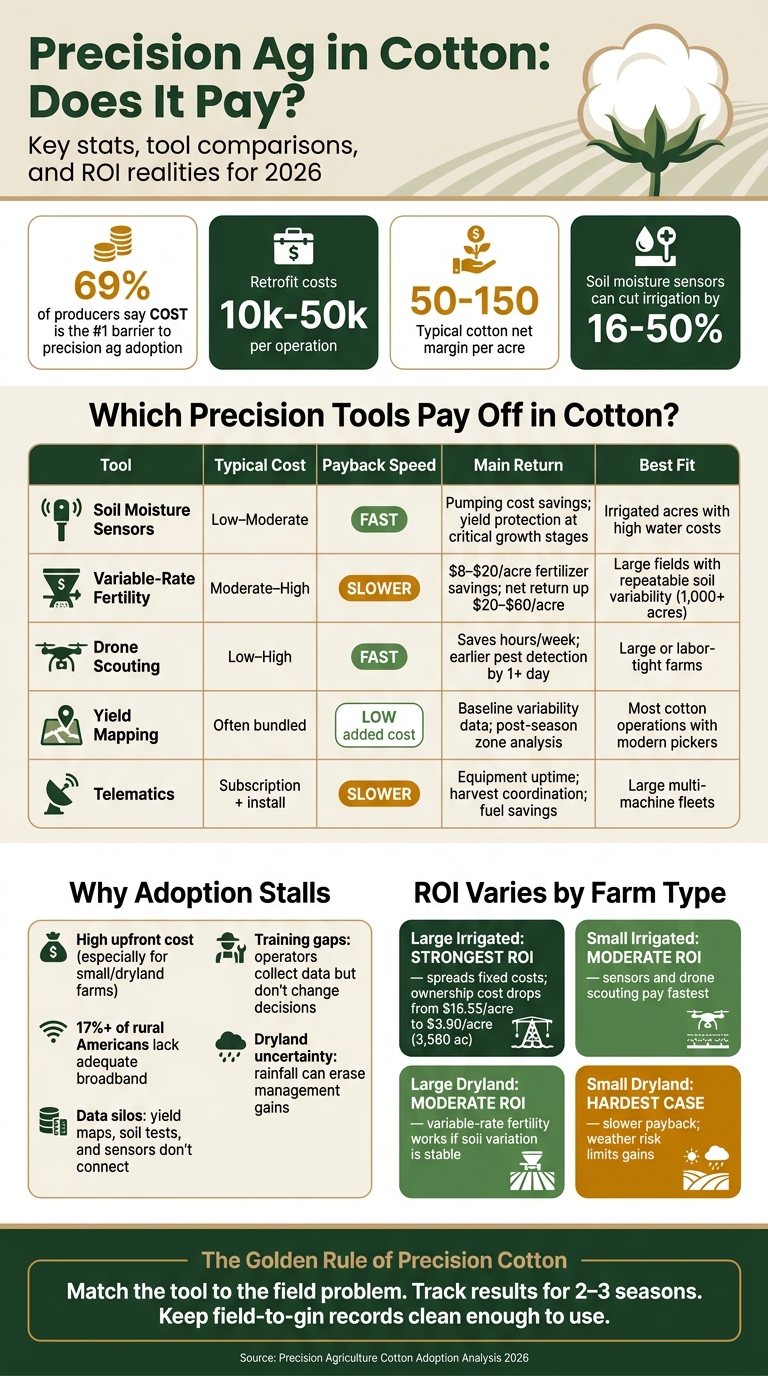
Most cotton acres already use the basics, like guidance. But data-heavy tools still lag. The article shows why: cost is the top barrier, older equipment can take $10,000 to $50,000 to retrofit, and many farms only net about $50 to $150 per acre. On the return side, the strongest numbers usually come from soil moisture sensors, variable-rate fertility, yield mapping, drone scouting, and telematics - but only when field conditions fit the tool.
If I had to boil the whole article down, it says this:
- Guidance is common. More advanced tools are still used on a much smaller share of cotton acres.
- ROI often comes from lower input and water costs, not just more yield.
- Soil moisture sensors can cut irrigation by 16% to 50% and, in some trials, add 150 to 200 lb/acre in cotton yield.
- Variable-rate fertility tends to work best on fields with repeat soil-driven variation and enough acres to spread mapping costs.
- Dryland cotton is a harder case because rainfall can wipe out the gains from better targeting.
- Large irrigated farms have an edge since they can spread fixed costs over more acres and react faster to data.
- Data problems slow farms down. If maps, probes, and software do not line up, people fall back to flat-rate decisions.
- The best rollout is small at first: test on problem fields, track strips, compare results, and then expand what proves out.
Precision Agriculture Cotton Tools: ROI, Cost & Best Fit (2026)
Estimating Cotton Yield with Dr. Mike Mulvaney
sbb-itb-0e617ca
Quick Comparison
| Tool | Main payoff | Best fit | Main issue |
|---|---|---|---|
| Soil moisture sensors | Lower pumping cost, better irrigation timing, yield protection | Irrigated cotton with high water costs | Bad probe placement or slow response |
| Variable-rate fertility | Lower fertilizer use and better zone targeting | Large fields with repeat soil variation | Weak response on uniform or dryland fields |
| Drone scouting | Less scouting time, earlier pest/stress calls | Big farms or lean labor setups | No payoff if findings are not acted on |
| Yield mapping | Better post-harvest field analysis | Most farms with newer pickers | Data gets ignored after harvest |
| Telematics | Better machine use, fuel tracking, harvest flow | Large fleets and gin-linked harvest systems | Hard to turn into dollars on small fleets |
Bottom line: the article makes a simple point. Precision cotton tools can pay, but the money shows up when I match the tool to the field, track results for 2 to 3 seasons, and keep field-to-gin records clean enough to use.
The Main Barriers Slowing Cotton Adoption
The biggest problem in cotton isn’t the tech itself. It’s turning data into decisions at a price the farm can live with. In a U.S. crop producer survey cited by IFMA, 69% of respondents said cost was the biggest barrier to precision agriculture adoption. That pressure shows up right away in equipment prices and uneven payback.
Equipment Cost and Uneven Payback
A full setup can mean guidance, variable-rate controllers, moisture sensors, drones, software, and retrofit work. The bill adds up fast, often landing in the tens of thousands of dollars.
Retrofitting older equipment can add $10,000–$50,000 once hardware, installation, and calibration are included.
That’s a tough sell in cotton. Many operations net $50–$150 per acre after all costs. At that level, a $25,000 tool needs to spread across a lot of acres or deliver steady, measurable savings to pay for itself within three to five seasons. On more uniform fields - or on dryland acres where weather has more say than management - the case gets harder to make.
Data, Training, and Connectivity Problems
Even when growers buy the right tools, they often hit a wall when they try to use the data. Yield maps may be stuck in proprietary formats. Soil test results show up as PDFs. Moisture probe readings sit in a separate web portal. Nothing talks to anything else on its own, so building a usable variable-rate prescription can turn into hours of file-sharing, cleanup, and reconciliation.
At some point, the work of merging data outweighs the gain. Growers slide back to uniform-rate plans even when they know field variability is there. And when the data stays split across systems, decisions slow down - or never happen.
Training gaps make it worse. Many operators learn enough to get the system running, but not enough to clean yield map data, catch GPS drift, or change moisture thresholds in the middle of the season. So the tool gathers data, but the farm doesn’t change many decisions.
Then there’s connectivity. The GAO found that at least 17% of rural Americans lack access to fixed broadband at 25/3 Mbps, and the FCC Precision Agriculture Task Force has stressed that dependable field-level connectivity - not just service at the farmhouse or headquarters - is required for day-to-day use. If a machine can’t send data to the cloud with any consistency, telematics and real-time scouting lose a big part of their use. That’s one reason many growers stop at trial acreage instead of going bigger.
Why Growers Hesitate to Scale Up
Most growers test precision tools on a small set of fields first. Fair enough. The trouble comes after that. If one field shows a clear gain and another shows nothing, it’s hard to tell what happened. Did the tool miss the mark, or did that field just have less variability to work with?
Without multi-season data across different soil types and weather years, the picture stays murky. And that murkiness sits at the center of ROI uncertainty.
Maintenance adds another layer of doubt. Yield monitors need recalibration. Sensor depths move. Rate controllers need to be checked. When labor is tight, and one calibration mistake could mean under-fertilizing a high-yield zone or missing an irrigation set, the risk doesn’t feel abstract. It feels immediate.
So many producers make a cautious move: they keep precision tools on a few high-value fields and leave the rest on uniform-rate management. That’s a sensible hedge, but it also limits how much return the whole setup can deliver.
| Barrier | Small Farm | Large Farm | Irrigated Acres | Dryland Acres |
|---|---|---|---|---|
| Equipment cost (relative burden) | High | Medium | Medium | High |
| Data integration complexity | Low–Medium | High | Medium | Medium |
| Training and staffing gaps | Medium | High | Medium | Medium |
| Rural connectivity | High | Medium–High | Medium–High | High |
| Uncertain payback | High | Medium | Low–Medium | High |
The tools getting the most traction tend to be the ones that prove their worth fast: variable-rate fertility, soil moisture sensing, and scouting tied to a clear baseline.
What Is Working: Cotton-Specific Tools and Success Stories
The cotton tools getting the most traction in 2026 are the ones that change an application rate, a route, or an irrigation call, not the ones that just pile up data. On most farms, the test is simple: does the tool fit the field variability, water costs, labor setup, and total acres?
Variable-Rate Fertility and Management Zones
Variable-rate fertility breaks fields into 3 to 6 zones based on multi-year yield maps, EC scans, elevation, and soil texture. In plain terms, sandy ridges that keep coming up short get less fertilizer, while heavier, higher-potential bottom ground gets more.
Cotton growers in Texas and the Mid-South have reported fertilizer savings of $8–$20 per acre, with net returns improving by $20–$60 per acre once yield response is factored in. One cotton study found $9/ha more return than standard practice in a sensor-guided topdress system and $16/ha in an idealized perfect-information model.
This tends to work best on fields with stable, soil-driven variability. If the same parts of the field underperform year after year, even when rainfall changes, zone-based management has a much better shot. The fixed cost of EC mapping and prescription writing also means you need enough acres to spread out the expense, often 1,000 acres or more across similar soils.
Soil Moisture Sensors and Irrigation Decisions
On irrigated cotton, soil moisture sensors give a live read on root-zone water at more than one depth. That matters most during first square, first bloom, and peak bloom, when water stress can hit boll retention hard.
Growers and extension programs have documented water-use cuts of 0.5–1.5 acre-feet per season, along with pumping and labor savings of $10–$30 per acre, without a yield hit when probe placement and thresholds are handled well. The strongest payback shows up on farms with high pumping costs, whether diesel or electric, tight water limits, and crews that can move fast when alerts come in.
Sensors also help spot overwatering. In cotton, with its deeper root system, extra water doesn't just burn fuel and power. It can also push nutrients below the root zone.
Drone Scouting, Yield Mapping, and Telematics in Daily Operations
Drones can cover a lot of ground in a hurry. One flight can check hundreds of acres in the time it takes a scout to walk a handful of fields. That makes it easier to catch canopy stress, stand gaps, potassium deficiency on sandier ridges, or pest pockets like bollworm or lygus infestations before they spread.
Cotton producers and consultants have reported saving several hours per week during peak monitoring windows, with spray or irrigation response times improving by a day or more compared with standard scouting. A USDA-ARS study in Lubbock, Texas, using UAV-based yield prediction, achieved R² > 0.9 at the row level, which shows how precise drone imagery can get when it is paired with ground data.
Yield monitoring and mapping are now built into many modern cotton pickers, which makes them one of the easiest tools to put to work. After harvest, those maps help confirm prescriptions, compare varieties, and point out low-response zones that keep showing up.
Telematics adds another layer to day-to-day management. It tracks machine location, fuel use, and operating status across pickers, module trucks, and boll buggies in real time. That can cut idle time, tighten harvest coordination, and give gin managers a better view of incoming modules. It also helps with module flow and gin intake planning.
That is why ROI comes down to farm type, not just tool type.
| Technology | Typical Cost Range | Management Complexity | Main Return | Best Fit |
|---|---|---|---|---|
| Variable-rate fertility | Moderate-high | Medium-high | Lower fertilizer use; yield gains or yield stability in high-potential zones | Stable zones with reliable soil, yield, and EC data |
| Soil moisture sensors | Low-moderate | Low-medium | Fewer irrigations, lower pumping costs, protected yield at critical stages | Irrigated acres with real pumping costs and fast response to alerts |
| Drone scouting | Low-high | Medium | Faster scouting, earlier pest and stress detection, fewer wasted field passes | Large, labor-tight farms needing fast issue detection |
| Yield mapping | Often bundled with picker | Low-medium | Baseline variability analysis, zone creation, post-season learning | Most cotton operations; best when reviewed after harvest |
| Telematics | Subscription + installation | Low-medium | Equipment visibility, harvest coordination, better logistics | Large or spread-out operations with routing and labor limits |
The next question is which farm situations make these returns repeat year after year.
ROI by Farm Situation: Where the Numbers Make Sense
In cotton, ROI comes down to fit. The right tool on the right field can pay. The wrong tool on the wrong acres usually won't. So the next step is simple: figure out which farm setups are most likely to turn that fit into actual dollars.
Best Fits for Irrigated, Dryland, Small, and Large Operations
Irrigated cotton often shows the strongest precision ROI. Water timing matters, energy costs matter, and protecting yield matters too. When all three are in play, even small improvements can add up fast.
Large operations also have a clear edge. They can spread fixed costs across more acres, which pushes ownership cost down in a big way. One case study found annual ownership cost dropped from $16.55 per acre on 356 acres to $3.90 per acre on 3,560 acres.
Dryland cotton is tougher. Payback tends to be slower and less predictable because rainfall can outweigh gains from better management. Variable-rate fertility makes the most sense when soil variation shows up again and again in the same places and when there are enough acres to cover mapping costs.
That gap helps explain why some tools can pay back in one season, while others take a few years of steady use.
Short-Payback Tools vs. Multi-Year Investments
Some tools tend to pay back faster than others. Outsourced drone scouting, yield mapping, and soil moisture sensors are usually the quickest to show value. On the other hand, full variable-rate hardware and fleet-wide telematics often need several seasons before the math starts to work.
Variable-rate nitrogen on cotton increased net return by $13.70 per acre in one economic review, but only on fields with enough yield variation to justify the service cost. In a separate multi-site study, variable-rate nitrogen did not improve yields or net returns compared with a fixed practice. Same tool, different outcome. The deciding issue was field variability.
How to Measure Results After the First Season
Once a tool is in place, the first season should show whether it changed a decision, not just whether it produced a pile of data.
Track results against a baseline or check strip. Focus on:
- Input cost
- Lint yield
- Irrigation water
- Labor hours
- Scouting trips
- Fuel use
- Harvest timing
After season one, the main question isn't only whether the tool paid for itself. It's whether it changed what the farm did. Did it cut a fertilizer pass? Move an irrigation event up by a day? Catch a pest pocket before it spread?
If full payback doesn't show up in year one, the honest next step is to ask whether the system improved decisions enough to keep going into year two.
| Technology | Return Drivers | Ideal Use Case | Payback Speed | Main Risk |
|---|---|---|---|---|
| Soil moisture sensors | Pumping-cost savings, yield protection | Irrigated acres with high water costs and hard irrigation timing | Fast | Poor sensor placement or uneven use of alerts |
| Variable-rate fertility | Fertilizer savings, better nutrient placement | Large fields with meaningful, repeatable soil variability | Slower, usually multi-year | Weak variability or limited crop response in dryland fields |
| Drone scouting (outsourced) | Labor savings, earlier problem detection | Large or labor-tight farms; fields where scouting time is already a constraint | Fast | Value depends on acting fast on findings |
| Yield mapping | Baseline data for management zones and post-season learning | Most cotton operations with modern pickers | Low added cost | Data goes nowhere if maps aren't reviewed or used |
| Telematics | Equipment uptime, fuel efficiency, operator accountability; for gin-connected operations, harvest coordination and module flow | Large multi-machine operations | Slower, usually multi-year | Hard to turn into dollars on small fleets |
Practical Adoption Steps for Growers and Gin-Connected Businesses
Start Small, Test on the Right Fields, and Build a Baseline
Once ROI is clear on a few fields, the next move is simple: follow the problem, not the tech.
A good starting point is 5%–20% of your acreage, focused on fields with repeat problems like yield swings, chronic over-irrigation, or recurring nutrient stress. That smaller test area helps cut three issues that slow many operations down: cost exposure, training gaps, and connectivity limits.
Before planting, record a baseline for the test fields and match gin classing reports to field IDs. Set up a treated strip and a matched comparison strip so the result reflects your conditions, not numbers pulled from another farm with different soils, weather, or management. That same field-ID discipline also makes harvest and gin records far more usable later.
A simple rollout can look like this:
- Year 1: map fields and clean data
- Year 2: apply variable-rate fertility and moisture sensing on the highest-variability acres
- Year 3: scale what worked and connect harvest data to the gin
Use Field-to-Gin Data More Effectively
Better harvest results often come down to one plain administrative habit: consistent field naming across every system you use.
If your field names match in your yield monitor, your consultant's records, and the gin's module tags, post-season analysis gets a lot more useful. Without that match, you're trying to piece the story together with half the pages missing.
Before harvest, share expected harvest windows and field-by-field acreage with your gin. During harvest, tag modules with field name, variety, and date. After the season, ask for turnout and quality data by field. When field IDs, module tags, and classing reports line up, growers can spot which zones keep underperforming and start digging into why.
Key Lessons from Cotton Precision ROI in 2026
Once the records are clean, the next job is figuring out what deserves to scale.
Precision adoption in cotton is growing, but it still isn't even across the board. Larger irrigated operations often move faster because they can spread fixed costs and spot clearer water-related savings. Smaller dryland farms usually deal with slower payback and more uncertainty.
The strongest ROI stories in 2026 have one thing in common: the tool fit a specific, documented field problem. Whole-farm rollouts without a clear target often don't produce numbers strong enough to defend to a lender or business partner.
ROI is most convincing when it's measured field by field over at least two or three seasons. A single year can get pushed around by weather or price swings. Multi-season tracking that combines yield, quality, input use, and labor gives a much more honest view of what a tool is delivering.
cottongins.org helps growers identify gins, organize module tagging, and connect field records to harvest data, which helps precision investments show up in the numbers.
FAQs
Which precision ag tool should I try first in cotton?
GPS-guided equipment - especially auto-steer - is often the best first move in precision cotton farming. A big reason is simple: many newer machines already support it, so the upgrade is usually easier than people expect.
It also lays the groundwork for later tools, like variable-rate seeding and zone-based inputs. And the payoff can show up fast: less overlap, lower fuel use, and less operator fatigue.
How many acres do I need for precision ag to pay off?
In cotton, precision ag usually starts to pay for itself at around 100 to 200 acres. Once an operation reaches 500+ acres, it’s often in a much better spot to justify a full tech stack, since those fixed costs get spread across more acres.
That said, smaller farms aren’t shut out. They can still get a solid return by starting small, with options like free apps, shared drone services, or GPS guidance before stepping up to full variable-rate systems.
How do I track ROI from field to gin?
Use yield monitors on pickers to record GPS-tagged harvest data in pounds per acre and tie field performance to gin intake.
Then compare harvest and input maps to spot cost overruns or execution gaps. Track lint yield, field-to-gin turnaround time, and fiber quality metrics to see whether field practices improved efficiency and gin turnout.
Related Blog Posts
- Implementing Precision Agriculture in Cotton Farming for Higher Yields
- Implementing Variable Rate Technology in Cotton Farming for Efficiency
- Precision Cotton Farming: Leveraging Digital Tools and Advanced Techniques for Maximum Yield
- Transforming Cotton Farming With Technology and Precision Agriculture