If I had to sum it up in one line: organic cotton protection at scale works best when I treat it like a system, not a spray program.
That means I plan for pests early, scout often, use field setup to lower pressure, bring in living controls when timing fits, and only use approved products when field counts say it’s time. In the article, the strongest field results came from a few tools used together, not alone:
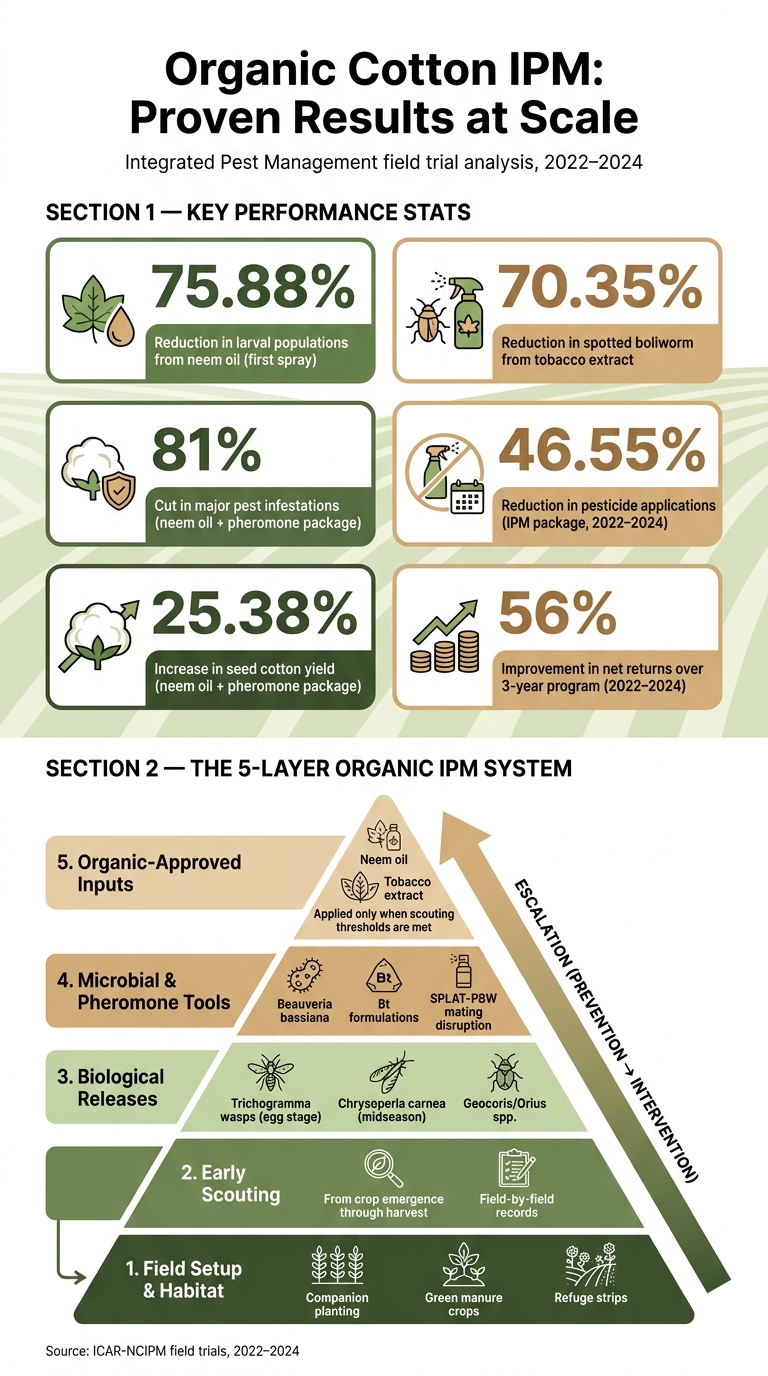
- Neem oil cut larval pressure by 75.88%
- Tobacco extract cut spotted bollworm by 70.35%
- A package with neem oil + pheromone tactics cut major pest infestations by 81%
- That same package reduced pesticide applications by 46.55%
- It also increased seed cotton yield by 25.38%
- A multi-year program from 2022–2024 improved net returns by 56%
If you grow cotton under USDA organic rules, the article makes one point very clear: prevention comes first. I’d focus on:
- early scouting from crop emergence through harvest
- field setup that supports predator insects
- releases like Trichogramma and Chrysoperla carnea when timing lines up
- microbial options like Beauveria bassiana and Bt when pest stage and weather fit
- pheromone tools such as SPLAT-PBW for pink bollworm
- records by field so I can time treatments and track what worked
Here’s the short version: use habitat, scouting, biological tools, and organic-approved inputs in one season-long IPM plan. That’s the clearest path to scaling organic cotton protection without relying on rescue sprays.
Organic Cotton IPM: Key Results & Proven Non-Chemical Strategies
Scouting for Cotton Insect Pests
sbb-itb-0e617ca
Build Pest Prevention Into the Production System
Build pest prevention into the system from the start, not after pest numbers climb. Habitat-based tactics can hold pests down before they become a bigger problem. In cotton fields, companion planting may help support beneficial insects and ease pest pressure. Beauveria bassiana and Trichogramma wasps are proven non-chemical control options for key cotton pests. When used early, they can lower pressure before rescue treatments are needed.
Biological control can also help slow resistance and cut spray dependence. The big limit is scale. Results can differ by region, and large-acre use still depends on local trial data and delivery logistics. So these tools work best when they’re tied to scouting and field-level IPM decisions.
Biological Control Methods That Work at Commercial Scale
Beneficial Insects and Field Habitat Design
Once prevention is in place, biological control becomes the next layer of pest pressure. On large farms, this only works if beneficial insects are in the field before pest numbers jump. That’s the hard part in day-to-day farm work: keeping those helpful populations active across a lot of acres.
Preplant green manure crops such as Sesbania bispinosa (dhancha) can cut thrips, whiteflies, and spider mites while increasing Geocoris punctipes and Orius spp.. Companion plantings or refuge strips can do much the same thing. The main idea is simple: build habitat ahead of pest peaks so beneficial insects are already in place when pressure starts to build.
That base in the field also makes in-season releases work better when pest pressure climbs.
Commercial Releases and Microbial Biopesticides
Augmentative releases and microbial sprays help fill the gap when resident predators are too thin. Chrysoperla carnea (green lacewing) release cards work against thrips, whiteflies, and spider mites. Use them from midseason onward, when sucking pests tend to increase.
For caterpillar and bollworm pressure, Trichogramma wasps attack pest eggs before larvae hatch. Beauveria bassiana works on whiteflies and aphids as a microbial foliar spray. One catch: time Beauveria bassiana applications around scouting and weather, because heat and drought can weaken results.
Pair habitat support with releases and scouting-based sprays.
Comparison Table: Biological Options by Target Pest and Application Method
| Biological Option | Target Pest(s) | Mode of Action | Application Method | Timing Window | Key Constraint |
|---|---|---|---|---|---|
| Trichogramma wasps | Caterpillars, bollworms | Egg parasitism | Augmentative release | Egg-laying period | Must match pest egg availability |
| Chrysoperla carnea | Thrips, whiteflies, spider mites | Predation | Release cards | Midseason onward | Less effective early season |
| Beauveria bassiana | Whiteflies, aphids | Entomopathogenic fungus | Microbial foliar spray | Based on scouting | Reduced efficacy in heat or drought |
| Geocoris punctipes | Sucking pests | Predation | Preplant habitat | Preseason through season | Requires habitat establishment pre-season |
| Orius spp. | Thrips, mites, aphids | Predation | Companion plantings/refuge strips | Preseason through season | Depends on habitat diversity |
Organic-Compliant Inputs With Documented Field Value
Botanical, Mineral, and Microbial Products for Cotton
When habitat support and beneficial releases don’t do enough, approved inputs can add another layer of control. The key is simple: spray only when scouting shows pressure, not on a fixed calendar.
Neem oil (azadirachtin) has the strongest documented field results in cotton. Trials showed a 75.88% reduction in larval populations after the first spray, along with a cost-benefit ratio of 1:85.9. That made it the strongest economic option among the botanicals tested against spotted bollworm and sucking pests.
Tobacco extract also performed well in cotton trials, reducing spotted bollworm populations by 70.35%. It can fit into a rotation when pest pressure is high.
Bt formulations (Bacillus thuringiensis) go after caterpillar larvae, including Earias insulana. But timing matters a lot here. They work best when applied at the early larval stage.
Beauveria bassiana helps suppress whiteflies and aphids as a microbial foliar spray. But there’s a catch: it needs the right weather. Apply Beauveria bassiana only under favorable moisture and temperature conditions, because heat and drought can weaken performance. Trichogramma wasps go after pests at the egg stage, before larvae hatch.
| Input | Primary Target | Key Caution |
|---|---|---|
| Neem oil (azadirachtin) | Bollworms, sucking pests | Repeat applications may be needed; verify organic status |
| Tobacco extract | Spotted bollworm | Best used within a rotation |
| Bt (B. thuringiensis) | Caterpillars | Timing-sensitive |
| Beauveria bassiana | Cotton pests | Use within a broader IPM program |
| Trichogramma wasps | Egg-stage pests | Works best with habitat support |
Semiochemicals, Repellents, and Compatibility Planning
For pests spread across an entire field, pheromones can do more than a one-time spray. For pink bollworm (Pectinophora gossypiella), SPLAT-PBW supports area-wide mating disruption and mass trapping. That can help cut the need for late-season rescue sprays.
One field validation package showed what this can look like in practice. Neem oil paired with pheromone-based tactics cut major pest infestations by 81%, reduced pesticide applications by 46.55%, and increased seed cotton yield by 25.38%.
"IPM strategy proved highly effective in reducing major cotton pests, ecologically safer by enhancing natural enemy population, and significantly lowering pesticide use across three seasons." - Ajanta Birah, ICAR-National Research Institute for Integrated Pest Management
None of these inputs work well on autopilot. Labels, timing, and tank-mix partners all need to line up. That’s what decides whether they support each other or get in each other’s way.
Before making any tank mix, confirm that each product is OMRI-listed or otherwise approved for organic use. Also avoid combinations that can weaken biological agents such as Beauveria bassiana or Trichogramma wasps. Rotating neem oil and tobacco extract can also help slow resistance and reduce harm to beneficial insects.
Building a Season-Long Cotton IPM Program
Scouting, Thresholds, and a Seasonal Schedule
Once you've picked your tools, timing is what makes them pay off. A season-long IPM program doesn't run on a spray calendar. It runs on what's happening in the field. That's why scouting sits at the center of every call.
Start regular field checks as soon as the crop emerges. Keep them going through the season so you can line up each move with pest thresholds and field history. Build the program around timely planting and early-season habitat support, then use scouting to time the biological and pheromone tools already in place. Check field edges more often when nearby crops increase pressure. After harvest, remove residues to help break pest cycles.
On large acreages, that kind of field-by-field timing has to stay coordinated.
Equipment, Records, and Regional Coordination
At scale, coordination matters more than any one tool. Use a single IPM plan to line up timing, placement, and rechecks across all fields.
Keep field-by-field records of scouting notes, threshold calls, planting dates, and treatment timing. Those records make it easier to repeat what worked, fix what didn't, and coordinate with nearby fields when regional pest pressure shifts.
Conclusion: The Practices That Scale Best in Organic Cotton
When the season ends, the record shows what needs to change next year. The best programs keep scouting, records, and thresholds on the same schedule. In a 2022–2024 field study, a package of timely sowing, cowpea intercropping, neem oil, and SPLAT cut pesticide use by 46.55% and raised net returns by 56%.
FAQs
How do I start an organic cotton IPM plan?
Start with regular field scouting to track pest levels and spot helpful insects already at work in the field.
Then layer in cultural practices like crop rotation, cover cropping, and border vegetation management. Add biological controls such as biopesticides and natural enemies like Trichogramma wasps or parasitoid wasps.
The best approach is to bring these practices in gradually. That gives you time to watch what changes, monitor results on a regular basis, and adjust based on what you see.
Which organic pest controls work best at scale?
At scale, the most effective organic pest controls for cotton are biological agents and field-level growing practices. Parasitoid wasps can cut bollworm populations by 60%–90%. Biopesticides such as Beauveria bassiana and Bt can deliver moderate suppression and help support yield gains.
Other methods also work well across large fields. Trap cropping with sunflowers or maize can pull pressure away from cotton. Sticky traps and row covers can help with early-season exclusion.
The best results usually come from using these tools together as part of an integrated pest management approach. That mix can improve control and reduce reliance on chemical pesticides.
When should I use neem, Bt, or beneficial insects?
- Use neem for selective, natural pest control. It disrupts pest growth while leaving helpful insects largely unharmed. For best results, apply it in the early morning or evening.
- Use Bt for pests like bollworms and caterpillars, especially when the pest needs to eat the treatment for it to work.
- Bring in or protect beneficial insects by giving them habitat and food sources. That way, they can help keep pest numbers down on their own.