The Organic Content Standard (OCS) ensures that products claiming to use organic cotton are traceable and verified throughout the supply chain. It tracks organic cotton from the cotton gin to the final product, requiring third-party audits and documentation at every stage. Key points include:
- Chain of Custody: OCS uses Scope Certificates (SC) and Transaction Certificates (TC) to verify the flow of organic cotton through the supply chain.
- Certification: Facilities must meet strict requirements, including annual audits, to maintain compliance.
- Volume Reconciliation: Ensures the quantity of organic cotton entering and leaving a facility matches, preventing substitution with non-organic fibers.
- Market Access: Certified products gain access to premium markets and build consumer trust.
OCS certification is vital for maintaining transparency and accountability in organic cotton production. By 2027, OCS will transition to the Materials Matter Standard, further refining these processes.
How OCS Ensures Traceable Cotton
Chain of Custody Tracking
The Organic Content Standard (OCS) ensures that organic cotton remains traceable through every stage of its production. This is achieved using two essential documents. The first is the Scope Certificate (SC), issued to facilities after a third-party audit confirms they meet OCS standards for handling certified materials.
The second document, the Transaction Certificate (TC), tracks ownership changes of organic cotton. Each time ownership transfers, a TC must accompany the transaction. This document not only verifies the transfer but also allows for precise volume reconciliation. As Textile Exchange explains:
"Every time organic cotton products change ownership, they need to be accompanied by a transaction certificate too. This details the volume of organic cotton being sold, helping to ensure that the original amount of organic cotton from the farm remains the same as it moves between facilities".
Volume reconciliation is the backbone of this system. Certification bodies - currently over 30 worldwide - audit facilities to ensure that the amount of organic cotton entering matches the amount leaving. To streamline this process, Textile Exchange introduced the Trackit program, a digital tool that automates volume checks by integrating certification data across different certifying bodies.
While digital tools enhance tracking, physical facilities enforce compliance at every stage. Cotton gins, in particular, play a pivotal role in maintaining the integrity of organic cotton through on-the-ground controls.
Role of Cotton Gins and First Processors
Certification documents may track volumes, but cotton gins are where the system truly takes shape. Although organic cotton is certified at the farm level by government standards, voluntary standards like OCS begin their certification process at the gin. This makes the gin the critical link between farm-level certification and supply chain tracking.
Textile Exchange highlights this role:
"From the gin onwards, organically grown cotton certified to any government-controlled standard... can be sold under the OCS, which acts as proof of its provenance, if specific chain of custody requirements are met".
Since December 1, 2022, OCS has required all first processors contributing to OCS-certified products to also hold OCS certification. Cotton gins are responsible for recording farm data and reconciling raw and processed cotton volumes. This step is essential for maintaining the integrity of organic cotton throughout its journey in the supply chain.
OCS Certification Requirements for Cotton
Farm-Level Certification Requirements
For cotton to qualify for the OCS supply chain, it must originate from farms certified under a government-controlled organic standard that is part of the IFOAM Family of Standards. Textile Exchange clearly states:
"Only material from certified organic farms (under one of IFOAM's Family of Standards) is accepted to the OCS".
In addition, producers must comply with the OCS-103 Policy for GMO screening, which is typically verified at the ginning stage. Cotton that is in the process of transitioning to full organic certification, known as "in-conversion" cotton, can also be marketed under the OCS framework.
Once farm-level compliance is confirmed, the integrity of the organic cotton must be upheld throughout the entire supply chain, supported by strict auditing processes.
Supply Chain Compliance and Audits
Every facility involved in handling organic cotton must undergo an annual on-site audit conducted by an independent third-party certification body. These audits ensure that organic cotton is properly segregated and that volume reconciliation is accurate during key processes such as ginning, storage, and handling. Auditors verify that the quantity of organic cotton entering a facility matches the amount leaving, eliminating the risk of substitution with conventional fibers.
The results of these audits also determine the certification level for each product. The two main certification categories under OCS are:
- OCS 100: Products containing 95–100% certified organic fiber.
- OCS Blended: Products with a minimum of 5% certified organic fiber.
The certification level directly impacts labeling and dictates how products can be marketed to consumers. This ensures transparency and trust in the organic cotton supply chain.
Organic Cotton Standards II What is OCS ? II OCS certification process ( English Version)
How to Obtain OCS Certification
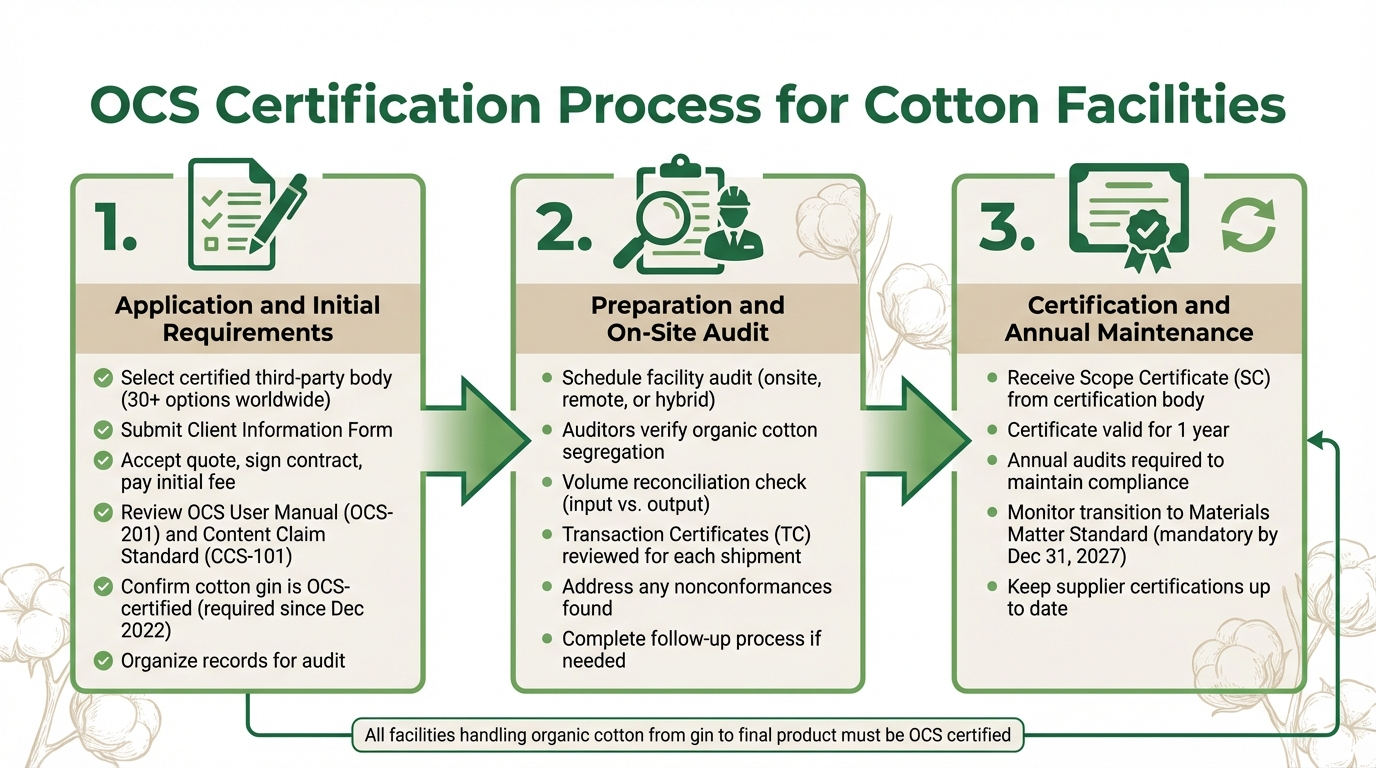
OCS Certification Process: 3 Steps from Application to Annual Maintenance
Step 1: Application and Initial Requirements
The process begins with selecting a certified third-party body from the Textile Exchange directory, which lists over 30 options worldwide. To start, submit the Client Information Form. Once reviewed, you'll need to accept a custom quote, sign a contract, and make the initial payment.
Before applying, familiarize yourself with the OCS User Manual (OCS-201) and the Content Claim Standard (CCS-101) to ensure you understand all necessary requirements. It's also essential to confirm that your cotton gin is OCS-certified, a requirement that has been in place since December 2022. Once these steps are complete, focus on organizing your records in preparation for the scheduled on-site audit.
Step 2: Preparation and On-Site Audit
After submitting your application for pre-assessment, the certification body will schedule an audit of your facility. Depending on your operation's risk level, this audit may take place onsite, remotely, or through a hybrid approach. During the audit, the focus will be on verifying the segregation of organic cotton and ensuring accurate volume reconciliation. Textile Exchange highlights:
"Every facility that handles the organically grown fibers from the gin to the final product needs to be audited against OCS criteria, including measures for keeping organic content separate and accurately reconciling volumes".
To prepare, maintain detailed records of all organic material received and products shipped, as auditors will prioritize volume matching. Each shipment must include a Transaction Certificate (TC), which verifies ownership and quantity. If any nonconformances are found during the audit, you'll need to address these issues through a follow-up process before a certification decision is made. Once the audit is cleared, you can move forward with obtaining your certification and planning for the required annual audits.
Step 3: Certification and Annual Maintenance
After successfully completing the audit and review, your certification body will issue a Scope Certificate (SC). This document confirms that your facility is qualified to handle OCS-certified goods. The certificate is valid for one year and must be renewed through annual audits to maintain compliance.
Looking ahead, the OCS will transition to the Materials Matter Standard, which takes effect on December 31, 2026, and becomes mandatory for all certified sites by December 31, 2027. To stay compliant, regularly check Textile Exchange resources and ensure all supplier certifications remain up to date.
sbb-itb-0e617ca
Benefits of OCS Certification for Cotton Producers and Ginners
Increased Transparency and Consumer Trust
With OCS certification, every step of the journey - from the gin to the final product - is carefully documented. Each ownership transfer comes with a Transaction Certificate, ensuring that the cotton's volume remains consistent and that no substitutions occur along the way.
Adding another layer of reliability, independent third-party audits ensure that organic cotton stays separate throughout the supply chain. On top of that, a centralized digital system tracks certification data, allowing certification bodies to quickly identify any irregularities as cotton moves through different facilities.
This level of transparency not only builds trust but also opens doors to better market opportunities and improved production methods.
Market Access and Production Practices
OCS certification connects farmers and ginners to global markets, linking them with buyers seeking verified organic cotton. Certified producers also gain visibility through the OCS supplier directory, a key resource for buyers worldwide.
For farmers transitioning from conventional to organic farming, OCS offers a lifeline through "in-conversion" recognition. This designation allows farmers to access organic markets during the often-challenging transition period, providing much-needed financial stability. As Textile Exchange explains:
"Financially supporting farmers through this transition will be essential to ensure organic fibers for the future. That's why we're now recognizing in-conversion content in our standard".
Cotton ginners also stand to benefit. By maintaining OCS certification, they can continue supplying certified materials to the textile industry. Since December 1, 2022, all first processors contributing to OCS products must hold OCS certification, ensuring ginners remain competitive while upholding the integrity of the organic cotton supply chain.
OCS in the U.S. Cotton Industry
OCS Integration at Cotton Gins
In the U.S., organic cotton certification operates under a two-part system. At the farm level, the USDA legally protects the term "organic." Beyond the farm, the Organic Content Standard (OCS) steps in as a voluntary chain-of-custody tool, with cotton gins serving as the key entry point for OCS certification.
For gins processing organic cotton, audits are mandatory to ensure organic fibers remain physically separated from conventional ones during processing. At every ownership transfer - whether from gin to spinner or spinner to weaver - a Transaction Certificate must accompany the cotton. This document specifies the volume of organic material, ensuring traceability and accuracy.
The USDA’s Strengthening Organic Enforcement (SOE) rule, effective March 19, 2024, has introduced unannounced inspections and standardized certificates, further bolstering OCS traceability.
Additionally, as of December 1, 2022, any cotton gin supplying inputs for GOTS (Global Organic Textile Standard) certification must also hold OCS certification. Dr. Gary Adams, President of the U.S. Cotton Trust Protocol, emphasized:
"The Trust Protocol's vision is to set a new standard in sustainable cotton production where full transparency is a reality and continuous improvement to reduce our environmental footprint is the central goal."
These measures highlight the role of OCS in ensuring traceability and accountability from the gin to the marketplace.
Case Studies of OCS-Certified Producers
The regulatory and technological advancements in the U.S. cotton industry have led to some compelling case studies. A major development came on December 12, 2025, when Textile Exchange introduced the Materials Matter Standard. This new framework, which integrates OCS, will become mandatory for U.S. producers and processors by December 31, 2027. This shift aims to streamline certification processes and focus on measurable impacts.
Digital tools like Trackit play a key role in maintaining consistency and transparency in certification processes.
For farmers transitioning to organic production, OCS provides an "in-conversion" designation. This allows them to access organic markets during the multi-year transition to USDA organic certification. This support is critical, offering financial stability as farmers work to meet full organic standards and ensuring a steady supply of organic cotton for future markets.
To enhance visibility, U.S. producers can list their certified facilities in the OCS supplier directory, connecting them with global buyers. Many producers also pair OCS certification with the U.S. Cotton Trust Protocol, which tracks metrics like land use and greenhouse gas emissions, giving buyers measurable data on sustainability efforts.
These examples underscore the U.S. cotton industry's dedication to transparent and responsible production practices, aligning with the broader goals of sustainability and accountability discussed throughout this article.
Conclusion
The Organic Content Standard (OCS) offers a reliable framework to maintain organic integrity from the gin stage to the final product. By requiring Transaction Certificates at every transfer of ownership and conducting third-party audits at each processing phase, OCS ensures a transparent chain of custody that protects the organic status of cotton throughout the supply chain.
For U.S. cotton producers and ginners, OCS certification provides access to global organic markets while addressing the increasing demand for verified sustainability claims. As Textile Exchange explains, "In a notoriously complex supply chain, the purpose of the OCS is to help strengthen companies' claims that the products they sell contain organically grown fibers". This verification not only builds consumer trust but also sets certified operations apart in a competitive market. By pursuing OCS certification, producers can meet buyer requirements, access premium markets, and support in-conversion cotton production.
The upcoming shift to the Materials Matter Standard, set to become mandatory on December 31, 2027, reflects the industry's dedication to streamlined, impact-focused certification. Digital tools like Trackit simplify traceability and reduce administrative workloads, further enhancing the certification process. These advancements strengthen traceability and position producers to capitalize on growing market opportunities.
For cotton ginners and producers aiming to tap into premium markets, OCS certification ensures compliance while making organic cotton production viable for operations of all sizes. With clear certification pathways, it provides the tools necessary to verify organic claims and meet the expectations of brands and consumers seeking sustainable and traceable cotton.
Transparency and accountability remain critical for the future of the cotton industry. OCS certification delivers both, offering the verification system needed to uphold organic integrity and meet the evolving demands of the market.
FAQs
What are the main advantages of OCS certification for cotton producers?
Getting Organic Content Standard (OCS) certification comes with some key advantages for cotton producers. It guarantees the organic authenticity of cotton throughout the entire supply chain - right from the farm to the finished product. This process, verified through third-party audits and meticulous tracking, helps establish transparency and builds trust with both buyers and consumers.
Another big plus? OCS certification opens doors to the expanding market for sustainable textiles. As demand for eco-friendly products continues to rise, certified organic cotton becomes more valuable, often fetching higher prices. This can provide farmers with better financial stability. Beyond the economic benefits, the certification also promotes sustainable farming practices, which contribute to healthier soil, conserve water, and support biodiversity.
In short, OCS certification not only creates stronger market opportunities but also encourages cotton production that’s better for the planet.
How does the Organic Content Standard (OCS) ensure organic cotton is traceable across the supply chain?
The Organic Content Standard (OCS) plays a crucial role in ensuring that organic cotton can be traced throughout its journey. It achieves this by using a thorough chain-of-custody system, which tracks the cotton from certified farms all the way to the finished product. This system ensures transparency at every step.
Independent third-party audits are conducted at each stage of the supply chain to confirm adherence to OCS guidelines. This rigorous process ensures that the organic cotton in your products is genuine, responsibly sourced, and meets high-quality benchmarks.
What does the transition to the Materials Matter Standard mean for OCS-certified facilities?
The shift to the Materials Matter Standard represents a meaningful evolution for OCS-certified facilities, expanding the focus beyond organic fibers to include broader sustainability and transparency goals. While the Organic Content Standard (OCS) primarily tracks and verifies organic fibers throughout the supply chain, the Materials Matter Standard introduces new criteria that address areas like resource efficiency, ecological impact, and social responsibility.
For facilities already certified under OCS, this transition means adopting more detailed guidelines that extend beyond organic content, ensuring stronger environmental and social accountability. This change aligns with the industry’s growing focus on more well-rounded sustainability practices, helping facilities meet the rising expectations of consumers and stakeholders for responsible production. Ultimately, this move aims to build greater trust in sustainability certifications and promote a more transparent, environmentally conscious textile supply chain.