Open-end spinning and ring spinning are two key methods used in cotton yarn production, each offering unique advantages depending on your needs. Here's the quick takeaway:
- Ring spinning creates smoother, stronger yarn with aligned fibers, making it ideal for premium fabrics like high-end apparel and luxury bedding. However, it's slower and more labor-intensive.
- Open-end spinning is faster and more cost-efficient, producing bulkier, coarser yarn suitable for items like denim, towels, and workwear. It also excels in using recycled fibers and offers better abrasion resistance.
Quick Comparison
| Feature | Ring Spinning | Open-End Spinning |
|---|---|---|
| Yarn Strength | Higher tensile strength | 15–20% weaker |
| Texture | Soft and smooth | Coarser and bulkier |
| Production Speed | Slower | Up to 7× faster |
| Fiber Alignment | Highly aligned | Less parallel orientation |
| Cost Efficiency | Higher cost | Lower cost |
| Best Applications | Premium apparel, fine fabrics | Denim, towels, workwear |
Choosing the right method depends on your product goals. Ring spinning is perfect for quality-focused textiles, while open-end spinning is ideal for high-volume, cost-sensitive production. Let’s dive deeper into how these methods compare in yarn quality, efficiency, and applications.
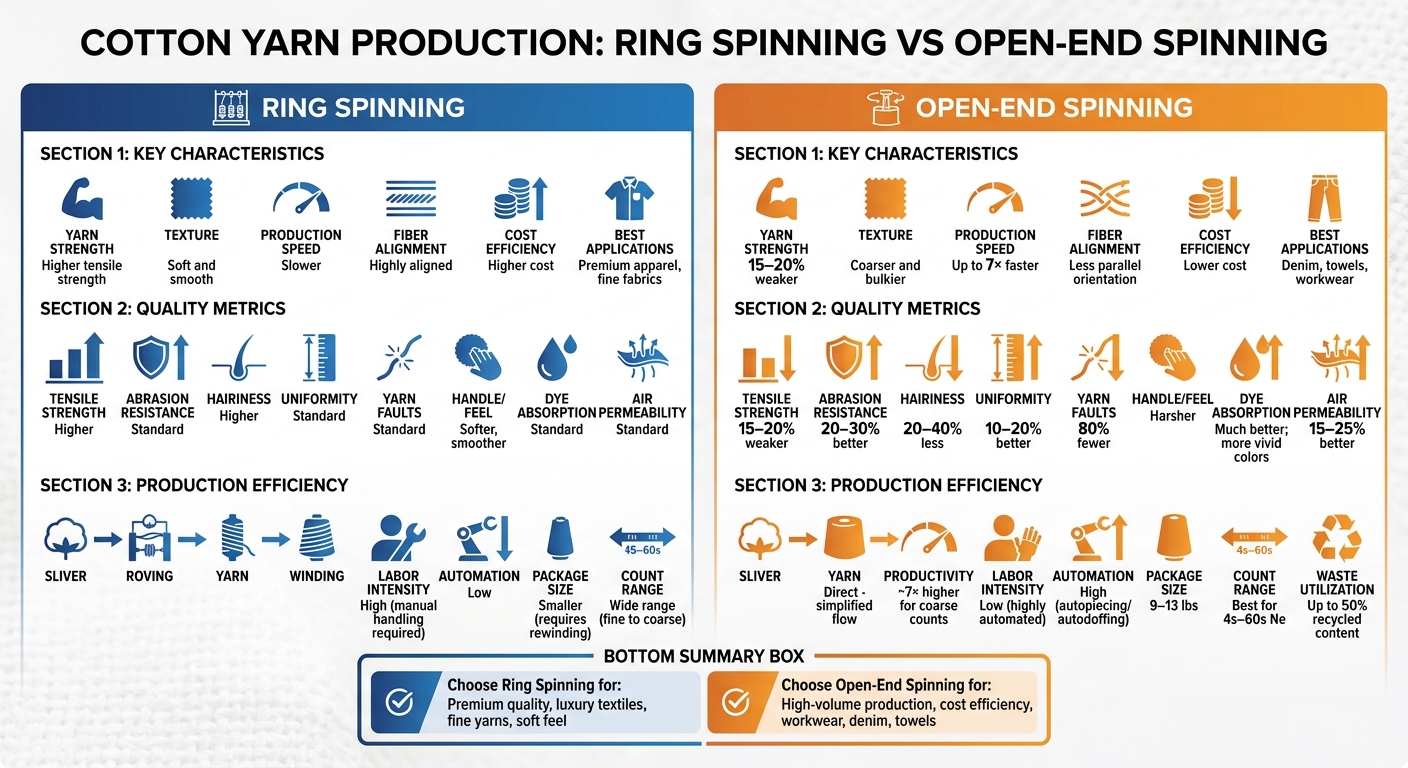
Ring Spinning vs Open-End Spinning: Quality and Production Comparison
Comparison Ring Spun VS Rotor Spun Yarn | GATE TF | Structural and physical properties|Yarn Spinning

sbb-itb-0e617ca
What Is Open-End Spinning?
Open-end spinning, also called rotor spinning or break spinning, is a method that skips the traditional roving stage and directly converts sliver into yarn using a high-speed rotor. This process combines spinning and winding into a single operation, making it more efficient. The unique mechanics of this method significantly influence the quality of the yarn it produces, as we'll explore further.
At the core of the process is a rotor that spins at incredibly high speeds, reaching up to 140,000 rpm. Here's how it works: the sliver is fed into an opening roller that separates the fibers. These fibers are then carried by an air stream through a tapered tube into the groove of the rotor. Inside the rotor, centrifugal force gathers the fibers into a ring. A "seed" yarn end is introduced into this groove, and as the rotor spins, it twists the fibers, continuously forming the yarn.
During this process, a sliver with over 20,000 fibers is drafted down to just 2–10 fibers before twisting. Thanks to the rotor's speed, open-end spinning can be up to seven times more efficient when producing coarse yarns. Modern machines also use autopiecing robots to reconnect broken yarn ends, reducing labor costs and minimizing defects. This high-speed technique gives the yarn its distinct features.
Properties of Open-End Yarns
The yarn produced through open-end spinning has specific characteristics due to the unique way fibers are handled during the process. Since fibers are randomly deposited into the rotor instead of being carefully aligned, open-end yarns have less parallel fiber orientation. This randomness creates "wrapper fibers" or fiber belts on the yarn's surface, giving it a rougher texture compared to the smoother finish of ring-spun yarn.
Because of this fiber arrangement, open-end yarns tend to be weaker and less resistant to wear than their ring-spun counterparts. However, the process also involves a "doubling action", where layers of fibers are laid onto the rotor surface. This helps smooth out irregularities, resulting in more uniform yarn.
Open-end spinning is particularly effective for short fibers, typically between 0.6 inches and 2 inches (15 mm to 50 mm) in length. This makes it an excellent choice for mechanically recycled fibers, which are often shorter after processing. The resulting yarn is bulkier and more absorbent, making it ideal for applications like denim, towels, and workwear. These qualities make open-end spinning a go-to method for specific textile needs. Later, we'll compare these properties with those of yarns produced by ring spinning.
What Is Ring Spinning?
Ring spinning is a long-established technique for making cotton yarn, involving several steps like carding, drawing, optional combing, roving, and finally, spinning. Unlike open-end spinning, which focuses on speed, ring spinning prioritizes fiber alignment and the structural integrity of the yarn.
The process kicks off with carding, where fibers are untangled and aligned into a continuous sliver that hasn’t been twisted yet.
"Carding is really the workhorse of a cotton mill... The carding process starts to align the fibers. It also takes trash and some short fibers out".
After carding, multiple slivers are combined during the drawing stage to improve uniformity and even out variations in fiber length and color. For higher-end applications, an optional combing step can be added. This step removes about 25% of short fibers and impurities, resulting in a smoother, stronger, and shinier yarn.
Next comes roving, where the sliver is thinned out into a pencil-like strand and given a slight twist to hold it together. Finally, during the spinning phase, the roving is drafted and twisted by a rotating spindle and traveler. Modern spindles can spin at speeds of 15,000–25,000 RPM, producing yarn with 15–30 twists per inch. This multi-step process is more intricate than the streamlined open-end spinning method.
One of the standout features of ring spinning is its use of drafting rollers, which stretch the roving while the spindle and traveler twist the fibers. This step ensures the fibers are highly aligned, improving uniformity and trapping short fiber ends within the yarn. These characteristics contribute to better yarn quality, even though the process takes about five times longer than open-end spinning. The precise alignment of fibers plays a crucial role in the superior performance of the yarn, as we’ll see when comparing quality metrics later.
Properties of Ring-Spun Yarns
Ring-spun yarns offer several advantages, thanks to their carefully controlled fiber alignment. These yarns are 10–30% stronger than those made through open-end spinning, providing greater tensile strength and durability. For instance, a study of 14.5 tex yarn showed that conventional ring-spun cotton had a breaking strength of 18.24 cN/tex. The tight twist in the yarn gives it a smooth, soft texture, which is preferred by more than 80% of consumers. Additionally, the uniform structure helps resist pilling by reducing loose fiber ends, unlike the coarser, fuzzier texture of open-end yarns.
Ring-spun yarns can also be produced in a wide range of counts, including very fine yarns like Ne 120, making them ideal for everything from high-quality t-shirts to luxury bedding.
"Ring-spun, combed yarn is the standard for a quality cotton garment as it creates a longer, smoother yarn".
For applications requiring extra smoothness or strength, such as sewing thread or lace, multiple ring-spun threads can be twisted together for added durability. These qualities highlight why ring-spun yarns are often the go-to choice for premium textile products.
Yarn Quality Comparison
Ring spinning and open-end spinning yield yarns with distinct characteristics, particularly in quality metrics. Ring-spun yarns are known for their strength - about 15–20% stronger than their open-end counterparts. This strength comes from the highly parallel alignment of fibers and the tighter twist in the yarn, making ring-spun yarns ideal for applications where durability under tension is essential, such as premium apparel or bedding.
Open-end yarns, however, bring their own set of advantages. They exhibit 20–30% better abrasion resistance and 20–40% less hairiness, resulting in fabrics that look cleaner and wear better over time. These yarns are also 10–20% more uniform and have 80% fewer yarn faults, which translates to consistent fabric quality and fewer production issues.
The handle and texture further highlight the differences. Ring-spun yarns offer a softer, smoother feel, making them a favorite for luxury items. In contrast, open-end yarns have a coarser texture but excel in dye absorption, delivering brighter, more vibrant colors. Open-end yarns also enhance fabric performance with 15–25% better air permeability and 10–15% superior thermal insulation, making them a great choice for items like towels and workwear.
Additionally, open-end spinning significantly reduces production interruptions, with 75% fewer end breaks during spinning, 70% fewer warp breaks, and 25% fewer weft breaks. These improvements streamline manufacturing and reduce downtime.
Yarn Quality Metrics Table
| Quality Attribute | Ring-Spun Yarn | Open-End Yarn |
|---|---|---|
| Tensile Strength | Higher | 15–20% weaker |
| Abrasion Resistance | Standard | 20–30% better |
| Hairiness | Higher | 20–40% less |
| Uniformity | Standard | 10–20% better |
| Yarn Faults | Standard | 80% fewer |
| Handle/Feel | Softer, smoother | Harsher |
| Dye Absorption | Standard | Much better; more vivid colors |
| Air Permeability | Standard | 15–25% better |
Data source:
The following section delves into production efficiency and cost considerations.
Production and Cost Differences
Beyond differences in yarn quality, the methods of production and cost efficiency between open-end and ring spinning vary significantly. Open-end spinning, powered by modern rotor systems, operates at incredibly high speeds compared to the slower, spindle-based technology of ring spinning. For coarse yarn counts like 10s, open-end methods can achieve productivity levels nearly 7 times higher than ring spinning, drastically cutting down the time it takes to convert fiber into yarn.
One of the key advantages of open-end spinning is that it removes certain production stages that are essential in ring spinning. For example, it eliminates the need for the roving frame and the winding/auto-coner stage. This translates to fewer machines, less floor space, and minimal production delays. Open-end systems also make use of larger sliver cans (up to 18 inches in diameter) and produce larger yarn packages (weighing around 9–13 lbs), which means fewer interruptions for creeling or tube changes. This streamlined process reduces the chances of production slowdowns.
Automation is another major strength of open-end spinning. Features like autopiecing and autodoffing robots significantly reduce the need for manual intervention. In contrast, ring spinning requires more hands-on labor across its multiple stages. When you factor in lower power costs per pound of yarn, open-end spinning becomes an economically attractive option for manufacturers focusing on coarse to medium yarn counts.
Another economic edge comes from raw material flexibility. Open-end spinning can effectively use fiber waste and recycled materials. Research indicates that blends containing 50% cotton and 50% fiber waste can produce functional yarns with quality coefficients as high as 94.67% for coarse counts. On the other hand, ring spinning typically requires cleaner, longer-staple fibers to maintain yarn strength, which limits its ability to use lower-cost recycled materials. These efficiencies and cost savings make open-end spinning a more competitive choice in terms of production economics.
Production and Cost Metrics Table
| Metric | Open-End Spinning | Ring Spinning |
|---|---|---|
| Production Speed | Extremely high rotor speeds | Significantly slower |
| Productivity for coarse counts (10s) | ~7× higher | Baseline |
| Process Stages | Sliver → Yarn (direct) | Sliver → Roving → Yarn → Winding |
| Labor Intensity | Low (highly automated) | High (manual handling required) |
| Energy Consumption | Lower per lb of yarn | Higher per lb of yarn |
| Package Size | Approximately 9–13 lbs | Smaller package size (requires rewinding) |
| Waste Fiber Utilization | High (up to 50% recycled content) | Low (requires cleaner fibers) |
| Count Range | Best for 4s–60s Ne | Wide range (fine to coarse) |
Data source:
Applications in the Cotton Industry
Choosing between ring-spun and open-end yarns comes down to the final product and the market being targeted. Ring-spun yarns are the go-to choice for premium apparel, where qualities like softness, durability, and a polished texture are essential. These yarns are widely used in high-quality dress shirts, delicate lace, and lightweight woven garments - products where consumers demand a smooth feel and long-lasting performance. Fashion-forward brands and premium private labels often prefer ring-spun yarns because of their superior texture and feel. In fact, ring spinning accounts for about two-thirds of global long and short staple yarn production, showcasing its adaptability across various fiber types and yarn counts.
On the other hand, open-end yarns cater to a different segment. They are ideal for products like promotional T-shirts, uniforms, denim, and towels, where production speed and cost-effectiveness take precedence over a silky finish. Their bulkier, coarser texture is perfect for home textiles, as the added volume enhances absorbency. Open-end spinning also shines in industrial applications due to its ability to handle coarser yarn counts (4s to 60s Ne) and produce large, continuous packages that reduce downtime during production. These qualities make open-end yarns a practical choice for mass-market goods.
However, when it comes to luxury fabrics and intricate designs, ring-spun yarns are unmatched. For applications requiring extremely fine yarns - those with counts of Ne 40 and above - ring spinning is the only viable option. This process involves carding and, optionally, combing to eliminate short fibers and impurities, resulting in the smooth, uniform yarn necessary for fine lace and delicate fabrics. While open-end spinning excels in speed and cost efficiency, it simply cannot achieve the level of refinement needed for these high-end uses. Each method, therefore, serves its own distinct role in the cotton industry, balancing quality, efficiency, and cost depending on the specific application.
Conclusion
After examining yarn quality and production efficiency in detail, it's clear that each spinning method comes with its own set of advantages and trade-offs.
The choice between ring spinning and open-end spinning largely hinges on production priorities. Ring spinning produces yarns with excellent strength, smoothness, and minimal hairiness, making it perfect for high-end apparel. However, this method operates at slower speeds and incurs higher production costs. On the other hand, open-end spinning creates yarn that is 15–25% weaker and coarser, but its faster production speeds and lower costs - thanks to skipping the roving stage - make it an efficient option. Open-end yarns also boast impressive evenness and fewer imperfections, making them ideal for high-volume production where uniformity and abrasion resistance are key priorities.
For textile manufacturers, aligning the spinning method with market demands is critical. Ring spinning is the go-to for luxury and fine textiles that demand softness and durability, while open-end spinning is better suited for cost-effective, high-volume products like denim, workwear, and towels.
The impact of this decision extends beyond manufacturing. Cotton growers, for example, need to consider that premium buyers prefer fibers tailored for ring-spun yarn, while mills focused on mass-market production value efficiency and consistency. Choosing the right cotton variety for the intended supply chain can make a significant difference.
Ultimately, the balance between speed, cost, and yarn quality highlights the importance of selecting the spinning method that aligns with your market goals and operational needs.
Key Takeaways
- Ring spinning delivers strong, smooth, and soft yarns, ideal for premium textiles, but comes with slower production speeds and higher costs.
- Open-end spinning offers a cost-effective, high-speed solution with excellent evenness and abrasion resistance, though the yarn is coarser and weaker.
- Each method has its strengths, and the best choice depends on your product requirements, target audience, and production capabilities.
FAQs
Which spinning method is best for my yarn count?
The best spinning method hinges on what you prioritize: cost, efficiency, or yarn quality. If you're looking for a faster and more cost-effective option for coarser yarns, open-end spinning is a solid choice. It delivers high production rates but may sacrifice some strength and uniformity.
On the other hand, ring spinning is better suited for finer yarns. This method ensures greater strength, better uniformity, and a smoother texture, making it ideal for higher-quality applications. Your decision should align with the specific yarn count and quality requirements you have in mind.
How do recycled fibers change open-end vs ring yarn quality?
Recycled fibers influence the performance of open-end and ring-spun yarns in distinct ways. Open-end yarns made with recycled fibers often experience a drop in strength and consistency, which limits their range of uses. On the other hand, ring-spun yarns fare better, retaining more strength and cohesion. This is largely due to their longer fibers and the controlled spinning process involved. In general, the quality of open-end yarns is more noticeably affected by recycled fibers compared to ring-spun yarns.
What fabric tests should I run before choosing a spinning method?
When it comes to fabric testing, while specific details aren't readily available from the search results, there are a few common evaluations you can expect. These typically include tensile strength tests, which measure the fabric's resistance to pulling forces; yarn uniformity checks, ensuring consistency in the threads; and texture analysis, which assesses the feel and surface quality of the material.
These tests are essential in deciding whether open-end spinning or ring spinning will deliver the fabric qualities you're aiming for. If you're looking for more precise recommendations, it's a good idea to consult industry standards or seek advice from a professional who can address your particular needs.