OEKO-TEX Organic Cotton certification, introduced in April 2023, ensures products meet strict safety and organic farming standards. It verifies cotton from farm to final product, testing for over 1,000 harmful substances (like PFAS and heavy metals) and limiting GMO contamination to under 5%. The certification provides two labels:
- ORGANIC COTTON: 100% organic cotton.
- ORGANIC COTTON Blended: At least 70% organic cotton.
Both require compliance with IFOAM standards, prohibiting GMOs and synthetic pesticides. Traceability is maintained through a chain-of-custody system, and safety testing aligns with global regulations like REACH and CPSIA.
While organic cotton reduces water use by 88% and energy by 62%, higher costs and lower yields make it pricier than conventional cotton. Certification fees range from $5,000 to $12,000 per facility, with annual renewals costing $3,000 to $8,000.
For consumers, OEKO-TEX ensures safer products with verified labels and online tools for transparency, while manufacturers benefit from clear guidelines and reduced testing costs through certified chemicals.
All you need to know about OEKO-TEX® ORGANIC COTTON
sbb-itb-0e617ca
Certification Standards and Requirements
OEKO-TEX has established rigorous guidelines to uphold the credibility of its organic cotton labels. Both certifications require IFOAM-compliant, farm-level verification to ensure organic farming practices. For ORGANIC COTTON products, the cotton must be 100% organic, while ORGANIC COTTON Blended products must contain at least 70% organic cotton.
To prevent fraud, OEKO-TEX strictly prohibits mixing organic cotton with conventional cotton. As they clarify, "Mixtures of organic and conventional cotton are forbidden in all three certificates". For blended goods, any non-organic content must come from alternative fibers like recycled polyester or lyocell, and the 5% contamination allowance applies only to unavoidable residues. These measures form the foundation for additional technical checks.
GMO testing plays a key role in ensuring compliance. Using molecular techniques to analyze cotton DNA, OEKO-TEX distinguishes between accidental contamination - such as fiber fly - and deliberate use of conventional cotton. When this standard was introduced in April 2023, the GMO threshold was set at under 10%. It has since been tightened to less than 5%.
In addition to lab testing, traceability strengthens the certification process. A chain-of-custody system, backed by transaction certificates (TCs), tracks organic cotton through every stage - from ginning to spinning, knitting, finishing, and the final product. A new certificate is required with each change in ownership. To further enhance traceability, OEKO-TEX partnered with TextileGenesis in January 2026, introducing digital tools to better monitor organic cotton supply chains.
For manufacturers working with less than 70% organic cotton, OEKO-TEX offers flexibility. These producers can apply for STANDARD 100 certification and potentially cut testing costs by using ECO PASSPORT-certified chemicals. This approach integrates smoothly into OEKO-TEX's broader quality assurance framework, accommodating diverse production needs.
Safety for Consumer Health
OEKO-TEX certified organic cotton undergoes thorough testing for over 1,000 harmful substances to safeguard consumer health. This extensive screening includes contaminants like pesticides, banned azo colorants, pentachlorophenol, PFAS (per- and polyfluoroalkyl substances), cadmium, and lead. The certification aligns with key international regulations, such as REACH Annex XIV and XVII, the US Consumer Product Safety Improvement Act (addressing lead), and the EU regulation on Persistent Organic Pollutants. These safety protocols complement the traceability and quality controls already embedded in the certification process.
Testing is tailored based on skin contact levels: stricter limits apply to items with intensive contact (like products for children under 3), while less stringent standards are set for items with minimal exposure. As OEKO-TEX explains:
"The more intensive the skin contact, the stricter are the human ecology requirements and laboratory tests."
Unlike standard organic certifications, which primarily focus on farming practices, OEKO-TEX certification ensures the safety of the finished product through independent lab testing. These tests confirm that any residues fall well below established safety thresholds.
For organic cotton, the certification process also includes mandatory GMO testing. Molecular DNA analysis ensures GMO levels stay under 5%, distinguishing accidental contamination from intentional mixing. Annual updates to safety limits - such as tighter restrictions on PFAS and antimony - further enhance consumer protection.
Consumers can easily verify OEKO-TEX certifications through the online Label Check tool. By entering the unique certificate number found on product tags, they can confirm that every component, from threads to zippers, meets the same stringent safety requirements. This system, combined with chain-of-custody tracking, provides added confidence in the integrity of certified products.
Environmental and Ethical Production
OEKO-TEX certification goes beyond safety protocols - it prioritizes environmental responsibility and ethical practices throughout the cotton supply chain. This certification ensures full traceability, from the farm to the finished product, by adhering to the IFOAM-Organics International standards right from the cultivation stage. Organic farming practices are monitored from the start, with every production phase tracked using transaction certificates and mass balance metrics for a clear chain of custody.
One key focus is reducing chemical use. Rigorous testing minimizes chemical inputs, helping to lower environmental contamination. Manufacturers can further reduce their impact by using OEKO-TEX ECO PASSPORT certified chemicals, which meet strict environmental criteria.
Another standout feature is the certification's approach to GMO testing. It uses a quantitative method to distinguish between accidental contamination, such as fiber fly, and intentional mixing with conventional cotton. This ensures organic cotton remains free from genetic modification, safeguarding environmental integrity across the supply chain.
OEKO-TEX also emphasizes ethical labor practices. The STeP certification enforces standards for occupational health, safety, and social responsibility in production facilities. Certified companies must adhere to the OEKO-TEX Code of Conduct, which outlines fundamental social criteria. For those seeking full transparency, combining ORGANIC COTTON certification with STeP certification qualifies products for the "MADE IN GREEN" label, which includes a consumer-friendly QR code for traceability. The RESPONSIBLE BUSINESS certification adds another layer by assessing human rights due diligence, including risk analysis and complaint mechanisms.
To ensure compliance, independent auditors conduct mandatory on-site inspections to verify self-assessment data and production conditions. With over 35,000 certified companies in its global network, OEKO-TEX provides a robust framework for sourcing materials that meet both environmental and ethical standards. As of April 1, 2025, all organic and GMO-free claims will be governed under the ORGANIC COTTON standard, further solidifying its commitment to transparency and integrity.
Pros and Cons
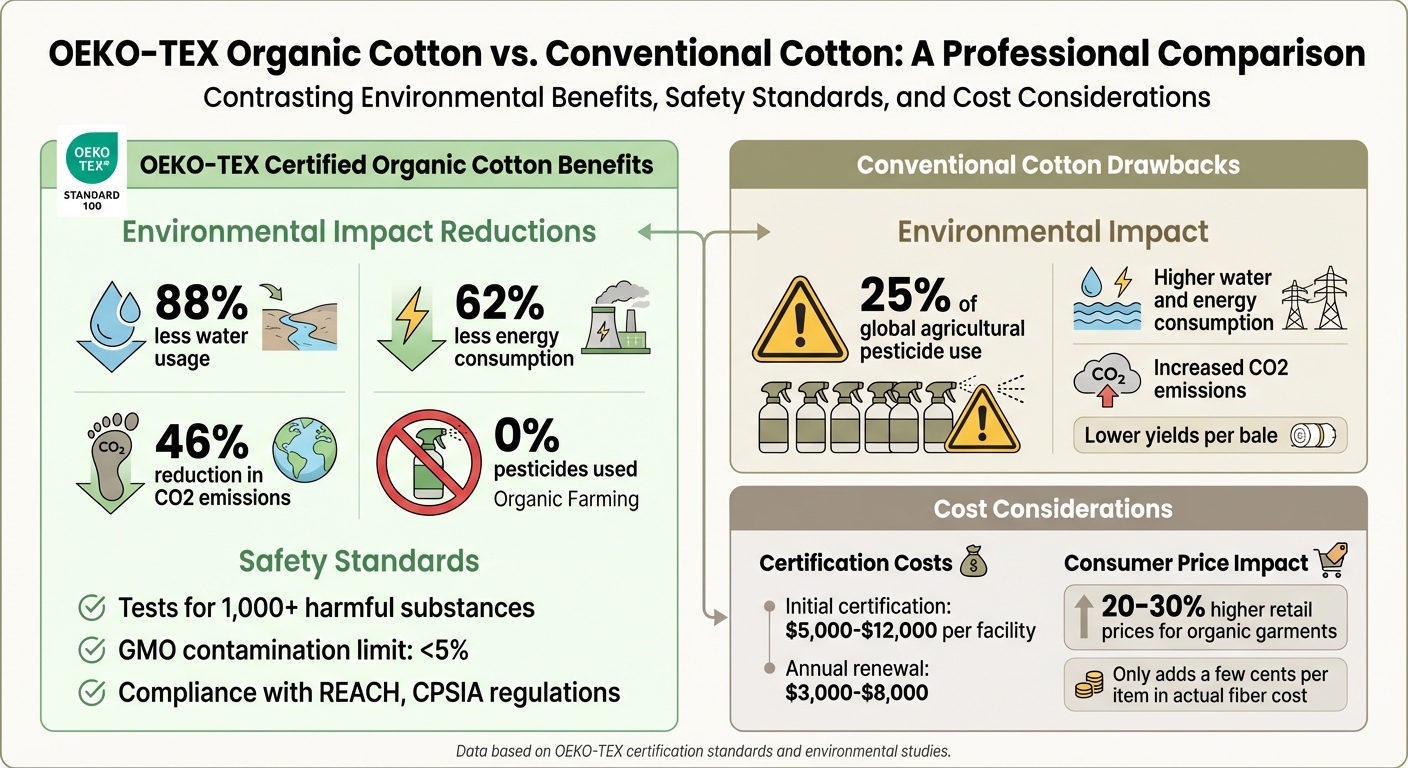
OEKO-TEX Organic Cotton vs Conventional Cotton: Environmental Impact and Certification Costs
OEKO-TEX certified organic cotton stands out for its rigorous safety and traceability standards, but it comes with notable challenges, particularly in terms of cost, accessibility, and the scope of certification.
The certification ensures thorough chemical safety testing and complete traceability from farm to finished product. It even includes quantitative GMO testing to confirm the organic integrity of cotton.
Environmental Benefits
The environmental impact of organic cotton farming is a major advantage. Compared to conventional methods, organic farming uses 88% less water and 62% less energy. It also avoids synthetic fertilizers, which helps reduce CO2 emissions by up to 46%. Meanwhile, conventional cotton farming is responsible for 25% of global agricultural pesticide use, whereas OEKO-TEX organic cotton prohibits pesticides entirely.
Cost Challenges
Despite these benefits, the higher costs of organic cotton production remain a significant hurdle. Organic farming is more labor-intensive and yields are lower, which drives up production costs. Consumers often pay 20% to 30% more for organic garments, even though the additional cost of organic fiber might only add a few cents per item.
The certification process itself is also expensive. Initial OEKO-TEX Made in Green certification - which includes facility audits - costs between $5,000 and $12,000 per facility, with annual renewal fees ranging from $3,000 to $8,000.
Accessibility and Market Limitations
Although the OEKO-TEX network includes over 35,000 certified companies, organic cotton remains far less accessible than conventional cotton. Lower yields also mean that organic cotton requires more land and water per bale, as noted by Professor Daniel Sumner from UC Davis:
"Organic cotton lessens negative environmental impacts from pesticides and fertilizers. But organic cotton will have larger land and water footprints per bale, because of lower yields".
Certification Scope
It’s important to understand the limitations of OEKO-TEX certification. As Orbasics points out:
"OEKO-TEX doesn't mean organic. Polyester textiles or conventional cotton can pass these tests just fine, as long as the finished textiles are clean".
The Standard 100 certification focuses on chemical residues in finished products but doesn’t address organic farming practices, factory working conditions, or wastewater management during production. These gaps highlight the practical challenges companies face when trying to balance OEKO-TEX certification with broader sustainability goals.
Conclusion
OEKO-TEX certified organic cotton ensures verified chemical safety and complete traceability from farm to finished product, making it a compelling choice for those who value health and eco-conscious practices. Rigorous GMO testing further protects the integrity of organic claims.
For U.S. manufacturers, the OEKO-TEX Buying Guide serves as a starting point. This online directory connects users with over 35,000 certified companies worldwide. Additionally, using ECO PASSPORT-certified chemicals during processing can help manufacturers cut down on testing requirements and costs. Hohenstein Americas acts as the main point of contact for companies in the U.S. seeking certification.
This efficient certification process not only benefits manufacturers but also boosts consumer trust.
Consumers can look for the "MADE IN GREEN" label, which guarantees products have undergone strict safety testing and ethical production practices. Safety classifications make it easier to choose products based on their intended use - Class 1 products, for example, meet the most stringent standards for babies and toddlers, while Classes 2 through 4 reflect varying levels of skin contact.
Digital traceability, powered by the TextileGenesis partnership, enhances transparency and helps prevent fraud throughout the supply chain. Together, these initiatives reinforce a commitment to safe and responsible cotton production.
For farmers, ginners, and other stakeholders in the U.S. cotton industry, resources like cottongins.org provide valuable directories and networking opportunities. The certification process, grounded in strict traceability and international standards, ensures thorough oversight. This benefits everyone - manufacturers, consumers, and farmers - while supporting compliance with global regulations like REACH and US CPSIA.
FAQs
How can I verify an OEKO-TEX organic cotton label is real?
To verify the authenticity of an OEKO-TEX organic cotton label, start by checking the certification using the OEKO-TEX official website or the myOEKO-TEX® portal. Make sure the product or manufacturer's certification number matches the records listed there. Additionally, look for correct certification marks and consult OEKO-TEX’s labeling guidelines to confirm compliance. Cross-referencing directly through OEKO-TEX is the most reliable way to ensure the label is genuine and aligns with safety and sustainability standards.
Does OEKO-TEX guarantee a product is truly organic cotton?
OEKO-TEX doesn’t claim that a product is made entirely of organic cotton. Instead, it ensures that the product has been tested for harmful substances, GMO contamination, and pesticides. This certification focuses on safety and traceability throughout the journey from the farm to the finished product.
What’s the difference between organic cotton and organic cotton blended?
The main distinction lies in how they're made. Organic cotton is cultivated without the use of synthetic pesticides, chemical fertilizers, or genetically modified seeds. It adheres to rigorous organic certification standards. On the other hand, organic cotton blended fabrics mix organic cotton with other fibers, which could include non-organic or synthetic materials. While the cotton portion of the blend is certified organic, the entire fabric might not align with the same eco-friendly criteria.