If I had to sum it up in one line: the biggest gains in a cotton gin usually come from steadier feed, tighter moisture control, smarter gin-stand loading, fewer extra lint-cleaning passes, and more automated bale handling.
Here’s the short answer.
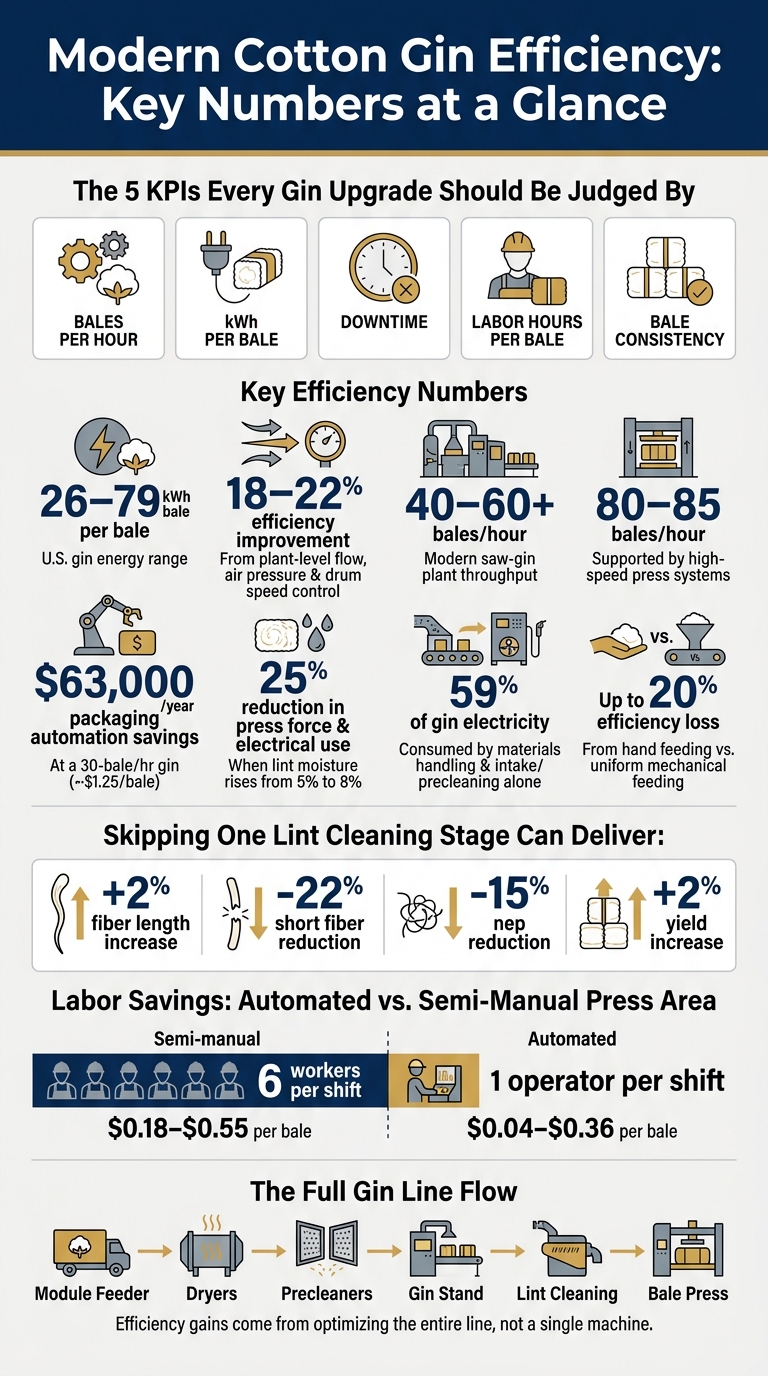
I’d judge any cotton-processing upgrade by five numbers first:
- bales per hour
- kWh per bale
- downtime
- labor hours per bale
- bale consistency
The article shows that these gains often come from a few key moves:
- keeping seed cotton feed even at intake so the line doesn’t surge
- drying cotton to the right range instead of over-drying it
- matching precleaners to gin capacity
- using gin-stand controls to hold steady loading
- avoiding extra lint cleaning when fiber quality would suffer
- automating pressing, bagging, and bale handling to cut labor and stops
- using plant sensors to track moisture, temperature, and motor load in real time
A few numbers stand out:
- U.S. gins can use about 26 to 79 kWh per bale
- plant control of flow, air pressure, and drum speed can improve efficiency by 18% to 22%
- modern saw-gin plants can reach about 40 to 60+ bales per hour
- high-speed press systems can support about 80 to 85 bales per hour
- packaging automation can save about $63,000 per year at a 30-bale-per-hour gin
- moving lint moisture from 5% to 8% can cut press force and electrical use by about 25%
The main point is simple: I would not look at one machine by itself. I would look at the full path from module feeder -> dryers -> precleaners -> gin stand -> lint cleaning -> bale press and ask where the line slows down, wastes power, or hurts fiber.
Cotton Gin Efficiency: Key Metrics & Modern vs. Older Setup Gains
See How Technology Super Charges a Cotton Gin
sbb-itb-0e617ca
Quick comparison
| Area | Older or basic setup | Newer setup |
|---|---|---|
| Intake feed | Uneven flow, more plugs | Metered flow, fewer surges |
| Drying | Manual adjustment, more over-drying | Better moisture control |
| Precleaning | Higher choke risk | Better trash removal with steadier flow |
| Gin stand | Fixed feed, more stress on fiber | Variable-speed control, steadier loading |
| Lint cleaning | Same cleaning level for all cotton | Bypass based on cotton condition |
| Bale press | More manual work | Automated pressing, bagging, and strapping |
| Plant control | Reactive checks after problems start | Sensor-based monitoring before faults grow |
If you want the plain-English takeaway, it’s this: the best machine is the one that helps the whole gin run smoother from intake to bale, not the one with the biggest standalone spec.
Seed cotton intake, drying, and precleaning equipment
The front end often sets the pace for the whole gin. If feed is uneven, moisture is too high, or precleaners are too small, the line starts to surge. And once that happens, everything downstream slows down too. That’s why intake upgrades are often the first place operators see efficiency gains.
High-capacity feeders and precleaners that keep cotton moving
Modern module feeders use spiked rollers to break apart compacted seed cotton and pull out the largest foreign material - such as big stalks and rocks - before the cotton reaches the cleaning line. That first step helps protect downstream equipment and gives the system a steady, metered flow right from the start.
This front-end sequence helps keep trash removal and moisture control in sync before the gin stand. The extractor-feeder’s main job is to meter seed cotton evenly; cleaning comes second.
Cylinder cleaners use several rotating spiked cylinders along with grid rods or screens to break up clumps, open the cotton, and remove fine trash such as soil and leaves. They also help even out flow density across the full machine width, which cuts down on surges into the extractor-feeder. Typical trash removal is about 10%–40% by weight.
Stick machines rely on centrifugal force and fast-turning saw cylinders to remove larger foreign matter like burs and sticks. On machine-stripped cotton, modern stick machines can remove about 65% of burs, 50% of sticks, and 10–35% of fine trash, with total cleaning efficiency in the 60–65% range. Newer designs use staged cleaning to limit lint loss and fiber damage.
Precleaners need to match gin stand capacity. A common target is about 2–2.5 bales per hour per foot of width. Go past that point, and the front end becomes the choke point. There’s also a tradeoff here: running precleaners too fast can pull out more trash, but it also increases lint loss because higher cylinder speeds remove more fiber along with the waste.
Controlled flow matters. But moisture control often decides how well the cleaners can do their job.
Drying and moisture control before the gin stand
Moisture is one of the biggest variables in seed cotton processing. If cotton is too wet, it doesn’t open into single locks the way it should. Instead, it clumps, forms wads, and creates the tight twists called "fishhooks" that can make it through ginning and show up in finished lint, hurting appearance and classing results. Moisture above 10% also creates conditions for mold growth, discoloration, and fiber decomposition.
The standard setup uses two drying stages: one before the first cylinder cleaner and another before the extractor-feeder. Each stage uses heated air to lower moisture enough for efficient cleaning without drying the cotton too much. That balance matters. Over-drying drives up energy use, makes fiber more brittle, and creates fine particles that build up in ducts.
A drying system moving 5,000 ft³/min of air at 300 °F delivers about 1.25 million Btu/hour. At 95% combustion efficiency, that uses about 1,300 ft³ of natural gas or 14.4 gallons of propane per hour.
Older precleaning lines vs. modern intake systems: a side-by-side comparison
Materials handling - including intake conveying and precleaning - can account for nearly 59% of electricity use in a gin operation. That puts the front end near the top of the list for efficiency upgrades. Here’s how older setups compare with modern intake systems on the metrics gin operators watch most closely.
| Category | Older Precleaning Lines | Modern Intake Systems |
|---|---|---|
| Feed control | Manual or basic mechanical feed; inconsistent rates | Automated module feeders that deliver uniform, metered flow |
| Trash removal consistency | Variable; screen cleaners less effective on burs and sticks | Progressive cleaning sequence; modern stick machines reach 60–65% efficiency on stripped cotton |
| Surge and choke risk | High; non-uniform feed causes wads, bridging, and plugging | Reduced; balanced loading and smoother cotton flow limit choke points |
| Moisture management | Manual dryer adjustments; over- or under-drying common | Better dryer control; cotton stays closer to target moisture |
| Labor demand | Higher; operators needed to monitor and clear chokes | Lower; automated controls reduce hands-on intervention |
| Downtime risk | Frequent stops to clear plugs and reset equipment | Fewer unplanned stops; modern designs reduce jam frequency |
| Energy use per bale | Higher due to inefficient drying and over-speed cleaning | Lower through balanced machine loading and better dryer control |
Hand feeding and poorly controlled intake have been reported to cut processing efficiency by up to 20% compared with uniform mechanical feeding, with direct effects on throughput and production costs. In plain terms, steadier feeding means fewer plug-ups and smoother gin stand performance.
A steady, dry front end gives the gin stand a much better shot at running near capacity without adding extra stress to fiber quality.
Gin stands and lint cleaning systems that balance output and fiber quality
When feed rate, moisture, and trash are already under control upstream, the gin stand has a much better shot at running near its target. At that point, the big levers are simple: speed and settings. Those two choices shape both plant output and lint quality.
Modern gin stands: higher output with less fiber damage
In U.S. gins, modern saw gin stands are still the main option for high-volume processing. When a modern saw stand is loaded the right way, it can process about 3,800 kg (8,400 lb) of lint per hour. That helps large plants reach roughly 40–60+ bales per hour.
A lot of that jump comes down to tighter machine tolerances. Precision upgrades like wider ribs, better saw spacing, and tighter saw-to-rib alignment help reduce stress on the fiber. When alignment is off, the stand starts acting more like a cutter than a separator. That breaks fiber, lowers capacity, and can lead to choking.
Variable-speed drives and automatic feed control also make a big difference. They help keep cotton flow steady instead of letting it surge. With sensor-based feed control, the system slows intake when motor load climbs and speeds it back up when load falls. That small, constant correction lets the stand stay near design capacity without pushing too much cotton through at once.
Moisture matters here too. Running near 6%–7% moisture helps limit seed damage and short fiber. Seed damage usually falls somewhere between 2% and 8%, depending on processing rate and moisture level. But if loading gets too heavy, damage can spike fast. One study found seed damage ranging from 19% to 33% as saw loading increased from 13.7 to 38.5 kg of seed cotton per saw per hour.
Roller gins fill a different role. They are used for ELS and Pima cotton, where protecting staple length matters more than pushing maximum volume. Compared with saw gins, roller gins produce longer fiber with fewer short fibers and neps.
After fiber and seed are separated, the next call is just as important: how much lint cleaning the cotton actually needs.
Lint cleaners, bypass decisions, and when less cleaning protects fiber quality
After the gin stand, lint still holds some leftover trash, including leaf fragments, bark, and small seed coat pieces. Saw, air-jet, and tower lint cleaners are used to remove that material before the press.
The tradeoff is hard to ignore. Every added lint cleaning stage removes more trash, but it also shortens fiber. USDA researchers found about 0.3–0.4 of a 32nd less staple and 0.01 inch less mean length for each added stage. And after the first lint cleaner, any gain from better trash and color grades is often pretty small. In some cases, those gains get canceled out by staple discounts.
That’s why bypass decisions matter. Skipping one lint cleaning stage can increase fiber length by about 2%, cut short fibers by 22%, reduce neps by 15%, and increase yield by about 2%. Many modern gins now use automated bypass controls tied to trash level, moisture, and motor load, so cleaning can match the cotton instead of following one fixed setting. In plenty of cases, one saw-type lint cleaner does the job and reduces entanglements by about 40%.
Still, bypass is not always the right move. If trash levels are high after a weather event, or when picker-harvested cotton comes in dirtier than expected, extra cleaning stages may make sense. But when cotton is already clean and well precleaned, skipping a stage helps protect staple, strength, and turnout.
Once lint quality is set at this step, the next gains come from automated pressing and bale handling.
Standard vs. high-capacity ginning and lint cleaning setups: a side-by-side comparison
| Category | Standard Setup | Modern High-Capacity Setup |
|---|---|---|
| Throughput | 30–40 bales/hour | 40–60+ bales/hour |
| Energy use per bale | Higher; inefficient motors and more restarts | Lower; as ginning rate rises from about 23 to 50+ bales/hour, kWh/bale drops from the low 40s to the low 30s |
| Fiber damage risk | Moderate to high; fixed feed and surge events | Lower; variable-speed drives and automated feed control limit surges |
| Lint cleaner control | Fixed intensity regardless of trash levels | Sensor-driven bypass; cleaning intensity matched to actual cotton condition |
| Bale quality consistency | Variable; depends heavily on operator experience | More consistent; plant controls maintain stable parameters lot to lot |
| Maintenance complexity | Simpler controls; higher in-season downtime risk | More automation reduces in-season stops |
| Effect on staple and strength | Higher risk of quality penalties from over-cleaning | Better preservation through bypass control |
Bale formation, plant automation, and system-wide control
At this point, the biggest gains don’t come from more lint cleaning. They come from faster bale formation, safer handling, and tighter control across the gin.
Automated bale presses and bagging systems
Bale formation begins at the condenser. Lint moves into the press box, where a tramper precompacts it before the hydraulic ram forms either a universal-density or high-density bale.
High-speed trampers can hit 12 strokes per minute. That’s enough to turn out a bale every 40–43 seconds, which supports throughput of about 80–85 bales per hour.
The press area changes a lot when tying and bagging are automated. In older setups, workers had to bag, tie, and move bales by hand. That meant pinch points, crush hazards, heavy physical work, and cycle times that could swing based on skill level or plain old fatigue.
Systems like the AB40 AutoBagger replace that manual chain of steps. The unit wraps and seals the bale automatically and syncs with the press cycle through a touch-screen console, so the operator watches the system instead of doing each task by hand.
The labor impact can be hard to ignore. One gin using an automated bagging and strapping setup cut press-area staffing from six workers to one per shift, while keeping output steady across four years of use. At a 30-bale-per-hour gin, packaging automation worked out to about $63,000 in yearly labor savings, or around $1.25 per bale.
Sensors and software that cut downtime and energy waste
Once the press is running well, the next gains come from controls that keep the whole plant moving together instead of lurching from stop to stop.
Plant-level control systems bring data from moisture sensors, temperature probes, motor loads, hydraulic pressures, and machine-status indicators into one dashboard.
That matters because moisture and temperature don’t just affect one machine. They shape the pace of the whole line. These sensors feed the press and plant controls, helping operators dial in dryer temperatures, air volumes, and module feed rates so cotton reaches the press within an acceptable moisture range and at a flow rate the press can handle. The result is fewer stop-and-go cycles and fewer energy spikes.
For bale moisture, systems such as the TexMax 2 Bale Moisture Sensor and dielectric platforms like Intelligin scan each bale, record average moisture, and automatically tell conditioners or Humidaire units to adjust output toward target levels. A USDA-developed microwave sensor showed lab accuracy of about 0.35% moisture content.
SCADA-style monitoring and gin apps add another layer of control. They flag unusual temperatures, load patterns, and moisture trends before those issues turn into downtime. That shifts maintenance away from reactive fixes and toward predictive service, giving crews time to work on hydraulic parts and recalibrate sensors before a breakdown hits production.
Semi-manual bale handling vs. automated press and control systems: a side-by-side comparison
The gap between semi-manual and automated setups shows up most clearly in labor, safety, and cycle stability.
| Category | Semi-Manual Setup | Automated Press and Control System |
|---|---|---|
| Cycle time per bale | Variable; depends on crew speed and fatigue | ~40–43 seconds at high-speed tramper rates; up to 80–85 bales/hour |
| Labor requirement | Multiple workers at press for tying, bagging, and bale movement | As few as one operator per shift with full bagging/strapping automation |
| Bale density consistency | Variable; manual press steps introduce inconsistency | More consistent; automated press cycles improve repeatability |
| Safety exposure | High; workers near pinch and crush points during tying and bagging | Lower; operators work at control stations rather than inside the press zone |
| Downtime response | Reactive; faults identified after production stops | Faster; sensor dashboards and alarms flag issues before breakdown |
| Visibility into plant performance | Limited; relies on operator observation and manual records | Real-time data on moisture, temperature, motor loads, and bale moisture across the gin |
| Per-bale labor cost | $0.18–$0.55 (semi-automatic bagging) | $0.04–$0.36 (fully automated systems) |
Conclusion: Where the biggest efficiency gains come from and how to evaluate upgrades
Modern gin efficiency comes from treating the plant as one connected system. That’s why the best way to judge an upgrade is by whole-line performance, not by a single machine’s spec sheet.
Look at what the full line is doing: bales per hour, energy per bale, downtime, moisture consistency, and lint quality across intake, gin stand, lint cleaning, and bale press. A machine can look great on paper and still do little for the plant if it doesn’t help the line move better as a whole. On the other hand, air system changes and layout improvements can make a big dent in total power costs, cutting them by 25% to 50% in some regions.
If you’re trying to find the control point that often brings the fastest stability gain, moisture management usually sits at the top of the list. Inline moisture control cuts overdrying and tightens bale-to-bale moisture spread. That matters more than many people think. Keeping cotton in the right moisture range can lower press force and electrical energy use by about 25% when lint moisture moves from 5% to 8%. It also helps protect fiber strength and leads to more even bales.
Once moisture is under control, automation tends to deliver the next wave of gains. It can push throughput higher, trim labor needs, and cut wasted energy. The documented upside also includes cleaner lint and lower cost per bale.
The best upgrade isn’t always the flashiest one. It’s the one that makes the entire line faster, steadier, and cleaner.
FAQs
What upgrade should a gin prioritize first?
Prioritize moisture monitoring and sensor-driven closed-loop control first.
Automated moisture control before and during drying helps you hit the right moisture targets for steady fiber separation. It also cuts energy waste that comes from fixed settings and helps reduce downtime, all while protecting fiber quality and bale consistency.
How do sensors improve gin performance?
Sensors help a gin run better because they feed real-time data into automated controls. That lets the system make fast adjustments as conditions change. The result: higher throughput, better fiber quality, and less downtime.
These sensors track key inputs like moisture, temperature, machine load, and impurity levels. That data supports a few core jobs:
- Process control: Keep the gin running within target settings instead of drifting off course.
- Predictive maintenance: Spot wear, stress, or odd behavior before a machine goes down.
- Safety responses: Trigger alerts or automatic actions when conditions turn risky.
- Energy efficiency: Cut waste by matching machine output to actual operating needs.
When should a gin skip extra lint cleaning?
A gin should skip extra lint cleaning - or at least cut it back - when the incoming cotton is already clean and the harvesting method makes that possible. Hand-harvested cotton is a good example. It usually needs just one stage of drying and pre-cleaning because it comes in with less debris.
Automation and machine vision can also help dial cleaning intensity up or down based on variety. On top of that, a steady material flow and proper moisture levels mean you don’t have to clean so aggressively in the first place.