Machine doffing automates the replacement of full bobbins with empty ones in spinning frames, ensuring uninterrupted yarn production. This process, once manual and labor-intensive, is now handled by advanced systems that improve efficiency, reduce labor costs, and enhance yarn quality. Key takeaways include:
- Efficiency Gains: Automated systems minimize machine stoppages, saving hours of production time per shift.
- Cost Savings: Labor expenses can drop by up to 30%, and consistent cycle times extend equipment lifespan.
- Quality Improvements: Uniform handling reduces yarn breakage and waste, ensuring consistent product quality.
- Modern Features: Systems use PLC technology, energy-efficient components, and flexible grippers for precise operation.
Automation is especially beneficial for mills facing labor shortages or aiming to optimize production. However, mills must evaluate equipment compatibility, upfront costs, and maintenance needs to maximize ROI. Regular maintenance, proper training, and a focus on compatibility are crucial for success.
Rieter ROBOdoff – Automated Doffing

sbb-itb-0e617ca
How Automated Doffing Systems Work
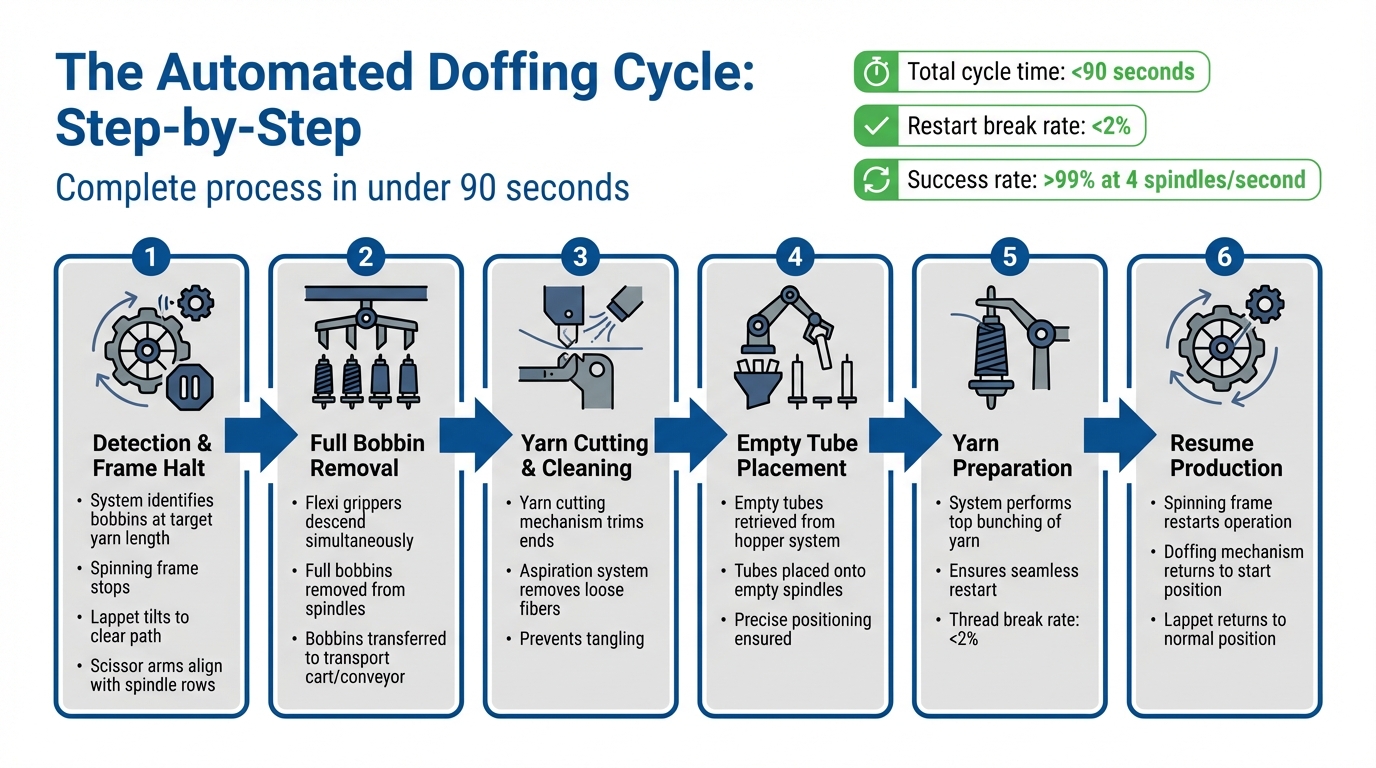
Automated Doffing Cycle: 6-Step Process in Under 90 Seconds
Main Components of Doffing Machines
Automated doffing systems combine mechanical precision with advanced digital controls. At the heart of these machines is a doffer shaft equipped with scissor arms, powered by servo belts to ensure synchronized operation across all spindles. Flexi grippers, featuring spring-assisted pressers, handle the bobbins with care - removing full ones and replacing them with empty tubes with pinpoint accuracy. A ball screw mechanism, paired with an encoder, provides precise lifting while using less energy compared to traditional hydraulic systems.
For seamless operation, these machines rely on PLC (Programmable Logic Controller) technology. These controllers manage the entire doffing process, coordinating movements and using sensors to detect full bobbins, monitor positions, and identify faults. Additionally, empty bobbins are stored in a hopper system, which feeds them into the process as needed.
Together, these components ensure a smooth and efficient doffing process, described in detail below.
The Doffing Cycle: Step-by-Step
The doffing process starts when the system identifies that bobbins have reached their target yarn length. At this point, the spinning frame halts, and the lappet tilts to clear the path for the grippers. The scissor arms then align themselves with the rows of spindles.
The flexi grippers descend simultaneously, removing the full bobbins from the spindles. These are transferred to a transport cart or conveyor system. Simultaneously, a yarn cutting and aspiration mechanism trims the yarn ends and removes any loose fibers, preventing tangling.
Next, empty tubes are retrieved from the hopper and placed onto the now-empty spindles. The system then top bunches the yarn, ensuring a seamless restart. This entire process is designed to minimize thread breaks, with modern systems achieving restart break rates of under 2%. Once the tubes are in place, the spinning frame resumes operation, and the doffing mechanism returns to its starting position. The entire cycle, from the initial lappet tilt to its return, is completed in under 90 seconds.
Modern System Features
Today’s automated doffing systems include touchscreen HMI (Human-Machine Interface) panels connected to PLC controllers, allowing operators to make real-time adjustments and monitor production metrics. Energy efficiency is a key focus, with toothed belt drives reducing both noise and power usage - machines with 1,200 spindles require just 2.8 kW. Additionally, ball screws equipped with encoders reduce the need for compressed air, further improving efficiency.
Maintenance is simplified with modular components like detachable caddy pegs, which can be replaced quickly without special tools. Some systems even allow the spinning frame to restart while the scissor arms are still returning to their home position, saving precious seconds and boosting production time.
These advancements work together to ensure consistent performance and maximize uptime in textile mills.
Benefits of Machine Doffing for Cotton Mills
Higher Efficiency and Production Rates
Automation in cotton mills significantly boosts efficiency, leading to higher production output. Automated doffing systems replace packages without halting production, ensuring continuous operation and increased productivity.
Take Vardhman Yarns in Mandideep, India, for example. Their manual doffing process on 26 Rieter G32 ring frames caused 97.42 minutes of stoppage per shift. By switching to an optimized automated doffing cycle, which saved 65.57 seconds per doff, they gained an impressive 3.788 extra hours of production time per shift. To put it in perspective, a mere 30-second delay in a 180-second cycle can lead to a loss of 1.5 tons of production annually per machine (based on 100% cotton, Ne 30, 1,200 spindles).
Automation also reduces the physical strain on operators. At Shunyuan Textile in Guangrao County, China, the integration of Rieter ROBOdoff on R 36 and R 37 rotor spinning machines cut the operator team down to five per shift while maintaining a daily output of 5–6 tons per machine. This allows operators to focus on tasks like managing yarn breaks and monitoring quality, further streamlining the production process.
"Integrating Rieter ROBOdoff on the rotor spinning machines R 36 and R 37 improved spinning process efficiency same as a yarn quality."
- Wang Jiaxiu, Owner, Shunyuan Textile
Lower Labor and Operating Costs
Efficiency gains from automation come with notable cost savings. Labor expenses can drop by as much as 30% when mills transition from manual to automated doffing. Fully automated piecing robots can even reduce manpower needs in the ring spinning department by half.
These savings extend beyond labor. Automated systems ensure consistent cycle times, which help reduce spindle wear and extend the lifespan of equipment. Additionally, their precision minimizes yarn breaks during doffing, cutting down on waste and improving efficiency in downstream processes like warping and weaving.
Poomex Clothing Company in India experienced these benefits firsthand. After installing a doffer maintenance kit to restore their automated systems, Managing Director Durai Arun remarked:
"After the installation of the doffer maintenance kit, the doffing cycle time remains consistent, and the machine efficiency and productivity have increased."
- Durai Arun, Managing Director, Poomex Clothing Company
More Consistent Product Quality
Automation doesn't just improve efficiency and costs - it also ensures better product consistency. Manual doffing can introduce variability in yarn production, but automated systems handle every package with the same precision, ensuring uniformity in yarn reserve formation and winding patterns.
This uniform handling reduces yarn breakage and waste. Properly shaped and wound cops result in less waste during winding. Advanced auto-doffing robots achieve doffing and donning success rates of over 99% at speeds of 4 spindles per second. Systems like ROBOspin piece more than 1,000,000 yarn breaks globally each week, with piecing efficiency reaching up to 95%. Such levels of consistency are challenging to achieve manually, which remains more prone to errors compared to automation.
These combined advantages position cotton mills to remain competitive in today’s textile industry.
Implementing Machine Doffing: What to Consider
Equipment Compatibility
Before diving into automated doffing, ensure your spinning frames are compatible. Start by checking key machine specifications, such as gauge (approximately 4.3 inches/110 mm for roving frames), spindle count (ranging from 220 on roving frames to 1,200 on ring frames), and bobbin dimensions (e.g., 6-inch diameters). These factors help confirm whether your equipment can support automation rather than relying on standard configurations.
It's also crucial to consider integration with automated transport systems like Rieter's SERVOtrail or SERVOdisc, which are designed to handle full cops and empty bobbins during the doffing process. Additionally, some systems may require air suction at each spinning position to prevent yarn breakage. If you’re working with older machines, keep in mind that retrofitting can be a major undertaking. It might disrupt production, lead to downtime, and even require extra floor space for specific system layouts.
Once you’ve confirmed compatibility, shift your focus to the financial aspects of automation.
Costs and Return on Investment
Automated doffing systems come with a hefty price tag, typically ranging from $100,000 to $500,000 depending on the setup and scale. To determine whether the investment is worth it, mills can calculate the return on investment (ROI) using this formula:
ROI (%) = (Net Profit from Equipment / Total Investment Cost) × 100.
The total cost includes not just the purchase price but also expenses like transportation, installation, foundation work, and any loan-related fees or interest. However, the savings from reduced labor costs and fewer yarn breaks can make automation a smart long-term move.
For example, even a small delay - just 30 seconds beyond the standard 180-second doffing cycle - can lead to a production loss of about 1.5 tons per year for a machine processing 100% cotton with 1,200 spindles. To understand when automation will pay off, conduct a break-even analysis and factor in machinery depreciation. Use the fully burdened rate of operators, which includes benefits and overhead, for accurate calculations.
Training and Maintenance Requirements
To maximize the benefits of automation, proper training and regular maintenance are essential. With automation, operators shift from physically demanding tasks to roles focused on monitoring, quality checks, and equipment upkeep. Training should cover system setup, calibration, and real-time data usage for predictive maintenance and intelligent process control.
Maintenance plays a huge role in keeping systems running smoothly. Routine tasks like lubricating, cleaning, and inspecting components are critical to avoid productivity drops. Key parts such as drive belts (e.g., the SERVOdisc), traction strips, guiding profiles, and pegs need consistent monitoring for wear and tear. To maintain optimal performance and extend the machine's lifespan, a full doffer overhaul every eight years is highly recommended. Pre-assembled maintenance kits can help minimize downtime by ensuring all worn components are replaced at once.
Skipping maintenance can be costly. For instance, worn drive belts can cause delays in the doffing process, leading to a production loss of approximately 1.5 tons annually. Regular monitoring and timely replacements are key to keeping your automated systems running at their best.
Key Takeaways for Cotton Mills
Main Benefits Recap
Automated doffing systems bring several advantages to spinning operations by improving efficiency, product quality, and workplace safety. These systems significantly cut down machine stoppage time, with optimized setups saving hours of production time per shift. Consistent doffing cycles also help mills avoid annual production losses. On the quality front, automation ensures uniform winding patterns and consistent tension control, which reduces defects and enhances yarn quality. Beyond productivity and quality, automation plays a key role in improving safety by eliminating the need for manual handling of heavy bobbins and repetitive tasks that can cause strain injuries. Together, these benefits create a strong case for mills to consider strategic upgrades.
Recommendations for Mills
To make the most of automation, mills should assess their current equipment and maintenance practices. For facilities with 3rd generation machines - common in many regions - mobile doffers are a cost-efficient automation option. With just 4 to 6 mobile units, an entire facility can be automated at a lower investment compared to stationary systems.
Regular maintenance is also crucial. Drive belts should be monitored frequently, and full overhauls should be scheduled every eight years. Using pre-assembled maintenance kits can help minimize downtime during these overhauls. Additionally, maintaining the doffing cycle at the 180-second standard ensures maximum production efficiency and extends machine lifespan. Properly shaping cops is another important step to reduce waste during winding and improve downstream processes.
FAQs
Will machine doffing fit my existing spinning frames?
Machine doffing can often be integrated with existing spinning frames, but whether it works depends heavily on your equipment's design and specifications. Many modern systems come with specific requirements, such as a 3-phase power supply. To ensure a smooth setup, it's crucial to check the technical details of your spinning frames and consult with the manufacturers or suppliers. If your frames don't meet the necessary requirements for automation, retrofitting might be required.
How fast does an automated doffing cycle pay back the investment?
Automated doffing systems can recoup their investment in as little as 3 minutes. By cutting manual cycle times from around 10 minutes to under 3 minutes, these systems dramatically increase efficiency and reduce operational costs. This swift turnaround makes automated doffing an excellent choice for improving productivity in spinning processes.
What maintenance schedule keeps an auto-doffer reliable?
To keep the auto-doffer running smoothly, a comprehensive maintenance check is advised every eight years. Routine care plays a big role too - tasks like lubrication, cleaning, resetting, and part inspections are critical. It's also smart to perform daily checks, focusing on doffer lugs and system resets, as these small steps can prevent unexpected delays and potential damage. Regular attention not only ensures consistent performance but also helps the machine last longer while keeping spinning operations efficient.