Better cotton starts with better seeds. Advanced cotton seed technology is transforming fiber quality, making cotton stronger, longer, and finer. Here's what you need to know:
- Fiber Quality Matters: Premium cotton meets USDA grading standards, fetching higher prices. Poor quality means discounts and lower profits.
- Genetics + Growing Conditions: Genetics influence fiber quality, but up to 80% depends on factors like water, soil, and climate.
- New Breeding Techniques: Genomic tools and hybrid breeding are improving cotton traits like strength, length, and fineness.
- Field Test Results: Farmers using advanced seeds report up to 30% stronger fibers, 18% longer fibers, and 22% finer fibers.
Modern cotton seeds are engineered for performance, offering measurable improvements that benefit farmers and textile industries alike. Let’s explore how these advancements are changing the game.
Ranger Nick | How Cotton is Processed & Turned Into Data for Farmers
sbb-itb-0e617ca
The Science Behind Better Cotton Seeds
Producing top-tier cotton fiber requires a combination of advanced genomic science, selective breeding techniques, and genetic diversification. These approaches focus on improving fiber length, strength, and micronaire while addressing the limits of traditional breeding methods. Together, they pave the way for better field performance and higher-quality cotton fibers, as explored in later sections.
Genomic Prediction Models and Breeding Accuracy
Genomic prediction models have become a game-changer for cotton breeders. These tools allow the prediction of fiber performance based on genotyping data, which is especially important for traits governed by numerous small-effect genes.
Take CSIRO's Cottonspec software, for example. In October 2023, researchers used this tool to analyze a recombinant inbred line population derived from four commercial cotton varieties: Sicot 71, Sicot 75, Sicot F-1, and Siokra 24. Cottonspec successfully predicted fine-count combed yarn quality, identifying elite lines that combined high lint yield with excellent fiber traits. The results were striking, with coefficients of determination ranging from 0.82 to 0.84 for yarn evenness and 0.85 to 0.98 for yarn tenacity.
These models also speed up the process of introducing beneficial genes from wild relatives and landraces, breaking the historical trade-offs between fiber length and strength. For instance, a genome-wide association study involving 348 elite upland cotton accessions identified 380 significant marker-trait associations across 10 environments. This dense data map gives breeders the precision they need to make more targeted selections . Such insights are setting the stage for groundbreaking hybrid breeding strategies.
Heterotic Hybrids: TCH1716 × GJHV516 and Fiber Performance
Heterosis, or hybrid vigor, occurs when the offspring of two genetically distinct parent lines outperform both parents. This process allows breeders to combine desirable traits from multiple sources into one genetic background, creating entirely new variations for fiber improvement .
A great example is the hybrid TCH1716 × GJHV516. This heterotic hybrid takes advantage of complementary genetic strengths from each parent, resulting in fibers with improved length, strength, and fineness. The F1 generation not only inherits these benefits but also surpasses the performance of both parent lines. This approach provides farmers with quicker access to cotton varieties that deliver superior fiber quality.
Interspecific Hybridization for New Gene Access
The genetic diversity of modern upland cotton is surprisingly narrow - representing less than 10% of the variation found in wild species. This limitation has driven breeders to explore interspecific hybridization, which involves crossing upland cotton with other Gossypium species to unlock novel or lost genes.
Crossing G. hirsutum (upland cotton) with G. barbadense (Pima cotton) has delivered impressive results. In July 2020, researchers Li Tengyu and Sun Chendong developed two interspecific hybrid combinations, T035 and T044, which achieved "5A grade" fiber quality. Field tests in Lin’an and Sanya, China, showed that these hybrids consistently produced superior fiber length and strength across varying environments.
Targeted genetic improvements have also emerged from specific gene introgressions. For example, in 2025, researchers identified the GhROPGEF5 allele from exotic cotton accessions. This allele, a single-base deletion, added approximately 1.5 mm to fiber length and 1.8 g/tex to strength without affecting yield. This discovery highlights how tapping into wild genetic pools can overcome long-standing trade-offs in fiber breeding.
"Exotic Gossypium accessions still harbor QTL-validated alleles that, combined with CRISPR pyramiding and genomic selection, can break the entrenched fiber length–strength trade-off."
- Theoretical and Applied Genetics
Different wild Gossypium species bring unique advantages to the table. For instance, G. tomentosum contributes D-genome haplotypes that enhance both fiber length and strength without compromising yield. Meanwhile, G. darwinii offers genes that improve fiber elongation. These breakthroughs continue to expand the genetic resources available for improving cotton fiber quality.
Field Results from Advanced Cotton Seeds
Field Trials and Farmer Outcomes
The introduction of advanced cotton seeds has brought measurable improvements to farming outcomes. For instance, American Upland cotton, which dominates about 95% of U.S. cotton acreage, has seen notable advancements in quality thanks to biotechnological breeding techniques. Farmers using these enhanced seed varieties report impressive gains, including fiber strength increases of 20–30%, fiber length improvements of 10–18%, and fineness enhancements of 14–22% compared to traditional methods.
Today's field assessments go far beyond simple visual inspections. Researchers now rely on mapping plant metrics and Marker-Assisted Selection (MAS) to evaluate quality and yield. MAS helps identify superior seed genotypes through genetic markers, enabling early detection of high-performing lines. This data-driven approach plays a critical role in improving fiber quality through precise seed selection.
"Biotech-modified cotton can boost fiber strength by up to 30% compared to traditional breeding methods." - Farmonaut
Modern monitoring technologies, such as genomics, satellite imaging, and AI-driven phenomics, allow farmers to track fiber development throughout the growing season. These tools provide real-time insights into how advanced seeds perform across various field zones. With this information, farmers can fine-tune irrigation, fertilization, and pest management strategies to optimize fiber quality.
These advancements in fiber traits pave the way for a deeper understanding of how environmental conditions influence seed performance.
Environmental Factors and Seed Performance
While advanced seeds offer significant potential, their performance heavily depends on environmental conditions, which can account for as much as 80% of fiber quality. Field data show that factors like temperature, solar radiation, humidity, rainfall, and soil characteristics interact with seed genetics to determine whether a variety achieves its full potential. For example, water management alone can have a noticeable impact - irrigated treatments can reduce micronaire by 12% compared to rainfed conditions.
In 2022, researchers at Mississippi State University's Environmental Plant Physiology Laboratory conducted trials on 40 different upland cotton cultivars under controlled conditions. By providing all cultivars with abundant water and nutrients, they observed fiber strength values ranging from 28.4 to 34.6 cN·tex⁻¹ and micronaire values between 2.7 and 4.6. Incorporating these results into the GOSSYM simulation model significantly improved prediction accuracy, raising the Willmott's index of agreement from below 0.45 to 0.88. This highlights the importance of considering environmental interactions when selecting seeds.
These findings emphasize why regional pedigree selection is so critical. Advanced seeds designed for specific U.S. growing regions take into account local climate conditions, soil types, and disease profiles. Farmers who align seed genetics with their environmental conditions consistently achieve better results in fiber length, strength, and uniformity - key factors that drive market value.
Fiber Quality Comparison: Standard vs. Advanced Seeds
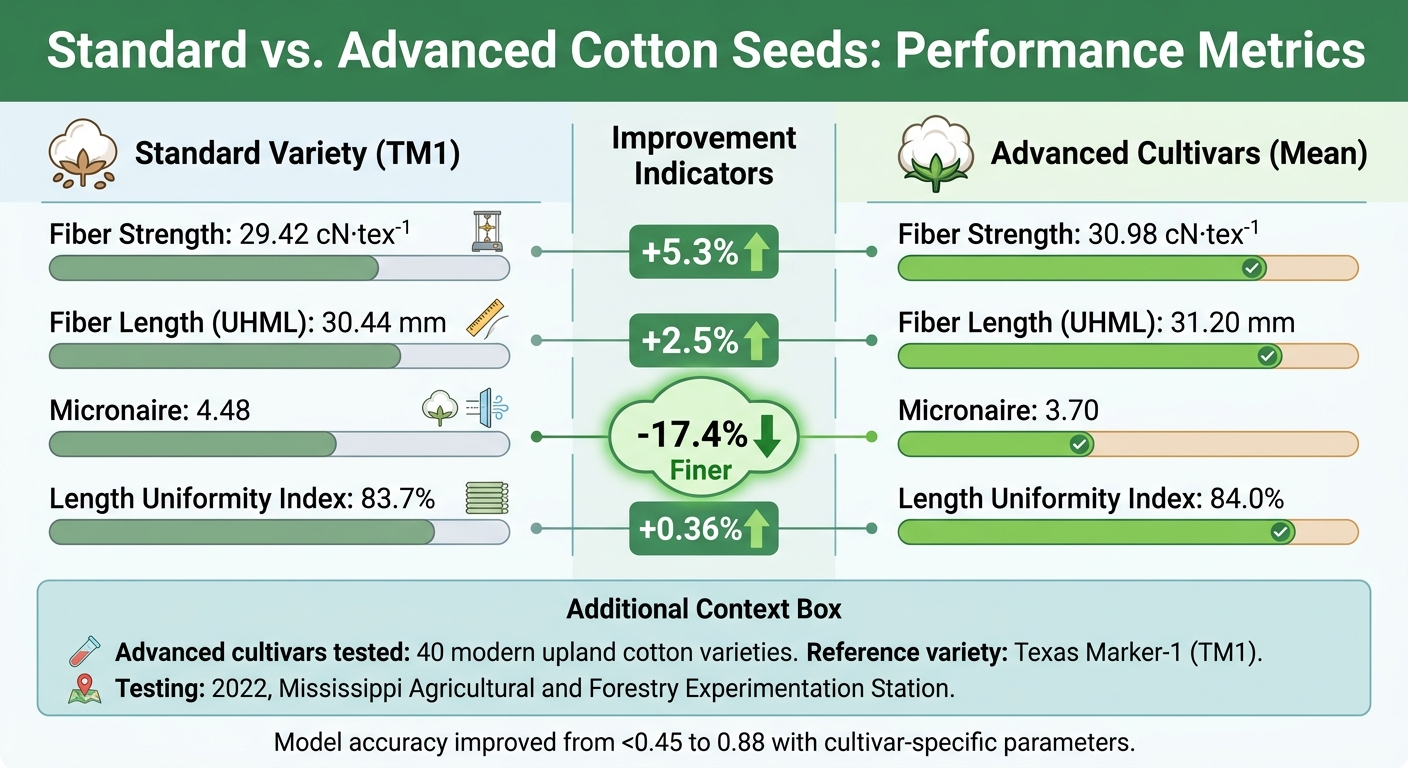
Standard vs Advanced Cotton Seeds: Fiber Quality Performance Comparison
Performance Metrics: Standard vs. Advanced Seeds
Recent field studies have highlighted clear differences in fiber quality when comparing standard and advanced seed varieties. In 2022, researchers at the Environmental Plant Physiology Laboratory, part of the Mississippi Agricultural and Forestry Experimentation Station, tested 40 modern upland cotton cultivars against the standard reference variety, Texas Marker-1 (TM1), to measure performance improvements.
Under ideal conditions, advanced cultivars outperformed TM1 significantly in key metrics. For instance, fiber strength in the top-performing advanced varieties reached up to 34.6 cN·tex⁻¹, compared to TM1's 29.42 cN·tex⁻¹. Similarly, fiber length saw notable gains, with advanced cultivars achieving 33.3 mm versus TM1's 30.44 mm. These improvements directly enhance yarn quality and reduce breakage during spinning.
Micronaire values, which indicate fiber fineness and maturity, showed the most striking improvement. Advanced cultivars averaged 3.70, reflecting a 17.4% improvement over TM1's 4.48. This finer fiber aligns with the needs of modern textile mills, which require uniform fibers for high-quality fabrics.
| Fiber Quality Metric | Standard Variety (TM1) | Advanced Cultivars (Mean) | Percentage Difference |
|---|---|---|---|
| Fiber Strength | 29.42 cN·tex⁻¹ | 30.98 cN·tex⁻¹ | +5.3% |
| Fiber Length (UHML) | 30.44 mm | 31.20 mm | +2.5% |
| Micronaire | 4.48 | 3.70 | –17.4% (Finer) |
| Length Uniformity Index | 83.7% | 84.0% | +0.36% |
Standard crop simulation models based solely on TM1 data often showed inaccuracies. However, updating these models with cultivar-specific parameters significantly improved prediction reliability. Willmott's index, a measure of model accuracy, jumped from below 0.45 to 0.88 when advanced cultivars were included. These advancements not only boost spinning efficiency but also result in better-quality fabrics, offering cotton growers a clear economic advantage.
Conclusion: Measured Results Driving Industry Progress
Advanced cotton seeds, backed by thorough research and field testing, are reshaping industry benchmarks. Modern upland cotton cultivars now produce fiber with strengths ranging from 28.4 to 34.6 cN·tex⁻¹ and lengths between 27.1 and 33.3 mm. These qualities directly improve yarn production by reducing breakage during spinning, making U.S. cotton more attractive to textile manufacturers.
The benefits aren't limited to fiber quality alone. In June 2017, the USDA-ARS in Stoneville, Mississippi, introduced two cutting-edge germplasm lines - USDA MD 16-1 and USDA MD 16-2 - developed by Efrem Bechere and Rex Manning. Tested across 13 locations during the 2016 Regional Breeders' Testing Network, USDA MD 16-1 achieved an impressive yield of 1,710 kg/ha (around 1,524 lb/acre), while USDA MD 16-2 delivered the strongest fiber at 355 kN·m·kg⁻¹. These lines outperformed standard check cultivars by 9% to 16% in lint yields. These advancements highlight how strategic breeding efforts are driving industry progress.
"High-quality cotton, which meets the USDA's grading standards, is eligible for premium pricing in the markets. Conversely, low-quality fiber... may receive discounted prices." – Journal of Cotton Research
By incorporating cultivar-specific parameters into simulation models, researchers have achieved an accuracy level of 0.88. This data underscores the importance of lint fiber, which represents about 80% of returns, making the selection of advanced seeds a key economic decision for growers.
The documented gains in fiber strength, length uniformity, and micronaire values demonstrate that advanced cotton seeds are not just theoretical improvements - they deliver measurable benefits to U.S. cotton farmers, ensuring better returns and a stronger position in the global market.
FAQs
Which advanced cotton seed traits matter most for USDA fiber grades?
Advanced cotton seed traits play a crucial role in determining USDA fiber grades. These include fiber quality variability, which directly influences the consistency of the cotton produced. Genetic markers, such as QTLs (Quantitative Trait Loci) and specific candidate genes tied to fiber traits, are essential tools for breeders aiming to enhance cotton quality. Additionally, fiber quality traits identified through GWAS (Genome-Wide Association Studies) provide valuable insights into improving fiber characteristics.
These traits collectively impact critical factors like fiber strength, length, and the overall grade of the cotton. By focusing on these advanced traits, farmers can produce higher-quality cotton, meeting both industry demands and market expectations.
How do I pick the best advanced variety for my region and soil?
To find the most suitable advanced cotton variety, start by assessing your local growing conditions, such as climate, soil type, and water resources. Focus on varieties that have consistently performed well in your region, offer resistance to common pests and diseases, and align with the characteristics of your soil and weather. For tailored advice, reach out to local agronomists or seed specialists who can provide insights from regional trials and farmer experiences. This approach will help you select a variety that thrives in your specific environment.
What management changes help advanced seeds reach top fiber quality?
Getting the best fiber quality from advanced cotton seeds requires fine-tuning your agronomic practices. Here are some key steps to focus on:
- Balanced Potassium Fertilization: Potassium plays a big role in improving fiber uniformity and micronaire, so ensure your fertilization plan is well-balanced.
- Use of Plant Growth Regulators (PGRs): PGRs can help boost staple length, which is crucial for high-quality fiber.
- Mid-Season Testing with HVI Technology: High Volume Instrument (HVI) testing allows you to track important traits like fiber length and strength during the growing season, enabling timely adjustments.
- Crop Rotation and Soil Health: Rotating crops and maintaining healthy soil conditions contribute to better results from advanced seed varieties.
These practices, when combined, can help you get the most out of advanced cotton seeds while ensuring superior fiber quality.