The Global Organic Textile Standard (GOTS) is the top certification for organic and ethically produced textiles. It ensures products meet strict requirements for organic fiber content, ethical labor practices, and chemical safety throughout the supply chain. In 2026, GOTS introduced Version 8.0, which includes stricter rules for transparency, audits, and traceability.
Key Updates in 2026:
- Higher Standards: Products labeled "organic" must have at least 95% organic fibers, while "made with organic" requires 70%.
- New Rules for Cotton Gins: Facilities must now separate organic and non-organic materials and conduct pesticide and GMO testing.
- Tighter Audits: Annual inspections and unannounced audits are now mandatory for certified facilities.
- Improved Transparency: Scope Certificates now include detailed product and activity lists to ensure better traceability.
Why It Matters:
GOTS certification helps brands meet growing consumer demand for safer, ethically made products. For consumers, the GOTS logo guarantees that textiles are free from harmful chemicals and produced under fair labor conditions.
To get certified, businesses must work with approved certification bodies, provide detailed documentation, and pass rigorous audits. Certification costs range from $1,200 to $3,000 annually per facility, with additional fees for chemical manufacturers.
GOTS remains a trusted standard for both brands and consumers, ensuring quality and integrity in the textile industry.
GOTS Connect - Introduction GOTS and Organics
GOTS Version 8.0 Updates for 2026
The release of GOTS Version 8.0 marks a major overhaul since Version 7.0 was introduced in March 2023. This update, developed over several years and finalized after public consultations ending in September 2025, brings tighter environmental protections and improved traceability standards. These changes will directly affect brands, cotton producers, and certification bodies, setting a higher bar for supply chain and auditing practices.
Enhanced Supply Chain Requirements
Building on its alignment with OECD principles, Version 8.0 introduces mandatory GMO and pesticide testing along with deforestation traceability measures. These updates enhance technical safeguards, such as chemical residue testing and detailed tracking of deforestation activities.
Cotton producers and gins must now adhere to updated parameters outlined in the "Gin Parameters V 2.1" document, set for release in December 2025. These new requirements align ginning operations with the stricter standards of Version 8.0, ensuring that environmental benchmarks are met from the earliest stages of organic cotton processing.
New Inspection and Audit Requirements
To support the updated supply chain protocols, Version 8.0 enforces stricter inspection and audit measures. Annual onsite inspections are now mandatory, and the frequency of unannounced audits has been increased across the entire supply chain. Unlike earlier versions, which allowed more flexibility in audit timing, Version 8.0 standardizes these processes to ensure continuous compliance. Additionally, auditors are now required to complete due diligence training, funded in part by an ISEAL Innovations Fund grant.
"The grant from the ISEAL Innovations Fund will support new due diligence training for GOTS auditors." - Global Standard
Brands preparing for the transition should consult the "Q&A Guideline for the Transition to a New GOTS Version" to ensure their supply chains and inventories are compliant with the 2026 deadlines. The newly launched Global Standard Academy offers free online training on Version 8.0 updates and due diligence protocols.
Product Transparency Requirements
As part of the new standards, Version 8.0 introduces stricter transparency measures to improve product traceability. Scope Certificates must now include detailed lists of certified products and activities, a significant shift from earlier versions that offered less specific reporting. This change ensures that the products listed on a Scope Certificate directly correspond to the goods being traded or processed, making it easier for brands to verify supplier claims.
| Document Type | Purpose in V8.0 | 2026 Update |
|---|---|---|
| Scope Certificate (SC) | Confirms a supplier meets GOTS processing criteria | Must include detailed lists of certified products and activities |
| Transaction Certificate (TC) | Verifies specific shipments meet GOTS criteria | Enhanced measures to prevent supply chain fraud |
| Gin Parameters V 2.1 | Sets operational standards for cotton gins | Updated December 2025 with stricter controls |
Brands can utilize the GOTS Certified Suppliers Database to verify a supplier's location, operations, and product groups to ensure alignment with Scope Certificate claims. Additionally, requesting the "Facility Appendix" of a supplier's Scope Certificate can provide a detailed list of all inspected subcontractors and facilities involved in production.
Who Needs GOTS Certification?
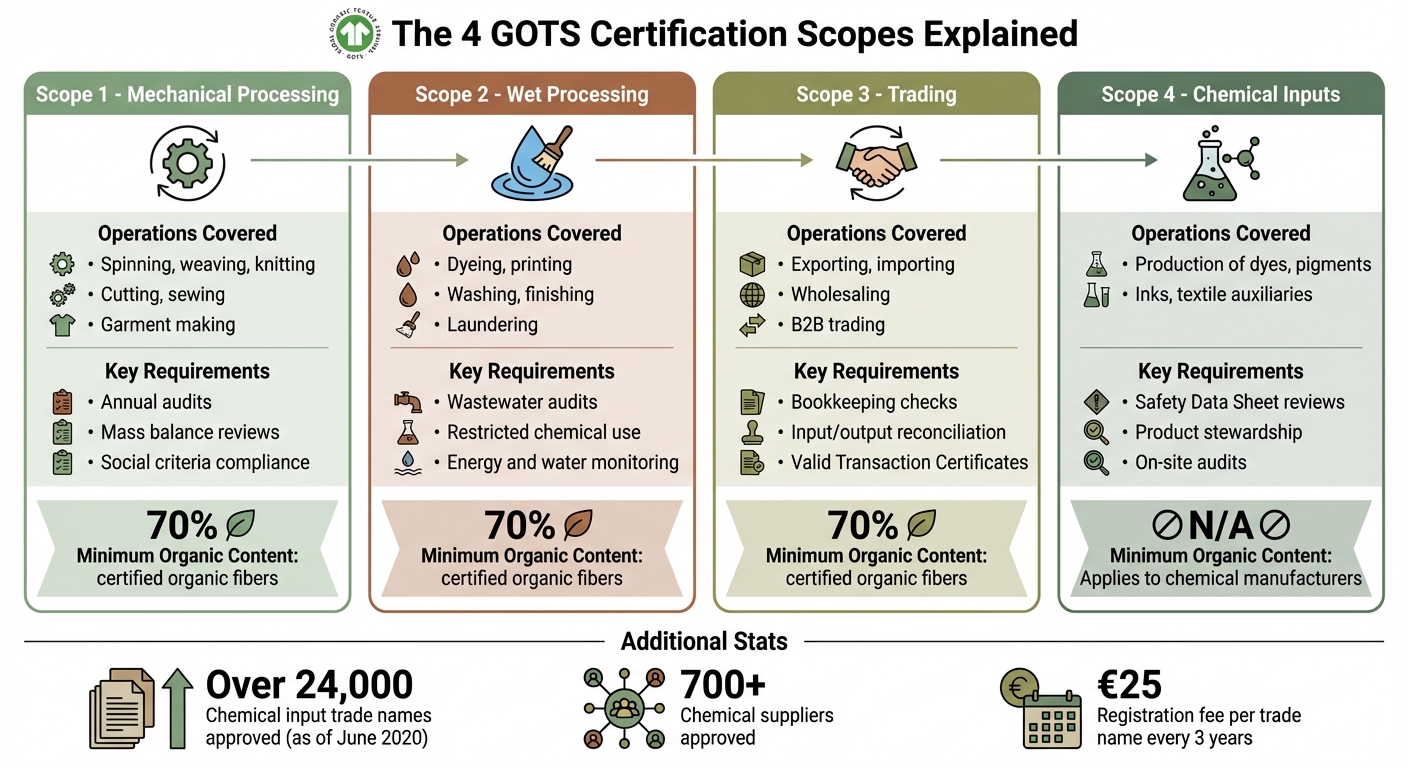
GOTS Certification Scopes and Requirements Comparison Chart
Anyone involved in the textile supply chain - from post-harvest handling to garment production - needs to obtain GOTS certification. This includes post-harvest handlers, processors, manufacturers, wholesalers, exporters, and importers. However, retailers selling directly to consumers are exempt, unless they also engage in processing or wholesaling. To make product-specific GOTS claims, each processing and trade step must meet strict annual requirements, such as on-site inspections and maintaining a valid Scope Certificate.
These rules set the foundation for understanding the four distinct certification scopes described below.
The 4 GOTS Certification Scopes
GOTS certification is divided into four categories, each focusing on a specific stage of the textile supply chain:
| Scope | Operations Covered | Key Requirements | Minimum Organic Content |
|---|---|---|---|
| Scope 1: Mechanical Processing | Activities like spinning, weaving, knitting, cutting, sewing, and garment making | Annual audits, mass balance reviews, compliance with social criteria | 70% certified organic fibers |
| Scope 2: Wet Processing | Processes such as dyeing, printing, washing, finishing, and laundering | Wastewater audits, restricted chemical use, energy and water monitoring | 70% certified organic fibers |
| Scope 3: Trading | Exporting, importing, wholesaling, and B2B trading | Bookkeeping checks, input/output reconciliation, valid Transaction Certificates | 70% certified organic fibers |
| Scope 4: Chemical Inputs | Production of dyes, pigments, inks, and textile auxiliaries | Safety Data Sheet reviews, product stewardship, on-site audits | N/A – Applies to chemical manufacturers |
As of June 2020, over 24,000 chemical input trade names from more than 700 suppliers had been GOTS-approved. Chemical manufacturers are required to pay a registration fee of €25 per trade name whenever a new version of the Standard is released, typically every three years.
GOTS Requirements for Cotton Gins
Cotton ginning, the first step in textile processing, must adhere to strict organic standards. Falling under Scope 1 (Mechanical Processing), cotton gins must comply with the "Certification and Operating Parameters for GOTS Certified Gins V 2.1", which was introduced in December 2025.
A critical requirement for gins is ensuring that organic and non-organic cotton remain completely separate to avoid contamination. This involves implementing robust separation protocols and conducting qualitative GMO and pesticide residue testing before processing begins. Additionally, all incoming organic cotton must be accompanied by valid Transaction Certificates to confirm its organic origin.
Like all GOTS-certified operations, cotton gins are subject to annual on-site inspections and must be ready for unannounced audits. These audits may include bookkeeping reviews, mass balance calculations, and confidential interviews with workers. Globally, GOTS-certified facilities employ over 4 million workers.
sbb-itb-0e617ca
How to Get GOTS Certification
To obtain GOTS certification, you’ll need to work with an approved third-party Certification Body (CB) that matches your operational scope. Whether your focus is mechanical processing, wet processing, trading, or chemical inputs, it’s crucial to verify that the CB you choose is accredited for your specific operations before proceeding.
The certification process involves three main steps: application, inspection, and supply chain documentation.
Application and Required Documents
Start by reviewing GOTS Version 8.0 and its accompanying manuals to familiarize yourself with the requirements. For initial guidance, you can reach out to GOTS Regional Representatives or consult GOTS Approved Consultants if your compliance questions are more complex. Your application needs to include details like facility locations, operational scopes, and the products you manufacture.
Key documents you’ll need to provide include:
- An Organic System Plan (OSP) outlining your processes.
- Bookkeeping records that demonstrate input/output reconciliation.
- A list of chemical inputs that comply with the Manufacturing Restricted Substance List (MRSL).
- Evidence of adherence to social criteria, such as personnel records.
Additionally, commercial buyers should make the issuance of Transaction Certificates (TCs) a contractual requirement for every shipment, ensuring product integrity throughout the process.
Once your documentation is ready, the CB will initiate the next step: a site audit.
Inspection and Testing Process
After submitting your application, the CB will schedule an on-site audit. This audit evaluates your facilities, reviews mass balances, inspects wastewater systems, and includes interviews with workers. Be prepared for both scheduled and unannounced inspections, which check for proper separation of organic and non-organic materials and confirm the use of approved chemical inputs.
If any non-compliance issues are identified during the audit, the CB will provide a timeline for you to address them before certification is granted. As for costs, annual certification fees typically range from $1,200 to $3,000 per facility, along with a $180 annual GOTS fee per inspected location. Chemical manufacturers should also budget for an additional $25 registration fee per trade name whenever a new Standard version is introduced, approximately every three years.
Transaction Certificates and Supply Chain Documentation
GOTS certification relies on two key certificates to ensure integrity across the supply chain:
- Scope Certificate (SC): This proves your facility is authorized to process GOTS-certified goods. It also lists your certified product categories and inspected locations.
- Transaction Certificates (TCs): These verify that specific shipments meet GOTS standards. TCs must be issued within 14 days of application and can cover multiple shipments on a single certificate, reducing paperwork for high-volume suppliers. However, they can still be issued up to six months after shipment if needed.
Every participant in the supply chain, from cotton gins to garment manufacturers, must hold a valid Scope Certificate and issue TCs for outgoing products to maintain GOTS compliance.
Benefits of GOTS Certification
Business Benefits
GOTS certification simplifies global trade for textile businesses by providing a single, universally recognized standard. According to Global Standard, "Having one common standard means textile processors and manufacturers can export their fabrics and garments with one organic certification that is accepted in all major markets". This eliminates the hassle of navigating different regional requirements, making compliance more straightforward.
Certified facilities gain increased market visibility through the GOTS database, a widely used tool for commercial buyers seeking sustainable partners. Additionally, certification allows businesses to display the trademarked GOTS logo on their products. This trusted symbol helps brands stand out in a market where consumers are increasingly wary of greenwashing.
GOTS certification also aligns with international frameworks like the OECD Guidance for Responsible Supply Chains in the Garment and Footwear Sector. This alignment supports businesses in managing social and environmental risks throughout their supply chains. By joining the GOTS-certified network, companies connect to a global community that employed over 4 million people as of late 2025.
These benefits not only streamline operations but also strengthen consumer trust in certified products.
Consumer Benefits and How to Identify GOTS Products
GOTS certification doesn’t just help businesses - it also reassures consumers. With stricter standards introduced in 2026, GOTS guarantees safer products by banning harmful substances like toxic heavy metals, formaldehyde, aromatic solvents, and functional nano-particles in textile processing. The standard also prohibits the use of genetically modified organisms and requires wastewater to be treated before discharge, protecting both the environment and consumer health. Social criteria, based on International Labour Organization norms, are rigorously verified at every stage of production.
To ensure a product is genuinely GOTS-certified, look for the official logo along with the label grade, certification body, and license number. The label grade will indicate either "organic" (for products with at least 95% organic fibers) or "made with organic" (for those with at least 70% organic fibers). Be cautious of partial claims like "made from GOTS certified yarn" without the full on-product label - only products displaying the complete GOTS logo confirm certification of the entire value chain.
Conclusion
The Global Organic Textile Standard (GOTS) stands as a symbol of organic integrity, environmental responsibility, and ethical labor practices in the textile industry. With the upcoming transition to Version 8.0 in 2026, GOTS is raising the bar even higher by introducing mandatory wastewater treatment and stricter bans on hazardous chemicals. As of now, it has a remarkable global reach, with over 15,000 certified facilities across 87 countries and more than 4 million workers involved.
For brands, GOTS certification opens doors to international markets, especially in Europe and North America. It also ensures compliance with global regulations like the OECD Due Diligence Guidance for Responsible Supply Chains. By addressing every stage of production - from the initial ginning process to the final garment - GOTS eliminates any opportunity for greenwashing. Independent, third-party audits ensure that every claim is backed by verifiable action.
Consumers also benefit significantly. GOTS-certified products guarantee freedom from harmful substances like PFAS and toxic dyes, while ensuring they are produced under fair labor conditions. Greenpeace has recognized GOTS for its rigorous standards, stating:
"The highest requirements for chemical management, recycling and workers' rights are met by [...] the Global Organic Textile Standard."
To further enhance transparency, GOTS provides tools like the Certified Suppliers Database and Shop-Finder, enabling both businesses and consumers to verify claims and make confident, informed choices. In today’s complex organic textile landscape, GOTS offers a trusted framework that bridges the gap between sustainable production and ethical consumption.
FAQs
What are the main updates in GOTS Version 8.0, and when do they take effect?
GOTS Version 8.0 brings updated certification criteria aimed at reinforcing sustainable and ethical practices in textile production. These updates focus on stricter adherence to both environmental and social standards, raising the bar for certified entities.
The official release is scheduled for March 2026, with a transition period extending until March 1, 2027. This gives organizations time to adjust to the new requirements. However, early adoption is encouraged to meet the updated standards sooner and stay ahead of the curve.
What are the benefits of GOTS certification for brands and consumers?
GOTS certification comes with distinct perks for both brands and consumers.
For brands, it boosts credibility by showing a verified commitment to ethical and eco-friendly practices. This not only strengthens customer trust but also ensures transparency throughout the supply chain. Plus, it helps brands avoid pitfalls like greenwashing by adhering to strict standards.
For consumers, GOTS certification guarantees that textiles are made from certified organic materials and meet rigorous environmental and ethical guidelines. Products are free from harmful chemicals, created under fair working conditions, and support sustainable practices. This certification gives consumers the confidence to choose products that reflect their values, promoting both eco-conscious and ethical living.
What changes does GOTS Version 8.0 introduce for cotton gins?
The release of GOTS Version 8.0 brings a series of updated rules for cotton gins, focusing on improving traceability and ensuring compliance with organic standards. Key updates include stricter sourcing requirements for raw cotton, more rigorous testing protocols, and risk-based measures to confirm adherence to GOTS guidelines.
In addition, cotton gins are now required to meet specific operational standards detailed in the updated certification framework, which was revised in September 2025. These measures aim to strengthen sustainable practices and foster greater transparency across the textile supply chain, offering clear benefits to businesses and consumers dedicated to ethical and organic production.