I’d choose ring for strength, rotor for lower-cost coarse-to-medium yarn, and vortex for low hairiness and high output. My first step is to match the yarn specification - not chase the highest machine speed.
The tradeoff? Ring needs more processing steps. Rotor accepts shorter fibers but still needs clean sliver. Vortex needs tighter fiber control, and compressed air adds cost.
Quick Comparison
| Factor | Ring | Open-end (rotor) | Air-jet (vortex) |
|---|---|---|---|
| Feed | Roving | Drawn sliver | Clean, uniform drawn sliver |
| Yarn counts | Broad, including fine counts | Typically 6–40 Ne | Practical range: 20–60 Ne |
| Strength and feel | Usually strongest; soft hand | Lower strength; bulky, firmer feel | Generally weaker than ring; smooth surface |
| Hairiness | Generally highest | Lower than conventional ring | Generally lowest |
| Output and cost | Slower; more processing stages | Higher output; fewer stages | Highest delivery speed; added air cost |
Higher Ne means finer yarn: 30 Ne is finer than 20 Ne.
Before choosing, I’d test the intended cotton and check strength, feel, and surface quality. Then I’d compare <u>cost per saleable pound</u> in USD, including labor, energy, waste, maintenance, and downtime - not just delivery speed.
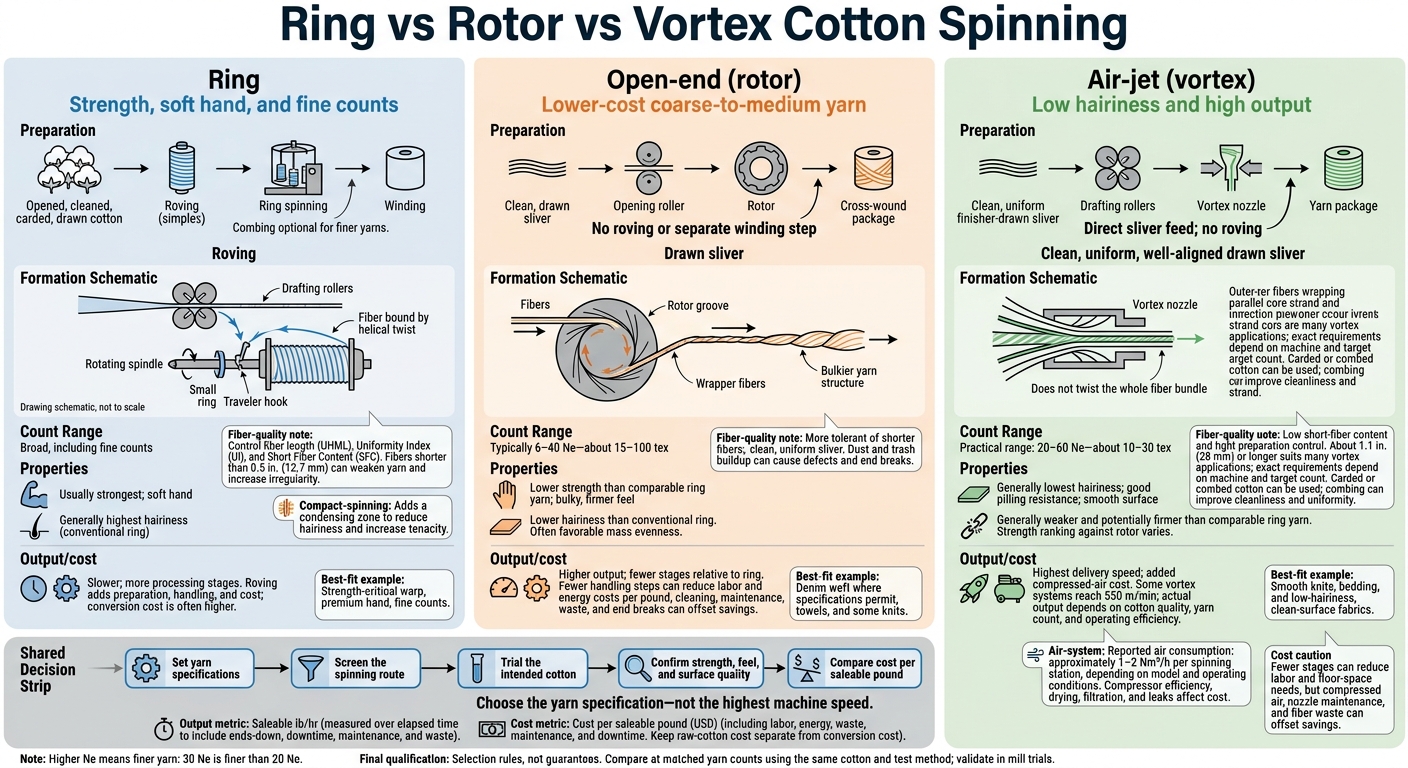
Ring vs Rotor vs Vortex Cotton Spinning
Comparison Ring Spun VS Rotor Spun Yarn | GATE TF | Structural and physical properties|Yarn Spinning
sbb-itb-0e617ca
1. Ring Spinning Frames
Ring spinning sets the benchmark for yarn quality. Its fiber requirements and cost tradeoffs provide a baseline for comparing the systems that follow.
Cotton Preparation
Cotton is opened, cleaned, carded, and drawn. For finer yarns, combing may also remove short fibers and neps. Before ring spinning, the cotton must pass through roving, also called simplex.
Ring spinning is especially sensitive to fiber length (UHML), Uniformity Index (UI), and Short Fiber Content (SFC). Fibers shorter than 0.5 in. (12.7 mm) can weaken yarn and increase irregularity.
Yarn Count Range
Ring spinning produces coarse-to-fine yarn counts. Finer yarns, however, need tighter control of UHML, UI, and SFC.
Yarn Properties
Drafting rollers thin the roving to the target count. The spindle and traveler add twist and wind the yarn onto the bobbin. That twist holds fibers together through friction, helping produce strong yarn. Compact spinning adds a condensing zone to reduce hairiness and increase tenacity.
Conventional ring yarn typically feels soft and natural, though it is hairier than rotor or air-jet yarn. Compact yarn has a smoother surface. Twist and packing density also affect strength and fabric hand - the way the fabric feels. The yarn’s intended use should guide the choice.
Throughput and Operating Cost
Ring spinning requires roving, which adds a preparation step, more handling, and higher costs compared with direct-from-sliver systems. This longer preparation path also lowers throughput. The tradeoff is higher yarn quality at a higher production cost.
2. Open-End (Rotor) Spinning Frames
Cotton Preparation
Rotor frames feed directly from drawn sliver. An opening roller separates the fibers, while centrifugal force separates trash and airflow moves it to a waste port. Air then carries the fibers into the spinning rotor, where they collect in a groove around its perimeter.
Rotor spinning can handle shorter fibers, but the sliver still needs to be clean and uniform. Dust and trash buildup can cause yarn defects and end breaks.
Yarn Count Range
Rotor spinning works best for coarse to medium counts, typically 6–40 Ne - about 15–100 tex. Match the blend and sliver quality to the target count. The ability to process shorter fibers doesn't make rotor spinning a fit for every blend.
Yarn Properties
A yarn tail in the rotor groove picks up the collected fibers. As the rotor turns, it inserts twist while the yarn is continuously drawn out through the center.
Compared with similar ring yarn, rotor yarn generally has more even thickness, fewer imperfections, and less hairiness - but lower tenacity. Wrapper fibers also make it bulkier and less compact. Rotor offers a middle option when uniformity and cost matter more than maximum strength.
Throughput and Operating Cost
The yarn winds directly onto a cross-wound package, eliminating roving and a separate winding step. This direct-to-package process, higher output, and fewer handling steps can reduce labor and energy costs per pound.
Denim, towels, and some knits fit this profile.
To compare costs, include rotor cleaning, maintenance, waste, and end breaks - not just delivery speed. Poor cleanliness can eat into savings by interrupting production and causing defects.
Air-jet systems push speed further but need cleaner, more uniform feed.
3. Air-Jet (Vortex) Spinning Systems
Cotton Preparation
Air-jet spinning runs at higher speeds, but it needs tighter control over fiber quality. Enough long fibers must be present to form a stable wrapper around the core. Use clean cotton with low short-fiber content and a uniform finisher-drawn sliver. A staple length of about 1.1 in. (28 mm) or longer suits many vortex applications, though the exact limit depends on the machine and target count.
Vortex systems can process both carded and combed cotton. Carding cuts preparation costs, while combing improves cleanliness, uniformity, and suitability for finer counts.
Yarn Count Range
Ne 20–60, or about 10–30 tex, is a practical target range.
Yarn Properties
Finisher-drawn sliver moves through drafting rollers into an air nozzle. A vortex wraps the outer fibers around a mainly parallel core to bind them into yarn. Unlike ring spinning, it doesn't twist the whole fiber bundle. Modern vortex systems use a redesigned nozzle and fiber-flow path to improve wrapper formation.
The resulting yarn has low hairiness and good pilling resistance, making it suitable for smooth knits and bedding. However, it may have lower tensile strength and a firmer feel than comparable ring yarn.
Throughput and Operating Cost
Like rotor spinning, air-jet spinning winds yarn directly onto a package, but it also requires compressed air. Some vortex systems reach 550 m/min, though actual output depends on cotton quality, yarn count, and operating efficiency.
Fewer processing stages can cut labor and floor-space needs. But compressed air, nozzle maintenance, and fiber waste can offset those savings. Compare cost per saleable pound, not quoted line speed.
Comparing Cotton Needs, Yarn Quality, and Production Costs
With the spinning systems defined, compare them using the same fiber, quality, and cost measures.
Cotton Preparation and Fiber Quality
Fiber consistency matters - not just staple length. Use HVI and AFIS data to sort bales, track short-fiber content, and check carding performance. Cotton grade alone is too broad to guide these decisions.
| Preparation factor | Ring | Open-end (rotor) | Air-jet (vortex) |
|---|---|---|---|
| Feed preparation | Requires roving | Direct sliver feed | Direct sliver feed with tight quality control |
| Fiber-length sensitivity | Longer, stronger fibers support finer, stronger yarn | More tolerant of shorter fibers | Especially sensitive to short fibers and poor parallelization |
| Preparation control | Stable roving and drafting matter | Clean sliver helps limit defects | Especially clean, uniform sliver is important |
Yarn Count Ranges and Limits
| Count consideration | Ring | Open-end (rotor) | Air-jet (vortex) |
|---|---|---|---|
| Practical limiting factors | Fiber length, strength, drafting, and breakage | Yarn strength and stable fiber collection | Short-fiber control and wrapper formation |
| Fine-count constraint | Fiber length, strength, drafting, and breakage | Maintaining strength and stable fiber collection | Maintaining wrapper formation and strength |
| Preparation priority | Consistent drafting | Clean, consistent drawn sliver | Low short-fiber content and tightly controlled sliver |
Yarn Strength, Feel, and Surface Quality
Compare yarns at matched counts using the same cotton and test method. Ring uses helical twist. Rotor uses wrapper fibers around a core, while vortex uses a parallel core with surface wrappers. These structures help explain why the same cotton performs differently at the same count.
| Property | Ring | Open-end (rotor) | Air-jet (vortex) |
|---|---|---|---|
| Strength | Usually highest | Usually lower than ring | Generally lower than ring; ranking against rotor varies |
| Softness and texture | Usually soft and flexible | Bulkier and more voluminous, often harsher | Smooth and crisp; often between ring and rotor |
| Hairiness | Generally highest | Generally lower than conventional ring | Generally lowest |
| Mass evenness | Depends strongly on drafting and preparation | Often favorable | Often favorable with controlled preparation |
| Pilling tendency | More surface fibers can contribute to pilling | Wrapper structure can limit loose fibers | Tight wrappers can improve resistance |
Production Speed, Process Steps, and Costs
Compare saleable lb/hr, not machine speed. Measure output over elapsed time to account for ends-down rate, downtime, maintenance, and waste. Higher speed only pays off when it produces saleable yarn at a lower total cost.
| Cost or output measure | Ring | Open-end (rotor) | Air-jet (vortex) |
|---|---|---|---|
| Output measure | Saleable lb/hr | Saleable lb/hr | Saleable lb/hr |
| Labor and floor space | Additional stages increase requirements | Automation can reduce requirements | Fewer stages can reduce requirements |
| Energy and maintenance | Spindles, drafting, and preparation equipment | Rotor drives, suction, cleaning, and opening components | Compressed air, nozzles, and preparation equipment |
| Waste and downtime | Ends-down and winding losses | Cleaning waste, breaks, and maintenance stops | Fiber loss, breaks, and nozzle maintenance |
| Conversion-cost tendency | Often higher because of added stages | Often favorable | Depends heavily on air use, fiber loss, and utilization |
Keep raw-cotton cost separate from conversion cost: a cheaper process may still need more expensive cotton.
Pros, Cons, and Best-Fit Yarn Uses
Start with what you can’t compromise on: strength and hand, low cost, or surface quality. Use this table to narrow your options before mill trials.
| System | Selection takeaway | Main limitation |
|---|---|---|
| Ring | Best for maximum strength and the broadest count range | More processing stages and generally higher operating cost |
| Rotor (open-end) | Best for lower-cost coarse-to-medium yarn | Usually weaker, bulkier, and firmer than comparable ring yarn; fiber tolerance doesn’t mean you can ignore trash or contamination |
| Air-jet (vortex) | Best for low-hairiness, high-speed production | Needs clean, uniform, well-aligned sliver with low short-fiber content; compressed air adds cost, and strength generally stays below ring |
Treat these as selection rules, not guarantees. Match the frame to the yarn specification first, then to the fabric’s end use.
The matrix below helps screen the production route. A higher English cotton count (Ne) means finer yarn; the count categories are representative, not fixed limits.
| Decision factor | Ring | Rotor | Vortex |
|---|---|---|---|
| Preparation | Roving required; consider combing for fine or premium specifications | Clean, drawn sliver; no roving | Tightly controlled, uniform, well-aligned sliver; combing may be needed |
| Count priority | Fine | Coarse-to-medium | Medium-to-fine |
| Strength priority | Strength-critical warp and weaving | Where lower tenacity meets the specification | Where surface quality matters more than maximum tenacity |
| Feel priority | Soft, premium hand | Bulkier, firmer feel | Smooth, clean surface |
| Delivery speed | Slowest | Moderate | Fastest |
| Process-cost trade-off | More stages | Fewer stages | Fewer stages, but added air cost |
| Cost match | Higher conversion cost justified by yarn requirements | Lower-cost coarse-to-medium production | High output must offset preparation and compressed-air costs |
| Best-fit uses | Strength-critical warp, premium hand, fine counts | Lower-cost coarse-to-medium yarn | Low-hairiness, clean-surface fabrics |
For denim, separate the warp decision from the weft decision. A lower-cost rotor yarn may suit the weft while ring remains preferable for demanding warp strength and abrasion requirements.
Budget the air system before approving vortex capacity. Reported consumption is approximately 1–2 Nm³/h per spinning station, depending on the model and operating conditions. Compressor efficiency, drying, filtration, and leaks affect the actual bill. Validate the route with the intended cotton lot, fabric construction, and finish.
Conclusion: Choose the Frame for the Yarn Specification
Choose ring for high strength and fine counts, rotor for lower-cost coarse-to-medium yarns, and vortex for high throughput and very low hairiness when preparation is tightly controlled.
Test the choice in mill trials. Set acceptance limits for yarn performance, and compare total conversion costs only after the yarn meets those limits.
Record cotton quality and mill conditions for every trial. Compare trial results to determine the true conversion cost for the yarn specification.
FAQs
Can I use recycled cotton in each spinning system?
Yes, but results vary. Open-end (rotor) spinning efficiently processes shorter recycled fibers and blends with up to 50% recycled content. Ring spinning generally needs cleaner, longer-staple fibers to maintain yarn strength and quality. That makes lower-cost recycled materials less suitable for this process.
Recycled fibers reduce strength and consistency more in open-end yarn than in ring-spun yarn. Even so, open-end spinning remains the industry standard for using recycled waste.
Which yarn tests should I use during mill trials?
Focus on tensile strength, elongation, yarn evenness (U%, CV%, and irregularity index), imperfection index (IPI), and hairiness. These tests check the yarn’s structural integrity, uniformity, and surface quality. Use IPI to monitor thin places, thick places, and neps.
Before testing, condition all samples for at least 24 hours at approximately 70°F and 63–65% relative humidity to help ensure accurate results.
How do I calculate cost per saleable pound?
Calculate cost per pound of usable yarn by dividing total production costs by the pounds of usable yarn produced. Include energy, labor, maintenance, and raw materials. Typical energy use is 0.82–1.00 kWh/lb for open-end spinning and 1.13–1.59 kWh/lb for ring spinning (1.8–2.2 and 2.5–3.5 kWh/kg, respectively).
Factor in savings from using lower-cost fiber waste ($0.20–$0.50/lb). When calculating saleable yarn weight, account for production waste, which typically runs 2%–4% for open-end spinning.