In seed cotton, foreign fibers - like plastic film, polypropylene, and human hair - can severely reduce quality and market value, especially for high-end textiles. Mechanized harvesting has worsened contamination issues, making manual sorting inefficient and prone to errors. A study led by Ling Zhao in 2025 introduced a hyperspectral imaging system combined with deep learning to address these challenges.
Key findings:
- Detection Accuracy: Achieved 97.2% accuracy in identifying contaminants.
- Technology Used: A PCA-AlexNet-23 model reduced data from 150 spectral bands to 23, ensuring precision while lowering computational demands.
- Challenges Solved: Successfully identified hard-to-detect materials like transparent plastic and white polypropylene.
This system offers a faster, more reliable way to detect and remove foreign fibers, improving cotton quality and efficiency in processing at cotton gins.
Foreign fiber detection in cotton using HIS approach for industrial automation (latest Project 2020)
sbb-itb-0e617ca
Study Overview and Research Objectives
In June 2025, Associate Professor Ling Zhao from the College of Mechanical and Automotive Engineering at Liaocheng University shared groundbreaking findings in Frontiers of Agricultural Science and Engineering. The research centered on Xinjiang long-staple cotton - a high-quality material prized in luxury textiles but highly susceptible to contamination during mechanized harvesting.
To tackle this issue, the team developed an intelligent system designed to detect foreign fibers, particularly those that are difficult to identify using traditional methods. These include white and transparent contaminants, such as plastic film and fragments of white polypropylene from broken fertilizer bags.
Research Goals and Challenges
The study aimed to address major hurdles in cotton gin operations. Traditional RGB systems often fail to differentiate white plastic film from cotton fibers, leaving manual sorting as the only solution. However, manual sorting is time-consuming and leads to operator fatigue. Similarly, fluorescence-based detection methods fall short when dealing with impurities that lack fluorescent properties.
The research team examined 585,600 samples across 10 contamination categories. These included plastic film, cotton boll hulls, leaf fragments, human hair, polypropylene fiber, colored thread, cotton stalks, and yellow cotton. Each type of contaminant brought its own set of difficulties. For example:
- Plastic film: Irregular shapes and transparency make it hard to detect.
- Human hair: Thin and challenging to segment.
- Yellow cotton: Often damaged by sunlight or fungi, it blends seamlessly with healthy fibers.
Technologies Used in the Study
To overcome these challenges, the researchers combined hyperspectral imaging with deep learning. They utilized the Gaia Sorter-Dual, a hyperspectral sorter capable of capturing 150 shortwave infrared spectral bands. Unlike standard cameras that only see visible light, this system creates a unique spectral fingerprint for each material.
To handle the immense amount of spectral data, the team used Principal Component Analysis (PCA). This method eliminates redundant information, focusing on the most valuable wavelengths. They then integrated a modified AlexNet - a 2D Convolutional Neural Network (CNN) - to achieve high accuracy and efficiency. This advanced system automatically extracts both spectral and spatial features, identifying contamination patterns without the need for manual programming. This innovative combination of hyperspectral imaging and deep learning laid the groundwork for the sophisticated detection methods discussed in the next section.
Detection Methods and Techniques
Hyperspectral Imaging for Feature Extraction
The research team employed hyperspectral imaging to capture a "spectral cube", a three-dimensional dataset that combines spatial images with spectral reflectance data for every pixel. Each pixel's spectral curve spans 150 wavelengths, offering a unique profile. This distinction is vital because materials like plastic film, cotton fibers, and polypropylene packaging rope, which may appear similar to the human eye, have distinct spectral signatures. To achieve this, the system used a Gaia Sorter-Dual hyperspectral sorter operating in the shortwave infrared range, paired with a halogen lamp and an industrial computer for real-time data processing.
To address environmental factors such as light intensity changes, angle shifts, and dark currents, the team applied spectral reflectivity correction. This involved referencing whiteboard and blackboard standards to refine the spectral data. These adjustments laid the groundwork for advanced feature extraction techniques, including PCA and a modified AlexNet model.
PCA-AlexNet Model Implementation
The team tackled the challenge of distinguishing between visually similar materials, like white plastic film and cotton fibers, by employing Principal Component Analysis (PCA) on the 150 spectral bands. PCA helped reduce data redundancy and isolate critical features. After testing various configurations, they found that reducing the data to 23 principal components - referred to as PCA-AlexNet-23 - produced the best results. Attempts with fewer dimensions, such as PCA-5 or PCA-8, led to issues like convergence problems and overfitting. PCA-23, however, provided stable accuracy and loss curves.
"PCA is utilized to select the optimal feature bands for each foreign fiber, reducing redundancy in hyperspectral data and minimizing training time costs." - Ling Zhao et al.
To improve efficiency, the team opted for a 2D convolutional neural network (CNN) structure instead of a 3D-CNN, which reduced computational demands and training time. The modified AlexNet architecture included five convolutional layers with ReLU activations, three max pooling layers, Batch Normalization, and a 55% Dropout rate. Training was optimized using Stochastic Gradient Descent with a learning rate that decayed from 0.001 to 0.000001 over 100 iterations. The final classification was performed using a softmax output layer.
Key Findings and Experimental Results
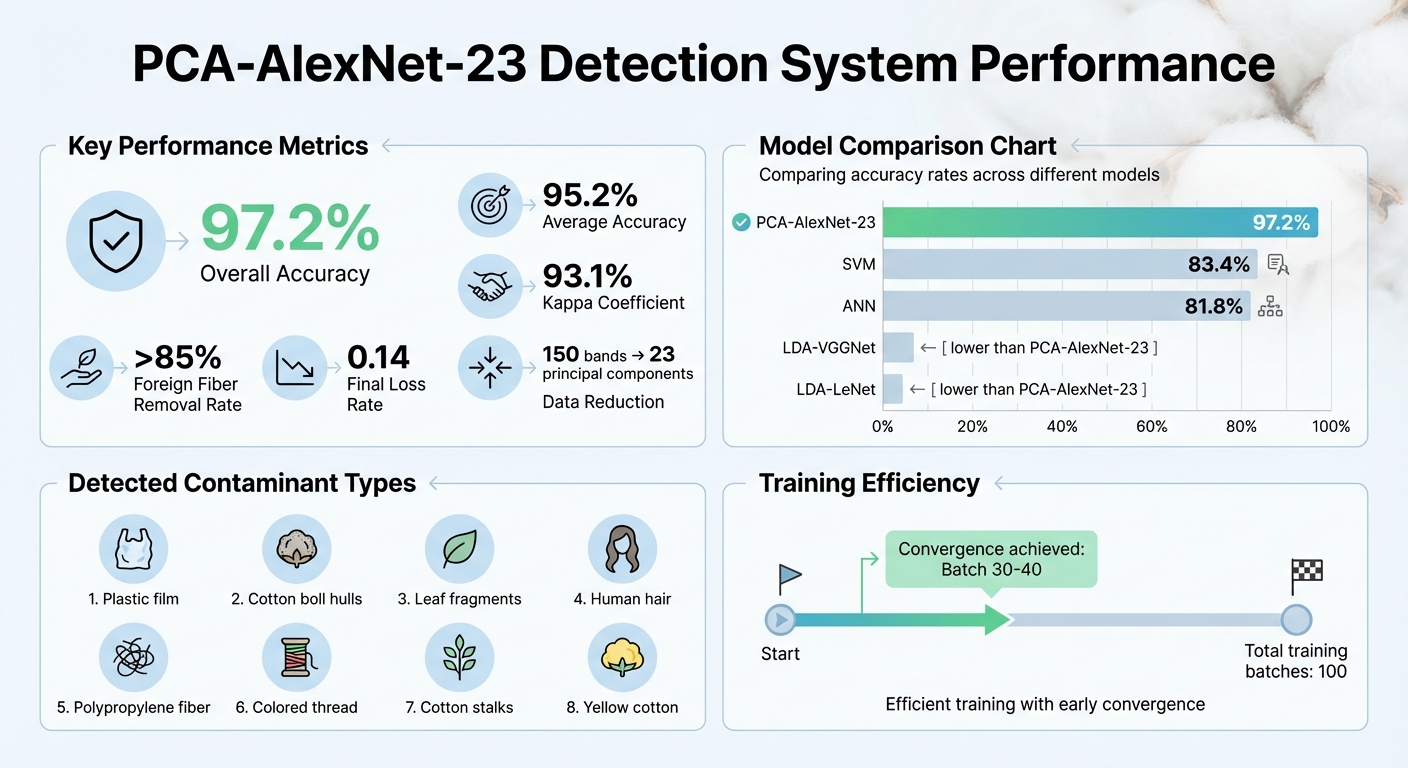
Hyperspectral Imaging System Performance Metrics for Cotton Foreign Fiber Detection
Performance Metrics
The PCA-AlexNet-23 model demonstrated strong capabilities in identifying foreign fibers within seed cotton. In June 2025, a team led by Associate Professor Ling Zhao from Liaocheng University, along with researchers from Beijing Jiaotong University, conducted tests using a 3.5-ounce (100 g) sample of mechanically harvested seed cotton from Awati County, Aksu Prefecture. To challenge the system, the sample was mixed with eight types of foreign fibers, including plastic film, human hair, and polypropylene fibers - materials that are notoriously difficult for traditional detection methods to identify.
The model achieved an impressive overall accuracy of 97.2%, with an average accuracy of 95.2% across the various fiber types. Additionally, the Kappa coefficient reached 93.1%, reflecting a high level of reliability in its classification performance. During practical sorting tests, the system managed to maintain a foreign fiber removal rate of over 85%. The training process was stable, with accuracy and loss curves converging between the 30th and 40th training batch, ultimately achieving a final loss rate of about 0.14. These metrics highlight the model's effectiveness and its clear edge over traditional methods.
Comparison with Other Models
When compared to other machine learning models, the PCA-AlexNet-23 model emerged as a superior option. It outperformed methods like Support Vector Machine (SVM), Artificial Neural Network (ANN), LDA-VGGNet, and LDA-LeNet. For instance, earlier studies showed that SVM achieved an accuracy of 83.4%, while ANN reached 81.8%. In contrast, the PCA-AlexNet-23 model's 97.2% overall accuracy represents a significant leap forward.
The model's use of a 2D-CNN structure also proved advantageous, as it cut down on computational complexity compared to 3D-CNN models. This reduction in complexity translated to faster training times without compromising accuracy. Another notable strength lies in its ability to automatically extract joint spectral and spatial features, eliminating the need for manual threshold selection typically required by traditional RGB methods. This feature is especially useful for detecting challenging materials like colorless, transparent plastic film, which lacks fluorescence reactions.
Impact on Cotton Gin Operations
Improved Efficiency in Cotton Gins
Automating detection processes has addressed long-standing challenges in manual sorting during cotton processing. The PCA-AlexNet-23 model takes over the task of identifying and removing foreign fibers, effectively eliminating the inefficiencies tied to manual sorting methods.
This technology excels at spotting contaminants that traditional systems often miss. For example, materials like plastic film or polypropylene fibers - especially those that are white, transparent, or closely match the color of seed cotton - can blend in and bypass detection by conventional RGB-based systems. By using hyperspectral imaging, which captures both spatial and spectral details, these "invisible" contaminants become detectable. This is particularly important for long-staple cotton, prized for premium textiles, where purity standards are exceptionally high.
The system’s use of Principal Component Analysis (PCA) reduces the original 150 spectral bands to just 23. This reduction minimizes redundant data, shortens training times, and maintains accuracy. Compared to more complex 3D-CNN models, this approach speeds up processing and lowers hardware demands. These improvements pave the way for further optimization of cotton gin operations.
Opportunities for Detection System Upgrades
The operational gains achieved through automation can be further amplified with hardware upgrades. To integrate this technology into existing cotton gins, facilities would need to adopt specific components, including line-scanning hyperspectral cameras (such as the Gaia Sorter-Dual cited in the June 2025 study), stable halogen lamp arrays for consistent lighting, and GPU-enabled industrial computers capable of running the PCA-AlexNet model in real time. Calibration tools - like whiteboard and blackboard references - are also essential to account for variations in light intensity and dark currents.
Research conducted by Liaocheng University and Beijing Jiaotong University highlights the potential of these upgrades. Their system, tested on mechanically harvested seed cotton, achieved an average accuracy of 95.2% in identifying eight types of foreign fibers, along with a Kappa coefficient of 93.1%.
"Efficient removal of various foreign fibers from long-staple cotton requires high-quality image acquisition, along with effective processing and feature extraction technologies, which are essential for automatic fiber removal." - Ling Zhao et al.
For operations focused on premium cotton, this level of precision means increased product value and less waste caused by contamination. Such advancements ensure both higher quality and greater efficiency in cotton processing.
Conclusion and Future Directions
PCA-AlexNet-23 pushes the boundaries of automated foreign fiber detection in seed cotton by combining hyperspectral imaging with deep learning. This system demonstrated impressive accuracy and contaminant removal rates, even when working with significantly reduced data volumes. It effectively tackles a persistent challenge in cotton gin operations: identifying difficult-to-detect contaminants that traditional methods often miss.
However, there’s still work to be done in bridging the gap between detection and removal. While the model excels at identifying foreign fibers, tests revealed that the mechanical systems tasked with extracting these contaminants need improvement. Addressing this issue will require future research to focus on integrating advanced extraction mechanisms capable of matching the speed and precision of the detection system.
"The mechanized harvesting and subsequent processing technology for long-staple cotton is still in its early stages" - Ling Zhao et al.
Ling Zhao et al. highlight another key area for progress: the development of mechanized harvesting and processing systems for long-staple cotton. Unlike fine-staple cotton, where mechanization is more advanced, long-staple varieties often rely on manual picking, which is labor-intensive and inconsistent. For automated detection systems to gain wider acceptance, innovations tailored to the unique needs of long-staple cotton harvesting and processing will be crucial.
Improving computational efficiency is another priority. Incorporating lightweight architectures and expanding the spectral range into the 1,000–2,500 nm near-infrared band could boost real-time performance and enhance material differentiation. These advancements have the potential to significantly improve operational efficiency and elevate product quality in U.S. cotton gins.
FAQs
How does hyperspectral imaging spot plastic and hair in seed cotton?
Hyperspectral imaging plays a key role in identifying contaminants like plastic and hair in seed cotton. By capturing detailed spectral data for every pixel, this method distinguishes foreign fibers based on their unique spectral signatures. Research has demonstrated its effectiveness, particularly when using reflection models within the visible and near-infrared spectrum.
What equipment would a U.S. cotton gin need to run this in real time?
To detect foreign fibers in real time, a U.S. cotton gin would require advanced technologies like pulsed thermographic imaging or hyperspectral imaging systems. These systems must also include robust data processing tools, such as support vector machines or PCA-AlexNet models, to analyze and identify contaminants effectively. This setup ensures efficient removal of impurities, helping to maintain the quality of the cotton.
What limits the system today: detection accuracy or fiber removal hardware?
The main challenge lies in detection accuracy. Although hyperspectral imaging and deep learning techniques are effective in spotting foreign fibers, achieving flawless identification is still difficult. On the other hand, fiber removal hardware is not currently seen as a major obstacle.