Bollworms are a major challenge for U.S. cotton growers, with infestations destroying up to 91.2% of green bolls if left unmanaged. In 2026, resistance to even advanced three-gene Bt cotton varieties (like Bollgard 3, TwinLink Plus, and WideStrike 3) is becoming a concern. This means growers need to combine biotech tools with Integrated Pest Management (IPM) strategies to protect yields and fiber quality.
Key takeaways for managing bollworms in 2026:
- Three-gene Bt cotton varieties remain effective but require careful resistance management and scouting.
- Use a 6% fruit damage threshold to decide when to apply insecticides, reducing unnecessary sprays by up to 75%.
- Regional differences in bollworm activity demand customized strategies, from pheromone traps to scouting schedules.
- Post-harvest practices like shredding crop residue can eliminate up to 90% of overwintering pupae.
- Avoid overusing pyrethroids due to resistance and focus on selective insecticides like diamides for better control.
Bollworm Pressure Across U.S. Cotton Regions
Regional Differences in Bollworm Activity
Bollworm activity varies significantly across the Cotton Belt, making a one-size-fits-all strategy ineffective. Each region experiences differences in timing, intensity, and the pest dynamics, requiring customized approaches.
In the Southeast (North Carolina), moths typically emerge in May. Early generations feed on wild hosts and corn before moving into cotton fields - usually by mid-July in the southern counties and early August in the northern ones. Over in West Tennessee, moth trap counts and field activity start ramping up around late July. The Mid-South and Texas, however, bear the brunt of the economic impact, with multiple infestation waves hitting during the mid-to-late season.
The West paints a different picture altogether. In California’s San Joaquin Valley, damaging populations often appear late in the season, usually after pest control treatments disrupt natural predators. In the desert valleys, bollworm damage aligns with two distinct fruiting cycles, creating two separate injury periods. These regional differences emphasize the importance of precise scouting and well-timed responses.
| Region | Peak Period | Primary Approach |
|---|---|---|
| Mid-South | Mid-to-late season; multiple waves | 6% fruit damage threshold; diamide rotations |
| Southeast | Mid-July to early August | Light/pheromone trap monitoring; larval thresholds |
| West (San Joaquin Valley) | Late summer | Preserve natural enemies; 8–20 larvae/100 plants threshold |
| West (Desert Valleys) | Mid-July; two cycles | 10–12 larvae/100 plants threshold |
These regional patterns also play a role in resistance development, a growing concern for cotton producers.
Resistance Issues in Current Cotton Systems
Resistance among bollworms is already altering how fields are managed. Across the southern U.S., bollworms have developed resistance to Cry1 and Cry2 Bt proteins. In addition, field populations have shown resistance levels exceeding 51.9-fold to λ-cyhalothrin and up to 141.8-fold to novaluron. This makes pyrethroids an unreliable option when dealing with heavy infestations.
"Bollworm resistance to currently used Bt traits has been documented in other states. Producers should monitor fields even if Bt products work well in the area." - Anthony Zukoff, Extension Entomologist, Kansas State University
To combat resistance, diamides like chlorantraniliprole (marketed as Vantacor and Besiege) have become the go-to supplemental solution, especially when larvae have already bored into fruiting structures. While bollworm populations remain susceptible to acephate, chlorantraniliprole, and spinosad, this window of effectiveness depends on careful rotation to preserve efficacy.
Environmental stressors add another layer of complexity. Drought conditions or fields nearing cutout can weaken Bt protein expression, leaving even three-gene cotton varieties vulnerable to breakthrough infestations.
"Bt expression is often negatively affected by environmental stressors and heavy worm infestations coupled with poorly expressing Bt cotton can equal unexpected damage." - Sebe Brown, University of Tennessee
As highlighted in the IPM section, threshold-based scouting is critical. Spraying without meeting thresholds wastes resources and accelerates resistance.
"Unless you're at threshold, save the money on the diamide spray in 3 gene cotton." - Tyler Towles, Entomologist, Mississippi State University
The effects of bollworm pressure extend beyond the field, impacting ginning operations as well.
How Bollworm Damage Affects Gin Operations
Bollworm damage doesn’t stop at the field. When larvae burrow into reproductive tissue, they not only harm the plant but also invite fungal and bacterial infections that weaken and stain fibers. This contamination carries over to the gin.
At the gin, cotton affected by bollworms often has higher trash levels, requiring more intensive cleaning and resulting in lower bale grades. Fiber strength can decrease, and staining from secondary infections can significantly reduce the value of the final product. The consequences are substantial: unmanaged infestations can damage up to 91.2% of green bolls. Even partial infestations lead to measurable losses in grade and market value. Managing bollworm pressure effectively is about more than just yield - it’s about protecting the quality and profitability of every bale.
sbb-itb-0e617ca
Biotech Tools for Bollworm Control in 2026
Current and Emerging Bt Cotton Traits
As we approach 2026, the transition from two-gene to three-gene Bt technology is reshaping cotton farming. These newer three-gene varieties - Bollgard 3, WideStrike 3, and TwinLink Plus - combine Cry and Vip toxins, offering stronger protection against resistant bollworm populations compared to the older two-gene options like Bollgard II and WideStrike. Over the years, Bt cotton has proven its value, cutting pesticide use by 28% and boosting productivity by 34%. In fact, data shows that supplemental insecticide use in fields planted with three-gene varieties only increased yields 10% of the time.
For 2026, BASF is introducing three new Stoneville varieties - ST 4130AXTP, ST 4650AXTP, and ST 5260AXTP - equipped with Axant Flex, the first quad-stacked herbicide trait paired with TwinLink Plus for insect control. Bryan Perry, Head of U.S. Seeds and Traits at BASF Agricultural Solutions, highlights the importance of these advancements:
"Our new Stoneville varieties are designed to give cotton growers doing the biggest job on Earth the confidence they need to tackle the toughest challenges in their fields."
Looking further ahead, emerging technologies like RNAi and CRISPR-Cas9 are expected to complement current Bt strategies, offering even more robust protection.
Choosing the Right Bt Trait for Your Region
Selecting the right Bt trait depends on your region's bollworm pressure and resistance history. It’s not just about seed availability or cost - it’s about choosing the right tool for the job. Check out the table below to see how different technologies align with specific regional needs:
| Technology | Trade Name | Proteins Expressed | Best Fit |
|---|---|---|---|
| Three-Gene | Bollgard 3 | Cry1Ac, Cry2Ab, Vip3Aa | High-pressure regions; resistance history |
| Three-Gene | WideStrike 3 | Cry1Ac, Cry1F, Vip3A | Strong control for bollworm and armyworm |
| Three-Gene | TwinLink Plus | Cry1Ab, Cry2Ae, Vip3Aa | High-yield potential; paired with Axant Flex in 2026 |
| Two-Gene | Bollgard II / WideStrike | Cry1Ac, Cry2Ab, Cry1F | Lower-pressure areas; requires closer scouting |
For growers in the Mid-South and Southeast, where moth flights are heavy and resistance is a major concern, three-gene varieties are essential. Missouri grower David Pearson shared his experience with WideStrike 3:
"I spent a lot of money to control bollworms in my other cotton, but I didn't spend a dime to control worms in the PhytoGen W3FE varieties. WideStrike 3 kept money in my pocket during the summer."
In the Eastern Cotton Belt, early-maturing ST 4130AXTP is a standout choice, while ST 5260AXTP offers consistent performance in the Mid-South. In areas with heavy moth migrations from cornfields, varieties with multiple toxins are critical to reduce dependence on insecticides.
Matching your trait selection to your region’s needs, combined with good management practices, ensures these tools remain effective over time.
Resistance Management Best Practices
Once you’ve chosen the right Bt trait, it’s critical to stick to resistance management strategies to preserve its effectiveness. The golden rule? Don’t spray unless thresholds are met. Bt toxins work when larvae ingest them, so spraying too soon, especially for neonates (recently hatched larvae), is counterproductive. For three-gene varieties, only spray when you find 3–4 live second-stage larvae (1/8 inch or longer) per 100 plants or 4% damaged bolls. For two-gene varieties, the threshold is higher - 6% fruit damage - and following this can cut spray applications by 75% without sacrificing yields.
Experts back these thresholds:
"6% fruit damage from bollworm injury is an accurate threshold to trigger an insecticide application." - Chase Floyd, University of Missouri
"Neonate (recently hatched) bollworms must feed on the cotton plant before they ingest a lethal amount of the Bt toxin, so these should never be used as a trigger point to spray." - Dominic Reisig, NC State Extension
Beyond thresholds, maintaining a 20% non-Bt refuge is crucial. This practice helps sustain a population of non-resistant insects, slowing resistance development. Post-harvest practices like shredding or tilling crop residue can eliminate 70–90% of overwintering pupae, reducing pest pressure for the next season. Finally, rotating insecticides - especially diamides (Group 28) like chlorantraniliprole, which provide 14–21 days of residual protection while sparing beneficial insects - helps ensure long-term success.
IPM Techniques for Long-Term Bollworm Control
Scouting Methods and Action Thresholds
Conducting weekly field inspections is a cornerstone of Integrated Pest Management (IPM). Be thorough - check all parts of the plant, including terminals, squares, blooms, bloom tags, and bolls. In Bt cotton, bloom tags are especially important since moths often lay eggs in these areas where Bt protein levels may be lower. Focus on larval size and fruit damage in Bt cotton rather than egg counts because larvae must feed on the plant to ingest the Bt toxin.
Here’s a breakdown of key scouting thresholds:
| Technology Type | Pre-Bloom Threshold | Post-Bloom Threshold |
|---|---|---|
| Conventional / Non-Bt | 8 larvae (>1/4") per 100 plants OR 6% fruit injury | 20% plants with eggs OR 6% fruit injury OR 4 larvae per 100 plants |
| Two-Gene Bt (e.g., BG2, WS) | 8 larvae (>1/4") per 100 plants OR 6% fruit injury | 20% plants with eggs OR 6% fruit injury OR 4 larvae per 100 plants |
| Three-Gene Bt (e.g., BG3, WS3) | 8 larvae (>1/4") per 100 plants OR 6% fruit injury | 6% fruit injury OR 4 larvae (>1/8") per 100 plants |
Stop scouting when the crop reaches about 450 degree days past cutout or when the upper harvestable bolls are too mature to be cut easily with a simple tool.
These scouting techniques set the stage for additional strategies to keep bollworm populations in check.
Field Practices That Reduce Bollworm Pressure
In addition to consistent scouting, certain field practices can help limit bollworm infestations. Early planting with early-maturing cotton varieties allows the crop to reach boll maturity before the peak moth flight season, which typically occurs from mid-July to early August. Managing rank growth and promptly shredding or tilling crop residue after harvest can eliminate 70–90% of overwintering pupae.
Avoid using preventative sprays during the pre-bloom stage. Such sprays can harm beneficial insects that naturally help control bollworm populations.
Biological Controls and Pheromone Traps
To complement scouting and good field practices, leverage natural biological controls and pheromone traps. Parasites like wasps, predatory insects, and ground beetles play a quiet but vital role in managing bollworm populations in untreated fields. In these fields, treatment thresholds can be as high as 20 small bollworms per 100 plants. However, in fields previously treated with broad-spectrum insecticides, where beneficial insect populations are reduced, the threshold may drop to around 8 per 100 plants. This highlights the importance of conserving natural predators.
Pheromone traps provide an effective early-warning system. Place these traps in or near fields before mid-July to monitor moth activity. If you notice a spike in trap captures, increase your scouting frequency instead of immediately resorting to insecticides. An example from the Saurashtra region of Gujarat, India, shows how growers using gossyplure-baited pheromone traps were able to time their foliar sprays effectively, reducing boll damage compared to fields relying only on Bt cotton.
When and How to Use Insecticides
If scouting reveals that thresholds are met, target early instar larvae (first or second instars, less than 1/4 inch in size). These younger larvae are easier to control.
"Try to preserve beneficial insect levels prior to bollworm infestations by scouting and treating for pests only when needed and by using more selective insecticides." - Dominic Reisig, Extension Entomologist, NC State Extension
Selective diamides like chlorantraniliprole (marketed as Coragen, Prevathon, or Vantacor) offer residual control for 14–21 days while minimizing harm to beneficial insects. Pyrethroids and carbamates, on the other hand, are broadly toxic to natural enemies and may lead to secondary problems like spider mite outbreaks. Use these only as a last resort. To prevent resistance, rotate modes of action and avoid using the same mode more than twice in a single season.
Bollworm management in cotton
From Field to Gin: Aligning Bollworm Control with Cotton Quality
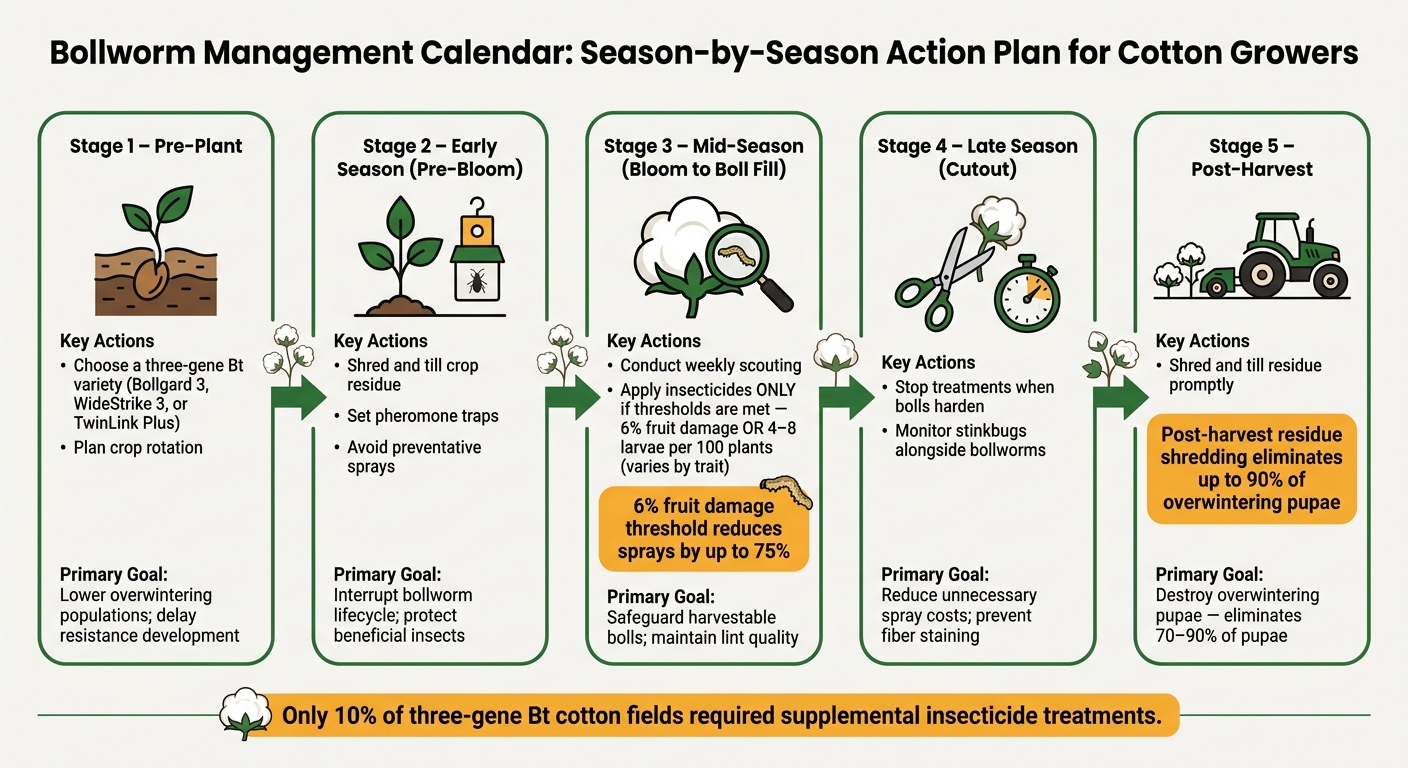
Bollworm Management Calendar: Season-by-Season Action Plan for Cotton Growers
A Season-by-Season Bollworm Management Calendar
Managing bollworms effectively requires careful planning and timely action throughout the growing season. Below is a breakdown of key steps to take during each stage, utilizing both biotech tools and integrated pest management (IPM) strategies.
| Season Stage | Key Actions | Primary Goal |
|---|---|---|
| Pre-Plant | Choose a three-gene Bt variety (e.g., Bollgard 3, WideStrike 3); plan crop rotation | Lower overwintering populations; delay resistance development |
| Early Season (Pre-Bloom) | Shred and till crop residue; set pheromone traps; avoid preventative sprays | Interrupt the bollworm lifecycle; protect beneficial insects |
| Mid-Season (Bloom to Boll Fill) | Conduct weekly scouting; apply insecticides only if thresholds are met (6% fruit damage or 4–8 larvae per 100 plants, depending on traits) | Safeguard harvestable bolls; maintain lint quality |
| Late Season (Cutout) | Stop treatments when bolls harden; monitor stinkbugs alongside bollworms | Reduce unnecessary spray costs; prevent fiber staining |
| Post-Harvest | Shred and till residue promptly | Destroy overwintering pupae |
Once bolls begin cracking, bollworm treatments should cease since the damage risk is gone. Spraying late-season squares is ineffective, as they won’t mature in time, making such treatments a waste of resources.
By following these practices, growers can not only protect their yields but also ensure that the cotton fiber delivered to the gin is of high quality.
How Field Pest Control Affects Gin Outcomes
The way pests are managed in the field has a direct impact on the quality of cotton fiber at the gin. When bollworm larvae feed on larger bolls, they damage the internal structure, leading to reduced lint turnout and increased trash content. Both of these factors lower the fiber’s market value.
If left unchecked, advanced-stage larvae can cause boll rot, which stains fibers and reduces their overall quality. Stained or discolored lint receives lower grades, which results in price penalties at the gin. Stinkbugs add to this issue by piercing bolls, creating internal warts and staining that can mimic or worsen bollworm damage.
"Field studies have validated the effectiveness of the 6% fruiting injury threshold and has been proven to reduce the number of sprays to effectively control bollworm and maintain yield." - Missouri Extension
Sticking to the 6% fruit damage threshold not only reduces chemical applications but also preserves beneficial insects, which play a crucial role in protecting fiber quality.
Using cottongins.org for Regional Coordination
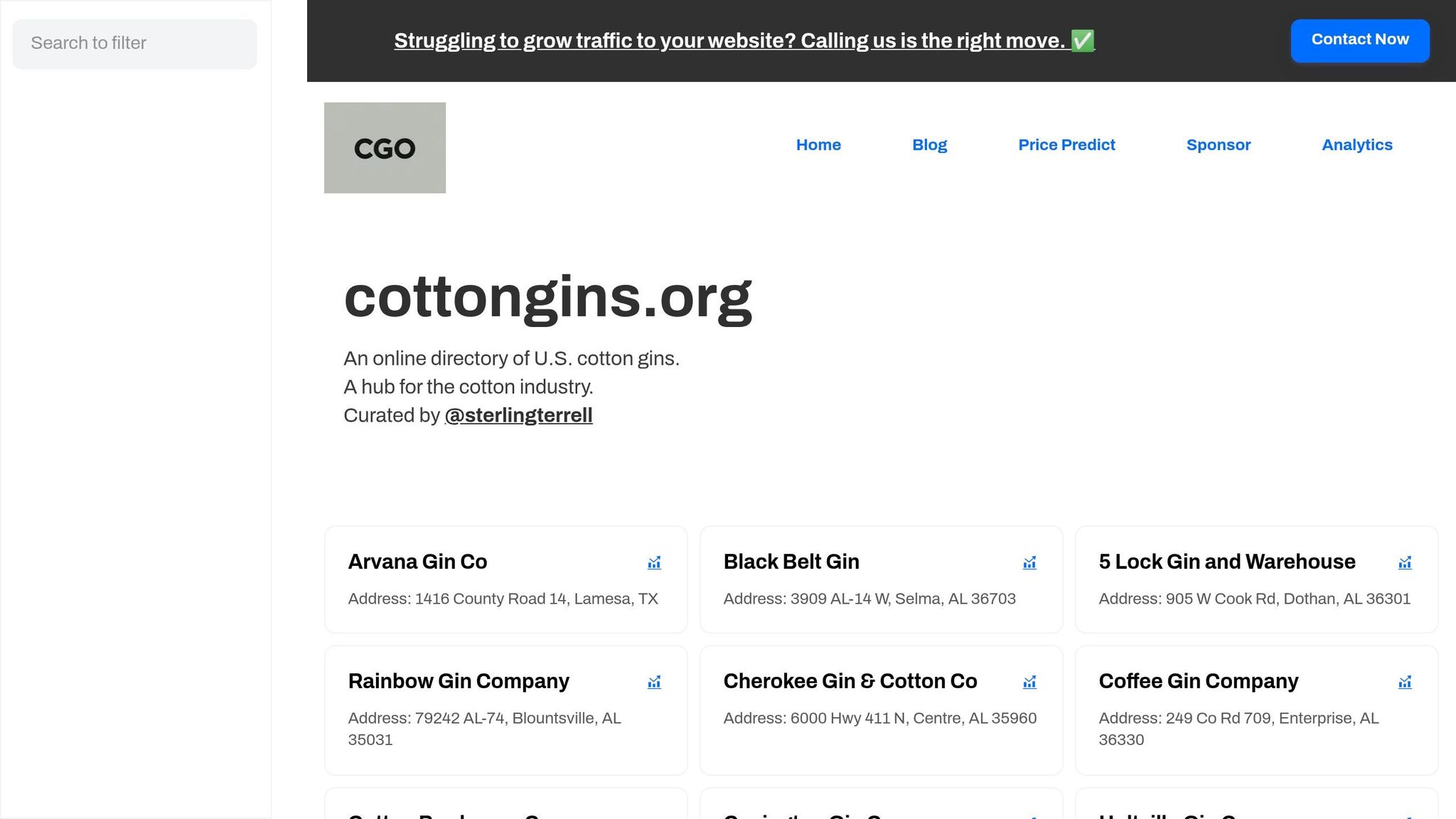
Bollworm pressure isn’t confined to individual fields - it’s a regional challenge. Coordinated efforts across an area can amplify the impact of IPM strategies and improve outcomes for everyone involved.
The website cottongins.org provides a valuable resource for connecting growers and ginners across U.S. cotton-producing regions. It features a directory of gin locations, organized by county and state, making it easy to identify local gins. This platform allows growers and ginners to exchange pest updates, align scouting efforts, and address localized outbreaks before they escalate. By working together and following the same thresholds and timing, regional coordination ensures more consistent fiber quality at the gin.
Conclusion
Managing bollworm in 2026 calls for a well-rounded approach. With resistance to older two-gene Bt traits now widespread, growers need to make a quick shift to three-gene varieties like Bollgard 3, TwinLink Plus, or WideStrike 3, paired with Integrated Pest Management (IPM) strategies, to maintain effective control. This combination of advanced biotech and disciplined pest management ensures reliable results throughout the growing season.
The data speaks volumes: only 10% of fields planted with three-gene Bt cotton required additional insecticide treatments. On top of that, growers using the 6% fruit damage threshold significantly cut down on spray applications, saving money and safeguarding beneficial insect populations.
Proper pest management also pays off after harvest. Boll damage leads to more trash and lower-quality lint, which can result in penalties at the gin. Keeping bollworm pressure under control from planting to post-harvest ensures consistent, high-quality fiber production.
"Field studies have validated the effectiveness of the 6% fruiting injury threshold and has been proven to reduce the number of sprays to effectively control bollworm and maintain yield." - University of Missouri Extension
Biotech traits set the stage, but IPM strengthens the system. By selecting the right traits, scouting regularly, protecting beneficial insects, and collaborating with neighbors and local gins, growers create a strategy that stands up to both bollworms and resistance. This integrated approach not only protects yields in the field but also ensures the fiber quality needed to meet industry standards at the gin.
FAQs
How do I know if my field’s bollworms are breaking through Bt cotton?
To monitor bollworm activity in Bt cotton, make weekly scouting trips from the plant's emergence stage through cutout. Focus on spotting second-stage larvae, which are typically 1/8 to 1/4 inch long, and inspect bloom tags, small bolls, and squares for signs of feeding damage. Pay special attention to larvae found in pink blooms, as they might evade the effects of Bt toxins. Always refer to the specific guidelines for your cotton variety - treatment is generally recommended if larval numbers or fruit damage surpass economic thresholds.
What’s the easiest way to use the 6% fruit-damage threshold in real scouting?
To determine if the 6% fruit-damage threshold has been reached, examine fruiting structures such as squares and bolls for signs of bollworm damage. Make sure your sampling is spread evenly across the field and avoid counting superficial damage. A useful strategy is to collect 10 squares and 10 bolls from several locations in the field. This ensures your sample is representative. Following this method allows for accurate identification of 6% damage, helping to avoid unnecessary insecticide applications while protecting your yield.
How should I rotate insecticide modes of action to slow bollworm resistance?
To keep insecticides working effectively, it's important to rotate their modes of action (or chemical classes). Using the same class repeatedly can cause pests to develop resistance, making those products less useful over time. Regularly scout your fields and only apply insecticides when necessary - for instance, when thresholds like 6% fruit injury or specific egg or larval counts are reached. Avoid sticking to a fixed spray schedule, as unnecessary applications can speed up resistance development.