U.S. cotton growers are facing new pest challenges in 2026, but advanced tools are offering smarter solutions. Cotton acreage has dropped to 9 million acres (a 3.2% decline from 2025), and pests like leafhoppers, thrips, and whiteflies are threatening yields by up to 60%. With no single solution, growers are turning to a mix of new technologies and strategies:
- Biotech Seeds: New varieties like BASF's Stoneville cotton with TwinLink Plus technology target multiple pests and resist diseases.
- Precision Spraying: AI-powered systems and drones reduce pesticide use by up to 40% while protecting beneficial insects.
- AI Monitoring: Real-time pest detection tools predict outbreaks and optimize treatments.
- Integrated Pest Management (IPM): Combining advanced insecticides like Syngenta's Vertento with biological controls and field sanitation.
These tools aim to improve pest control efficiency, reduce costs, and slow resistance development. Early detection, chemical rotation, and tailored strategies are key to thriving in 2026.
Key Cotton Pests and Challenges in 2026
Emerging Cotton Pests
Over the last decade, the pest landscape in U.S. cotton fields has undergone a major shift. While Bt cotton largely resolved the bollworm issue, it inadvertently created space for new pests to thrive. Leafhoppers, thrips, lygus bugs, aphids, and whiteflies have transitioned from minor irritants to major threats, with the potential to slash lint yields by 40% to 60%. Leafhoppers alone can reduce seed cotton output by as much as 25% to 45%.
The rapid spread of these pests adds to the challenge. For instance, cotton jassids (leafhoppers) can invade fields at an alarming pace. As highlighted by one industry expert:
"Jassids didn't 'ease into' Georgia cotton, they exploded across the map." - Talkin' Cotton Podcast
Once hopperburn sets in - marked by leaves turning yellow or red - the damage is irreversible. Growers are left with only a two-week window to act.
Adding to the concerns is the two-spot cotton leafhopper (Amrasca biguttula), a new invasive pest about the size of a pencil eraser (5 millimeters or 0.20 inches). First identified in South Carolina in August 2025, it took growers by surprise. By November 2025, Clemson University's Pee Dee Research and Education Center, led by Dr. Muhammad Z. "Zee" Ahmed, released a field guide on its biology and management in GrowerTalks:
"Invasive species continue to place increasing demands on agricultural and regulatory systems nationwide, simply because the number of new detections has risen steadily in recent years." - Muhammad Z. "Zee" Ahmed, Ph.D., Clemson University
These emerging pest issues highlight the urgency for integrated pest management strategies, drawing on lessons from past successes like the pink bollworm eradication effort.
Lessons from Pink Bollworm Management
The eradication of the pink bollworm offers a roadmap for managing today’s pest challenges. This effort relied on a comprehensive strategy - combining sterile insect releases, widespread adoption of Bt cotton, and coordinated regional action over time. The key takeaway? No single tool can solve the problem alone. Resistance management must be a core part of any pest control strategy from the outset.
This lesson is especially relevant given the current rise in sucking pests. Neonicotinoid seed treatments, such as clothianidin, have proven effective in controlling early-season leafhoppers and mirids. However, a two-year field study revealed a downside: these treatments reduced predator populations by 43% in 2021 and up to 75% in 2022 compared to untreated plots. Reduced natural enemy populations can lead to secondary pest outbreaks later in the season. As one researcher observed:
"These findings highlight a trade-off: early pest suppression comes at the cost of natural enemy populations." - Melis Yalçin, Author
For 2026, the message is clear: growers need to rotate insecticides with different modes of action, adhering to IRAC guidelines. With confirmed pyrethroid resistance in plant bugs, many growers are already turning to newer chemistries. Ignoring resistance management is a gamble that no grower can afford to take.
sbb-itb-0e617ca
Managing Cotton Jassid
Biotech Advances in Cotton Pest Control
Biotechnology continues to play a key role in cotton pest management, with new traits addressing challenges posed by evolving pest populations. While first-generation Bt cotton successfully tackled bollworm infestations, it left other pests - like thrips and lygus bugs - unchecked. Now, new biotech solutions are stepping up to address these gaps.
Bt Cotton and Pest-Specific Traits
In January 2026, BASF Agricultural Solutions introduced three new Stoneville cotton varieties for the 2026 season: ST 4130AXTP, ST 4650AXTP, and ST 5260AXTP. These varieties feature TwinLink Plus technology, which combines Cry1Ac, Cry2Ab, and Vip3Aa toxins. This pyramiding strategy not only targets caterpillar pests but also helps slow the development of resistance.
The ST 5260AXTP variety offers additional benefits, including tolerance to root-knot and reniform nematodes, as well as resistance to bacterial leaf blight. This eliminates the need for separate treatments, making it a comprehensive option for growers.
| Variety | Maturity | Primary Pest/Disease Traits | Region |
|---|---|---|---|
| ST 4130AXTP | Early | TwinLink Plus, root-knot & reniform nematode tolerance | Eastern Cotton Belt |
| ST 4650AXTP | Early-to-mid | TwinLink Plus, root-knot nematode tolerance, bacterial leaf blight resistance | Eastern Cotton Belt |
| ST 5260AXTP | Mid | TwinLink Plus, root-knot & reniform nematode tolerance, bacterial leaf blight resistance | Mid-South |
These advancements are designed to complement precision farming and biological pest control methods, creating a more integrated approach to pest management.
Bryan Perry, Head of U.S. Seeds and Traits for BASF Agricultural Solutions, highlighted the significance of these innovations:
"Our new Stoneville varieties are designed to give cotton growers doing the biggest job on Earth the confidence they need to tackle the toughest challenges in their fields."
In addition to caterpillar management, ThryvOn technology is being adopted to target thrips and lygus bugs. These pests have become more prevalent since Bt cotton reduced bollworm populations, making ThryvOn a much-needed solution for today’s growers.
Upcoming Biotech Developments
Looking ahead, researchers are exploring ways to manage pests by targeting their nutritional needs instead of relying solely on toxins. At Texas A&M AgriLife, scientists are studying the Hydra1 gene in cotton, which affects the plant's sterol production. Since plant-feeding insects depend on dietary sterols like cholesterol, modifying how cotton produces these compounds could disrupt pest development across multiple species, including aphids, caterpillars, lygus bugs, and stink bugs.
Gregory Sword, a Regents Professor and Cotton Entomology Specialist at Texas A&M AgriLife, emphasized the importance of this approach:
"It's not a magic bullet that kills insects. But you just need to keep populations below damaging thresholds. That's the key to any successful integrated pest management program."
"Our research identified that difference [cholesterol synthesis] as a weakness we can exploit to protect plants."
This sterol-targeting strategy aligns with broader trends toward tools like CRISPR and RNA interference (RNAi). These gene-editing technologies could face fewer regulatory hurdles than traditional GMOs. Moreover, because sterol disruption affects a fundamental biological process shared by many pests, it may significantly slow the development of resistance compared to conventional insecticides or single-toxin Bt traits.
Precision Spraying and Targeted Applications
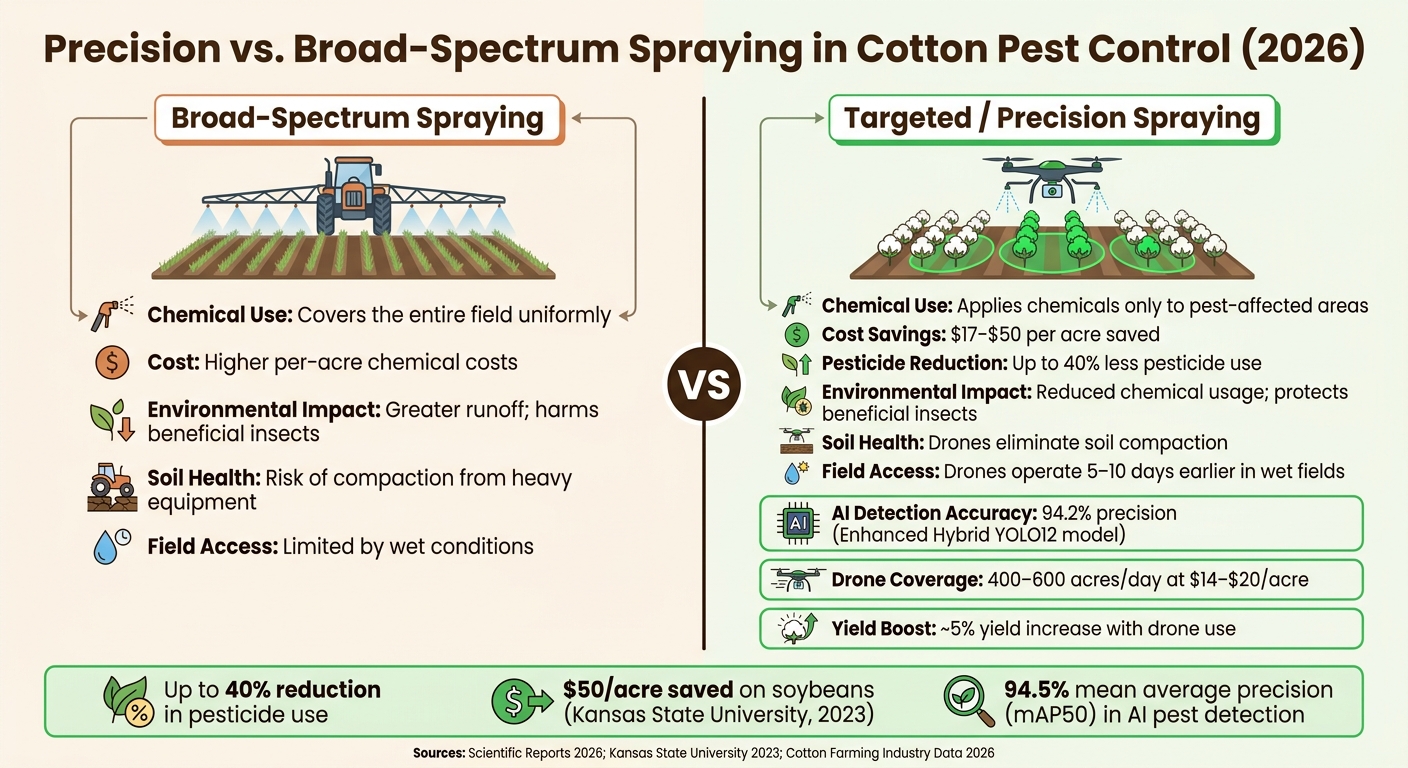
Precision vs. Broad-Spectrum Spraying: Cotton Pest Control Comparison 2026
Precision spraying is stepping up as a key tool in modern agriculture, working alongside biotech and AI-driven monitoring systems. While biotech traits tackle pests from within the plant, precision spraying addresses above-ground threats, cutting down on waste, lowering costs, and protecting beneficial insects.
Precision Spray Systems
Today's precision sprayers are equipped with high-resolution cameras and AI that allow them to identify and treat pest-infested areas in real time. Instead of blanketing entire fields with chemicals, these systems focus solely on problem spots. This targeted approach not only reduces chemical usage but also lessens the environmental footprint.
One standout example is the Enhanced Hybrid YOLO12 model. Trained on 3,225 high-resolution images of 13 different cotton insect types, this framework achieved a precision rate of 0.942 and a mean Average Precision (mAP50) of 0.945, as reported in Scientific Reports in 2026.
"Enhanced Hybrid YOLO12 can be considered as a state-of-the-art framework for precision agriculture, with its high detection accuracy and real-time capability." - Scientific Reports
Drones are also playing a major role in precision spraying, especially in wet or hard-to-reach fields. Covering 400–600 acres daily at a cost of $14–$20 per acre, drones not only prevent soil compaction but also boost yields by about 5%. Operators can fine-tune these systems with settings like "Efficacy" mode for high pest pressure or "Savings" mode for fields with fewer pests, ensuring optimal chemical use and pest control.
Broad-Spectrum vs. Targeted Spraying
When comparing traditional broad-spectrum spraying to targeted methods, the benefits of precision spraying become even clearer. A 2023 study by Jeremie Kouame and Anita Dille from Kansas State University evaluated the ONE SMART SPRAY system, a collaboration between Bosch and BASF, in corn and soybean fields. Their research revealed herbicide cost savings of $50 per acre for soybeans and $17.41 per acre for corn compared to traditional spraying methods.
"The ability of the cameras to detect very small areas of green plant material allows for more herbicide savings." - Jeremie Kouame, Weed Scientist, Kansas State University
Here’s a quick comparison of broad-spectrum and targeted spraying:
| Feature | Broad-Spectrum Spraying | Targeted / Precision Spraying |
|---|---|---|
| Chemical Use | Covers the entire field | Applies chemicals only to pest-affected areas |
| Cost | Higher per-acre chemical costs | Saves $17–$50 per acre |
| Environmental Impact | Greater runoff and harm to beneficial insects | Reduced chemical usage and limited impact on non-target areas |
| Soil Health | Risk of compaction from heavy equipment | Drones eliminate soil compaction |
| Field Access | Limited by wet conditions | Drones can operate 5–10 days earlier in wet fields |
The move toward targeted spraying offers not only economic advantages but also helps slow the development of chemical resistance by minimizing the overall use of insecticides in the field. This shift reflects a smarter, more sustainable approach to pest management.
AI-Driven Pest Monitoring and Early Detection
Precision spraying works best when farmers know exactly where pests are hiding, and that's where AI comes in - spotting issues before crops suffer damage. Every year, pests cause an estimated 20% to 40% of global crop losses, with invasive insects alone racking up a staggering $70 billion in costs worldwide. Tackling these outbreaks early isn't just smart - it’s a financial necessity. By identifying problem areas in advance, AI tools make it easier to apply treatments precisely where they're needed.
Modern pest monitoring systems rely on technologies like wingbeat recognition and computer vision. For instance, the FarmSense FlightSensor uses an infrared light curtain to analyze insect wingbeat patterns in real time. In September 2025, researchers from Georgia Southern University and the City of Millen tested this system across eight large cotton fields in Jenkins County, Georgia. The goal? Detect pests like stink bugs and bollworms early enough to cut down on pesticide use.
"AI tools can help farmers pinpoint exactly where pest outbreaks are likely – before they happen. That means they can treat only the areas that need it, saving time, labor and pesticide costs." - Debra Lam, Founding Director of the Partnership for Inclusive Innovation, Georgia Institute of Technology
Another layer of defense comes from remote environmental sensors. These devices monitor field-level conditions like temperature, humidity, and wind. AI then combines this data with insect population trends to create localized pest risk maps. Some models can even predict outbreaks 5 to 10 days in advance. This extra lead time allows farmers to plan targeted treatments, avoiding the scramble to react after damage is done.
Scouting and Outbreak Prediction
AI doesn’t just enhance monitoring - it’s revolutionizing traditional scouting methods. Typically, scouting involves walking fields, checking traps, and making manual observations on a set schedule. While this approach is effective, it usually achieves about 70% to 80% precision. In contrast, AI-powered systems provide 24/7 automated surveillance, with precision levels consistently reaching 88% to 95%. Data from these systems is sent to a cloud dashboard, accessible via phone or computer, ensuring growers have real-time insights at their fingertips.
Biological and Cultural Pest Control Methods
Non-chemical strategies play a vital role in cotton farming. These methods not only cut down on pesticide use but also help create a healthier ecosystem, naturally keeping pest populations in check over time.
Residue Management
One effective cultural practice is removing crop residues after harvest. Leftover plant material can serve as a safe haven for pests like bollworms and whiteflies, allowing them to survive and multiply before the next planting season. Clearing fields thoroughly - removing all plant debris - can significantly reduce these pest reservoirs. For viral threats such as Cotton Leaf Curl Virus, the solution is often drastic but necessary:
"Effective control of virus disease is a big menace; there is no effective and simple control measures except to cut and burn the crop." - Journal of Cotton Research
In addition to field sanitation, other strategies like adjusting planting dates to avoid peak pest activity or using trap crops (e.g., marigolds to attract thrips away from cotton) are cost-effective ways to minimize pest pressures before resorting to chemical controls.
Clearing residues is just one part of the equation - preserving beneficial insects is equally important for sustainable pest management.
Protecting Beneficial Insects
Conserving natural predators is a critical component of an Integrated Pest Management (IPM) approach. Predators such as Trichogramma wasps, lacewings, ladybird beetles, and damsel bugs provide natural pest control at no additional cost. However, some seed treatments can harm these helpful insects, disrupting this balance, as highlighted in research:
"These findings indicate a potential trade-off between effective pest suppression and the conservation of natural enemy populations within the arthropod community." - Melis Yalçin, PLOS One
Arizona offers a compelling example of the benefits of conserving natural predators. According to the Arizona Pest Management Center, 35 years of area-wide IPM efforts - led by experts like Macey Wildermuth - have transformed cotton production in the state. By 2026, Arizona had achieved the highest cotton yields in the U.S. while cutting insecticide applications from an average of 11 sprays per season to fewer than 2. Since 1996, this approach has saved over $700 million and kept more than 40 million pounds of insecticides out of the environment. As Macey Wildermuth explained:
"In Arizona organic cotton, the smartest spray may be no spray at all." - Macey Wildermuth, University of Arizona
Planting flowering strips near cotton fields is another practical way to support beneficial insects. These strips provide nectar and pollen, helping these natural allies thrive. This conservation-focused biological control method complements emerging technologies aimed at reducing pesticide dependency while maintaining high crop yields.
How to Choose the Right Pest Control Strategy
Every farm and season requires a pest control plan tailored to specific factors like pest type, crop growth stage, and budget constraints.
Key Factors for Tool Selection
Start by assessing pest pressure. For example, sucking pests like aphids, thrips, whiteflies, and mirids can slash lint yield by 40–60%, while leafhoppers can reduce seed cotton output by 25–45%.
Crop stage timing is equally important. Products like Vertento work best when applied during the third week of squaring or the first week of bloom. This timing is essential because the product doesn’t move through the plant.
"Application timing proved to be a very critical piece relative to the product's efficacy, especially because the product does not translocate through the plant." - Ben Thrash, Researcher, University of Arkansas
Chemical rotation and multi-gene traits like TwinLink Plus are crucial for managing resistance. Soil conditions also play a role in variety selection. For instance, ST 4130AXTP is better suited for the Eastern Cotton Belt’s tough soils, while ST 5260AXTP is designed for areas with nematode pressure in the Mid-South.
Another factor is balancing early pest suppression with the impact on beneficial insects. Neonicotinoid seed treatments, for example, can reduce natural predator populations by 43–75%, potentially leading to secondary pest outbreaks later in the season.
These considerations are essential when deciding on the right pest control tools, as detailed below.
Pest Control Tools at a Glance
| Tool Category | Example | Primary Target | Key Consideration |
|---|---|---|---|
| Biotech Seed | TwinLink Plus / Axant Flex | Bollworms, nematodes, herbicide resistance | Match variety to soil type and nematode history |
| Seed Treatment | Clothianidin (CLO) | Early-season thrips, leafhoppers, mirids | Reduces natural enemy populations by 43%–75% |
| New Insecticide | Vertento (Plinazolin) | Plant bugs, stink bugs, mites | Non-systemic; needs oil-based surfactant and precise timing |
| Biological/IPM | Lacewings, Trichogramma wasps | Natural suppression of sucking pests | Avoid broad-spectrum sprays to protect beneficials |
| Monitoring | Digital tools, pheromone/sticky traps | Early outbreak detection | Balances labor costs with precision and timing accuracy |
Action Steps for Cotton Growers in 2026
Key Focus Areas
In 2026, cotton farming is shifting gears - from traditional calendar-based spraying to a smarter, data-driven approach. The biggest challenge? Sucking pests like thrips, aphids, and whiteflies. These pests have become the primary threat on many Bt cotton farms, with the potential to slash lint yields by 40–60%. The key to staying ahead? Early detection.
Start scouting early. Use tools like pheromone traps and yellow sticky traps combined with AI-powered imaging to detect outbreaks before they hit critical levels. This precision monitoring can cut chemical pesticide use by as much as 40%. Pair these efforts with drone-based spot treatments to target problem areas, safeguarding beneficial insects and reducing costs.
Rotating modes of action is a must. By incorporating newer chemistries like Vertento and using biological controls - such as lacewings, Trichogramma wasps, and Beauveria bassiana - you’ll lower resistance risks and keep spray counts manageable. These steps form the backbone of a strong Integrated Pest Management (IPM) strategy.
Building a Sustainable IPM Plan
A sustainable IPM plan in 2026 is all about layering your defenses. Start with seed selection: varieties like ST 4130AXTP (ideal for the Eastern Cotton Belt) or ST 5260AXTP (suited for Mid-South nematode pressure) provide built-in protection before you even think about spraying. Digital monitoring platforms with real-time alerts can track pest activity and help you time interventions effectively.
"A successful season starts with the right seed, and with Stoneville and FiberMax cotton, we're helping farmers lay the groundwork for strong yields and premium fiber quality." - Bryan Perry, Head of U.S. Seeds and Traits, BASF
Don’t overlook cultural practices - they’re cost-effective and impactful. Plant trap crops like marigolds to lure thrips away from your main field. Destroy crop residues after harvest to limit pest carryover. Maintain flowering strips to attract natural predators. These simple steps can make a big difference. For inspiration, look to Arizona’s IPM program. Over 35 years, it reduced insecticide use from 11 sprays per season to fewer than two. This saved growers over $700 million and eliminated more than 40 million pounds of insecticide active ingredients since 1996. That’s the long-term payoff of a well-designed IPM plan.
FAQs
Which 2026 cotton pests should I prioritize scouting for first?
The two-spot cotton leafhopper (Amrasca biguttula) has recently made its way into the southeastern United States, raising concerns among cotton growers. This pest has shown up quickly and could pose serious risks to cotton crops if not addressed promptly. Its emergence calls for immediate and thorough monitoring to protect the region's agricultural output.
How do I decide between biotech traits, seed treatments, and in-season sprays?
Choosing the right pest control method - whether biotech traits, seed treatments, or in-season sprays - depends on factors like pest pressure, resistance concerns, and potential environmental effects.
- Biotech traits offer extended pest protection but may lose effectiveness as resistance develops.
- Seed treatments are great for early-season control but can unintentionally impact beneficial insects.
- In-season sprays give you the flexibility to address sudden outbreaks but demand precise timing to be effective.
By combining these strategies and relying on regular pest monitoring, you can create a balanced and sustainable approach to pest management.
What’s the easiest way to start using AI monitoring or precision spraying on my farm?
The simplest way to get started is by using AI-powered sensors and data-driven systems to apply pesticides more precisely. First, choose a system that matches your farm's size and the crops you grow. Next, work with providers who can help with installation and training. Once the equipment is installed, follow the setup instructions, calibrate it to fit your fields, and use the accompanying software to track data. This approach helps you fine-tune spraying, making the process more efficient while minimizing environmental impact.
Related Blog Posts
- Integrated Pest Management in Cotton Farming
- Cotton Aphid Control: Advanced Strategies for Minimizing Damage and Protecting Yields
- Advanced Cotton Crop Management: Digital Innovations and Sustainable Practices for Enhanced Yield
- Pest-Resistant Cotton Genetics: How Biotech Is Revolutionizing Crop Protection