If I had to sum it up in one line: automation in cotton gins helps protect fiber quality, cut waste, and add more dollars per bale.
I see four main takeaways in this piece:
- Moisture control matters most early. Keeping seed cotton near 6%–7% moisture helps limit fiber breakage, neps, and short fiber.
- Steady feed protects both quality and throughput. Automated module feeders and gin stand load control help avoid surges and slow spots.
- Plastic contamination is expensive. USDA discounts of $0.1870 to $0.2080 per pound can hit contaminated bales, and spot-market losses can reach about $0.40 per pound.
- Plant-wide monitoring can add profit. USDA research ties computerized process control to about $10–$20 per bale, with some systems showing about $8 per bale in net gains.
Here’s the simple version: when I connect moisture sensors, feed controls, contamination checks, bale tracking, and one dashboard, I get tighter control over the gin. That can mean cleaner lint, fewer discounts, lower fuel use, less downtime, and better season-long consistency.
A few numbers stand out:
- Dryer fuel and electricity run about $6.11 per bale
- Better lint cleaner use can add about $8 per bale
- Moisture-control systems have shown 15% gas savings
- A 500-pound bale with plastic issues can lose a lot of value fast
This article shows where those gains come from, what each system does, and how I’d think about payback before buying.
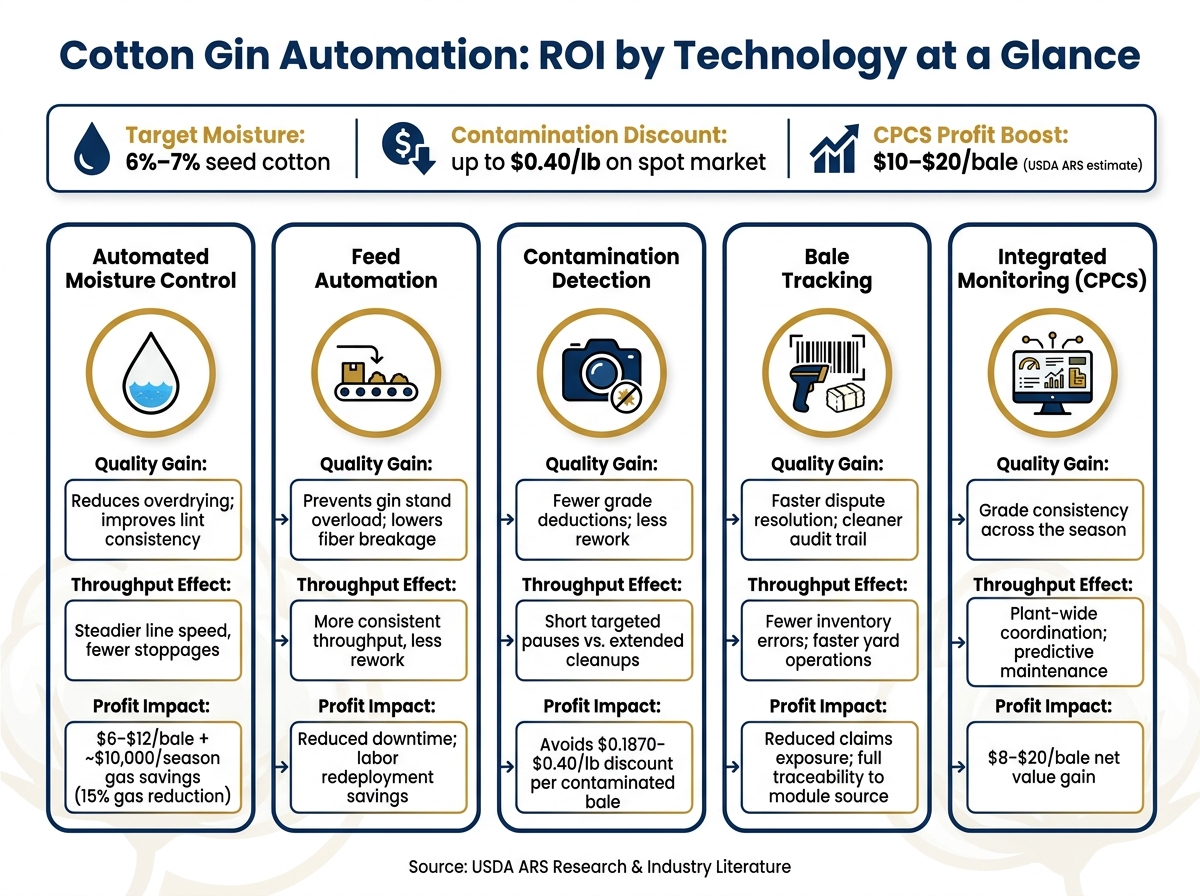
Cotton Gin Automation: ROI by Technology at a Glance
Exploring New Cotton Gin Technology at White Oak Gin in Missouri
sbb-itb-0e617ca
Automated Moisture and Feed Control Systems
Moisture and feed rate are the two fastest ways to protect fiber quality - or lose it - before cotton reaches the gin stand. Automation keeps both closer to target by swapping out spot checks for continuous sensor-based control.
Real-Time Moisture Sensors and Dryer Controls
Modern gin control systems use inline moisture sensors at the feed hopper and dryer exit, along with temperature sensors at the dryer entrance, to monitor incoming cotton and dryer performance. That setup creates closed-loop control, which keeps seed cotton near its target moisture and cuts overdrying between manual checks.
That matters because once cotton falls below about 6% moisture, problems start to stack up. Fiber breakage goes up. Nep formation increases. Short-fiber content rises too. Keeping moisture in range helps protect classing results while also cutting rework, fuel waste, and price discounts.
Industry literature reports that microwave-based sensing can reduce overdrying and improve fiber strength in gin deployments.
| Factor | Manual Moisture Checks | Automated On-Line Moisture Control |
|---|---|---|
| Consistency | Variable; depends on check frequency | Continuous; adjusts in real time |
| Fiber quality risk | Higher; over-drying can occur between checks | Lower; stays closer to target range |
| Labor | Higher; requires regular operator attention | Lower; system handles adjustments automatically |
| Damage risk | Less efficient; dryers may run harder than needed | More efficient; burner output matched to actual demand |
Once moisture is under control, the next choke point is keeping the gin stand fed at a steady rate.
Module Feeders and Gin Stand Load Management
Feed consistency matters just as much as moisture control. When cotton surges, the gin stand can overload, which increases fiber and seed damage. When flow drops off, throughput suffers.
Automated module feeders help smooth that out. They use optical level sensors and through-beam sensors tied to PLC logic to control feeder-floor speed based on hopper fill level. As the hopper empties, the PLC speeds up the feeder floor. As the hopper fills, it slows the floor down. That keeps the gin stand loaded without constant manual adjustment and cuts surge-related fiber damage.
Some setups go a step further and tie in gin stand shutdown signals. If a stand goes offline, the PLC can slow the feeder instead of letting cotton build up in the system. The payoff is pretty direct: steadier throughput, fewer overloads, and less operator attention.
With moisture and feed under control, the next quality risk is contamination entering the bale stream.
Contamination Detection and Bale Tracking
Once moisture and feed are under control, contamination becomes the next big quality check.
Camera and Sensor Systems for Plastic and Foreign Matter
Plastic contamination is one of the biggest quality issues in U.S. cotton gins right now. More than 84% of plastic contamination events come from round module wrap. And the cost can get ugly in a hurry.
When a bale gets extraneous matter codes 71 or 72, the USDA CCC loan schedule discounts are $0.1870 and $0.2080 per pound. In the spot market, discounts on contaminated lint can reach about $0.40 per pound. On a 500-pound bale, that turns into a serious hit.
The first job is simple: catch plastic at the module feeder before it moves deeper into the plant. Camera-based inspection systems place IP cameras on the module feeder and around the dispersing cylinders, where wrap often shows up as modules break apart. From the control room, operators can watch a live feed and act as soon as wrap appears.
Some gins stop there. Others go further.
More advanced setups use machine vision tied to PLC control. These systems detect plastic in real time and can trigger air knives or pneumatic ejectors before the material reaches the gin stand. They also store time-stamped images and event logs, which helps tie a contamination event to the module or run involved.
| Detection Method | Detection Reliability | Downtime Impact | Upfront Cost |
|---|---|---|---|
| Manual visual inspection | Low to moderate; intermittent and dependent on crew attention | High if contamination is found late; may require extended cleanup or bale rejection | Minimal; limited to labor and basic access improvements |
| Camera-only monitoring | Moderate; continuous visibility, but still relies on operator response | Moderate; no automatic stops, but earlier visibility shortens interventions | Modest; uses off-the-shelf IP cameras and standard viewing software |
| Automated sensor/PLC detection | High; algorithms analyze every image and trigger consistent responses | Lower long-term; short targeted pauses or ejections help prevent severe contamination events | Higher; requires cameras, software, PLCs, and pneumatic hardware, though bolt-on designs help manage cost |
The best fit depends on the gin's contamination history, labor on hand, and how much seasonal discount risk it faces. If a gin gets frequent plastic calls, the higher upfront cost of automation often comes back fast through avoided discounts and fewer mill complaints.
Once contamination is flagged, bale IDs and run logs help show where it started.
Bale Tracking for Traceability, Claims, and Inventory Control
Detection matters most when the gin can tie the problem to a specific bale.
Modern bale tracking systems use barcodes, QR codes, or permanent bale ID tags to link each bale to its production record, including module source, run data, moisture, and contamination alerts. That data can also pair with USDA Permanent Bale Identification, so traceability continues from the gin yard all the way to the mill.
Yard crews scan bale IDs during storage and loading, which keeps location records current without relying on handwritten counts. If a mill reports plastic in a bale, the gin can pull the full history for that exact bale ID: module origin, run timing, moisture readings, and any camera logs from that time period.
That makes it much easier to tell whether the issue was isolated or part of a larger run problem. It also helps speed up dispute resolution and shows mills that the gin can find the root cause and keep the same problem from happening again.
Integrated Process Monitoring and Profit Management
Catching contamination and tracking bales matter. But the biggest day-to-day gains usually show up when a gin stops looking at each machine in isolation and starts looking at the whole plant at once.
The next move is simple in concept: connect those sensors into one plant-wide control view.
Dashboards, Alerts, and Machine-Level Process Control
Modern integrated monitoring systems pull data from moisture sensors, dryers, feeders, gin stands, lint cleaners, and the bale press into one dashboard. From the control room - or even a phone - managers can watch real-time throughput, moisture and temperature profiles, machine load levels, and active alarms.
That matters because the screen itself isn't the point. What counts is how managers use that information while the plant is running. Systems like Uster IntelliGin and other CPCS can automatically coordinate dryer settings, cleaning aggressiveness, and lint cleaner use to help protect fiber quality. USDA ARS estimates CPCS can increase profits by $10 to $20 per bale.
Alerts for overloads, fire risk, contamination, and downtime also help crews react fast during peak ginning periods. And the payoff doesn't stop with the alert itself. Event logs give managers a record they can study later, which helps with predictive maintenance. If the same load anomaly keeps showing up, or a machine starts drifting hotter than normal, repairs can be planned during slower periods instead of turning into a mid-season breakdown.
How to Evaluate Return on Investment Before Buying
Once the control system is defined, the next step is a conservative payback test. Before spending money on automation, gin owners should build a model using their own season data - not vendor averages alone.
The main inputs are pretty direct:
- Capital cost
- Expected bales per season
- Labor hours automation could remove or shift to other work
- Energy savings
- Avoided quality discounts
- Likely drop in downtime
Independent analysis of IntelliGin systems points to about $8 per bale in net value gains. On the energy side, moisture-control-based automation has shown gas savings of at least 15%, worth about $10,000 per season for a typical gin using around 250 tons of LPG annually.
The table below lays out the main technologies against three practical decision points. Treat it as a planning tool, not a promise. Actual returns will depend on gin size, crop conditions, labor costs, and the equipment already in place.
| Technology | Likely Quality Gains | Throughput Effect | Estimated Profit Impact per Season |
|---|---|---|---|
| Automated moisture control | Reduces overdrying, improves lint consistency | Steadier line speed, fewer stoppages | $6–$12/bale in added value; gas savings around $10,000 |
| Feed automation | Prevents gin stand overload, lowers fiber breakage | More consistent throughput, less rework | Reduced downtime; labor redeployment savings |
| Contamination detection | Fewer grade deductions, less rework | Short targeted pauses vs. extended cleanups | Protects bale value and reduces cleanup costs |
| Bale tracking | Faster dispute resolution, cleaner audit trail | Fewer inventory errors, faster yard operations | Reduced claims exposure; traceability value |
| Integrated monitoring (CPCS) | Grade consistency across the season | Plant-wide coordination, predictive maintenance | $8–$20/bale net value gain |
If a system can't pay back within a realistic number of seasons using conservative assumptions, it may not be the right fit yet - even if it looks great on paper.
Using cottongins.org to Support Vendor Outreach and Industry Visibility
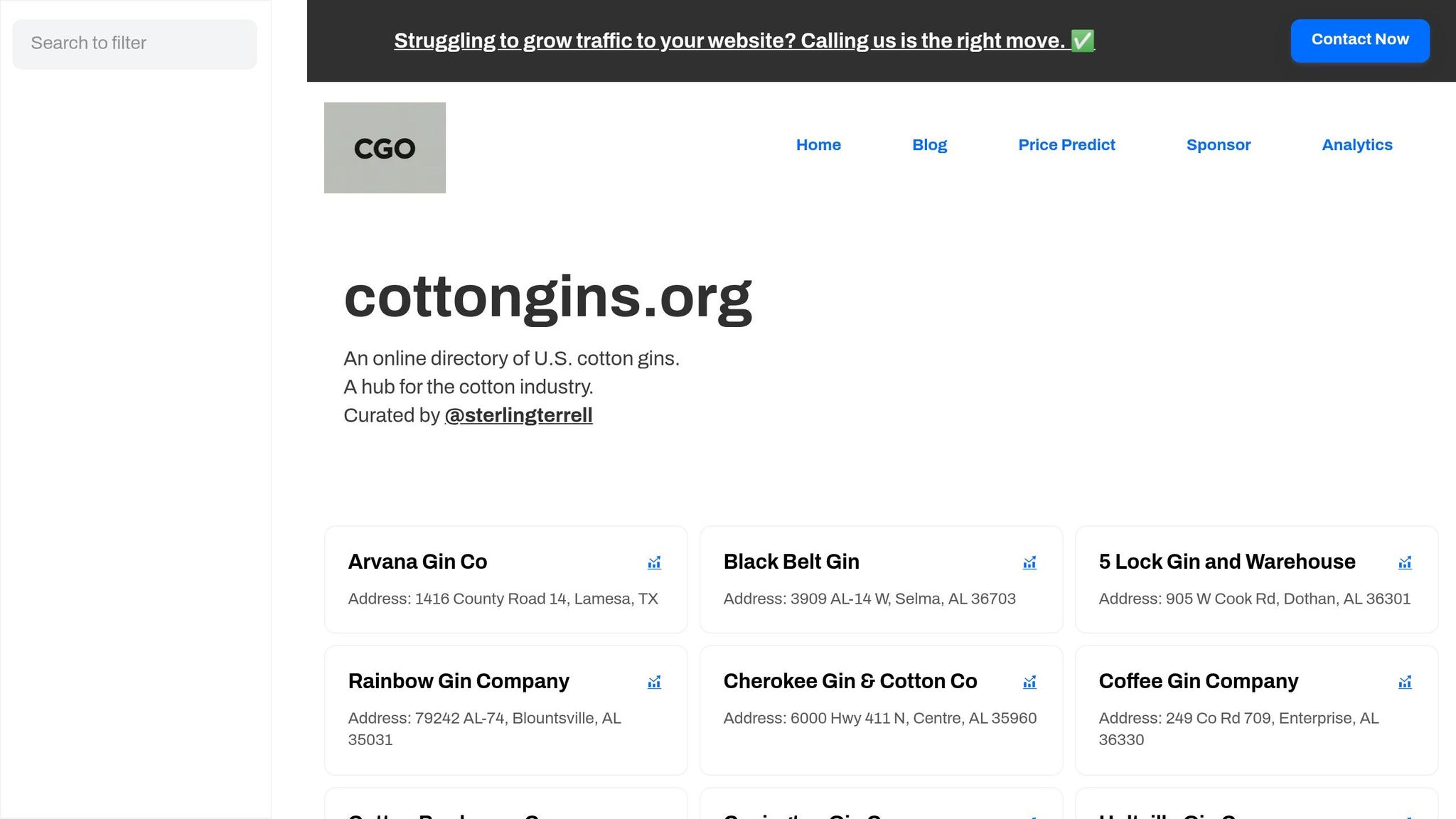
For vendor outreach and plant visibility, cottongins.org also lets gin operations list and update their presence, submit new gin entries, and stay current through mailing list updates. That makes it a practical tool for business development and industry networking.
Conclusion: Automation Upgrades That Improve Quality and Margins
These automation upgrades do the most good when they work as one connected system, not a stack of separate tools. Put them together, and process control starts to look a lot like profit control - helping deliver cleaner fiber and more even output.
Moisture control offers the clearest near-term return. It helps protect fiber quality while also cutting operating cost.
That matters for a simple reason: contamination losses often turn into direct price deductions. Camera-based detection spots plastic early, and bale tracking links each issue to a specific bale, which helps with faster claims resolution and tighter inventory control.
Integrated monitoring pulls those signals into one place so managers can step in before small issues hurt bale value. Real-time dashboards and alerts also give crews a chance to fix problems before they turn into downtime or quality loss.
For U.S. gin owners, the best automation investments improve fiber quality, cut waste, and lift margin. In a tight-margin season, that can be the gap between breaking even and making more profit per bale.
FAQs
Which automation upgrade should a gin prioritize first?
Start with a baseline audit. Check for hydraulic cavitation, and review HVI rejects for non-lint above 2.5%.
A typical three-year plan looks like this:
- Year 1: hydraulics
- Year 2: robotics
- Year 3: AI/IoT
If manual error is the main issue, prioritize digital inventory management first. Whatever path you choose, match the upgrade plan to your budget and the size of your operation.
How quickly can a cotton gin recover the cost of automation?
Automation is an investment that usually pays for itself in 18 to 24 months.
Here’s what that can look like in plain numbers: a $25,000 to $35,000 hydraulic system upgrade can hit full payback in that window through added revenue and better efficiency, based on standard ginning fees.
The timeline can shrink even more if a USDA REAP grant covers 25% to 50% of the upfront cost. A 36-month equipment lease can also make the cost easier to handle from day one.
Do these systems work well in older gin facilities?
Yes. Modern automation systems can work well in older gin facilities, especially when you roll them out in phases.
Many older gins can be retrofitted with PLC-based controls, real-time moisture sensors, and automated feed systems. In some cases, the site will need careful planning or a few hardware upgrades first. But a gradual rollout makes the process much easier to handle.
Instead of changing everything at once, teams can upgrade one part of the operation at a time. That helps improve efficiency, cut downtime, control costs, and give staff time to learn the new system without a major disruption.