Yarn hairiness - fibers sticking out from the yarn surface - can cause issues like fabric defects, machinery clogs, and inconsistent dyeing. While some hairiness improves softness, excessive levels disrupt production and fabric quality. Here’s how to manage it:
- Raw Materials: Choose cotton with longer, uniform fibers and low short fiber content. Use High Volume Instrument (HVI) testing to ensure quality.
- Spinning Adjustments: Increase twist levels, use soft rubber rollers, or implement compact spinning systems to reduce loose fibers.
- Post-Spinning Treatments: Singeing burns off protruding fibers, while sizing strengthens yarn for weaving.
- Maintenance: Regularly replace rings, travelers, and clean machinery to control hairiness.
Hairiness of yarns | 11/87 | UPV

sbb-itb-0e617ca
How Raw Materials Affect Yarn Hairiness
The quality of raw cotton plays a big role in determining yarn hairiness. Key fiber traits - like length, uniformity, and fineness - dictate whether fibers blend smoothly into the yarn or stick out, creating that unwanted fuzz.
Cotton Fiber Quality Characteristics
Fiber length is a major factor. Longer fibers create a tighter, more compact yarn with fewer ends poking out. On the flip side, cotton with a high Short Fiber Content (SFC) tends to produce more hairiness because shorter fibers leave more ends exposed.
Fiber fineness also matters. Finer fibers, with their lower torsional rigidity, twist more effectively during spinning, resulting in reduced hairiness. The Length Uniformity Index - which compares the mean fiber length to the upper-half-mean length - further impacts the process. A higher uniformity index means fibers are more consistent in length, which leads to smoother, less hairy yarn.
Even the fiber's shape plays a part. Cotton fibers with a circular cross-section pack more tightly during spinning, which minimizes hairiness compared to fibers with irregular shapes. As CottonWorks highlights:
"The staple length of cotton affects yarn strength, evenness, and efficiency of the spinning process".
To keep yarn hairiness in check, sourcing cotton with these ideal characteristics is key.
How to Source High-Quality Cotton
Using High Volume Instrument (HVI) testing is the best way to assess cotton quality. In the U.S., every bale of cotton is classed with HVI technology, providing detailed data on staple length, uniformity, and strength. This eliminates guesswork and ensures you know exactly what you're buying.
When sourcing, look for cotton with low Short Fiber Content and a high Length Uniformity Index. Work with suppliers who provide full USDA classification or equivalent data to confirm fiber maturity and micronaire values. While fine fibers (low micronaire) can enhance yarn strength by increasing the number of fibers in the yarn cross-section, they need careful handling during cleaning to avoid damage that could create more short fibers.
Choose suppliers who offer complete traceability and classification data for their cotton. This ensures consistent fiber quality across batches, reducing variability in yarn hairiness during production.
Spinning Process Adjustments to Reduce Hairiness
Once you've sourced quality cotton, the next step is fine-tuning the spinning process. This stage is all about ensuring fibers are integrated smoothly into the yarn. The way fibers are twisted and handled during spinning plays a major role in reducing loose fiber ends. By optimizing twist application and fiber control, you can minimize hairiness even before post-spinning treatments come into play.
Adjusting Twist Levels
Twist insertion is key to binding loose fiber ends into the yarn core. Increasing the Twist Per Inch (TPI) tightens the yarn structure, locking fibers in place. A critical area to focus on is the spinning triangle - the triangular zone where fibers exit the front rollers and twist begins. Loose fibers in this zone are a primary cause of hairiness.
The Siro-jet system addresses this issue by using air nozzles to entangle loose fibers during twisting, cutting hairiness by as much as 40%. For yarns intended for knitting, lower twist levels can still maintain strength and elongation while enhancing softness. Meanwhile, the Nu-torque system adjusts twist density specifically within the spinning triangle to improve fiber integration.
Installing Soft Rubber Rollers
Soft rubber rollers in the yarn formation zone help control fibers during twisting. Acting as a contact surface, these rollers prevent fibers from escaping and wrap them tightly into the yarn body, creating a smoother surface.
Compact Spinning Technology
Compact spinning offers one of the most effective ways to reduce hairiness by addressing the spinning triangle directly. This technology condenses the fiber strand after drafting but before twisting, using aerodynamic or mechanical forces to align fibers in a parallel, compact arrangement. Peter Artzt from ITV Denkendorf explains:
"Compact spinning forms fibres into a narrow sliver by drafting in a virtually tension-free process within a compacting zone. The compact sliver is twisted in a very small spinning triangle, thereby eliminating peripheral fibres".
The results speak for themselves: compact spinning reduces long protruding fibers (over 3 mm) by an average of 65% and shorter fibers by about 16%. Long, troublesome hairs (6–8 mm) are almost entirely eliminated, with only about 10% remaining compared to conventional ring-spun yarn. Additionally, yarn twist can be reduced by around 10% without sacrificing strength, enabling faster machine speeds and higher productivity.
Two main types of compact spinning systems are available:
- Pneumatic systems (e.g., Rieter COM4 and Suessen EliTe): Use suction through perforated drums or aprons to condense fibers.
- Mechanical/magnetic systems (e.g., RoCoS): Use a magnetic compactor and compression chamber, eliminating the need for air suction and lowering energy use.
Research shows that Rieter’s Com4 system often delivers better yarn strength and consistency, while Suessen’s EliTe system may achieve superior hairiness reduction. Compact spinning works particularly well with short-to-medium staple cotton or fibers with uneven characteristics.
To maintain consistent yarn quality, regularly clean components in the condensing zone, such as perforated drums, lattice aprons, and suction slots. Also, adjust overfeeding in the compacting zone (typically 0–4% for cotton) to manage fiber tension and optimize results.
These spinning adjustments create a solid base for further treatments that enhance yarn quality even more.
Post-Spinning Treatments for Hairiness Control
Once spinning refinements are complete, post-spinning treatments step in to address any lingering loose fibers. These processes focus on removing surface fibers that didn’t fully integrate during spinning, resulting in smoother yarn that’s better suited for weaving, dyeing, and other downstream operations.
Singeing for a Cleaner Yarn Surface
Singeing, also called "gassing" when applied to yarn, is a thermal process that burns off protruding fiber ends and surface fuzz using a direct flame. During this treatment, the yarn moves quickly over gas burners, with a carefully maintained gap of about 6 to 8 millimeters (approximately 0.24 inches) between the flame and the yarn. This ensures that surface fibers are effectively scorched without harming the yarn’s core.
By eliminating protruding fibers, singeing offers several benefits:
- Enhances yarn luster and surface appearance
- Reduces pilling during wear
- Boosts dye uptake by improving wettability
- Lowers air drag on rotating cotton yarn packages by around 26%
Sara J. Kadolph highlights the value of this process:
"Singeing improves the surface appearance by removing fuzzy fibers and improves luster, and the pilling".
Operating conditions are critical for effective singeing. Machine speeds must exceed 200 m/min to avoid over-singeing, and yarns must be completely dry before entering the singeing chamber, as moisture increases the risk of scorching. After singeing, the material is immediately quenched in water to extinguish any sparks. Regular maintenance, such as cleaning burner slits with a gauge, is also essential to prevent uneven flames and black spots on the yarn.
Once superficial fibers are removed through singeing, additional steps prepare the yarn for more demanding processes.
Sizing for Strength and Durability
Sizing involves coating the yarn with a thin film, often made from materials like starch, polyvinyl alcohol, or polyacrylates. This coating binds loose fibers and strengthens the yarn, making it more resistant to friction and breakage during weaving.
After applying the sizing paste, excess material is removed using squeezing rollers, and the yarn is carefully dried to form a continuous protective layer. Meena Ansari, co-founder of M/s Tex Aux Chemicals, emphasizes the importance of this step:
"Sizing in textile manufacturing is not merely a preparatory step but a productivity-enhancing and quality-assuring operation".
Proper sizing reduces warp breakages and supports high-speed weaving operations. According to Uster, approximately 15% of fabric defects stem from yarn hairiness issues, highlighting the importance of this treatment.
Maintenance and Process Control for Consistent Quality
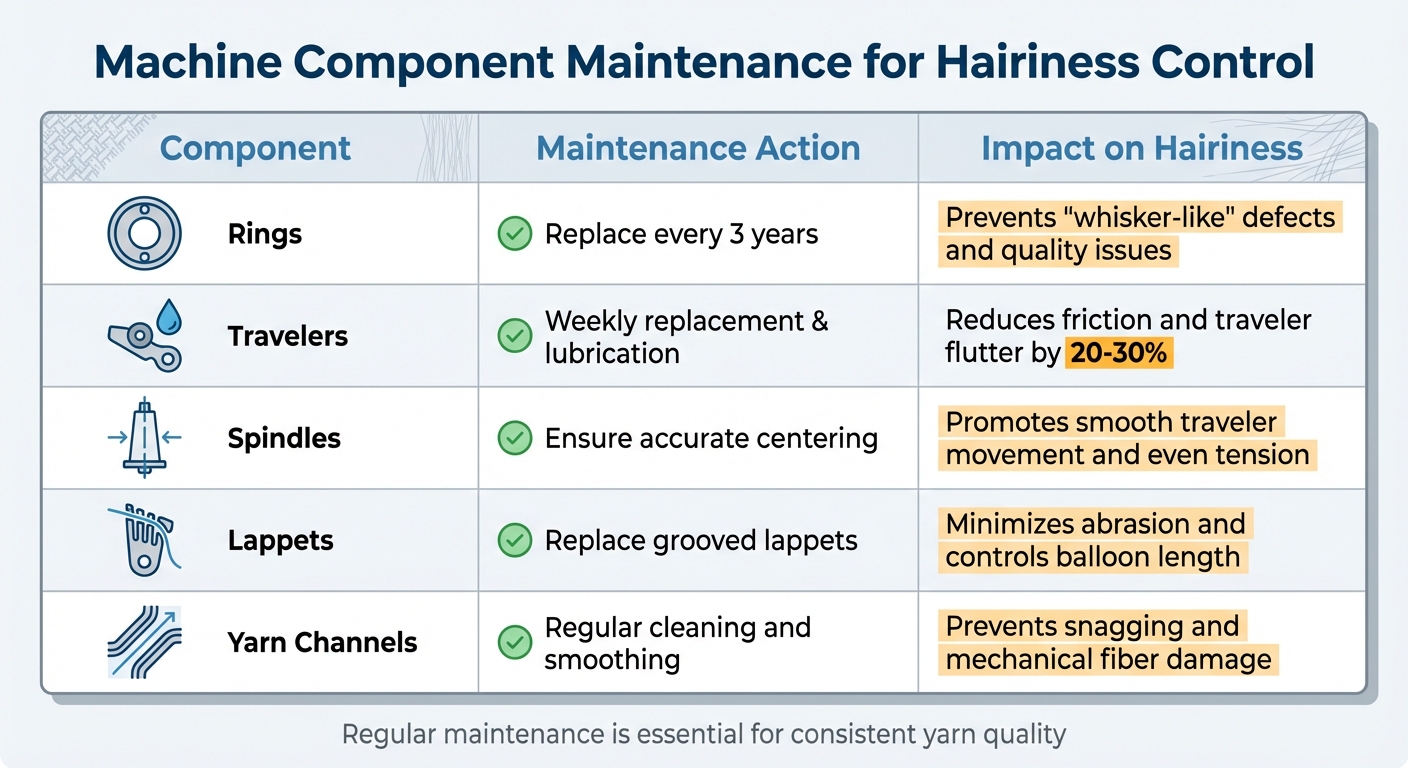
Machine Component Maintenance Schedule for Yarn Hairiness Control
Even with advanced spinning and post-treatment techniques, the quality of yarn depends heavily on proper equipment care. Neglecting machinery maintenance can lead to increased hairiness, neps, and waste. Regular upkeep and precise adjustments work hand-in-hand with advanced spinning methods to minimize yarn hairiness at every production stage.
Regular Machine Maintenance
Certain machine components demand consistent attention to ensure optimal performance. For example, spinning rings are a common source of increased hairiness. After three years of use, these rings can cause "whisker-like" defects and significant variations in yarn quality. Replacing them on this timeline helps maintain consistent production standards.
Travelers also play a crucial role. For producing high-quality yarns like those used in hosiery or sewing threads, travelers should be replaced weekly. As they wear down, their weight and stability decrease, causing traveler flutter, which increases yarn abrasion. Lubricating travelers can further reduce hairiness by 20%-30%.
Spindle alignment is another essential aspect. Misaligned spindles lead to uneven traveler movement, resulting in inconsistent tension and variations in hairiness across the production line. Regularly inspecting and adjusting spindle alignment ensures smooth operation and uniform yarn quality.
Additionally, maintaining clean yarn channels and smooth contact surfaces prevents mechanical snagging. Grooved lappets should be replaced, or glass-finish lappets can be used to minimize abrasion. For winding operations, steel grooved tubes are preferable over aluminum or bakelite tubes, as they help reduce yarn hairiness.
| Component | Maintenance Action | Impact on Hairiness |
|---|---|---|
| Rings | Replace every 3 years | Prevents "whisker-like" defects and quality issues |
| Travelers | Weekly replacement & lubrication | Reduces friction and traveler flutter |
| Spindles | Ensure accurate centering | Promotes smooth traveler movement and even tension |
| Lappets | Replace grooved lappets | Minimizes abrasion and controls balloon length |
| Yarn Channels | Regular cleaning and smoothing | Prevents snagging and mechanical fiber damage |
These maintenance practices lay the groundwork for effective process control.
Monitoring and Adjusting Process Settings
Once maintenance is in place, continuous monitoring of process settings becomes critical. Since 80%-85% of yarn hairiness originates in the spinning triangle - the area between the front roller and the twist point - this zone requires particular attention.
Spindle and winding speeds should remain within optimal ranges. Exceeding these speeds increases centrifugal force and friction, which dislodge fibers from the yarn body . Similarly, winding tension should be kept as low as possible to reduce friction. Automatic winding machines can help maintain consistent tension throughout the process .
Photoelectric hairiness testers are useful tools for monitoring the hairiness index and total hair length. These devices can identify underperforming machines or spindles that fall outside quality standards . As Hangzhou Dengte Textile Machinery Co., Ltd. explains:
"The state of the winder equipment is the basis for controlling the hairiness reduction in this process".
Conclusion
Managing cotton yarn hairiness effectively requires attention to every stage of production - from choosing the raw materials to applying finishing treatments. The journey begins with selecting high-quality raw cotton, as better fiber properties naturally lead to fewer protruding ends and smoother yarn surfaces.
Spinning techniques play a pivotal role in controlling hairiness. For instance, compact spinning has been shown to significantly reduce hairiness levels. Even small changes, like adjusting twist levels, can enhance yarn smoothness without requiring costly upgrades to equipment.
Finishing treatments further refine the yarn. Processes like singeing effectively remove surface fibers, reducing air drag by approximately 26% and improving the yarn's overall performance. These steps ensure not only reduced hairiness but also better fabric quality.
Yarn hairiness is a major contributor to fabric defects, such as pilling and uneven printing. By combining superior raw material selection, precise spinning techniques, and advanced finishing treatments, manufacturers can achieve smoother yarn, improved weaving efficiency, and more durable fabrics. This comprehensive approach not only enhances production efficiency but also meets higher customer expectations.
FAQs
What’s the fastest way to lower yarn hairiness without changing cotton suppliers?
The fastest way to cut down on yarn hairiness without changing your cotton supplier is by fine-tuning the winding process. Start by reducing the winding speed - this helps lower the tension, friction, and collisions between the yarn and machine components. Also, make sure the winding equipment is stable and properly balanced. These process tweaks can quickly improve results without needing to modify the raw materials.
How do I choose between compact spinning, higher twist, and singeing for hairiness control?
Different techniques can help manage hairiness in cotton yarn, each with its own advantages. Compact spinning ensures fibers are tightly aligned, which minimizes protruding fibers and results in smoother yarn. Higher twist improves fiber cohesion, though it can slightly compromise flexibility and strength. Singeing is a finishing method that removes surface fibers, delivering instant results. The choice of technique depends on factors like desired quality, cost, and the intended use of the yarn. Compact spinning is often favored for long-term control, while singeing works well as a final touch.
How can I tell if hairiness is coming from raw cotton, spinning settings, or worn machine parts?
Hairiness in raw cotton often stems from fiber characteristics such as length, strength, or contamination, including dust or seed-coat fragments. Issues like loops or floating fibers can arise from spinning settings, particularly when twist levels or spindle speeds are not properly adjusted. Additionally, worn machine parts can create uneven tension or slippage, leading to fibers sticking out. To pinpoint the cause, it’s essential to evaluate fiber quality, optimize process settings, and ensure machines are in good condition.