Cotton farming can be more profitable and environmentally friendly with the right conservation practices. Here are seven proven methods to improve soil health, conserve water, and reduce input costs - all while qualifying for federal subsidies under programs like EQIP, CSP, and CRP:
- No-Till Farming: Avoid plowing to reduce soil erosion and improve water retention. This practice enhances soil organic matter, allowing fields to hold more water and withstand droughts.
- Cover Cropping: Plant grasses or legumes during the off-season to protect soil, suppress weeds, and boost water absorption. Cover crops also reduce the need for fertilizers and herbicides.
- Precision Agriculture: Use GPS and sensors to apply water, nutrients, and pesticides with pinpoint accuracy, lowering costs and improving yields.
- Conservation Buffers: Establish vegetative strips along field edges or waterways to prevent erosion, trap nutrients, and improve water quality.
- Integrated Pest Management (IPM): Combine biological, mechanical, and chemical methods to control pests efficiently while minimizing chemical use.
- Efficient Irrigation Systems: Upgrade to systems like microirrigation to deliver water directly to plant roots, reducing waste and improving soil stability.
- Conservation Reserve Program (CRP) Enrollment: Retire marginal farmland for 10-15 years in exchange for annual rental payments, while improving soil and water quality.
These practices not only protect natural resources but also help farmers qualify for payments of up to $450,000 under EQIP, $200,000 under CSP, and $50,000 annually under CRP. Work with your local USDA Service Center to create a conservation plan tailored to your farm's needs.
How Conservation Saved a Cotton Farmer
1. No-Till Farming
No-till farming skips the traditional plowing and tilling process, leaving the soil undisturbed. Instead, cotton farmers plant seeds directly into the residue of the previous crop, which forms a protective layer over the soil. The USDA Natural Resources Conservation Service defines this method as "Residue and Tillage Management, No-Till" under Conservation Practice Standard Code 329.
Soil Health Improvement
No-till farming helps maintain the soil's natural structure and reduces erosion. The leftover crop residue gradually increases soil organic matter, which is vital for maintaining fertility over time. To put it into perspective, a 1% rise in soil organic matter allows the soil to hold more than 20,000 gallons of extra water per acre. This method also promotes better root growth in cotton plants, making them more capable of withstanding challenges like drought and other environmental pressures. These improvements in soil health play a critical role in conservation efforts that often qualify for federal support.
Before fully transitioning to no-till, it’s important to apply lime, phosphorus, and potassium throughout the root zone, as these nutrients move slowly in untilled soil. Once the system is established and nutrient levels are balanced, farmers can reduce the soil sampling depth from 8 inches to 4 inches.
Water Conservation
No-till farming helps the soil act like a sponge, improving its ability to absorb and hold water while reducing runoff - an important feature for drought-prone areas. The residue left on the surface minimizes water evaporation and shields the soil from the impact of rainfall. For regions like North Carolina, conservation-tillage practices require at least 30% ground cover after planting to meet standards. Since cotton residue alone often falls short of this requirement, farmers can use cover crops or plant high-residue crops like corn to meet the necessary threshold. This ability to conserve water strengthens no-till farming’s importance in meeting federal conservation standards.
Eligibility for Federal Subsidy Programs
To qualify for federal subsidy programs, farmers must strictly follow conservation standards, including no-till protocols. These programs require adherence to the "minimum planning criteria" outlined in national and state-specific conservation practice standards. Farmers should consult their local Field Office Technical Guide (FOTG) to verify state-specific criteria for no-till compliance. Visiting a USDA Service Center can also help confirm whether their chosen no-till practices meet federal requirements. Maintaining an approved conservation farm plan that incorporates no-till is essential for growers to remain eligible for USDA program benefits.
2. Cover Cropping
Cover cropping involves planting specific crops, like grasses or legumes, during the off-season to protect and improve soil. According to the USDA Natural Resources Conservation Service, this practice is classified under Conservation Practice Standard Code 340. Unlike cash crops, cover crops aren't grown for profit. Instead, they act as a living barrier, enhancing soil health and offering year-round benefits. Plus, adopting this practice can help farmers qualify for federal subsidies.
Soil Health Improvement
Cover crops play a key role in preventing soil erosion and increasing organic matter, which strengthens soil structure and boosts fertility. Their roots create a favorable environment for beneficial microorganisms that recycle nutrients. Did you know? A single gram of healthy soil can host millions of organisms and thousands of species of beneficial bacteria. These microorganisms are like tiny farmhands, helping cotton growers cut back on synthetic fertilizers. For example, cotton fields amended with compost have been shown to need 15% to 30% less nitrogen fertilizer compared to those that aren’t.
Water Conservation
Cover crops improve how soil absorbs and holds water while minimizing runoff. By enhancing soil structure, they allow water to seep deeper into the ground instead of pooling or washing away. This is especially valuable for cotton farmers dealing with inconsistent rainfall. The improved water retention can help crops survive dry spells, reducing the risk of drought-related losses. For farmers in areas with unpredictable weather, this resilience can be a game-changer.
Reduction of Chemical Use
Another benefit of cover crops is their ability to naturally suppress weeds, cutting down on the need for herbicides. They also attract beneficial insects and pollinators, which help control pests like bollworms and whiteflies. This means fewer chemicals are needed for pest and weed control, leading to lower costs and a smaller environmental footprint for cotton farms.
Eligibility for Federal Subsidy Programs
In addition to on-farm advantages, cover cropping aligns with requirements for federal subsidy programs like EQIP, CSP, and CRP. For instance, EQIP offers payments up to $450,000 over five years, while CSP caps payments at $200,000 within the same period. The CRP program can cover up to 50% of the costs for establishing approved conservation covers. However, it's important to note that farmers must wait for application approval or a specific waiver before starting the practice. To get started, reach out to your local USDA service center to set up farm records and confirm eligibility before planting cover crops.
3. Precision Agriculture Technologies
Precision agriculture combines GPS, sensors, and data analysis to apply resources like water, nutrients, and pesticides exactly where they’re needed. This approach not only cuts down on waste but also boosts yields and supports healthier soil. The USDA Natural Resources Conservation Service highlights several precision practices under specific conservation codes, such as Controlled Traffic Farming (Code 334), Precision Land Forming and Smoothing (Code 462), and Nutrient Management (Code 590). These practices can improve a farmer’s eligibility for federal subsidies while reducing operational costs.
These technologies integrate smoothly with existing conservation strategies, making them a practical choice for many farmers.
Soil Health Improvement
Precision agriculture plays a key role in maintaining and improving soil quality. For instance, Controlled Traffic Farming minimizes soil compaction by restricting equipment movement to specific lanes. Similarly, Precision Land Forming and Smoothing uses advanced tools like lasers or GPS to reshape fields, ensuring better water distribution and preventing erosion. Precision mapping further supports these efforts by identifying compacted zones and optimizing drainage systems.
Water Conservation
Precision techniques also help conserve water by delivering it exactly where and when it’s needed. Systems like Microirrigation (Code 441) and Irrigation Water Management (Code 449) apply water directly to plant roots at low pressure, reducing evaporation and runoff. These methods allow farmers to control the volume, timing, and rate of water application, improving crop performance while saving water. To qualify for water conservation subsidies under EQIP, fields typically need to have been irrigated for at least two of the past five years.
Reduction of Chemical Use
Another advantage of precision agriculture is its ability to cut down on chemical use. Variable Rate Technology (VRT) enables the precise application of fertilizers and pesticides, avoiding overuse and reducing costs. Similarly, Precision Nutrient Management (Code 590) and Pest Management Conservation Systems (Code 595) rely on soil testing and field data to apply inputs only where they’re needed. On average, GPS guidance systems can lower input costs by 5%, with reductions typically ranging from 2% to 7%.
Eligibility for Federal Subsidy Programs
Precision agriculture doesn’t just benefit the environment - it can also help farmers qualify for federal programs like the Environmental Quality Incentives Program (EQIP) and the Conservation Stewardship Program (CSP). These programs prioritize issues like water availability and soil erosion. For example, EQIP offers payments of up to $450,000 over five years, while CSP provides up to $200,000 per contract period. Farmers can improve their chances of approval by identifying local priority concerns through their USDA Service Center and creating a custom conservation plan. Additionally, beginning, veteran, and socially disadvantaged farmers may qualify for higher cost-share rates and can receive at least 50% of their payments upfront.
4. Conservation Buffers
Conservation buffers are a key practice for improving soil health, conserving water, and meeting federal eligibility requirements for agricultural support programs.
These buffers are strips of vegetation strategically placed between cropland and water sources or along field edges. Examples include filter strips, riparian buffers, contour strips, and saturated buffers. Each type serves to protect soil and water resources effectively.
Soil Health Improvement
Buffers are essential for reducing erosion and maintaining soil structure, especially on cotton farms. For instance, filter strips and riparian zones trap sediment before it can leave the field, while vegetative barriers like contour strips and grassed waterways help prevent the formation of gullies on vulnerable land. By slowing down surface water, these measures reduce runoff that can strip away topsoil and nutrients. They also improve water infiltration, allowing the soil to better absorb and retain moisture during dry spells. As highlighted by MU Extension:
Riparian buffer strips make systems more resistant to drought stress, enhance water infiltration and quality, and reduce runoff
. These soil benefits are critical for better water management on farms.
Water Conservation
Buffers not only protect the soil but also safeguard water quality. By intercepting runoff before it reaches streams and rivers, they help reduce sedimentation and runoff. As noted by Cotton.org:
These practices protect water quality by reducing sedimentation and runoff
. Additionally, buffers enhance local moisture retention, which is especially valuable for farms in regions prone to water shortages. This dual role - protecting existing water sources while improving drought resilience - makes buffers an important tool for sustainable farming.
Eligibility for Federal Subsidy Programs
Farmers who implement conservation buffers can access significant federal support. For example, enrolling buffer land in the Conservation Reserve Program (CRP) offers annual rental payments and covers up to 50% of the establishment costs, with contracts lasting 10–15 years depending on the specific practice. Maintenance incentives can add up to $4 per acre annually, and some practices qualify for an additional 20% financial incentive on top of the annual payment. CRP payments are capped at $50,000 per participant annually.
Alternatively, the Environmental Quality Incentives Program (EQIP) provides up to $450,000 over five years for farmers using buffers on active farmland. Beginning, veteran, and socially disadvantaged farmers often qualify for higher cost-share rates and may receive at least 50% of payments upfront.
| Buffer Practice Type | NRCS Code | Primary Benefit |
|---|---|---|
| Contour Buffer Strips | 332 | Erosion control on slopes |
| Filter Strip | 393 | Sediment and nutrient trapping |
| Riparian Forest Buffer | 391 | Water quality and wildlife habitat |
| Saturated Buffer | 604 | Nitrate removal from subsurface flow |
| Vegetative Barrier | 601 | Runoff reduction and soil trapping |
Reduction of Chemical Use
Buffers also play a role in reducing chemical runoff, making them an integral part of the Pest Management Conservation System (Code 595). While their primary purpose is to manage soil and water movement, buffers also capture fertilizers and pesticides carried in runoff. This helps prevent agricultural pollutants from entering downstream ecosystems. By filtering out these chemicals, buffers contribute to the protection of local water resources and the surrounding environment.
sbb-itb-0e617ca
5. Integrated Pest Management
Integrated Pest Management (IPM) takes a thoughtful approach to pest control while promoting ecosystem health. Instead of relying solely on chemical solutions, IPM combines cultural, biological, mechanical, and chemical methods to manage pests in a way that protects soil and water quality. A key feature of IPM is the use of action thresholds, meaning pesticides are only applied when pest populations reach levels that could cause economic harm. This targeted strategy minimizes unnecessary chemical use and fosters a healthier, more balanced farm ecosystem.
Soil Health Benefits
One of the standout advantages of IPM is its positive impact on soil health. By reducing the use of harmful chemicals, IPM helps preserve beneficial soil organisms that are vital for maintaining soil fertility. Additionally, cultural practices like crop rotation - using crops such as wheat, faba beans, or chickpeas - are integral to IPM. These rotations break the cycles of soilborne diseases and improve soil structure. Rather than aiming for complete pest eradication, IPM focuses on keeping pest levels below economic thresholds, which encourages biodiversity and supports natural predators and soil microorganisms.
Cutting Back on Chemical Use
A major strength of IPM is its ability to significantly cut down on chemical usage. Simple methods like field scouting allow farmers to detect pest issues early and apply targeted treatments only when absolutely necessary. This approach not only reduces the volume of chemicals but also prioritizes products that are less harmful to beneficial insects and other organisms. For example, the Australian cotton industry’s adoption of a robust IPM system led to a 97% decrease in insecticide use between 1992 and 2021. The National Cotton Council of America highlights this shift, stating:
Effective cultural and biological control strategies can, in some instances, effectively reduce the dependence on chemical control of pests.
Access to Federal Subsidy Programs
IPM doesn't just offer environmental perks - it can also make farms more competitive for federal subsidy programs. The USDA Natural Resources Conservation Service (NRCS) officially recognizes IPM as part of the Pest Management Conservation System (Code 595). Like other conservation practices such as precision agriculture and cover crops, IPM strengthens a farm’s conservation plan, making it more attractive for federal funding opportunities. Programs like the Environmental Quality Incentives Program (EQIP) provide up to $450,000 over five years for adopting conservation practices, including IPM. Similarly, the Conservation Stewardship Program (CSP) offers payments of up to $200,000 per contract period for maintaining and expanding practices like advanced IPM. Additionally, IPM can enhance a producer's Environmental Benefits Index (EBI) score for the Conservation Reserve Program (CRP) by improving wildlife habitats and reducing chemical runoff.
6. Efficient Irrigation Systems
Efficient irrigation systems allow cotton farmers to deliver water precisely, reducing waste and ensuring crops absorb the maximum amount. The USDA Natural Resources Conservation Service includes this method in its Irrigation Water Management guidelines (Code 449). By moving away from older techniques like flooding, modern systems focus on directing water exactly where it's needed.
Water Conservation
Effective water conservation starts with improving how water moves from its source to the fields. Traditional open channels often lose water to seepage and evaporation. Instead, using irrigation pipelines (Code 430) or adding ditch lining (Code 428) significantly cuts down on these losses. Once water reaches the field, systems like microirrigation (Code 441) and advanced sprinkler setups (Code 442) target the root zone directly, reducing evaporation and deep percolation. Tailwater recovery systems (Code 447) collect runoff, while proper irrigation land leveling (Code 464) ensures even water distribution across the field. These methods not only save water but also improve soil stability and fertility.
Soil Health Improvement
Efficient irrigation doesn’t just save water - it also protects and enhances soil health. By applying water evenly and in controlled amounts, these systems help prevent soil erosion and reduce nutrient leaching. This keeps organic matter and beneficial organisms intact, which are critical for keeping cotton fields productive in the long term. Precision irrigation also complements nutrient management practices, ensuring fertilizers stay where they’re needed most.
Eligibility for Federal Subsidy Programs
With these advantages, cotton farmers can tap into federal programs that offer financial support for irrigation upgrades. For instance, the Environmental Quality Incentives Program (EQIP) provides technical and financial assistance, with payments of up to $450,000 over five years. To qualify for water conservation or irrigation-related payments, the land must typically have been irrigated during at least two of the past five years. Additionally, underserved farmers - such as beginning, veteran, or socially disadvantaged producers - may receive advanced payments covering at least 50% of total contract costs. The Conservation Reserve Program (CRP) also supports conservation by covering up to 50% of establishment costs and offering maintenance incentives of up to $4 per acre annually. To learn more, visit your local USDA Service Center for specific eligibility requirements.
7. Conservation Reserve Program Enrollment
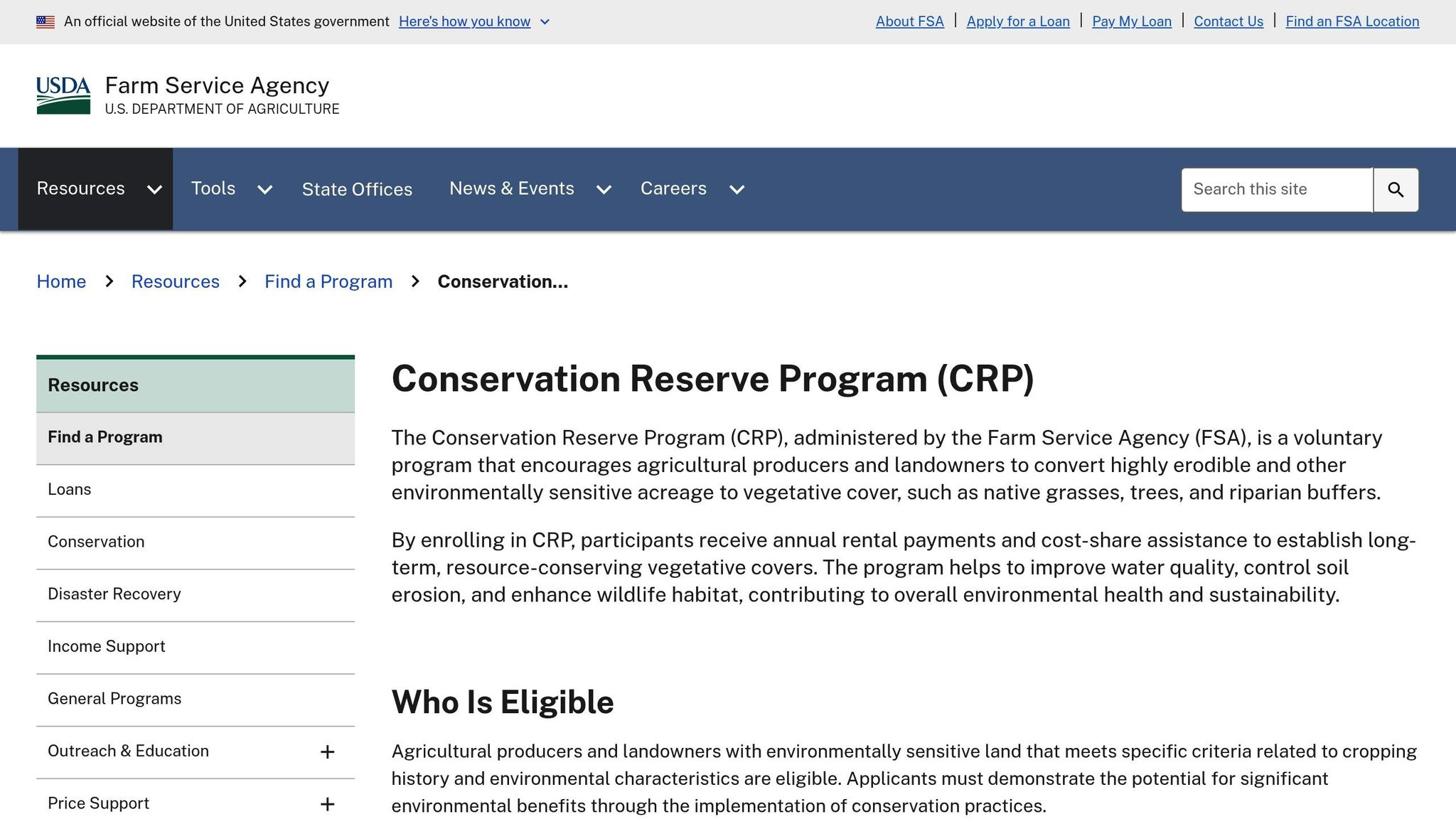
The Conservation Reserve Program (CRP) offers cotton farmers an opportunity to take environmentally sensitive land out of production in exchange for annual rental payments. Managed by the USDA Farm Service Agency with support from the NRCS, CRP contracts typically run for 10 to 15 years. During this time, marginal farmland is converted to permanent vegetative covers like native grasses, trees, or riparian buffers. Below, we’ll explore how enrolling in CRP benefits soil health, conserves water, and reduces chemical use.
Soil Health Improvement
Switching from row crops to permanent vegetation helps curb soil erosion and boosts organic matter, which strengthens soil structure and improves its capacity to retain water during dry spells. In 2021, the USDA allocated $10 million to study how CRP practices - such as using perennial grasses and wetlands - affect soil carbon levels.
Water Conservation
CRP enrollment plays a key role in protecting water quality. Establishing filter strips and riparian buffers minimizes sedimentation and nutrient runoff from cotton fields, keeping streams and rivers cleaner and less impacted by agricultural pollutants.
Reduction of Chemical Use
Beyond environmental benefits, CRP enrollment lowers farming costs by reducing the need for pesticides and fertilizers on enrolled acres. This not only cuts chemical inputs but also saves money for producers.
Eligibility for Federal Subsidy Programs
Cotton farmers have several CRP enrollment options: General CRP (competitive bidding), Continuous CRP (focused on high-priority practices), and Grassland CRP. Sign-up periods for 2025 are as follows:
- General CRP: May 12–June 6
- Continuous CRP: June 7–July 18
- Grassland CRP: July 14–August 8
To qualify, land must have been planted or considered planted to an agricultural commodity in at least four of the six crop years between 2012 and 2017. Additionally, the land must have been owned or operated for at least 12 months. Farmers may receive cost-share assistance for up to 50% of establishment costs, along with annual rental payments capped at $50,000 per participant. To participate, producers must have an adjusted gross income below $900,000, though waivers are available for land deemed environmentally significant. Farmers interested in CRP should visit their local USDA Service Center to establish records, confirm eligibility, and work with an NRCS conservation planner to create a tailored site plan.
How These Practices Qualify for Federal Subsidies
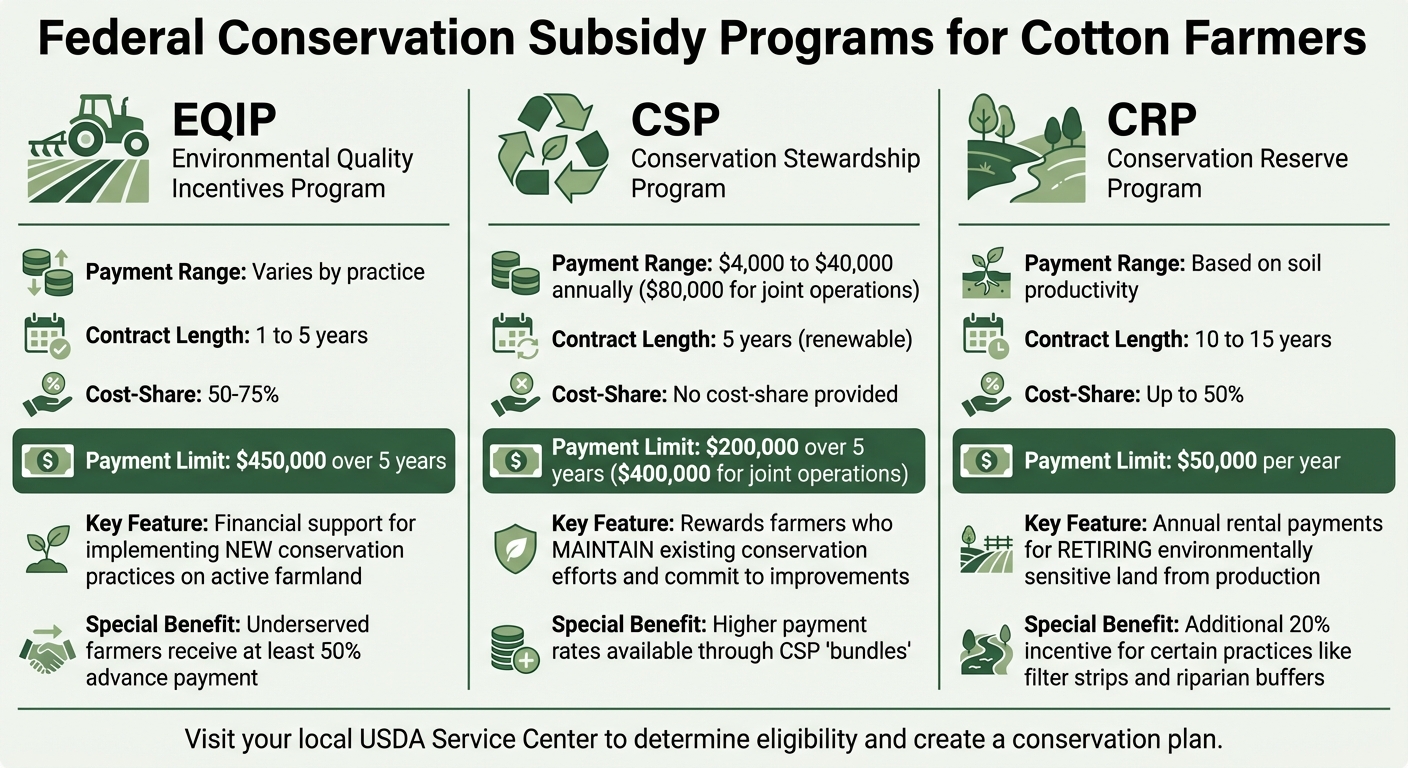
Federal Conservation Subsidy Programs for Cotton Farmers: EQIP, CSP, and CRP Comparison
The Environmental Quality Incentives Program (EQIP), Conservation Stewardship Program (CSP), and Conservation Reserve Program (CRP) are structured to financially support farmers and landowners who adopt conservation-focused practices. Each program has its own set of payment requirements and objectives, encouraging sustainable land use while offering economic incentives.
EQIP provides funding to help farmers implement new conservation practices on active farmland. To qualify, applicants must target a natural resource issue, such as soil erosion, water quality, or soil health, and collaborate with NRCS conservation planners to create a tailored plan. Farmers who are historically underserved may receive advance payments of at least 50% of their total contract value to cover upfront expenses like materials or services. Applications are evaluated based on their environmental impact, with priority given to those addressing national, state, or local conservation goals. Additionally, applicants must meet income eligibility limits and comply with regulations for highly erodible land and wetlands.
CSP is designed for farmers who maintain existing conservation efforts while committing to further improvements. The program recently raised its minimum annual payment from $1,500 to $4,000. Individual participants can earn up to $40,000 per year, with a cap of $200,000 over a five-year contract. Joint operations are eligible for higher limits - up to $80,000 annually and $400,000 over the contract period. To participate, applicants must meet a "stewardship threshold" for at least two resource priorities at the time of application and agree to address an additional priority by the end of the contract. Farmers can also benefit from CSP "bundles", which offer higher payment rates for combining multiple enhancements like precision agriculture and advanced irrigation systems.
CRP focuses on retiring environmentally sensitive land from agricultural production in exchange for annual rental payments. Participants can receive up to $50,000 annually, with cost-sharing available for up to 50% of the expenses needed to establish conservation practices. Certain practices, such as creating filter strips or riparian buffers, may qualify for additional financial incentives, increasing annual payments by up to 20%. To be eligible, the land must have been used for agricultural commodities in at least four of the six crop years from 2012 to 2017, and applicants must have owned or managed the property for at least 12 months.
| Program | Payment Range | Contract Length | Cost-Share | Limit |
|---|---|---|---|---|
| EQIP | Varies by practice | 1 to 5 years | 50-75% | $450,000 over 5 years |
| CSP | $4,000 to $40,000 | 5 years (renewable) | No | $200,000 over 5 years |
| CRP | Based on soil productivity | 10 to 15 years | Up to 50% | $50,000 per year |
Conclusion
The conservation practices outlined above not only align with federal standards but also enhance farm profitability and ensure long-term resilience.
By adopting these practices, you can qualify for federal subsidies while creating a stronger, more profitable operation. Federal programs offer financial assistance that helps offset initial costs and supports efforts to improve soil health, reduce input expenses, and boost drought resistance.
To make the most of these opportunities, work with your local USDA Service Center to tailor a conservation plan that maximizes subsidy eligibility. Be sure to establish your farm records with the Farm Service Agency before applying. Also, avoid implementing any practices before your contract is approved, as early implementation often disqualifies you from receiving payments.
These strategies provide lasting benefits. Healthier soil improves water retention and drought tolerance, acting as a natural buffer against extreme conditions. Practices like integrated pest management, precision irrigation, and cover cropping not only cut down on expensive inputs but also encourage natural nutrient cycling and weed control.
For guidance, connect with an NRCS conservation planner who can help you navigate program requirements and ensure your practices align with state guidelines.
To access resources tailored to the cotton industry, including a detailed directory of U.S. cotton gins and valuable industry insights, visit cottongins.org. This platform is a great starting point for supporting your conservation efforts and staying informed about the latest developments in the field.
FAQs
What financial benefits can cotton farmers gain from using conservation practices?
Adopting conservation practices can open up opportunities for cotton farmers to boost their income through federal programs designed to support sustainable farming. For instance, the USDA’s Environmental Quality Incentives Program (EQIP) provides financial and technical assistance to help farmers implement practices like planting cover crops, reducing tillage, or installing water-efficient irrigation systems. By covering a portion of the costs, these programs not only reduce farmers' expenses but also improve productivity.
Another option is the Conservation Stewardship Program (CSP), which offers additional payments for farmers who go a step further by adopting advanced conservation techniques. Similarly, the Conservation Reserve Program (CRP) provides annual rental payments for setting aside land to protect natural resources - such as planting native grasses or creating wildlife buffers. These programs not only encourage better land management but also provide reliable financial benefits.
Considering that federal farm subsidies account for an average of 13.5% of net farm income nationwide, participating in these programs can help cotton farmers secure a larger share of these payments. On top of that, these conservation practices can strengthen their resilience to challenges like drought and improve long-term profitability.
What are the benefits of using precision agriculture in cotton farming?
Precision agriculture equips cotton farmers with cutting-edge tools to manage their fields with greater precision. Using technologies such as GPS-linked sensors, satellite imagery, and variable-rate equipment, farmers can deliver water, fertilizer, and herbicides exactly where they’re needed. This targeted method not only reduces waste but also lowers input costs and boosts crop yields.
Beyond improving efficiency, precision agriculture plays a key role in protecting natural resources and meeting federal subsidy requirements. Tools like real-time soil moisture monitoring and drought forecasting allow farmers to conserve water while maintaining productivity during dry spells. Paired with practices like cover cropping and reduced tillage, these technologies help minimize soil erosion and nutrient runoff, promoting more sustainable farming methods.
How do conservation buffers benefit water quality and soil health on cotton farms?
Conservation buffers, like contour buffer strips, are essential tools for protecting water quality and boosting soil health on cotton farms. These strips act as natural filters, trapping sediment and capturing excess nutrients before they can wash away, ultimately reducing runoff and keeping pollutants from contaminating downstream water sources.
Beyond that, these buffers slow down water flow, giving it more time to soak into the ground. This improved water infiltration helps maintain soil moisture levels. Over time, they also enrich the soil by building up organic matter and strengthening its structure, making the land more stable and less prone to erosion.