Here's what you need to know:
- Extreme Weather Impact: Heat above 90°F slows cotton root growth, cutting biomass by two-thirds. Droughts cause up to 80% yield losses in the U.S.
- Genetic Solutions: New cotton varieties feature deeper roots, better water retention, and heat protection. Key genes like GhHSP70-26 and AVP1 improve resilience.
- Economic Benefits: Farmers using these varieties save $74.30 per acre and earn $172.87 more per acre on average.
- Technology Boost: CRISPR and digital tools like "digital twins" allow faster breeding and better performance predictions.
These advancements are transforming cotton farming, ensuring crops survive and thrive in a changing climate.
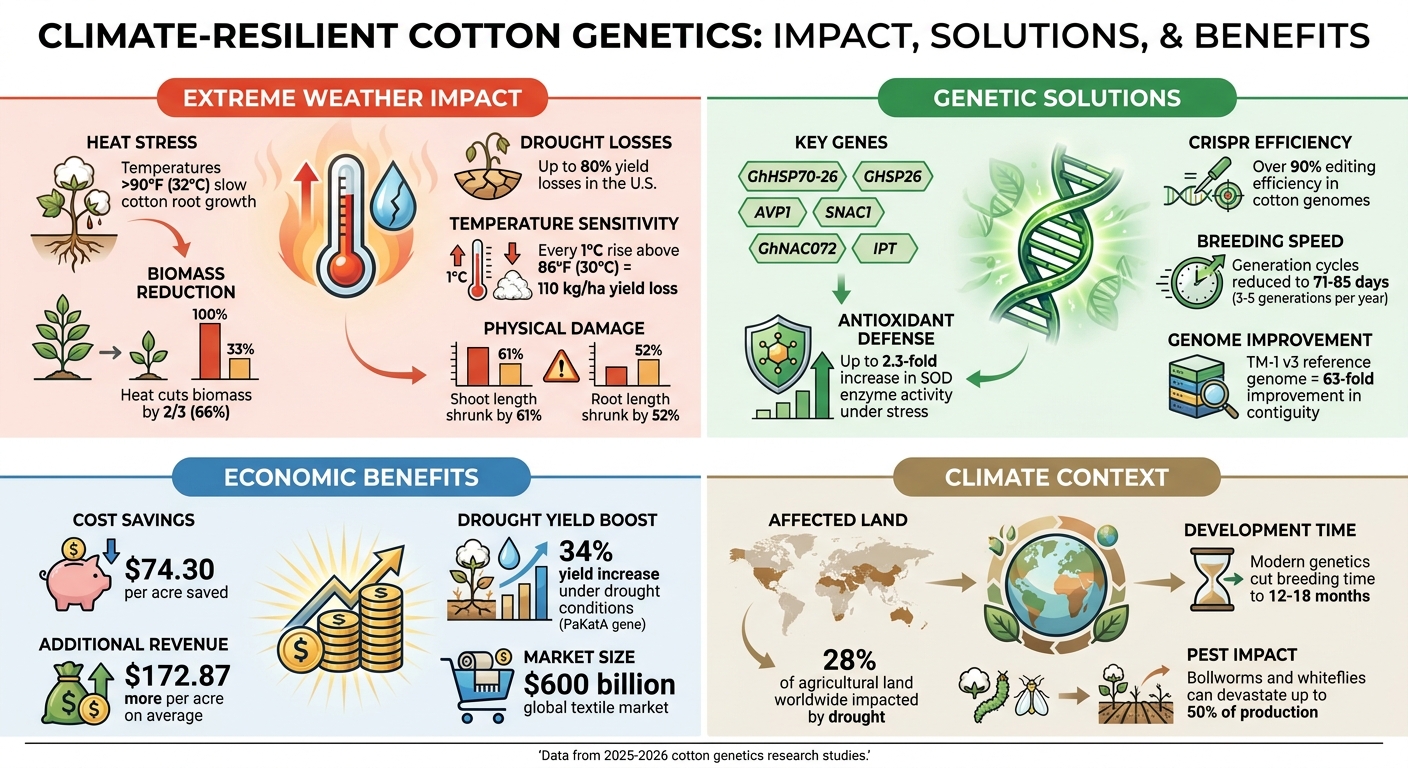
Climate-Resilient Cotton Genetics: Key Statistics and Economic Impact
Revolutionizing Cotton Breeding Boosting Yield, Quality & Climate Resilience
sbb-itb-0e617ca
Genetic Traits That Build Climate Resilience
This section explores the genetic traits that give cotton its ability to withstand extreme weather. These traits are essential for helping farmers choose varieties that thrive even when conditions are tough.
Heat and Drought Tolerance Mechanisms
Cotton's ability to endure heat and drought starts with heat shock proteins (HSPs), which act as a first-line defense. Genes like GhHSP70-26 and GHSP26 help reduce wilting, protect cell membranes, and support root growth during high temperatures.
Transcription factors such as GhABF2, DREB, and PeDREB2a play a critical role in managing stomatal function and maintaining osmotic balance under stress. These mechanisms are vital, considering that every 1°C rise above 86°F (30°C) can cut cotton yields by about 110 kg/ha .
Cotton also relies on its antioxidant defense systems to protect cells from oxidative damage caused by heat and drought. Enzymes like SOD, POD, CAT, and APX are key players, with some cotton lines showing up to a 2.3-fold increase in SOD activity during stress. A study from February 2026 highlighted three upland cotton genotypes - MNH-886, NIAB-545, and MNH-988 - as particularly resilient. These varieties excelled in maintaining reactive oxygen species (ROS) within safe levels under combined stress conditions.
Root architecture genes further enhance drought tolerance by improving water uptake. For example, the AVP1 gene promotes larger root systems with better ion storage, while SNAC1 and GhNAC072 encourage rapid root growth and reduced water loss . Severe drought can shrink cotton shoot length by 61% and root length by 52%, so varieties with stronger root traits are more likely to survive. Additionally, the IPT gene helps delay leaf aging by regulating cytokinin production, allowing plants to maintain biomass even during water shortages.
Farmers should look for genotypes with high Relative Water Content (RWC) and strong Ascorbate Peroxidase (APX) activity, as these are reliable indicators of heat and drought resilience. Monitoring Proline and Malondialdehyde (MDA) levels can also provide valuable insights. Resilient cotton varieties tend to show a steady rise in Proline and a non-linear trend in MDA during stress.
While these traits help cotton withstand environmental challenges, genetic factors also play a role in defending against pests and diseases, which are increasingly problematic in unstable climates.
Pest and Disease Resistance in Variable Climates
In addition to coping with abiotic stresses, genetic traits help cotton fend off pests and diseases that thrive in changing climates. Pests like bollworms and whiteflies can devastate up to 50% of cotton production during outbreaks.
One standout genetic factor is the GhMYB36 transcription factor, which boosts the expression of PR1 (Pathogenesis-Related) genes. This enhances the plant's defenses against both biotic and abiotic stresses .
"The GhMYB36 transcription factor confers resistance to biotic and abiotic stress by enhancing PR1 gene expression in plants." - Functional & Integrative Genomics
To combat growing pest resistance to single-gene Bt traits, researchers are turning to multi-trait pyramiding. This approach stacks multiple resistance mechanisms into a single variety, offering a more robust defense. Chromosome Segment Substitution Lines (CSSLs) allow breeders to incorporate beneficial alleles from wild Gossypium species, such as those providing resistance to Verticillium wilt, into high-performing upland cotton varieties.
Additionally, cotton plants rely on hormonal crosstalk between Abscisic Acid (ABA) and Jasmonic Acid (JA) signaling pathways. This coordination helps balance growth and defense, especially when facing multiple stress factors simultaneously - an increasingly common scenario as climate change continues to escalate.
Recent Advances in Cotton Genetics Research
Genomics and Molecular Breeding Techniques
Recent strides in genetic research have given farmers access to cotton varieties engineered to handle extreme weather conditions. Tools like CRISPR/Cas9 and Cas12a systems, including the adaptable Mb2Cas12a variant, have achieved over 90% editing efficiency in cotton genomes, allowing precise and rapid genetic modifications. Additionally, speed breeding techniques - using controlled environments and embryo rescue - have shortened generation cycles to just 71–85 days, enabling up to 3–5 generations per year. A notable success was achieved in 2025 with the elite line JND24-i3, where multiple resilience and quality traits were combined into a single variety.
Graph-based pangenomes have also been game-changers, uncovering genetic variations that traditional reference genomes often miss. These systems identify structural and presence–absence variations across cotton species, such as traits from G. barbadense (Pima cotton) that improve fiber quality and stress resistance. The updated TM-1 v3 reference genome represents a 63-fold improvement in contiguity, making it possible to study previously complex regions. On top of these advancements, digital tools like digital twins now integrate genomic, phenomic, and environmental data to predict varietal performance in different climates, reducing the need for extensive field trials.
"Recent advances in chromosome-scale genome assemblies, pan-genomics, and haplotype-resolved resequencing have greatly enhanced the capacity to identify causal variants and recover non-reference alleles linked to fibre development and environmental adaptation." - Zahra Ghorbanzadeh et al., Agronomy
Examples of Resilient Cotton Varieties
These advancements have led to the development of cotton varieties that thrive under challenging conditions. For example, in January 2026, CSIRO Australia introduced the "early-saver" genotype CSX2027. This variety conserves soil moisture by closing stomata at a higher water threshold (around 31%) compared to the "late-saver" CSX8521, which closes at 25%. Key genes like MEX1 and pGlct-2 help the early-saver manage energy more efficiently during drought, providing a noticeable edge in dry conditions.
Other genotypes, such as MNH-886, NIAB-545, and MNH-988, maintain "oxidative-window homeostasis" under combined drought and heat stress. Using a Multi-Trait Genotype-Ideotype Distance Index, researchers have also identified drought-tolerant genotypes like IR-14 (G2), N-221 (G8), and FH-154 (G17), which excel in photosynthetic efficiency and antioxidant activity during critical flowering stages when water stress is most damaging.
In the U.S., modern reference genomes now guide the development of region-specific cultivars. Examples include UGA230, suited for the Southeast; UA48, which combines blight resistance with high fiber quality; and CSX8308, an Australian okra-leaf variety resistant to fusarium wilt. Specialty cotton varieties are also emerging. For instance, multiplex editing of GhPGF loci has resulted in glandless cotton, making seeds edible and creating new opportunities for cotton as a food source. Additionally, transgenic cotton overexpressing the PaKatA gene (catalase) from Pseudomonas aeruginosa has shown a 34% yield increase under drought conditions.
These examples highlight how advancements in cotton genetics are transforming the industry, offering farmers tools to adapt to a changing climate and meet growing demands for sustainable farming practices.
How Farmers Can Adopt Resilient Cotton Genetics
Selecting the Right Resilient Varieties
Choosing a climate-resilient cotton variety starts with understanding the unique weather challenges of your region. It’s not just about picking a seed - it’s about selecting one that has been tested across multiple growth stages. For instance, varieties evaluated during the seedling stage (to assess early vigor and root development) and the flowering stage (a key period for yield) tend to perform better. This is critical because extreme temperatures during flowering can drastically reduce yields.
Key traits to look for include stronger root systems, taller plants, larger cotyledon node diameters, higher Relative Water Content (RWC), and better photosynthetic efficiency during stress. These indicators point to better drought resistance. For example, a 2025 study of 202 cotton lines highlighted J206-5, jiumian20, TD1, and zhongmiansuo27 as top drought-resistant performers based on D-value analysis using the entropy weight method. For combined drought and heat stress, varieties like MNH-886 (G2), NIAB-545 (G10), and MNH-988 (G14) stood out for maintaining oxidative balance under harsh conditions.
Advanced tools like the Multi-Trait Genotype-Ideotype Distance Index (MGIDI) can further refine selection by ranking varieties based on how well they match an ideal drought-resistant profile. Using this method, researchers identified IR-14, N-221, N-444, FH-154, FH-492, and FH-540 as highly drought-tolerant during critical reproductive phases.
"The flowering stage, being highly susceptible to moisture limitations, often suffers from pollen sterility and ovule abortion, leading to reduced boll retention and lower lint yield." – Scientific Reports
Once you’ve chosen the right varieties, fine-tuning agronomic practices can maximize their potential.
Pairing Genetics with Climate-Smart Farming Methods
Even the best cotton genetics need proper farming techniques to thrive. Start by selecting varieties with deeper, thicker roots at the seedling stage - these traits are closely tied to improved drought tolerance and better water uptake later in the season. Complement these genetics with soil management practices like maintaining organic matter and reducing soil compaction to help roots access deeper moisture during dry spells.
Understanding the specific traits of your chosen variety can also help you adjust irrigation schedules to minimize water waste while maintaining yields. Monitoring oxidative stress markers like Malondialdehyde (MDA) can offer insights into how well a variety handles stress. For instance, resilient varieties often show an initial rise in MDA levels, followed by a decline - signaling that their defense mechanisms are kicking in. They also tend to have higher antioxidant enzyme activity (like SOD, POD, CAT, and APX), with superoxide dismutase activity increasing up to 2.3 times under severe drought conditions.
Combining these genetics with advanced farming practices ensures plants are better equipped to handle climate challenges.
Using Technology for Climate Adaptation
Technology takes cotton farming to the next level by offering tools that predict and manage stress with precision. For example, digital twins allow farmers to simulate how a cotton variety will perform in their specific environment before planting. This reduces the need for resource-heavy field trials and helps identify the best variety for local conditions.
"Emerging digital agriculture tools, such as digital twins that combine genomic, phenomic, and environmental data layers, allow simulation of ideotype performance and optimisation of trait combinations in silico before field validation." – MDPI Agronomy
High-tech tools like Time Domain Reflectometry (TDR) probes and InfraRed Gas Analyzers (IRGA) provide real-time data on soil moisture, stomatal conductance, and photosynthetic efficiency. Thermal imaging and digital sensors can detect heat stress before visual symptoms appear, enabling quicker responses. Additionally, thermostatic sensors and digital loggers help track temperature and humidity for more precise stress management.
At the seedling stage, rapid assessments of root structure and RWC can predict drought performance early, cutting down on expensive full-field trials. When paired with multivariate analysis tools like Principal Component Analysis (PCA), farmers can pinpoint which traits - such as APX activity or root dry weight - are most critical for success in their specific climate.
Conclusion
The future of cotton farming hinges on blending advanced genetic tools with smart management strategies. With climate change intensifying, traditional breeding methods are no longer sufficient to meet the challenges ahead. Modern genetic technologies like CRISPR/Cas9 and genomic selection have stepped in to fill this gap, cutting development time down to just 12–18 months.
But genetics alone won't solve the problem. Even the most robust cotton varieties need proper support to thrive. Techniques like precision irrigation, effective soil management, and real-time monitoring are critical. These practices help maintain what researchers call "oxidative-window homeostasis", ensuring plants stay in a stress-responsive state rather than succumbing to cellular damage. This is particularly important in an industry that supports millions of smallholder households across more than 90 countries and underpins a $600 billion global textile market.
Predictive tools like digital twins and machine learning offer a unique advantage. By simulating how specific traits will perform in local environments, farmers can make smarter decisions before planting.
"Developing climate-resilient and high-quality cotton cultivars remains an urgent challenge, as the key target traits - yield, fibre properties, and stress tolerance - are highly polygenic and strongly influenced by genotype–environment interactions." – Agronomy
To secure the future of cotton production, it’s essential to integrate resilient genetics with precise management. Choose varieties with proven multi-trait resilience, adopt the climate-smart practices laid out here, and embrace technology to stay ahead of the curve. With drought already impacting 28% of agricultural land worldwide, the urgency to act has never been greater.
FAQs
Which climate-resilient cotton traits matter most for my region?
In regions grappling with intense drought and scorching heat, certain plant traits become essential for survival and productivity. Characteristics like drought and heat tolerance, mechanisms to maintain oxidative balance, and biochemical resilience play a key role. Specifically, in areas frequently affected by drought stress, morpho-physiological and biochemical markers during flowering are vital. These traits ensure crops can sustain yield stability, even when faced with harsh weather conditions.
How can I tell if a variety is truly drought- and heat-tolerant?
A drought- and heat-tolerant crop variety is one that keeps its physiological, biochemical, and morphological traits steady even under stressful conditions. Key indicators to watch for include oxidative homeostasis, morpho-physiological responses, and critical biochemical traits, especially during sensitive phases like flowering. These characteristics are essential for ensuring the variety can endure harsh conditions without compromising its performance.
Do resilient cotton genetics require different irrigation or management?
Resilient cotton varieties may require changes in management practices, such as fine-tuning irrigation strategies, to make the most of their ability to handle stress. These traits are specifically developed to help cotton withstand challenges like drought and heat, which can influence its water and nutrient needs. Adjusting how these crops are managed ensures they thrive even in harsh weather conditions.