Better Cotton and Organic Cotton represent two approaches to making cotton farming less harmful to the planet. Better Cotton focuses on improving farming practices at scale, while Organic Cotton emphasizes strict natural methods and avoids synthetic inputs. Here's a quick breakdown:
- Better Cotton: Accounts for 23% of global cotton production. Allows GMO seeds, synthetic inputs, and uses methods like Integrated Pest Management (IPM) to reduce harm. It’s scalable and designed for mainstream use but doesn’t meet the strict ecological standards of organic farming.
- Organic Cotton: Makes up only 1–2% of global cotton supply. Prohibits GMOs, synthetic pesticides, and fertilizers. It uses crop rotation and natural pest control, resulting in a smaller environmental footprint but higher costs and lower availability.
Key Stats:
- Water Use: Organic cotton can reduce water usage by up to 91%, while Better Cotton focuses on improving water efficiency.
- Market Share: Better Cotton dominates with 5.64 million metric tons produced in 2023–24, compared to Organic Cotton's niche presence.
- Cost: Organic cotton costs ~37% more due to labor-intensive processes.
Quick Comparison
| Feature | Better Cotton | Organic Cotton |
|---|---|---|
| Seeds | GMO allowed | Non-GMO only |
| Pesticides | Controlled use | Prohibited |
| Water Use | Efficient practices | Up to 91% less |
| Market Share | 23% of global supply | 1–2% of global supply |
| Cost | Moderate | ~37% higher |
Conclusion: Better Cotton works for large-scale production with incremental improvements, while Organic Cotton delivers stricter ecological benefits but comes with higher costs and limited availability. The choice depends on your priorities: scalability or stricter eco-friendly standards.
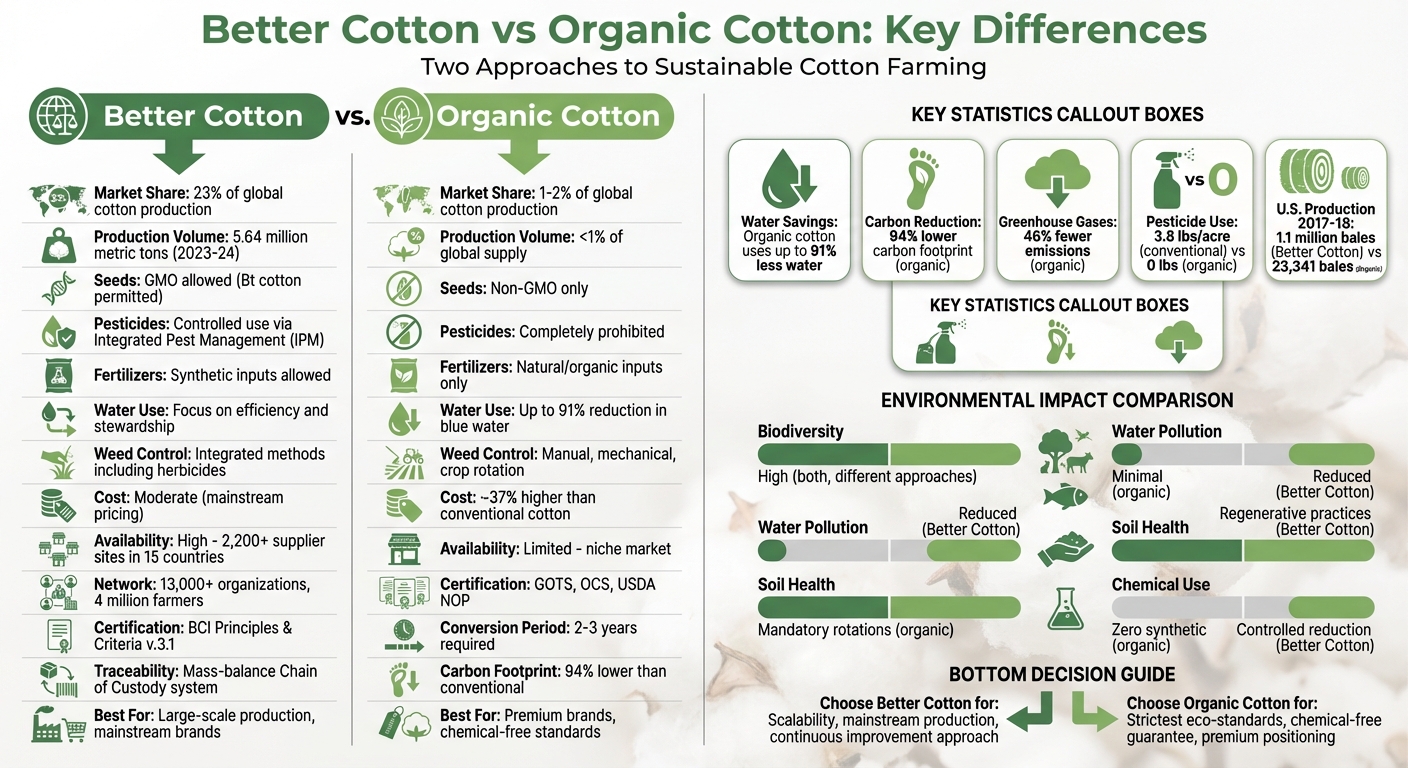
Better Cotton vs Organic Cotton: Complete Comparison of Sustainability, Cost, and Environmental Impact
Organic vs conventional cotton - what's the difference? And why should you buy organic cotton?
What Is Better Cotton?
Better Cotton comes from farmers certified under the Better Cotton Initiative (BCI) Standard System. This system is designed to improve how cotton is farmed, focusing on both environmental and community well-being. As of April 2025, the initiative operates under version 3.1 of its framework, which is built around six key principles: Management, Natural Resources, Crop Protection, Fiber Quality, Decent Work, and Sustainable Livelihoods. These principles guide farming practices to ensure a more sustainable approach.
The BCI network has grown significantly, now including over 2,500 members and connecting more than 13,000 organizations. It reaches close to 4 million farmers and workers across 15 countries.
Farming Methods and Standards
BCI emphasizes sustainable farming methods, such as Integrated Pest Management (IPM) and more efficient water use practices like drip irrigation. These approaches help reduce reliance on synthetic chemicals and conserve vital resources. Instead of using harmful pesticides, farmers adopt biological, cultural, and physical methods to manage pests. The initiative also mandates phasing out Highly Hazardous Pesticides (HHPs) and ensures any necessary pesticide use is handled safely to minimize risks.
In regions where water is scarce, such as the southwestern United States, shifting from traditional flood irrigation to drip irrigation can cut water usage by as much as 50%. Projects in states like Arizona and North Carolina showcase how BCI-backed innovations - such as advanced pest scouting and data-driven soil testing - help reduce chemical use and improve soil health.
The program also enforces strict social standards under its "Decent Work" principle. These standards address critical issues like child labor, forced labor, fair wages, and safe working conditions.
Certification and Traceability
BCI goes beyond farming practices by ensuring transparency and accountability through rigorous certification and traceability systems.
In the 2024-25 period, BCI introduced a formal certification system along with a consumer-facing label to promote market transparency. The certification process relies on an Assurance Programme, which measures compliance at the farm level using eight consistent indicators. This approach encourages ongoing improvements over time.
To track Better Cotton throughout the supply chain, BCI uses a mass-balance Chain of Custody system. This method records the volume of Better Cotton purchased by brands, even if it gets physically mixed with conventional cotton during production. While not a direct one-to-one tracking system, it allows for scalability and ensures accountability for sustainable cotton volumes. Additionally, BCI collaborates with over 50 partners to help farmers address specific challenges related to local soil, water, and climate conditions.
What Is Organic Cotton?
Organic cotton is grown using farming techniques that prioritize the health of ecosystems and people. Instead of relying on synthetic inputs like harmful pesticides, fertilizers, or genetically modified seeds, organic cotton production focuses on natural ecological processes and biodiversity to sustain its growth.
At its core, organic cotton is defined by what it avoids. To maintain soil health, farmers use natural practices such as crop rotation. Before fields can be certified as organic, they must go through a 2–3 year transition period. This ensures that no chemical residues from previous farming methods remain in the soil.
While organic cotton offers environmental advantages, it accounts for only 1–2% of the global cotton supply. India is the largest producer, contributing 51% of the world’s organic cotton, followed by China at 19%.
Farming Methods and Standards
Organic cotton farming is built on natural processes rather than chemical solutions. Farmers restore soil nutrients through crop rotation with a variety of plants. For pest control, they rely on approved natural pesticides and biological methods.
"Organic cotton is grown as part of a production system that sustains the health of soils, ecosystems and people. It relies on ecological processes, biodiversity and cycles adapted to local conditions, rather than the use of inputs with adverse effects." – Textile Exchange
A notable example comes from Egypt, where the SEKEM organization converted 400,000 hectares of cotton fields. This shift resulted in a 90% reduction in synthetic pesticide use and a 30% increase in yields. Additionally, organic farming improves soil quality by increasing organic carbon levels and enhancing water retention compared to conventional methods.
Organic cotton farming also significantly reduces water usage - by as much as 91%. This is partly achieved by halting irrigation several weeks before harvest. These sustainable practices are a cornerstone of organic certification processes, ensuring compliance and traceability.
Certification and Traceability
The term "organic" is legally regulated, meaning farms must meet strict government-controlled standards to market their cotton as organic.
Beyond government regulations, certifications like the Global Organic Textile Standard (GOTS) and the Organic Content Standard (OCS) play a critical role in overseeing the supply chain. GOTS is widely recognized as the leading certification for organic fibers, incorporating additional environmental and social criteria during the processing stages. On the other hand, OCS focuses on verifying the organic fiber content throughout the supply chain.
In 2019, global GOTS-certified facilities grew by 35% across 70 countries, with the United States alone seeing a 73% increase. This certification process involves rigorous third-party audits and the use of Transaction Certificates (TCs) at every stage of ownership transfer. These certificates document the volume of organic cotton being traded, ensuring consistency from the farm to the final product.
Key Differences Between Better Cotton and Organic Cotton
Farming Practices
The main distinction between Better Cotton and organic cotton lies in their farming techniques and inputs. Organic cotton farming strictly avoids synthetic pesticides, fertilizers, and genetically modified (GMO) seeds. Instead, it relies on natural alternatives like biological pest control and manual or mechanical methods for weed management.
On the other hand, Better Cotton permits the use of GMO seeds (such as Bt cotton) and synthetic inputs, including herbicides like glyphosate. While it allows these inputs, Better Cotton promotes Integrated Pest Management (IPM) to minimize harmful effects and actively works to phase out the use of Highly Hazardous Pesticides. Organic cotton farming emphasizes crop rotation and natural inputs to maintain soil health, while Better Cotton focuses on continuous improvements, such as experimenting with biochar to enrich soil.
| Feature | Organic Cotton | Better Cotton (BCI) |
|---|---|---|
| Seeds | Non-GMO only | Allows GMOs (e.g., Bt cotton) |
| Pesticides | Prohibits synthetic pesticides | Encourages IPM; phases out hazardous pesticides |
| Fertilizers | Natural/organic inputs only | Allows synthetic inputs |
| Weed Control | Manual, mechanical, and crop rotations | Integrated methods, including herbicides |
| Soil Health | Mandatory rotations and cover crops | Focus on regenerative practices |
These farming methods significantly shape the environmental impact of each cotton type.
Impact on the Environment
Both organic and Better Cotton contribute to environmental sustainability, but their approaches differ. Organic cotton enhances soil's water-holding capacity through natural management practices and avoids water-intensive synthetic chemicals. Better Cotton, meanwhile, emphasizes water stewardship by training farmers to manage water quality and availability, though it doesn't enforce specific reduction targets.
In the U.S., conventional cotton farming uses an average of 3.8 pounds of pesticides per acre. Organic cotton eliminates synthetic pesticide use entirely, while Better Cotton reduces pesticide reliance through controlled application. Organic practices like composting and using cover crops improve soil organic carbon levels. In contrast, Better Cotton incorporates climate change mitigation strategies but doesn't require the same organic inputs. However, about 20% of organic cotton farmers face challenges with GMO contamination, affecting 2–10% of their crops and potentially jeopardizing certification.
| Impact Area | Organic Cotton | Better Cotton (BCI) |
|---|---|---|
| Water Use | Up to 91% reduction in blue water | Focus on water stewardship and efficiency |
| Carbon Footprint | Enhanced sequestration via organic matter | Mitigation through regenerative practices |
| Biodiversity | High; relies on beneficial insects | Promotes enhancement of natural habitats |
| Water Pollution | Minimal due to absence of synthetic chemicals | Reduced through managed chemical use |
Certifications and Traceability
The differences between Better Cotton and organic cotton also extend to certification and traceability processes. Organic cotton requires a three-year conversion period to eliminate chemical residues and comply with regulations like USDA NOP and international standards such as GOTS. These standards mandate annual third-party audits and lab testing to check for GMO contamination.
Better Cotton follows its Principles and Criteria (P&C) v.3.1, effective April 2025. Instead of requiring a conversion period, its system focuses on continuous improvement across six core principles. By November 2025, Better Cotton achieved over 50% traceable cotton - a step toward physical traceability driven by consumer and regulatory demands.
"Traceability builds trust, transparency, and transformation across the cotton supply chain." – Better Cotton Initiative
Currently, Better Cotton represents about 23% of global cotton production, producing 5.64 million metric tons during the 2023–24 season across 15 countries. In comparison, organic cotton accounts for just 1–2% of global supply. A notable example of large-scale organic farming is the Texas Organic Cotton Marketing Coop (TOCMC), established in 1993. This cooperative, based near Lubbock, Texas, includes approximately 35 producers cultivating 18,000–20,000 acres of organic cotton as of 2020.
sbb-itb-0e617ca
Cost, Availability, and Quality Considerations
Cost and Market Availability
Better Cotton accounts for a substantial 23% of global cotton production, while organic cotton remains a niche player, contributing less than 1% of the world’s supply. The disparity is even more striking in the U.S.: during the 2017–18 season, Better Cotton production reached about 1.1 million bales, compared to just 23,341 bales of organic cotton in 2017.
Organic cotton is notably more expensive - around 37% higher in cost than conventional cotton. This price difference stems from increased labor requirements and the expenses associated with seed certification. On the other hand, Better Cotton is designed to be a more accessible, sustainable option for mainstream markets. In the 2023–24 period, retailers and brands sourced 2.5 million metric tons of Better Cotton through over 2,200 supplier sites worldwide. Organic cotton’s higher costs are further influenced by production challenges, such as yields that can be up to 14% lower than those of conventional cotton.
For farmers, the benefits and challenges differ significantly. Better Cotton practices, like Integrated Pest Management, help lower costs by reducing reliance on synthetic pesticides. Additionally, these practices enhance fiber quality by minimizing contamination, which can lead to better market prices. Organic farmers, however, face hurdles like weed management - cited as a top issue by 90% of growers - and difficulties in accessing high-yield, non-GM seeds, a problem for 20% of these farmers. Despite these challenges, consumer demand for organic products has driven U.S. organic fiber sales to grow by 12.1% in 2019, surpassing $2 billion.
While cost and availability are key factors, the quality of the cotton fibers also plays a significant role in distinguishing these two types.
Fiber Quality
Organic cotton stands out for its natural strength and durability, largely because it avoids the use of harsh chemicals that can weaken fibers during production. The absence of synthetic agents also gives organic cotton a softer texture, making it gentler on the skin and less likely to cause irritation. However, these advantages come with trade-offs, particularly in terms of cost and limited availability.
Better Cotton, meanwhile, prioritizes fiber quality through targeted farmer training in areas such as seed selection, harvesting, and storage. These efforts aim to reduce contamination and "trash" in the lint, ensuring a consistent product suitable for large-scale production. Although it may not achieve the same softness as organic cotton, Better Cotton’s quality standards make it a reliable choice for mass-market applications where scalability is critical. Both types of cotton can produce durable textiles, but organic cotton’s chemical-free processing gives it an edge in maintaining fiber strength over time.
| Feature | Better Cotton | Organic Cotton |
|---|---|---|
| Market Availability | High; 5.64 million MT produced (2023–24) | Limited; <1% of global supply |
| Production Cost | Moderate; mainstream pricing | ~37% higher than conventional |
| U.S. Supply (2017–18) | ~1.1 million bales | ~23,341 bales |
| Fiber Characteristics | Focus on reducing contamination | Softer, stronger; retains natural integrity |
| Scalability | Suitable for large-scale production | Limited to niche/premium lines |
Which Is More Sustainable?
When choosing between organic cotton and Better Cotton, the decision often boils down to environmental impact versus scalability. Organic cotton offers a significant reduction in carbon emissions and chemical use. Its carbon footprint is about 94% lower than conventional cotton, largely because it avoids synthetic nitrogen fertilizers, which are responsible for 47% of greenhouse gas emissions from traditional cotton farming. Organic cotton also uses 91% less water and produces 46% fewer greenhouse gases compared to conventional methods. However, under certain local conditions, organic cotton farming may require more water.
On the other hand, Better Cotton provides a scalable solution for the global cotton industry. The Better Cotton Initiative focuses on continuous improvement rather than strict bans, making it accessible to both large-scale industrial farms and smallholder farmers. Its practices include reducing synthetic pesticide use through Integrated Pest Management, improving irrigation efficiency, and enhancing soil health with crop rotation and regenerative techniques. This adaptability makes Better Cotton a preferred choice for high-volume manufacturers.
Market dynamics also play a key role in sourcing decisions. For large-scale manufacturers and mainstream brands, Better Cotton is often the practical option. Its global supply chain, which includes over 2,200 supplier sites in 15 countries and a network of more than 13,000 organizations, ensures the availability needed for large-scale production. On the flip side, premium brands, small-scale operations, or companies prioritizing strict chemical-free standards might lean toward organic cotton. However, organic cotton comes with its own challenges: production costs are 37% higher, and supply can be limited. Additionally, organic cotton yields are about 14% lower in some regions, requiring more land to produce the same amount of fiber. Weed management is another significant obstacle, with 60% of organic growers citing it as a major challenge.
Choosing between these two options often means weighing environmental benefits against supply chain scalability. The right choice depends on whether your priority is achieving the highest environmental standards or ensuring consistent, large-scale supply.
Conclusion
Better Cotton offers a large-scale, mainstream option with ongoing advancements in pest management and water stewardship. On the other hand, Organic Cotton, while free from chemicals and non-GMO, is less widely available and comes with higher production costs. Better Cotton's extensive network of over 2,200 supplier sites supports the demands of high-volume production, whereas Organic Cotton caters to premium brands that prioritize strict chemical-free standards, despite occupying a smaller share of the market. This difference plays a key role in sourcing decisions that align with production needs and brand identity.
While Organic Cotton can reduce water usage by as much as 91% in certain cases, Better Cotton emphasizes soil health and climate resilience to support large-scale cotton production. As the Better Cotton Initiative explains:
"Our mission is to help cotton communities survive and thrive, while protecting and restoring the environment."
When considering farming practices, environmental impacts, and certification details, the choice ultimately depends on your supply needs and sustainability objectives. Retailers requiring millions of pounds of sustainable cotton annually may find Better Cotton's scalability more practical. Meanwhile, smaller businesses or premium brands might lean toward Organic Cotton for its chemical-free attributes, despite its higher costs and limited availability. Both options meet distinct market demands and sustainability approaches within the cotton industry.
FAQs
What makes organic cotton more environmentally friendly than Better Cotton?
Organic cotton stands out for its eco-friendly approach, steering clear of synthetic pesticides, herbicides, and fertilizers entirely. This not only prevents chemical runoff and soil contamination but also significantly reduces water usage - about 80% of organic cotton relies on rainwater instead of irrigation. On top of that, organic farming methods like crop rotation and composting contribute to healthier soil and even help trap carbon, cutting down greenhouse gas emissions.
On the other hand, Better Cotton takes steps to improve conventional farming practices but still depends on synthetic inputs. While it promotes more efficient water use and pesticide management, organic cotton's complete avoidance of synthetic chemicals, natural water conservation, and carbon-reducing farming techniques set it apart as the more environmentally conscious option.
Why is organic cotton more expensive and harder to find compared to Better Cotton?
Organic cotton tends to come with a higher price tag and is harder to find. Why? It’s all about the stricter farming practices. Organic farming prohibits synthetic chemicals and genetically modified seeds, which naturally push up production costs. On top of that, farmers incur extra expenses for labor and certification processes. Transitioning to organic farming isn’t quick, either - it can take as long as three years to convert fields to meet organic standards.
On the flip side, organic cotton makes up only about 1% of the world’s cotton production. This limited supply positions it as a niche product. Meanwhile, Better Cotton takes a different approach by allowing conventional farming methods, leading to higher yields and greater availability. This broader production capability helps keep its costs more affordable.
How does Better Cotton promote sustainability while allowing the use of synthetic pesticides?
Better Cotton takes a thoughtful approach to sustainability by adhering to strict Principles & Criteria, ensuring synthetic pesticides are used sparingly and only under controlled circumstances. Farmers are encouraged to focus on non-chemical solutions first, such as using biological controls, planting resistant crop varieties, and employing mechanical methods. This ensures that synthetic inputs are a last resort, helping to reduce the impact on the environment.
When synthetic pesticides are necessary, the program emphasizes Integrated Pest Management (IPM). This involves limiting the types and quantities of chemicals allowed, alongside training farmers on safe and effective application techniques. This method strikes a balance between protecting the environment and giving farmers the tools they need to sustain healthy crop yields, all while fostering better soil health, smarter water use, and richer biodiversity.