The Better Cotton Initiative (BCI) is a global non-profit organization that aims to improve cotton farming practices worldwide. Its focus is on supporting farmers, protecting the environment, and ensuring fair working conditions. Here’s what you need to know:
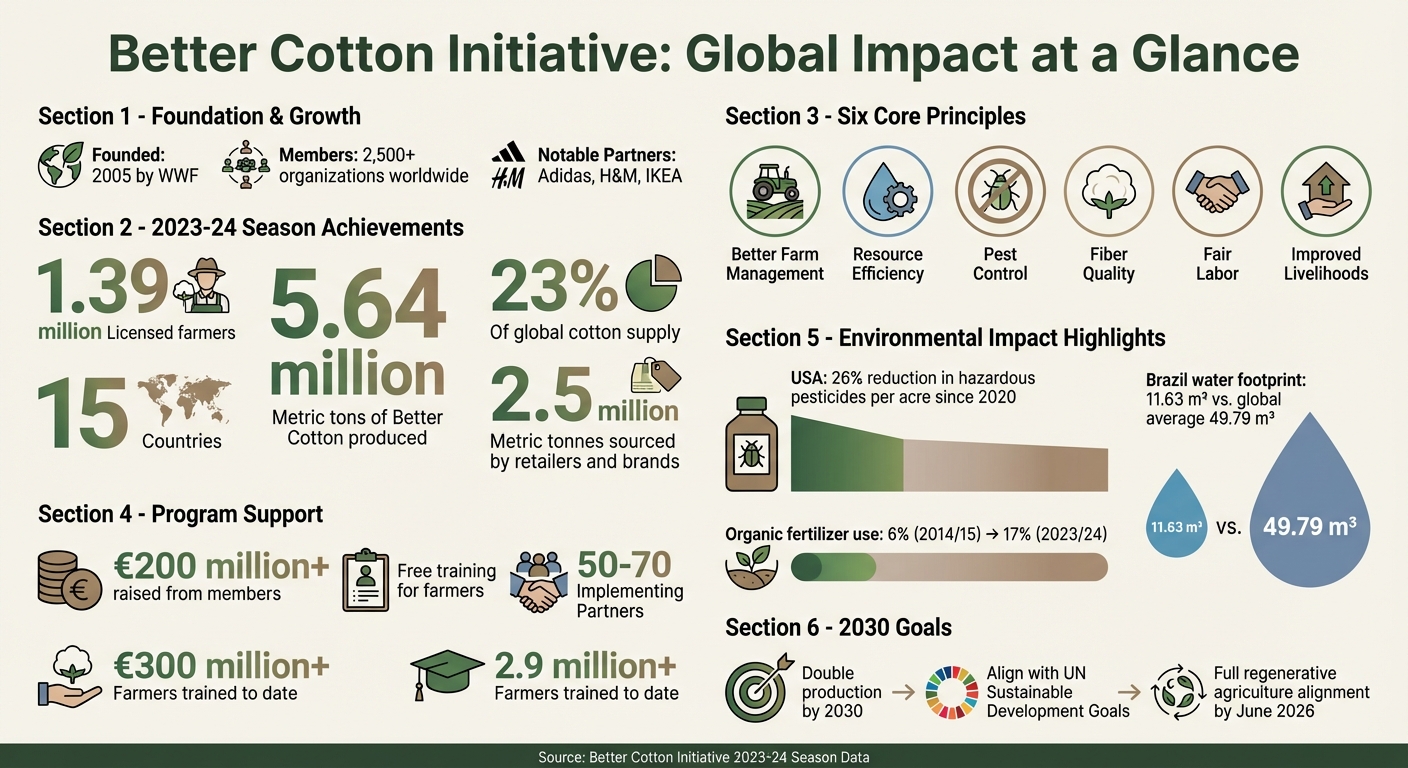
- Founded in 2005 by WWF, BCI collaborates with over 2,500 members, including brands like Adidas, H&M, and IKEA.
- Key Achievements: By 2023–24, 1.39 million licensed farmers in 15 countries produced 5.64 million metric tons of Better Cotton - 23% of the global supply.
- Six Core Principles: These include better farm management, resource efficiency, pest control, fiber quality, fair labor, and improved livelihoods.
- Training and Funding: BCI provides free training to farmers, funded by over €200 million raised from members.
- Traceability: A new system introduced in 2023 allows tracking cotton back to its country of origin.
- Global Goals: BCI aligns with the UN Sustainable Development Goals and aims to double its production by 2030.
BCI connects cotton farmers with global markets, offering tools and training to improve practices while addressing social and economic challenges in the industry.
Better Cotton Initiative Impact Statistics and Global Reach 2023-24
History and Growth of the Better Cotton Initiative
Founding and Early Partners
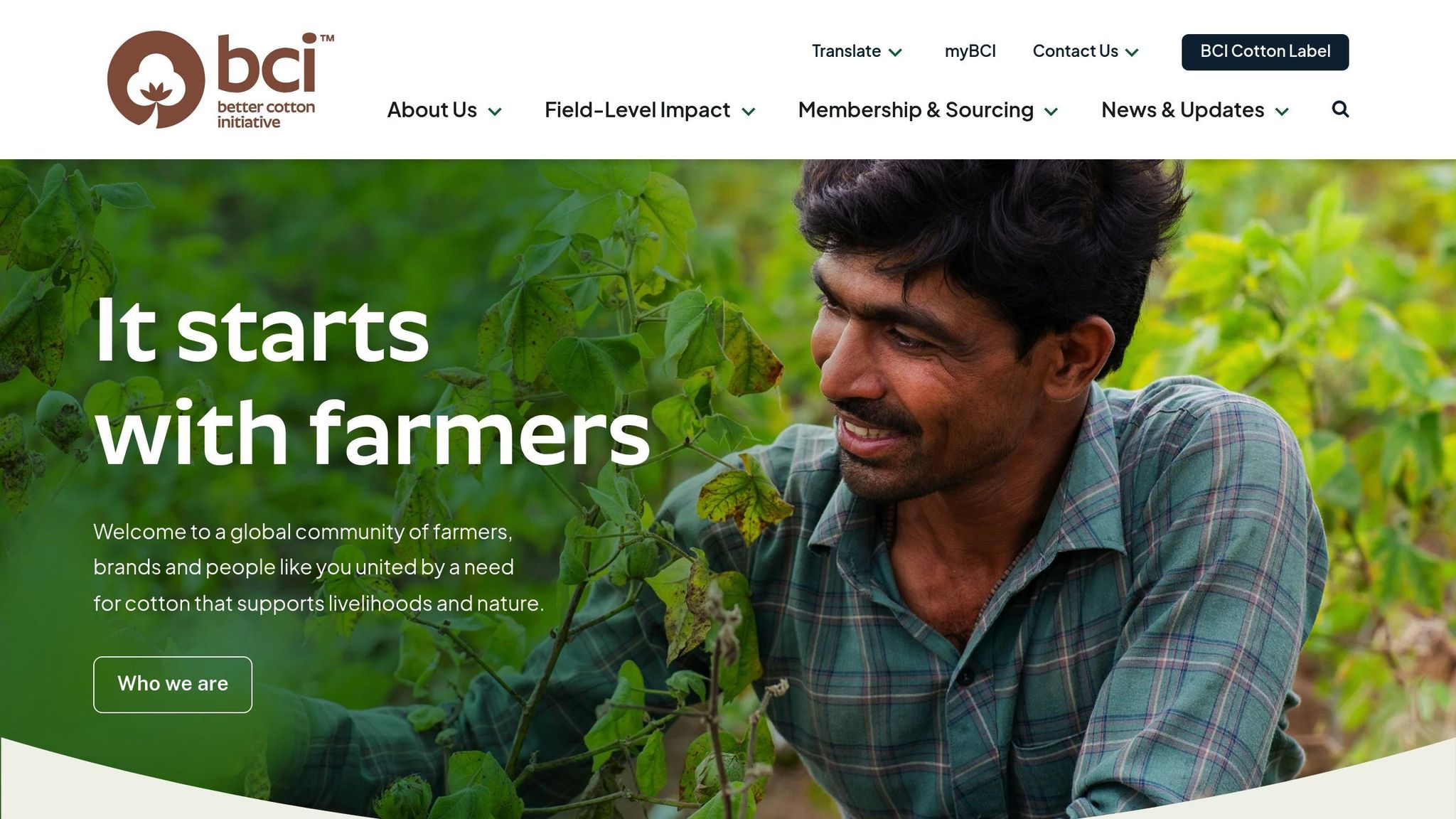
The Better Cotton Initiative (BCI) got its start in 2005, thanks to the World Wildlife Fund (WWF), which brought together a diverse group of organizations to tackle sustainability issues in the cotton industry. This early coalition included big-name retailers like Adidas, Gap Inc., H&M, and IKEA. Development organizations such as the International Finance Corporation (IFC) and ICCO Cooperation, along with civil society groups like Oxfam and Pesticide Action Network (PAN) UK, also played key roles.
From 2006 to 2009, these partners embarked on what they called the "Preparation Phase", testing whether the market could support more sustainable cotton farming. During this time, Levi Strauss & Co. stepped in with a $600,000 contribution between 2009 and 2011 to kick off field operations. This foundational work paved the way for growth and experimentation. By 2010, the BCI Fast Track Programme had taken off, fueled by a €20 million investment from IDH (The Sustainable Trade Initiative), ICCO, and the Rabobank Foundation. This funding helped launch farmer training initiatives in Brazil, India, and Pakistan.
Rebranding to Better Cotton
As BCI gained momentum, it refined its identity to better reflect its ambitions. In 2021, the organization shortened its name from "Better Cotton Initiative" to "Better Cotton", aligning with its 2030 strategy. However, in October 2025, it returned to its original name, Better Cotton Initiative, emphasizing its ongoing commitment to sustainability. Rogerio Simoes, Media & Content Manager, explained the reasoning behind the decision:
"By becoming once again the Better Cotton Initiative, we remind our farmers, members, and partners that BCI is and has always been an initiative, a forward movement committed to constantly improve sustainability in cotton farming".
This rebranding came alongside some major operational changes. In February 2025, BCI adopted a formal certification system with independent third-party verification. Additionally, in November 2023, the organization introduced a traceability system capable of tracking physical cotton back to its country of origin.
Global Reach and Production
Over the years, BCI has grown significantly in scope and impact. By the 2018-19 season, the initiative had teamed up with 76 local partners to train 2.3 million farmers across 23 countries. Together, these farmers produced 5.6 million metric tons of Better Cotton, accounting for 22% of the global cotton supply. In May 2020, Egypt officially joined the program after a successful trial funded by the Italian Agency for Development Cooperation, which brought around 2,000 smallholder farmers into the fold.
BCI has also expanded its reach through equivalent standards like myBMP (Australia), ABR (Brazil), Cotton Made in Africa (CmiA), and ICPSS (Israel). Brazil, using its ABR standard, became the largest producer of Better Cotton by volume during the 2018-19 season, while India led in the number of licensed farmers. Looking ahead, BCI has set ambitious goals, including doubling production by 2030. By June 2026, it plans to fully align its standards with regenerative agriculture principles. These milestones are key to understanding the Better Cotton Standard System that supports all of BCI’s efforts.
What is BCI Cotton II BCI Cotton training (Part 1) II BCI Cotton Definition
The Better Cotton Standard System (BCSS)
The Better Cotton Standard System (BCSS) plays a key role in the Better Cotton Initiative's (BCI) mission by turning sustainability goals into measurable actions. It establishes clear standards for sustainable cotton production, addressing environmental, social, and economic aspects of sustainability. As of April 2025, BCSS operates under version 3.1 of its Principles and Criteria, shifting the focus from simply adopting sustainable practices to achieving measurable results directly in the field.
The system is built around six core principles, with additional emphasis on Gender Equality and Climate Change Mitigation and Adaptation as overarching priorities. Better Cotton describes its purpose as follows:
"By following these principles, BCI Farmers produce cotton in a way that is better for themselves, their communities and the environment".
The Six Principles of BCSS
These six principles guide farmers in adopting sustainable cotton production methods:
- Management: Encourages integrated farm management systems that promote transparency and trust through inclusive decision-making.
- Natural Resources: Focuses on regenerative practices that improve soil health, conserve biodiversity, and ensure sustainable water use.
- Crop Protection: Advocates for Integrated Pest Management (IPM) to reduce reliance on synthetic pesticides, phase out Highly Hazardous Pesticides (HHPs), and promote safe handling practices.
- Fibre Quality: Supports best practices from seed selection to storage, reducing contamination and enhancing market value.
- Decent Work: Promotes fair and safe working conditions, addressing issues like child labor, forced labor, and discrimination while encouraging fair wages.
- Sustainable Livelihoods: Aims to strengthen farming households' resilience, with a focus on supporting women and young people to better handle economic and climate challenges.
Connecting Principles to Sustainability Outcomes
The BCSS principles are designed to deliver tangible benefits across environmental, social, and economic dimensions. Here's how they translate into real-world improvements:
| Sustainability Pillar | BCSS Principle | Key Practices | Farmer & Environmental Benefits |
|---|---|---|---|
| Environmental | Natural Resources | Regenerative soil management, water stewardship, biodiversity conservation | Restored ecosystems, better climate resilience, and sustainable resource use |
| Environmental | Crop Protection | Integrated Pest Management (IPM), phasing out HHPs, safe pesticide handling | Reduced health risks, lower input costs, and decreased environmental harm |
| Social | Decent Work | Eliminating child/forced labor, ensuring workplace safety, promoting freedom of association | Improved working conditions and enhanced quality of life |
| Social | Sustainable Livelihoods | Building resilience, focusing on women and youth | Greater financial stability and the ability to handle economic or climate shocks |
| Economic | Fibre Quality | Proper seed selection, contamination prevention, effective storage | Increased crop value, better market prices, and stronger demand |
| Economic | Management | Transparent farm management and inclusive decision-making | Continuous improvement, greater market trust, and better transparency |
Table source: Better Cotton Initiative
Each principle is tied to specific sustainability outcomes that benefit both farmers and the environment. For instance, the Natural Resources principle emphasizes regenerative practices that not only restore ecosystems but also help farmers adapt to climate challenges. The focus on smallholder farmers - most of whom operate farms under 20 hectares - makes the economic benefits even more impactful.
Unlike traditional certification systems that rely on a "pass/fail" model, BCSS emphasizes capacity-building. This approach ensures farmers can access training and support, regardless of their starting point. Additionally, the system remains neutral on technology, allowing the use of genetically modified cotton where legally permitted. This flexibility ensures the program remains accessible to millions of farmers worldwide.
How the Better Cotton Initiative Works
The Better Cotton Initiative (BCI) operates through a three-part system: it trains farmers, tracks cotton using a digital chain of custody, and measures its impact across the supply chain. This structure is built on the principles of the Better Cotton Standard System.
Farmer Training and Support
BCI focuses on training farmers before production rather than conducting checks afterward. This proactive approach has helped more farmers qualify for BCI licenses to sell their cotton. Training is delivered through a network of 50–70 Implementing Partners, including NGOs, government agencies, and private organizations, who work directly with farming communities. Using a "train-the-trainer" method, BCI equips its Program Partners’ staff, who then guide local Field Facilitators to provide practical, region-specific training.
So far, over 2.9 million cotton farmers have participated in BCI field training. In the 2023–24 season alone, 1.63 million farmers received training, with 1.39 million earning licenses. This training is free for farmers, funded by fees from retail and brand members. In 2019–2020, BCI collaborated with Kuza, a social enterprise, to pilot an online skill development tool in Maharashtra and Gujarat, India. The project reached 500 trainers and benefited tens of thousands of farmers with digital resources in six languages. By May 2020, following a successful trial with the United Nations Industrial Development Organisation, Egypt joined as a BCI Program country. Around 2,000 smallholder farmers participated in the initial training, supported by local partners ALKAN and Modern Nile Cotton.
"We know that to create positive change and deepen the impact of our programme, we must ensure that farmers and farm workers have access to the necessary tools, training and support that they need to continuously improve their practices."
– Better Cotton Initiative
Traceability and Chain of Custody
While training equips farmers with knowledge, a strong traceability system ensures that their efforts are upheld throughout the supply chain.
BCI’s Chain of Custody Standard (version 1.2, effective November 1, 2025) tracks cotton from field to retail. This is managed through The BCI Platform, a digital tool that records data and monitors Better Cotton throughout the supply chain. BCI offers two sourcing methods: the Mass Balance model, which mixes Better Cotton with conventional cotton while maintaining volume tracking, and Physical Traceability, launched in late 2023, which traces cotton back to its country of origin. Physical Traceability operates under three models: Single Country Segregation, Multi-Country Segregation, and Controlled Blending. Depending on the region, cotton can be traced back to the ginner (e.g., India, Pakistan, Turkey, China) or the spinner (e.g., USA, Brazil, Australia, Egypt). Currently, over 2,200 supplier sites worldwide can source Physical Better Cotton, and during the 2023–24 season, retailers and brands sourced 2.5 million metric tonnes of cotton - accounting for 23% of global production.
Monitoring and Measuring Results
To complement training and traceability, BCI actively evaluates the outcomes of its initiatives.
BCI’s Assurance Programme conducts regular farm assessments using eight key indicators to measure environmental, social, and economic impacts. The Delta Framework further enhances sustainability reporting. BCI’s monitoring focuses on three primary areas: environmental outcomes (like soil health, water usage, and pesticide reduction), social outcomes (such as fair labor practices and gender equality), and economic outcomes (including yield improvements, profitability, and living income). These efforts are aligned with the ISEAL Codes of Good Practice.
In 2019, BCI launched the Better Cotton Innovation Challenge in partnership with IDH The Sustainable Trade Initiative to improve data collection and training. The challenge attracted 87 applications offering new solutions, and by 2020, finalists were testing these innovations in the field.
"The Innovation Challenge will identify solutions that will help us deepen the impact of the BCI Programme on cotton farmers and accelerate the adoption of sustainable cotton farming practices globally."
– Alan McClay, CEO, Better Cotton Initiative
sbb-itb-0e617ca
Impact of the Better Cotton Initiative
Environmental and Social Results
The Better Cotton Initiative (BCI) has shown measurable progress in improving environmental practices worldwide. In the United States, licensed growers have cut down the use of Highly Hazardous Pesticide (HHP) active ingredients by 26% per acre since 2020. At the same time, the use of organic fertilizers has grown significantly, jumping from 6% in the 2014/15 season to 17% in the 2023/24 season. By 2020, over 80% of U.S. growers adopted regenerative farming practices aimed at boosting biodiversity, improving soil health, and enhancing water quality.
Water efficiency is another standout achievement. For instance, cotton grown under the BCI in Brazil has a water footprint of 11.63 m³ equivalent - far below the global average of 49.79 m³ equivalent for virgin cotton. These results are closely monitored through Better Cotton's Monitoring, Evaluation, and Learning (MEL) Program, which tracks outcomes at the farm level across various regions.
"Better Cotton's US Impact Report speaks to the people on the frontline of our industry whose commitment and dedication has been intrinsic to continuous improvements at the farm-level."
These environmental advancements also pave the way for financial benefits for farmers and businesses alike.
Economic Benefits for Farmers and Businesses
Farmers participating in the Better Cotton Initiative have seen real economic improvements, thanks to the training and support provided under the program. By reducing input costs and increasing profitability, BCI has created opportunities for smallholders to connect with a supply chain supported by over 2,500 members, including leading fashion brands.
A 2022 study conducted by Wageningen University and Research in Maharashtra and Telangana, India, highlighted how BCI practices helped farmers lower costs and boost profits through more efficient use of fertilizers and pesticides. Importantly, farmers receive this training free of charge, funded by a Volume-Based Fee (VBF) paid by brands and retailers based on the amount of Better Cotton they source. This system not only strengthens smallholder farmers' market access but also enhances their financial resilience.
The initiative’s economic impact extends beyond individual farmers, as its broader strategy aligns with global sustainability efforts.
Alignment with UN Sustainable Development Goals (SDGs)
Better Cotton's long-term strategy is designed to align with the 2030 Sustainable Development Goals (SDGs). The organization also spearheads the Delta Project, a collaboration with other sustainability standards like Fairtrade and Textile Exchange, to establish a unified framework for tracking and reporting progress toward these goals.
This approach integrates multiple SDG targets into its operations. For environmental goals (SDGs 6, 13, and 15), the initiative focuses on water efficiency, soil conservation, and climate resilience. On the social and economic front, it addresses SDGs 1, 5, 8, and 10 by promoting principles of "Decent Work", such as fair wages, safe working conditions, equal opportunities, and gender empowerment. Additionally, BCI supports responsible production (SDG 12) by embedding sustainable practices into its framework.
"We have a 10-year strategy mapped out to deliver real, measurable change, in line with the 2030 Sustainable Development Goals. Improving the environment is the precursor to regenerative agriculture."
Membership and Branding in the Better Cotton Initiative
The Better Cotton Initiative (BCI) brings together the entire cotton supply chain under a unified framework, emphasizing clear membership criteria and recognizable branding.
Membership Requirements
BCI offers five membership categories to cover all key players in the supply chain: Retailers and Brands, Suppliers and Manufacturers, Producer Organizations, Civil Society, and Associate Membership. By late 2025, the initiative had grown to over 2,500 members worldwide, with more than 350 Retailer and Brand Members spanning 34 countries and over 2,200 Supplier and Manufacturer Members operating in 65 countries.
To join, applicants must be legally established entities with at least one year of operations and a commitment to sustainable practices. The application process involves a thorough due diligence check to ensure that new members align with BCI's values and do not pose reputational risks. Following this, organizations undergo a 12-week consultation period after paying the required fees. Most applicants achieve full membership within 3 to 6 weeks. These steps ensure that all members actively contribute to BCI's mission of promoting sustainable cotton farming.
Retailers and Brands are required to pay an annual membership fee along with a Volume-Based Fee (VBF), which is determined by the total weight of Better Cotton they purchase. For instance, during the 2023–24 season, Retailer and Brand Members sourced 2.5 million metric tonnes of Better Cotton, while spinner members procured 3.2 million tonnes to support global supply. Members are encouraged to set ambitious goals, with many working toward sourcing 100% more sustainable cotton.
Using the Better Cotton Logo
Members who meet specific eligibility criteria and comply with the Member Code of Practice can use the Better Cotton logo and the "Mass Balance On‑Product Mark" in their marketing efforts.
"The BCI Cotton label is the assurance consumers need that your product contains cotton produced by farmers certified to the BCI Standard."
To maintain trust, all sustainability claims must follow the Claims Framework guidelines. Members can choose between the Mass Balance model or Physical Chain of Custody (CoC) models - such as Segregation or Controlled Blending - to track cotton through the supply chain. Only products sourced using Physical CoC models can be traced back to their specific country of origin. Additionally, all members use the BCI Platform to monitor orders and document the movement of cotton, with more than 13,000 organizations actively sourcing through the system. This structured branding approach reinforces partnerships with key industry players.
Partnerships with Major Brands
From the start, collaborations with global brands and WWF helped shape BCI’s vision for sustainability. These partnerships remain vital, driving demand and providing the financial backing needed to expand the initiative. For example, Australian retailer Canningvale joined BCI with a pledge to source 100% of its cotton more sustainably - approximately 400 metric tonnes annually - by January 2020. Canningvale highlighted:
"BCI really is a shared effort, encompassing organizations, communities and individuals in its effort to make more sustainable cotton, mainstream"
These collaborations show how member organizations use their influence to reshape the cotton industry while earning consumer trust through transparent and sustainable sourcing practices.
Conclusion
Key Takeaways for the Cotton Industry
The Better Cotton Initiative (BCI) has fundamentally changed how cotton is produced worldwide. Today, it represents 23% of global cotton production, directly impacting the livelihoods of nearly 4 million people involved in cotton farming. During the 2023–24 season, over 1.4 million licensed farmers - most of whom are smallholders - produced more than 5.6 million metric tons of Better Cotton across 15 countries.
BCI's approach to cotton production weaves together environmental care, social responsibility, and economic progress. By focusing on environmental safeguards, promoting fair labor practices, and offering farmer training alongside improved market access, the initiative has raised over $200 million to provide free capacity-building programs for farmers. The upcoming shift to a formal certification system in 2024–25, combined with plans to adopt regenerative agriculture standards, underscores BCI’s drive to set higher benchmarks for the industry. This holistic strategy not only enhances farming techniques but also aligns with the growing demand for traceability and quality in the market.
For stakeholders across the cotton supply chain, BCI offers a clear route to meet the increasing consumer demand for sustainable products while reinforcing supply chain resilience. Through its training programs, traceability systems, and certification processes, BCI supports every part of the supply chain in achieving sustainable growth. With over 13,000 organizations currently sourcing cotton through the BCI Platform, it’s evident that sustainable cotton is no longer a niche market - it’s now mainstream. As one BCI farmer, Todd, aptly stated:
"Regenerative agriculture is a journey, not a destination."
This journey entails ongoing progress, from improving soil health and conserving water to fostering gender equality and building resilience against climate challenges. The updated Principles and Criteria (v.3.1), set to launch in 2025, reinforce this commitment by introducing stricter requirements for climate action and sustainable livelihoods. Whether you’re a farmer looking to increase yields while protecting natural resources, a brand seeking traceable cotton, or a supplier striving for transparency, BCI provides the tools, training, and market connections to make these goals a reality.
Ultimately, it’s the collaboration between farmers, manufacturers, brands, and civil society that drives meaningful change - not just in cotton production, but in the communities and ecosystems that rely on it.
FAQs
How does the Better Cotton Initiative make cotton farming more sustainable?
The Better Cotton Initiative (BCI) works to help cotton farmers embrace more sustainable farming practices through its Better Cotton Standard System. This system emphasizes improvements across environmental, social, and economic areas. Farmers receive training on reducing synthetic pesticide use, conserving water, maintaining soil health, and safeguarding local biodiversity. They also explore alternative techniques like natural pest management and mechanical weed control.
BCI directly supports over 2 million small-scale farmers, many of whom manage farms smaller than 20 acres. Through hands-on training and field assistance, these farmers achieve higher yields, enjoy safer working conditions, and gain greater financial stability. The initiative's ongoing impact is strengthened by partnerships and funding that drive tangible progress in productivity, community welfare, and environmental care.
What are the environmental and economic benefits of the Better Cotton Initiative?
The Better Cotton Initiative (BCI) works to lessen the environmental footprint of cotton farming by encouraging practices that are kinder to the planet. These include techniques like cover cropping, using water more efficiently, and adopting Integrated Pest Management. Together, these approaches boost soil health, cut down on pesticide use, and help conserve vital natural resources. On top of that, they contribute to lower greenhouse gas emissions, aligning with global efforts to address climate change.
From an economic perspective, BCI helps farmers improve both the quality and yield of their crops, leading to higher productivity and income. For small-scale farmers - many of whom work on less than 50 acres - these improved methods provide a path to greater financial security and a buffer against unpredictable market changes. The initiative also prioritizes better working conditions, making cotton farming not only more sustainable but also more rewarding for farmers across the globe.
How does the Better Cotton Initiative promote sustainability and ensure traceability in the cotton supply chain?
The Better Cotton Initiative (BCI) has developed a Better Cotton Traceability System to improve visibility across the cotton supply chain. This system tracks the journey of Better Cotton from its starting point - whether it's the farm or country of origin - through every step of the supply chain. By connecting cotton to verified chain-of-custody models like segregated, mass-balance, or blended, BCI gives retailers and brands a clear understanding of where their cotton originates and how it gets to them. On top of that, this traceability platform simplifies transaction management, helping members maintain accurate records while meeting growing demands for transparency.
To complement this, BCI incorporates sustainability through its Better Cotton Standard System (BCSS). This framework establishes measurable benchmarks across environmental, social, and economic areas for farmers. It ensures that the cotton being traced meets goals such as minimizing pesticide use, improving water resource management, and supporting farming communities. BCI also equips farmers with training and tools to adopt sustainable practices, ensuring the cotton they produce not only meets traceability standards but also contributes to a more responsible and sustainable cotton industry.