Choosing the right cotton certification can make or break your sustainability goals. Here's what you need to know:
- GOTS: The gold standard for organic cotton, covering the entire supply chain with strict environmental and social criteria. Ideal for premium markets but comes with higher costs.
- BCI: The largest program for sustainable cotton, focusing on scalability and accessibility. Now shifting to traceable cotton by May 2026.
- OCS: Verifies organic fiber content without covering processing or social aspects. A budget-friendly option for entering the organic market.
- Fairtrade Cotton: Prioritizes fair wages and farmer support, but limited to small-scale producers.
- OEKO-TEX Standard 100: Focuses on chemical safety in finished products, not farming or social practices.
Quick Comparison
| Certification | Focus Area | Best For | Limitation |
|---|---|---|---|
| GOTS | Organic, full supply chain | Premium, eco-conscious markets | High cost, strict compliance |
| BCI | Scalable, traceable cotton | Mass-market sustainability | GMO use, limited traceability (until May 2026) |
| OCS | Organic fiber verification | Affordable organic entry | No social or processing standards |
| Fairtrade Cotton | Farmer welfare, fair wages | Socially focused brands | Limited scalability |
| OEKO-TEX 100 | Product safety, chemicals | Consumer safety assurance | No farming or social criteria |
Key takeaway: GOTS leads for premium organic products, BCI excels in scale and accessibility, and Fairtrade Cotton supports ethical farming. Choose based on your business needs and sustainability goals.
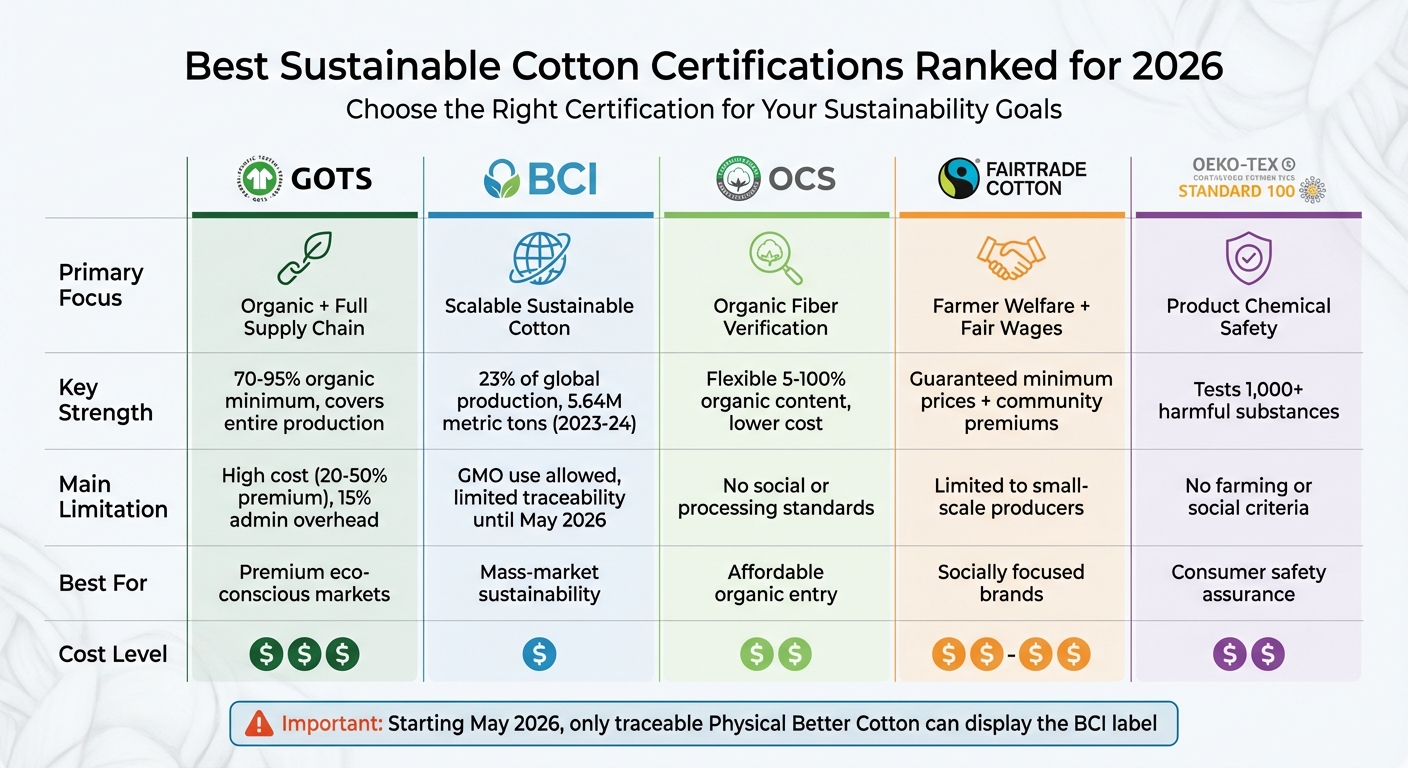
Sustainable Cotton Certifications Comparison Chart 2026: GOTS vs BCI vs OCS vs Fairtrade vs OEKO-TEX
Find the Best Organic Sheets: Oeko-Tex vs GOTS Textile Certifications
sbb-itb-0e617ca
1. GOTS (Global Organic Textile Standard)
GOTS governs the entire textile supply chain, requiring at least 70% certified organic fibers (or 95% for products labeled "organic"). It supports over 4 million workers worldwide, offering a comprehensive framework for sustainable textile production.
Environmental Impact
GOTS enforces strict environmental rules during both farming and processing. At the farming stage, it bans over 300 substances, including synthetic pesticides and GMOs. Organic farming under GOTS can cut energy use by 30–70% per unit of land. Beyond farming, GOTS oversees chemical use, water treatment, and waste management to minimize harm.
Social Responsibility
GOTS aligns with International Labor Organization (ILO) conventions, banning forced and child labor and enforcing an 8-hour workday (48 hours per week, excluding overtime). Starting with Version 7.0, the standard also requires wage gap analyses to address pay inequities and enforces strict policies against sexual harassment and gender-based violence.
Supply Chain Transparency
GOTS ensures transparency through public tools like the "Certified Suppliers Database" and the "Shop-Finder", which let users verify supplier certifications, locations, and operations. The certification process mandates complete physical segregation and traceability, ensuring organic cotton stays separate from conventional cotton throughout production. In 2020, GOTS exposed 20,000 metric tons of fraudulent cotton in India, highlighting its rigorous tracking measures.
Cost and Accessibility
GOTS certification requires significant investment in organic practices and compliance, often leading to higher product costs. This positions it well for premium markets where such costs can be recouped. The certification process is demanding, but Version 7.0 demonstrates alignment with the OECD Due Diligence Guidance for Responsible Supply Chains, adding further credibility.
2. BCI (Better Cotton Initiative)
The Better Cotton Initiative (BCI) stands as the largest global program focused on cotton sustainability, holding a prominent share in the market and production landscape. During the 2023–24 season, BCI facilitated the production of 5.64 million metric tons of Better Cotton across 15 countries, positively impacting nearly 4 million individuals connected to cotton farming. Unlike organic certifications, BCI employs a technology-neutral approach, allowing the use of genetically modified (GM) cotton while emphasizing reduced synthetic inputs to achieve large-scale improvements. This approach enables BCI to address environmental, social, and supply chain goals in a comprehensive manner.
Environmental Impact
BCI's sustainability measures are designed for scale and differ from the methods used in organic certifications. The initiative follows its Principles and Criteria (P&C) Framework, version 3.1, effective April 1, 2025. This framework focuses on six key areas: Management, Natural Resources, Crop Protection, Fiber Quality, Decent Work, and Sustainable Livelihoods. A major component of BCI's environmental strategy is Integrated Pest Management (IPM), which uses biological, cultural, and physical methods to lower dependence on synthetic pesticides while phasing out Highly Hazardous Pesticides. Additionally, climate action is woven into every farm-level decision, with practices aimed at improving soil health, enhancing biodiversity, and promoting responsible water management.
Social Responsibility
To support smallholder farmers, BCI removes financial barriers by offering free training through its Growth and Innovation Fund, which has raised over $220 million to date. The program has licensed 2.13 million farmers to sell Better Cotton. In February 2026, a staff member from RSWM Limited in India shared:
BCI helps us offer a more sustainable product to our customers and at the same time it helps farmers to reduce their cost and give a better cotton for the end users.
This training not only builds farmers' capacity but also ensures workers are educated on safety measures and fair working conditions throughout the supply chain.
Supply Chain Transparency
BCI complements its environmental and social efforts with a strong focus on supply chain transparency. In January 2025, the initiative shifted from a licensing model to a third-party certification system, with all certification decisions handled by independent entities accredited to ISO 17065 standards. By February 2026, more than 3,000 suppliers, manufacturers, and brands across 44 countries had achieved certification. The initiative uses two Chain of Custody models: Mass Balance, which allows cotton to be mixed, and Physical Chain of Custody (Segregation or Controlled Blending), which ensures traceability to the country of origin. Starting in May 2026, only products containing certified, traceable Physical Better Cotton can display the BCI label. Andrew Whale, Sustainability Delivery Lead at Big W in Australia, highlighted the efficiency of the certification process, stating it took about three weeks to complete, providing the independent assurance needed for transparent ESG reporting across their 179 stores.
Cost and Accessibility
BCI's cost structure is designed to support smallholder farmers while meeting the market's need for traceable, sustainable cotton. Farmers benefit from free training and capacity-building programs. Retailers and brands contribute through membership fees and a Volume-Based Fee (VBF) applied to every ton of cotton sourced. To carry the BCI label, products must contain at least 30% Better Cotton. In February 2026, Turkish manufacturer İskur Boya Tekstil reported an immediate increase in orders from major brands following their BCI certification, as brands sought traceable Physical Better Cotton. This balance of accessibility and market demand makes BCI an attractive choice for producers aiming to meet the growing need for verified sustainable cotton.
3. OCS (Organic Content Standard)
The Organic Content Standard (OCS), overseen by Textile Exchange, ensures the verification of organically grown fiber volumes through detailed chain-of-custody documentation. Unlike GOTS, OCS focuses exclusively on tracking organic inputs and does not include processing methods or social criteria. This narrow focus on documentation strengthens its role in verifying organic content effectively.
Supply Chain Transparency
OCS relies heavily on a strict chain-of-custody system to maintain transparency. Facilities handling organic fibers must obtain a Scope Certificate, and every change in ownership requires a Transaction Certificate (TC) to record the volume of organic cotton. Textile Exchange's Trackit program centralizes these certificates, improving traceability and helping to identify irregularities. Since December 1, 2022, OCS has stopped accepting GOTS-certified inputs unless they provide complete traceability back to the farm.
Cost and Accessibility
The OCS certification process involves independent audits at each stage of the supply chain. While this approach ensures accurate verification of organic content, it also increases costs for brands and manufacturers. These additional expenses can be particularly challenging for smaller businesses, as the model does not account for processing or social criteria, focusing solely on organic verification.
4. Fairtrade Cotton
Fairtrade Cotton stands out for its dedication to human rights. It ensures fair wages, safe working conditions, and empowers workers globally. This initiative supports around 2 million farmers and workers across 67 countries.
Environmental Impact
Fairtrade actively addresses climate challenges by helping farmers adopt eco-friendly practices and prepare for climate-related risks. It focuses on improving biodiversity and maintaining soil health. Many of its products also earn organic certification, avoiding synthetic pesticides and fertilizers. Compared to BCI, Fairtrade enforces stricter environmental guidelines for farming.
Social Responsibility
One of Fairtrade’s key features is the Premium - a bonus payment that farmers can reinvest in community projects, infrastructure, or business growth. This approach aligns with the UN Sustainable Development Goals, aiming to balance economic growth with environmental care. With over 37,000 FAIRTRADE-marked products and partnerships involving more than 2,500 businesses in 145 countries, Fairtrade significantly supports farmers and younger generations.
Supply Chain Transparency
Consumers can trust Fairtrade’s claims through the FAIRTRADE Mark or the FLOCERT directory. Independent audits further strengthen the transparency and reliability of its cotton supply chain.
Cost and Accessibility
Fairtrade cotton is accessible through major retailers and sustainable brands like Pact and Yes Friends. In the UK alone, over 6,000 certified products are available. However, the mandatory Price Premiums and fair wages associated with Fairtrade tend to raise costs compared to simpler certifications like OCS, which can lead to higher retail prices.
This comprehensive approach to ethical and environmental standards sets the stage for exploring the role of OEKO-TEX Standard 100 in sustainable cotton production.
5. OEKO-TEX Standard 100
OEKO-TEX Standard 100 is all about product safety. This certification ensures that every part of a textile product - threads, buttons, zippers, and more - is tested for over 1,000 harmful substances. With a global network of more than 35,000 certified companies, it’s a widely recognized standard for safe textiles.
Environmental Impact
The focus of OEKO-TEX Standard 100 is on the chemical safety of finished products. It ensures compliance with international regulations like the REACH directive (Annexes XVII and XIV), CPSIA, and the ECHA-SVHC candidate list. Products are tested in four categories based on how much they touch the skin. Class 1, for example, applies the strictest limits for items like baby clothes, while Class 4 covers materials used in home décor, such as curtains. There's also an optional certification for recycled materials, promoting a circular economy. The limits are reviewed and updated at least once a year, keeping the standard up to date. This focus on chemical safety sets OEKO-TEX apart from certifications that also address farming or social practices.
Social Responsibility
While OEKO-TEX Standard 100 prioritizes chemical safety, it does not include audits for social responsibility as part of its core criteria. However, companies seeking to highlight both chemical safety and ethical working conditions can opt for the MADE IN GREEN label. This combines Standard 100 testing with STeP (Sustainable Textile & Leather Production) certification, which ensures socially responsible manufacturing practices.
Supply Chain Transparency
OEKO-TEX makes it easy for consumers to verify its labels. By scanning a QR code or entering the certificate number into the OEKO-TEX Label Check tool, buyers can confirm a product’s certification. The certification process itself involves several steps: an application, material sample testing, an on-site company inspection, and a detailed test report. Once approved, a one-year certificate is issued. Manufacturers can save money if individual components, like fabrics or buttons, are already certified, as testing costs for the final product are waived.
Cost and Accessibility
The modular cost system of OEKO-TEX Standard 100 allows flexibility for producers. Certification costs depend on factors like the number of production sites, geographic location, and the complexity of the facility. To reduce costs, manufacturers can use pre-certified components listed in the OEKO-TEX Buying Guide, an online directory of certified suppliers. Using chemicals certified under the OEKO-TEX ECO PASSPORT also reduces testing requirements and fees. Certification contracts last one year and must be renewed annually.
Pros and Cons
Every certification comes with its own strengths and challenges. Let’s break them down:
GOTS is known for its thorough approach, covering everything from the seed to the final product while adhering to strict environmental and social standards. However, this rigor comes at a cost. Administrative overhead increases by 15%, and premiums can range from 20–50%, making it the priciest option in the industry.
BCI stands out for its scale, accounting for 23% of global cotton production and producing 5.64 million metric tons in the 2023–24 season. It’s an excellent choice for large-scale producers, allowing the use of GMOs and synthetic pesticides while encouraging better practices overall. However, its mass balance model limits the ability to trace the exact origin of the cotton. Starting in May 2026, new products with the BCI label must include certified, traceable cotton.
OCS is a cost-effective option for verifying organic fiber content (ranging from 5–100%) without the administrative complexity of GOTS. It’s a solid choice for manufacturers looking to scale quickly or enter the organic market at a lower cost. That said, OCS doesn’t address social standards or chemical use in processing, offering only basic fiber verification.
Fairtrade Cotton prioritizes fair conditions for farmers, including guaranteed minimum prices and premiums that fund community projects. However, it’s limited to small-scale producers, which may restrict its scalability.
OEKO-TEX Standard 100 focuses solely on product safety, testing for over 1,000 harmful substances. While it ensures chemical safety, it does not address farming practices or social responsibility.
Here’s a quick comparison to help clarify how these certifications differ:
| Certification | Primary Strength | Main Limitation | Best For |
|---|---|---|---|
| GOTS | Full-chain eco-social rigor (70% organic minimum) | High admin overhead (15% increase) | Premium exports, fine spinning |
| BCI | Scale and accessibility (23% of global production) | Mass balance doesn't guarantee physical origin | Mass-market sustainability |
| OCS | Flexible, lower-cost entry (5-100% organic) | No environmental or social depth | Blended products, quick market entry |
| Fairtrade Cotton | Guaranteed minimum prices for farmers | Limited to small-scale producers | Social justice focus |
| OEKO-TEX Standard 100 | Chemical safety (1,000+ substances tested) | No farming or social criteria | Product safety assurance |
This comparison highlights the key factors to consider when selecting a certification, especially as the industry moves toward meeting the sustainability requirements of 2026.
Conclusion
Deciding on the right certification comes down to your specific goals and how your business operates. For premium exports or brands catering to eco-conscious consumers who value full-chain transparency, GOTS stands out as the top choice. It’s widely recognized for its credibility, particularly in high-end markets.
If scalability and accessibility are your priorities, BCI is hard to beat. Supporting over 1.6 million farmers worldwide and offering zero-cost entry for smallholders, it’s the most practical option for large-scale, mass-market producers. A notable example is İskur Boya Tekstil in Turkey, which saw a surge in orders from major brands after achieving BCI certification and transitioning to traceable Physical BCI Cotton in February 2025. Keep in mind that starting in May 2026, only products made with certified, traceable cotton will qualify for the BCI label.
For businesses entering the organic market without the stringent demands of GOTS, OCS provides a more flexible and affordable alternative. If your focus leans toward social justice and empowering small-scale farmers, Fairtrade Cotton is a great fit, emphasizing living wages and worker rights. Meanwhile, OEKO-TEX Standard 100 works well as an additional certification, especially when product safety is a key concern.
Before committing to any certification, validate claims through trusted resources like the GOTS directory or the FLOCERT directory for Fairtrade. With stricter EU regulations on sustainability claims coming into effect in 2026, third-party verification is becoming a must for market access.
The best certification for your business will depend on your customer base, production scale, and sustainability objectives. There’s no universal solution, but understanding these options will help you choose what aligns with your goals while contributing positively to the planet.
FAQs
Which certification is best for my brand’s goals?
The best certification for your needs depends on what matters most to your sustainability goals. GOTS works well if you're focused on organic fibers, ethical practices, and transparency across the entire supply chain. It mandates at least 95% organic fibers and enforces rigorous audits. On the other hand, BCI is a better fit for brands prioritizing efficient water use, reduced pesticide impact, and social responsibility. It’s easier to implement, provides better market access, and supports yield improvements, though it relies on mass balance traceability rather than a full chain-of-custody system.
What changes for BCI labeling in May 2026?
In May 2026, BCI plans to introduce a new product label that highlights the use of Physical BCI Cotton in items. This initiative aims to improve traceability and transparency throughout its supply chain, showcasing a deeper dedication to accountability and sustainable practices.
Can I combine certifications on one product?
Yes, it’s possible to combine certifications for a single product. For instance, USDA Organic can be paired with certifications like GOTS (Global Organic Textile Standard) or OCS (Organic Content Standard). This strategy allows products to meet multiple standards, addressing diverse requirements while appealing to a wider audience with varying priorities.