The Better Cotton Initiative (BCI) is transforming cotton farming globally by improving production practices and addressing environmental, social, and economic challenges. Established in 2005 with support from brands like Adidas and IKEA, BCI now impacts 23% of global cotton production. Key highlights include:
- 2023–24 Season Impact: 1.39 million farmers in 15 countries produced 5.64 million metric tons of Better Cotton.
- Environmental Focus: Reduced synthetic pesticide use, improved water efficiency, and promoted soil health through regenerative farming techniques.
- Social Benefits: Supported fair labor practices, increased farmer income, and empowered women in farming communities.
- 2030 Goals: Halve greenhouse gas emissions per ton of cotton and double Better Cotton production.
BCI’s efforts align with global sustainability goals, improving livelihoods and farming practices while protecting ecosystems.
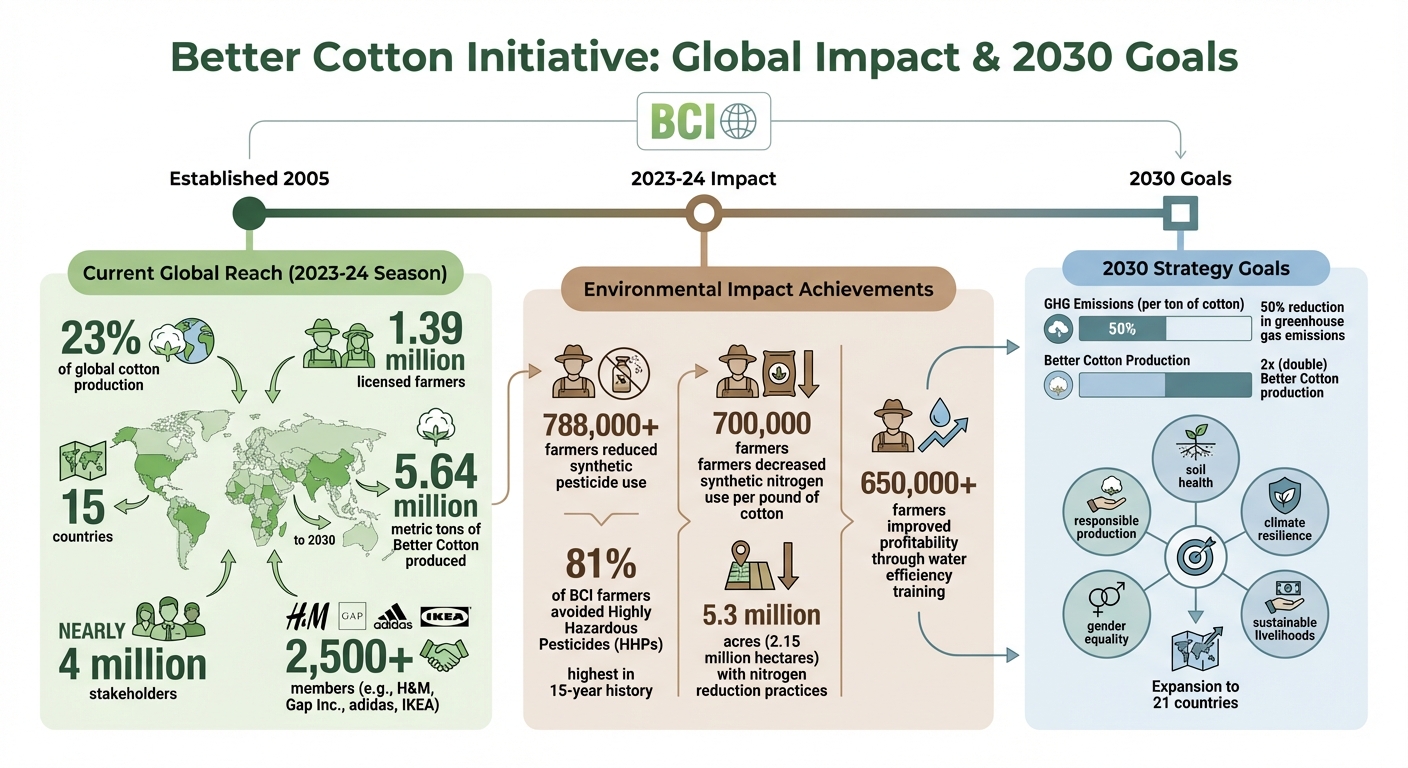
Better Cotton Initiative 2023-24 Impact Statistics and 2030 Sustainability Goals
The future of cotton farming: scaling regenerative sourcing
sbb-itb-0e617ca
BCI's Environmental Practices
BCI tackles environmental challenges by equipping farmers with hands-on training and on-site guidance. With support from nearly 70 partners on the ground, the initiative focuses on practical education to help farmers reduce synthetic chemical use, manage water resources efficiently, and cultivate healthier farms. This approach benefits both smallholders managing farms under 50 acres and larger industrial operations, creating positive effects throughout the cotton supply chain. A key focus of BCI’s work is improving chemical safety to make farming more sustainable.
Cutting Pesticide Use and Promoting Safer Alternatives
BCI's strategy to reduce pesticide use revolves around Integrated Pest Management (IPM), an approach that limits reliance on synthetic chemicals. With backing from organizations like the Pesticide Action Network (PAN) UK, BCI brings expert knowledge on chemical safety directly to farming communities. Farmers are trained to monitor pest activity, rely on natural predators, and use targeted treatments only when absolutely necessary, moving away from routine chemical spraying.
In the 2023–24 season, over 788,000 BCI farmers successfully reduced their use of synthetic pesticides. Additionally, nearly 700,000 farmers decreased their use of synthetic nitrogen per pound of cotton produced. These nitrogen reduction practices spanned around 5.3 million acres (2.15 million hectares) of farmland during that season. Such efforts reflect BCI’s dedication to fostering healthier ecosystems and more resilient farming systems.
Miguel Gomez-Escolar Viejo, Head of Monitoring, Evaluation and Learning at BCI, emphasized:
"As pesticide reliance decreases, biodiversity on farms is expected to improve – showing how sustainability and productivity can move forward together".
Reducing pesticide use not only improves working conditions by limiting chemical exposure but also boosts local biodiversity by encouraging the return of beneficial insects and wildlife. These changes lead to better crop quality, reduced input costs, and improved financial security for farmers, all of which enhance their access to markets. Alongside these efforts, BCI also focuses on water conservation to strengthen sustainable farming practices.
Water Conservation and Management
Efficient water use is a cornerstone of BCI’s environmental program. Farmers are trained in agronomic techniques designed to minimize water waste while maintaining or even improving crop yields. This includes practical skills like monitoring soil moisture and applying irrigation only when crops truly need it.
BCI’s water management initiatives address the challenges of climate-driven water scarcity in cotton-growing areas. By integrating water conservation with soil health improvements, the program ensures that soil retains moisture more effectively. Practices such as composting, cover cropping, and crop rotation enhance soil structure, allowing it to hold water longer and reducing the need for irrigation. These methods not only support crop performance but also contribute to healthier ecosystems.
This multi-layered approach is accessible to a wide range of farmers, from small-scale operations under 50 acres to large industrial farms. It benefits a global network of 1.39 million licensed farmers across 15 countries, demonstrating the broad reach of BCI's sustainability efforts.
Improving Soil Health and Biodiversity
Building on its progress in reducing pesticide use and conserving water, BCI has turned its attention to improving soil health and biodiversity, key pillars of sustainable cotton farming.
BCI promotes regenerative farming techniques that rejuvenate soil health, which is the backbone of sustainable cotton production. Farmers are trained in practices like composting, cover cropping, intercropping, and crop rotation. These methods naturally enhance nutrient cycling, prevent erosion, and minimize the need for synthetic fertilizers. By focusing on these approaches, farmers can improve soil biology and structure while boosting their resilience to climate-related challenges.
BCI also emphasizes data-driven soil conservation. Farmers analyze soil samples, plant tissue, and sap to fine-tune nutrient inputs. For example, in March 2026, Zeb Winslow, a BCI-certified producer in Scotland Neck, North Carolina, partnered with the Soil Health Institute and Growers Guide on a project to study nutrient uptake and soil biology on his family farm. Winslow shared his findings at the BCI Large Farm Symposium, offering a practical guide for other farmers. This field research reflects BCI's dedication to integrating sustainability into every aspect of cotton farming.
Karen Wynne, US Impact Manager at BCI, highlighted the value of this approach:
"We want to make sure that growers have the knowledge, capital, and tools to make these practices work successfully. On-farm research allows them to test systems in the same unpredictable and complicated environment that they work in every day."
Soil Health Improvement Methods
BCI’s approach to soil management focuses on three key areas: nutrient cycling, erosion prevention, and maintaining soil structure. Farmers receive tailored conservation plans and access to carbon programs that encourage long-term land stewardship. Techniques like cover cropping and crop rotation help maintain soil structure while naturally recycling nutrients, reducing the need for synthetic fertilizers.
Justin Taylor, Senior Sales Manager at Growers Guide, emphasized the importance of monitoring soil conditions:
"Being able to learn what's going on in the soil and plant in season - and then tying that to trends in harvest data at the end of the season - really helps to focus in on key trends that show up."
Real-time soil monitoring allows farmers to connect in-season observations with harvest outcomes, uncovering valuable patterns. Yogeshbhai, a BCI farmer, noted that soil feedback helps refine input applications with precision. These strategies not only improve soil health but also lay the groundwork for effective ecosystem management, which is essential for preserving biodiversity.
Protecting Biodiversity
A major part of BCI’s biodiversity strategy involves reducing the use of harmful chemicals and safeguarding High Conservation Value areas. By cutting back on synthetic pesticides and phasing out Highly Hazardous Pesticides (HHPs), BCI creates safer habitats for beneficial insects, wildlife, and local ecosystems. During the 2023/24 season, 81% of BCI farmers avoided using HHPs - the highest rate in the program’s 15-year history.
This reduction in chemical use allows natural predators to thrive, creating a balanced ecosystem that controls pests without excessive chemical intervention. Additionally, BCI ensures farming practices do not encroach on critical natural habitats, helping to protect biodiversity-rich areas. Collaborations with groups like the Soil Health Institute also enable BCI to establish regional benchmarks for soil health. These benchmarks help farmers measure the benefits of regenerative practices, showing that sustainable farming can support both productivity and environmental health.
Social and Economic Benefits for Farmers
BCI’s initiatives don’t just benefit the environment - they also create meaningful social and economic opportunities for cotton farming communities. By focusing on training, improved market access, and fair labor standards, the program has helped enhance livelihoods, improve working conditions, and support women in the cotton sector.
Increasing Farmer Income and Stability
BCI helps farmers increase their income through a combination of training, better market connections, and sustainable practices. Farmers learn methods to reduce input costs and improve yields, which directly boosts profitability. Through its licensing system, the program links smallholders to global buyers, allowing them to sell their cotton as "Better Cotton" to well-known brands.
Additionally, initiatives like the Better Cotton Living Income Project and climate resilience training equip farmers to handle environmental challenges, ensuring long-term financial stability. These efforts not only improve income but also align with the program’s focus on fair and safe labor practices.
Fair Labor Practices
BCI incorporates "Decent Work" principles into its sustainability standards, ensuring fair wages, equitable treatment, and safe working conditions on certified farms. To enforce these practices, the initiative conducts unannounced checks and interviews with workers to identify and address risks like child or bonded labor early on. Partnerships with groups such as the Terre des hommes Foundation and Ergon Associates bolster these efforts.
For instance, in March 2026, BCI hosted multi-stakeholder workshops in Benin to encourage collective action on improving labor practices in the cotton industry. These actions highlight the importance of fair labor while also tying into broader goals like promoting gender equality.
Supporting Women in Cotton Farming
Empowering women is a key focus of BCI’s social strategy. Local partners work closely with communities to ensure women gain access to education, training, and leadership roles. Amina, a cotton farmer, captures the essence of this effort:
"For a sustainable future, women should be autonomous and have a continuous source of income."
BCI’s 2030 strategy includes specific goals aimed at reducing gender disparities and improving conditions for women farmworkers. The program recognizes that sustainable cotton production relies on empowering all members of the farming community, especially women, to thrive.
Global Impact and Alignment with Sustainability Goals
BCI has established a global footprint by aligning its efforts with major international frameworks aimed at sustainability. Using a well-rounded approach, it addresses social, environmental, and economic objectives that correspond with key United Nations Sustainable Development Goals (SDGs). Operating across multiple continents, BCI plays a significant role in advancing global sustainability efforts. This broad reach underscores its contributions to the UN SDGs.
Contribution to the UN Sustainable Development Goals (SDGs)
BCI directly supports several UN SDGs by providing practical solutions for farming challenges. For instance, it contributes to SDG 2 (Zero Hunger) by helping farmers increase their yields and financial stability. This, in turn, boosts local economies and enhances community well-being. Through training in modern agronomic practices and water efficiency, over 650,000 BCI farmers have seen profitability improvements.
In line with SDG 3 (Good Health and Well-being), BCI has made strides in reducing the use of harmful chemicals. Since joining the program, more than 788,000 farmers have cut back on synthetic pesticide use. During the 2023/24 season, 81% of BCI farmers avoided using Highly Hazardous Pesticides (HHPs) - a record high in the program’s 15-year history. These efforts help protect farming communities from exposure to dangerous chemicals.
BCI also supports SDG 12 (Responsible Consumption and Production) by providing supply chain training. Over 2,500 members across the cotton supply chain have been trained to follow the BCI Standard, which emphasizes reducing synthetic inputs and improving water management. Nearly 700,000 farmers have lowered their use of synthetic nitrogen per kilogram of cotton produced, positively impacting 2.15 million hectares of farmland.
BCI's 2030 Strategy and Impact Targets
BCI’s 2030 strategy builds on its earlier successes to drive sector-wide transformation. This 10-year plan focuses on five key impact areas and a robust climate strategy spanning 21 countries. Alan McClay, CEO of Better Cotton, highlights the strategy’s core:
"Ultimately, by improving soil health, we can increase the environment's resilience to climate change whilst simultaneously enhancing productivity and ensuring sustainable, long-term income for farmers".
Improving soil health is a central goal of the strategy. BCI aims to restore soil chemistry, structure, and organic content, which enhances water retention and captures carbon. To achieve this, the program promotes regenerative practices such as composting, cover cropping, intercropping, and crop rotation. McClay emphasizes the broader benefits:
"Regenerative agriculture and improving soil health are not just key to strengthening the global agricultural ecosystem and mitigating the effects of climate change. Any business stands to benefit from these improved practices in the long-term".
The 2030 Strategy also aims to double Better Cotton production while intensifying efforts to support sustainable livelihoods and climate resilience. As Miguel Gomez-Escolar Viejo, Head of Monitoring, Evaluation and Learning at BCI, puts it:
"Together, we are creating a future in which cotton truly benefits people, nature, and the climate".
To track its progress, BCI relies on its Monitoring, Evaluation and Learning department, which uses data collected over 15-year cycles to assess impacts on livelihoods, ecosystems, and the cotton sector’s resilience.
Conclusion: BCI's Impact on the Cotton Industry
The Better Cotton Initiative (BCI) has reshaped the cotton industry on a global scale, becoming the largest sustainability initiative in the sector. As of the 2023–24 season, BCI's reach spans 15 countries, producing millions of metric tons of cotton and representing a significant portion of global production.
Participation in BCI has brought tangible benefits to hundreds of thousands of farmers, including improved profitability and reduced reliance on synthetic pesticides. With nearly 4 million stakeholders and over 2,500 members - including major brands like H&M, Gap Inc., and adidas - BCI has created a collaborative supply chain model that drives meaningful change.
BCI's work is built around three key pillars of sustainability: environmental protection through better water and soil practices, social equity by promoting fair labor and gender empowerment, and economic resilience through higher farmer incomes. By connecting farmers, ginners, spinners, and retailers, BCI fosters a unified effort to make cotton production more sustainable.
Looking forward, BCI has ambitious goals, including doubling production by 2030 and cutting greenhouse gas emissions per ton of Better Cotton by 50%. These objectives align with its ongoing commitment to improving environmental, social, and economic outcomes. As Miguel Gomez-Escolar Viejo, Head of Monitoring, Evaluation, and Learning at BCI, puts it:
"Together, we are creating a future in which cotton truly benefits people, nature, and the climate".
Through its comprehensive approach, BCI is paving the way for a resilient cotton industry that supports both people and the planet.
FAQs
How does BCI verify farms meet its standards?
BCI uses a detailed process to verify that farms adhere to its standards. This process involves regular evaluations that cover three key areas: environmental practices, social responsibilities, and economic factors. Through these assessments and compliance checks, BCI ensures farms operate in line with its established guidelines.
Can U.S. cotton farms become Better Cotton certified?
Yes, U.S. cotton farms have the opportunity to earn Better Cotton certification by meeting the standards established by the Better Cotton Initiative (BCI). To achieve this, farms must follow sustainable farming practices and pass a verification process that confirms their compliance with BCI's guidelines.
How can brands buy Better Cotton if it’s mixed in the supply chain?
Brands have the option to buy Better Cotton through the Better Cotton Initiative's certification system, even if it’s mixed with conventional cotton. The BCI follows a mass balance approach, which ensures that the total amount of Better Cotton sourced aligns with responsible practices. Products featuring the BCI label adhere to standards that promote water conservation, lower pesticide usage, and better labor conditions, encouraging transparency and responsible practices throughout the industry.