If I had to sum it up in one line: automation pays off when it keeps cotton moving and keeps fiber from getting damaged.
In U.S. gins, fewer plants now handle more cotton, so lost time and off-grade bales cost more than they used to. From the article, the main jobs for automation are simple: control moisture, smooth feed flow, track each bale, and catch contamination early. When those four areas are under control, a gin can cut downtime, limit fiber damage, and make it easier to trace problems back to the right module, shift, or machine setting.
Here’s the short version of what matters most:
- Moisture control helps keep lint near the target range, often around 6%–7% at the gin stand, so cotton is less likely to be over-dried or too wet.
- Feed and flow control uses sensors and PLC logic to smooth surges, protect gin stands, and keep throughput more steady.
- Bale tracking links bale IDs, module data, and process records so staff can trace quality issues faster.
- Contamination detection uses cameras and sensors to spot plastic and other foreign material before it spreads across more bales.
- Payback usually starts with the biggest loss point, which is often moisture swings or stop-and-start feed problems.
A few numbers stand out:
- U.S. active gins are down to about 509, from 2,254 in 1980.
- Automated moisture and lint-cleaning control cut short fiber content to about 5.8% versus an industry norm near 9%.
- That same work showed about $17.50 per 480 lb bale in added value.
- Some West Texas gins moved from 40 to 50 bales per hour after automation upgrades.
- Seasonal downtime in those cases dropped from 5%–10% to under 1%.
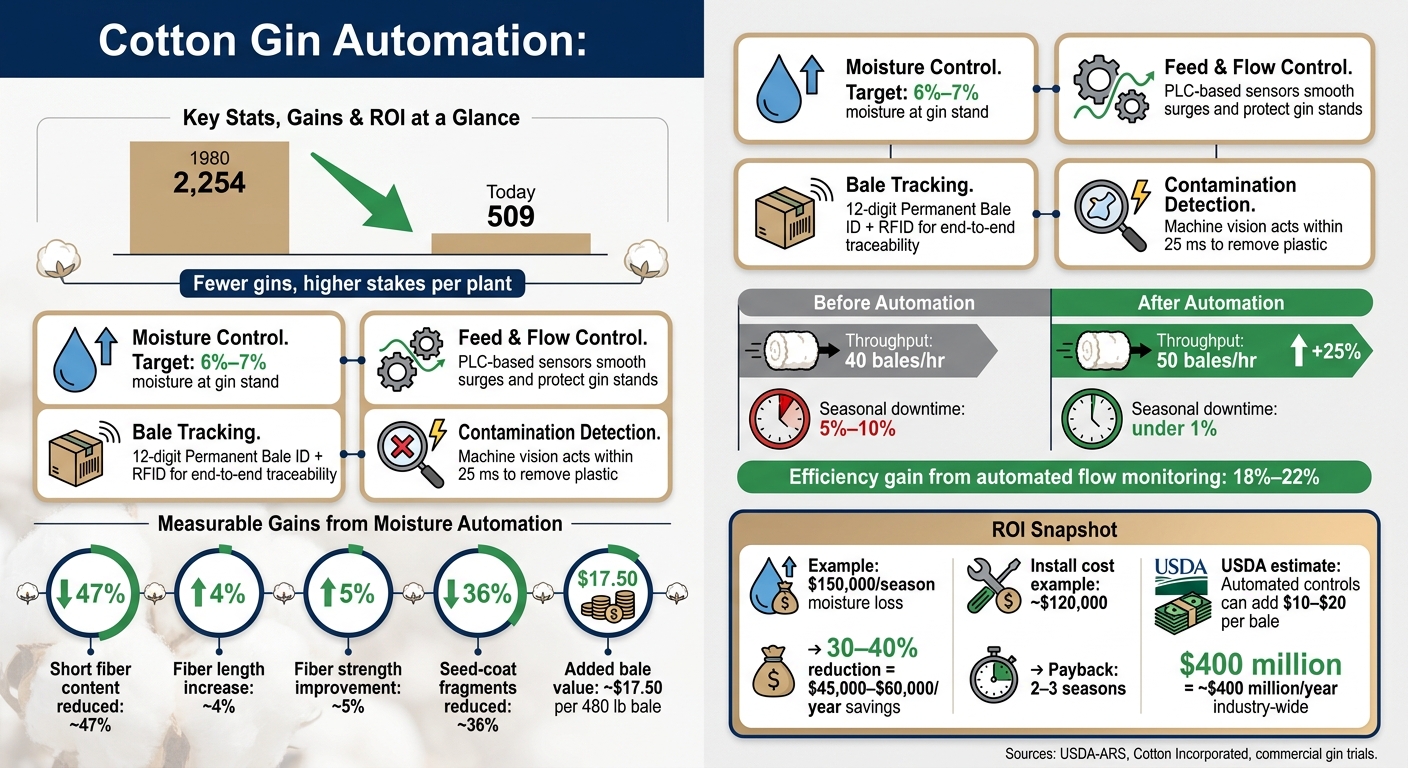
Cotton Gin Automation: Key Stats, Gains & ROI at a Glance
See How Technology Super Charges a Cotton Gin
sbb-itb-0e617ca
Quick comparison
| Area | What it fixes | Main result |
|---|---|---|
| Moisture automation | Overdrying, wet spots, uneven drying | Better fiber length, strength, and bale consistency |
| Feed and flow automation | Surges, chokes, overloads, idle time | More steady throughput and less downtime |
| Bale tracking | Paper errors, weak traceability, slow lookup | Faster recordkeeping and bale-level history |
| Contamination detection | Plastic and foreign material spreading through runs | Lower risk of multi-bale contamination problems |
| Live plant monitoring | Late response to drift or machine stress | Earlier alarms and faster in-shift corrections |
So if I were reading this to make a decision, I’d take away one thing first: start with the bottleneck that costs the most per season, then add the automation that cuts that loss first.
Moisture Control Systems That Cut Fiber Damage
Moisture control is often the first automation step a gin adds. And for good reason: it helps protect fiber quality while keeping drying more steady. If you want one upgrade that affects both throughput and fiber protection, this is usually the clearest place to start.
How Online Moisture Sensors and Dryer Controls Work
Modern setups place moisture sensors at the feed hopper and at dryer exits. In one documented commercial gin trial, the system used three sensing points: one sensor at the feed hopper to measure incoming seed-cotton moisture, plus two sensors at separate dryer exits. Temperature probes track dryer plenums and cotton flow along with the moisture sensors so the system can catch overheating early. Best-practice guidance sets 199°F as the upper limit for dry fiber and 351°F as the maximum for any part of the drying system.
Once those sensors are installed, a closed-loop control system handles the next step. It keeps comparing live moisture readings with a target setpoint, usually around 6% to 8% moisture overall, and then adjusts dryer air temperature, exposure time, or feed rate in real time. That matters because the gin no longer has to wait for an operator to spot a drift and make a manual change.
Some systems use different sensing methods, but the goal is the same. IntelliGin uses electrical-resistance sensors to measure seed cotton and lint moisture on a continuous basis, while Moisture Mirror II combines electrical-resistance and microwave sensing to give instant readings at incoming, post-drying, and bale stages. The loop keeps running the whole time, so control stays tight even during long production runs.
Real-time moisture data also helps protect the rest of the process from overdry cotton. The same control loop can guard lint cleaners by stopping cotton before it gets too dry for safe mechanical cleaning. That helps cut rework and keeps material moving through the gin. If moisture drops too low, dryers shut down and humidifiers turn on. If moisture climbs too high, the system does the reverse.
Where Moisture Automation Delivers Measurable Results
The gains show up in fiber quality and day-to-day work on the gin floor. Proper moisture control can reduce short fiber content by about 47%, increase fiber length by around 4%, improve strength by roughly 5%, and cut seed-coat fragments by about 36%.
It also removes a lot of the stop-and-check routine. Instead of relying on sample-and-adjust work during long shifts, the gin gets continuous monitoring and automatic dryer tuning. Bale-moisture units tied to control software can also log each bale's moisture, which creates bale-level traceability when quality disputes come up.
Feed and Flow Automation That Keeps Cotton Moving Through the Gin
Moisture control steadies one part of the process. Feed automation steadies the next one: keeping cotton moving through the gin at a steady pace.
Once moisture is under control, feed rate often becomes the next choke point. Uneven flow from wet spots in a module, uneven module density, or a developing choke can turn the whole plant into a stop-and-start system. And when that happens, throughput drops and fiber can take more abuse than it should. Automated feed and flow control is what helps close that gap.
Automatic Feed-Rate Control and Gin Stand Protection
PLC systems connect the module feeder, hoppers, air lines, and gin stands into a single control loop. That loop uses hopper level, drive-current sensors on gin stands, and line pressure to match feed rate to stand load. If load drops, the system speeds up feed. If current starts climbing toward an overload point, it slows feed down or pauses it.
USDA's Cotton Ginning Research Unit showed that a light-bar array can measure cotton mass flow in pipes with R² = 0.98, making it suitable for closed-loop feed control.
That same control layer helps prevent chokes and overheating. If amperage spikes, flow falls, or temperature climbs, the PLC cuts feed to that stand, stops upstream feeders, and alerts operators. Startup also follows a clear sequence: downstream equipment comes online first. On shutdown, the feeder stops first so the stands can clear.
At West Texas gins, automation upgrades increased throughput from 40 to 50 bales per hour - a 25% gain - while cutting seasonal downtime from 5%–10% to under 1%. On a broader level, automated control systems that monitor cotton flow, air pressure, and drum speed in real time have been reported to increase efficiency by 18%–22%.
You can see the difference pretty fast when manual and automated flow control are compared side by side.
Manual Flow Control vs. Automated Flow Control: A Direct Comparison
| Control Method | Avg. Throughput (bales/hr) | Downtime Events per 12-hr Shift | Staff Attention Required | Impact on Fiber Quality |
|---|---|---|---|---|
| Manual flow control | 28–32 | 20–30 short stops | Continuous floor monitoring | Variable; over- or under-feeding increases nep formation and fiber damage |
| Automated PLC-based control | 32–36+ | 5–10 events, many auto-resolved | Alarm response and HMI oversight | More consistent; steady flow reduces mechanical stress on fiber |
Automation changes the operator's job. Instead of making constant hand adjustments on the floor, crews can focus on HMI supervision and alarm response. In plain terms, that makes training newer workers easier and lets the same team handle more throughput - or more stands - without adding headcount. The same data stream can also feed bale tracking and live plant monitoring.
Bale Tracking, Contamination Detection, and Real-Time Plant Monitoring
The same control network that keeps flow steady can also track bales, flag contamination, and show problems as they happen. Once the gin is running smoothly, those digital controls can also show exactly what moved through the plant.
How Automated Bale Tracking and Data Capture Work
It starts with unique bale identification. Permanent Bale Identification gives each bale a 12-digit ID: a 5-digit gin code plus a 7-digit bale number, along with a barcode for steady warehouse, shipping, and mill traceability. That ID becomes the main reference point for inventory control, classing reconciliation, and shipping records.
RFID pushes that traceability further by picking up module identity automatically as cotton moves through the gin. Cotton Incorporated describes an Electronic Module Management (EMM) workflow that uses RFID readers at the weighbridge, module feeder, and bale scale, all tied to a central data hub called RFIDGinDataManagement. In plain terms, each scan helps build one connected record trail. That trail pulls together module-level data and produces ginner and grower reports with much less hand entry. In a 2021 South Carolina demonstration, RFID readers at the module feeder recorded module order and productivity data for later matching with fiber-quality results.
That record trail becomes even more useful when quality and contamination events are tied to each bale.
Sensors and Dashboards for Quality and Contamination Control
The IntelliGin system gathers live measurements of fiber color, trash content, and moisture at three key points in the ginning process, then stores those readings in a database for reporting and analysis. So instead of finding quality problems later, managers can watch trends take shape while production is still moving.
Contamination detection is the part where timing matters most. A Cotton Gin Stand Machine-Vision Inspection and Removal System developed by USDA-ARS uses low-cost color cameras to find plastic on the feeder apron and blow it out of the cotton stream before it reaches the lint. The detect-and-remove decision happens inside a 25 ms software window - fast enough to act before the contaminant is chopped up and spread through the lint, which helps protect bale value and cut downstream loss. Catch it early, and the problem stays small. Miss it, and it can travel through a lot of cotton in a hurry.
USDA-ARS also installed a robotic bale camera system in a commercial gin in 2024 to timestamp each bale image and match it to bale ejection. That keeps the visual record lined up with the correct bale ID and helps catch bale skips.
Paper Records and Reactive Monitoring vs. Automated Tracking and Live Alerts
The gap between manual records and automated capture is easiest to see side by side.
| Category | Paper-Based / Manual | Automated / Digital |
|---|---|---|
| Record accuracy | Higher risk of transcription and tag errors | Lower error rate through RFID, barcode, and software capture |
| Time per bale | Slower due to hand entry and reconciliation | Faster because scan events populate records automatically |
| Traceability depth | Often limited to paper logs or partial records | Bale, module, and process history can be linked end to end |
| Speed of issue detection | Reactive; problems found after the fact | Live alerts flag issues before they spread |
| Effect on plant operations | Labor-intensive; inventory gaps are more common | More proactive, with better inventory control and faster decisions |
This is where digital tracking starts to show its value day to day. If a missed scan, contamination alarm, or inventory mismatch triggers an alert right away, managers can deal with it during the same shift instead of waiting for the next morning’s reconciliation.
Choosing the Right Automation Upgrades for a U.S. Gin
Once the plant is stable, the next step is simple: figure out which upgrade pays back first.
How to Rank Investments by Bottleneck and Payback
Start with one season of downtime logs, fuel bills, classing reports, and labor hours. When you line those up side by side, the biggest cost drains usually show up fast.
Here’s a plain example. If moisture swings cost $150,000 per season in fuel and grade losses, an automated moisture control system that cuts that loss by 30% to 40% would return about $45,000 to $60,000 per year. On a $120,000 install, that’s a simple payback of about two to three seasons.
Feed and flow automation and moisture control tend to sit at the top of the list because they hit the two things gins care about most: throughput and bale value. USDA estimates CPCS and related tools can add $10 to $20 per bale, or about $400 million per year if used at scale. That’s hard to ignore.
By contrast, bale tracking and advanced dashboards often fit better as a second wave. They still matter, but they usually pay off more after the core process is steady. The main exception is when traceability is a firm buyer requirement. In that case, the need moves up fast.
Local conditions can change the order. In areas where labor is tight, tools that cut hands-on intervention - like automatic feed-rate controls and choke detection alarms - deserve more attention. If contamination complaints keep popping up, detection sensors move higher on the list. The point is to match the upgrade to the plant’s biggest cost driver, not follow some one-size-fits-all plan.
Regional peers can also help you sanity-check those same cost drivers.
Using U.S. Gin Directory Data for Planning Context
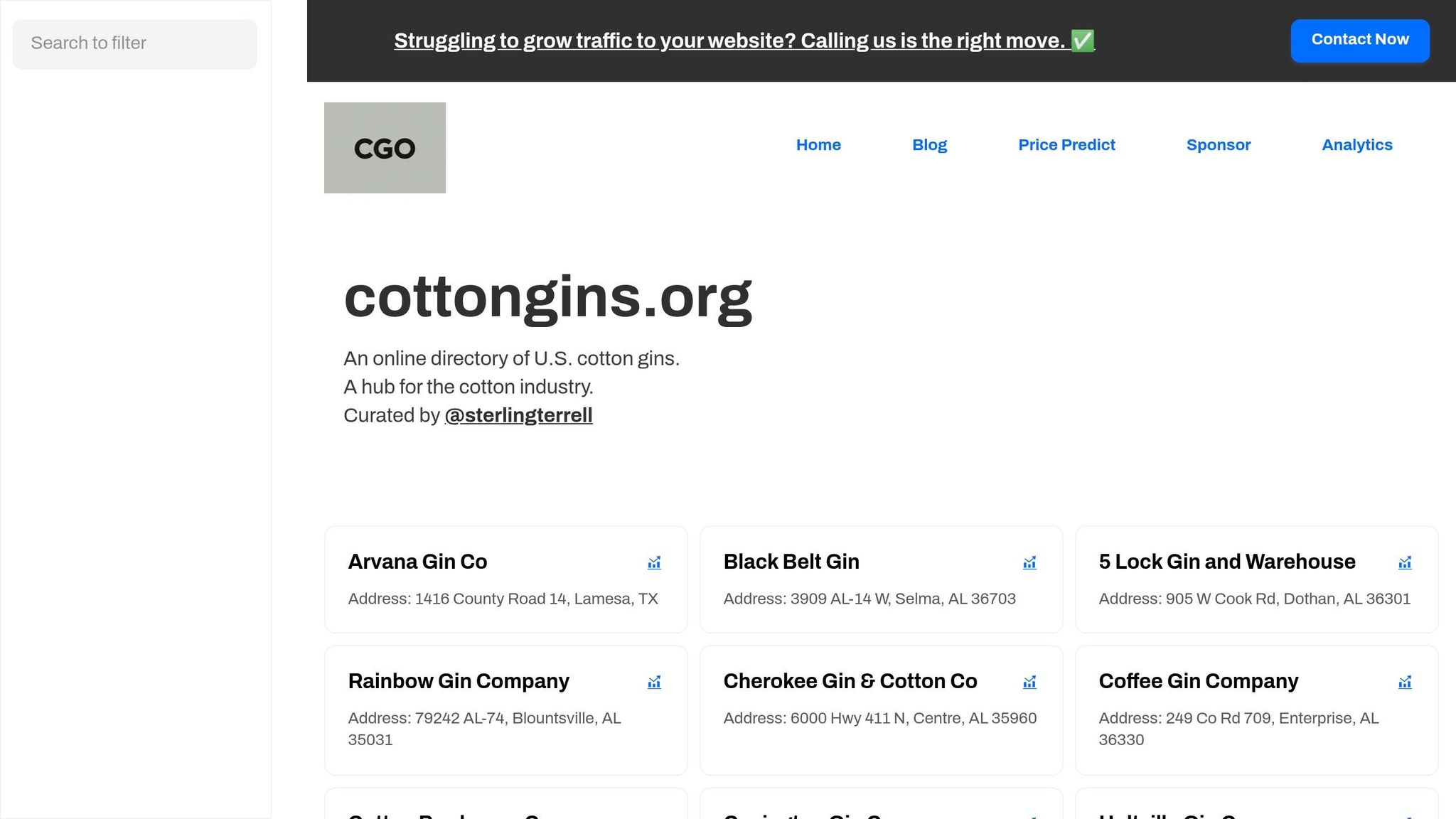
Use the U.S. Gin Directory to benchmark local gin density, harvest timing, and peer operating conditions.
Conclusion: Automation Tools That Protect Both Throughput and Lint Value
Moisture automation helps protect lint value by keeping fiber in the target moisture range, cutting overdrying damage, and reducing fuel waste. Feed and gin stand controls help steady throughput by cutting choke-related stoppages. Bale tracking cuts clerical mistakes that can create friction with warehouses and buyers. And real-time monitoring gives early warning on contamination, equipment stress, and grade trends before those issues spread across a run of bales.
Start with the biggest seasonal cost, then back the upgrade that cuts it fastest.
FAQs
What should a gin automate first?
Start with a baseline audit to spot bottlenecks, like hydraulic cavitation or high non-lint content. For many gins, the first move should be a hydraulic system upgrade. It can boost processing speed and throughput without a huge upfront cost.
Then bring in real-time moisture sensing and machine vision. These tools can improve fiber quality, cut energy use, and catch contamination faster.
How much can automation improve bale quality?
Automation can improve bale quality in a very practical way: it uses real-time data to protect fiber integrity and keep output more consistent.
With automated controls, operators can fine-tune moisture levels and cleaning intensity as conditions change. That helps preserve fiber strength and length while cutting down on damage.
Sensors also play a big part here. They can help keep moisture in the 6%–7% range and spot contaminants like plastic, which leads to cleaner, more consistent lint.
The payoff isn’t just about cleaner output on paper. It can add about $6–$12 per bale in value.
What data should a gin track on each bale?
Track each bale’s main quality and efficiency data in real time, including:
- moisture levels
- trash content and non-lint percentage
- fiber traits, such as neps and seed-coat fragments
- contaminants and energy use per bale
When you pair this with RFID module identification and machine vision, the system can adjust cleaning settings automatically, keep bale quality steady, and build records you can use for trend analysis and predictive maintenance.