If I had to sum it up in one line: mills cut labor costs fastest by automating the most manual jobs first.
In cotton spinning, labor can take up about 31% of total manufacturing cost per kilogram of yarn. With U.S. textile wages around $18–$24 per hour, even a small drop in headcount can save $190,000 to $400,000 per year. So if I were looking at where automation pays off first, I’d focus on:
- Bale opening and blowroom feeding to cut manual fiber handling
- Autolevelers to reduce sliver checks and manual adjustments
- Robotic doffing to cut ring-frame labor and machine stoppage
- Automated winding and packing to reduce inspection and handling work
- MES and live monitoring tools to cut patrol time, overtime, and overstaffing
Here’s the short version:
- Blowroom staffing can drop by 40%+
- Packing and transport labor can fall by 25%–30%
- Doffing labor can drop by 50%–70%
- Winding labor can fall by 30%–85%, depending on setup
- Some mills have cut headcount from 54 to 30 operators, a 44% drop
- Large mills often see payback in about 2 to 4 years
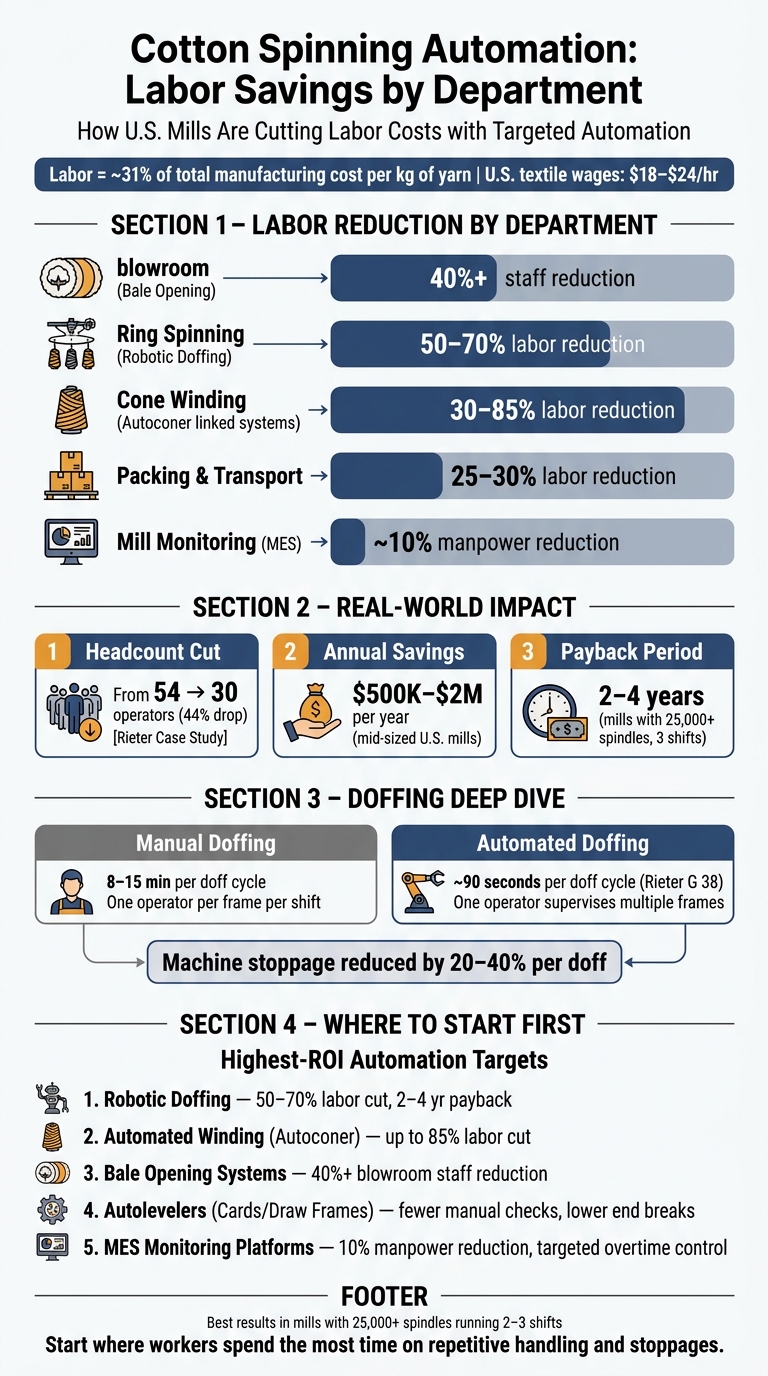
Cotton Spinning Automation: Labor Savings by Department
Quick Comparison
| Area | Main labor problem | What automation does | Typical labor effect |
|---|---|---|---|
| Bale opening | Manual bale handling and feeding | Automatic pluckers and feeders | Blowroom staff down 40%+ |
| Carding/draw frame | Constant sliver checks and corrections | Autolevelers adjust sliver mass in real time | Fewer manual checks and interventions |
| Ring spinning | Slow manual doffing | Robotic or integrated auto-doffing | Doffing labor down 50%–70% |
| Winding | Manual clearing, splicing, and package handling | Autoconers and linked winding lines | Labor down 30%–85% |
| Monitoring | Repeated patrols and broad overtime use | Live alerts and machine dashboards | Manpower down about 10% in one case |
What stands out to me is simple: the best first move is not automating everything. It’s starting where workers spend the most time on repetitive handling, stoppages, and checks.
sbb-itb-0e617ca
Fiber Preparation Upgrades That Cut Manual Work
The biggest labor savings in a spinning mill start before yarn is even formed. Bale opening, blending, and sliver preparation are repetitive, physical steps that used to need constant hands-on work.
Automatic Bale Opening and Feeding Systems
In older setups, workers had to break open bales by hand, move cotton to the blowroom, watch blending, and deal with jams all shift long. Now, automatic bale pluckers and openers do that job mechanically, opening multiple bales at the same time.
Systems such as the Rieter UNIfloc A 11/A 12 and Trützschler BO-P Portal Bale Opener can process fiber from 5 to 14 bales simultaneously. From there, fiber moves pneumatically through cleaning and mixing stages, so there's no manual transfer in between. Modern portal bale openers can reach up to 3,000 kg/h and are built to run through unattended night shifts or weekend production, which helps mills keep output high without adding shifts.
One documented upgrade with a Rieter A 11 take-off unit lifted one mill's output by 20%, from 1,150 kg/h to 1,400 kg/h, while also cutting energy use by 20% and lowering maintenance costs. That kind of setup can shrink staffing needs in this area to one operator for loading and routine checks, instead of a full crew.
These systems make the most sense in high-throughput mills with a steady cotton supply, standard bale sizes, and long runs of the same yarn counts. Smaller mills with frequent fiber changes or uneven bale patterns can still gain from them, but the labor cut is smaller when runs are shorter and changeovers happen more often.
Once the blowroom is running on its own, the next big labor cut usually shows up in sliver control at cards and draw frames.
Autolevelers on Cards and Draw Frames
Without automation, operators spend a lot of time checking sliver weight, changing draft settings, and stepping in when quality starts to drift. That adds manual work and opens the door to human error. Autolevelers cut most of that out by measuring sliver mass all the time and correcting deviations in real time.
On carding machines, sensors pick up thickness variation and adjust feed roller speed or draft to smooth it out. On draw frames, electronic draft control fine-tunes the output sliver so count variation stays within tight limits. Modern autoleveler draw frames can reach sliver CV₁ₘ around 0.4% and keep yarn count variation clearly below 1%.
That means less operator intervention and a lower chance of end breaks later in the process. Studies on autoleveler draw frames show that mills spinning cotton yarns with autolevelers achieve count CV around 1.2% to 1.4%, improve lea count CV by 1.2% to 1.6%, and improve single yarn strength CV by 4%, while also cutting end breaks at ring frames by a large margin. Fewer end breaks means less pneumafil waste, fewer machine stops, and less time spent chasing quality issues across the shift.
As a result, one operator can supervise more draw frames because manual tuning and frequent quality checks are mostly removed.
Spinning and Winding Automation That Reduces Direct Labor
After fiber prep, the spinning floor is often the next big labor pinch point. In most mills, ring-frame doffing and winding eat up a large share of the work hours that are still left. That makes them the clearest places to automate.
Robotic Doffing for Ring Spinning Frames
Manual doffing is hard, repetitive work. An operator has to walk the full length of the frame, pull off full bobbins, load empty tubes, and start the machine again. In a typical mill, that job can take 8 to 15 minutes per doff. Spread that across dozens of frames and three shifts, and doffing alone can burn through thousands of labor hours each year.
Robotic doffing systems take over most of that routine. A rail-mounted or gantry robot moves along the frame, detects full bobbins, and swaps them out on its own. On the Rieter G 38 ring spinning machine, integrated auto-doffing finishes a full doff in 90 seconds. That’s about 25% faster than older 120-second cycles. Less time spent doffing means less stoppage, and more spindle time during every shift.
Instead of standing at one frame and repeating the same motion over and over, one operator can watch several frames and robots at once. Their job shifts toward exceptions, checks, and yarn quality. In practice, robotic doffing can cut doffing labor by 50–70% and reduce frame stoppage per doff by 20–40%.
The numbers tend to work best in large mills. Sites running 25,000 or more spindles across three shifts usually have enough labor savings to earn back the investment in about 2 to 4 years. Smaller mills can still see gains, but the payback period often stretches past four years unless the robots support more than one line.
Once doffing is handled, winding usually becomes the next place to trim labor.
Automated Cone Winding, Yarn Clearing, and Packing
On the winding floor, autoconers can handle yarn clearing, automatic splicing, cone building, and doffing finished packages. Electronic yarn clearers also spot thick places, thin places, neps, and foreign matter on their own. That gives the mill a steady inspection standard that manual checking just can’t match with the same consistency.
Saurer Autoconer X5/X6 linked systems, where ring frames feed straight into autoconers, can cut winding labor by up to 85% compared with stand-alone setups. Even a standard direct-link autoconer can lower winding staff costs by about 30% to 40% versus stand-alone setups.
There’s another piece here that’s easy to miss: material handling. Conveyors or robotic arms that move cones to packing reduce handling work even more, and they let the same crew manage more output without adding headcount.
Comparison Table: Manual vs. Automated Doffing and Winding
| Metric | Manual Process | Automated Process |
|---|---|---|
| Operators required | One operator per frame/shift for doffing; one operator per 8–12 winding heads | One operator supervising multiple frames/robots |
| Doffing cycle time | 8–15 min per doff | About 90 seconds with integrated auto-doffing |
| Machine stoppage per doff | Higher; more variation across operators | Reduced by 20–40% |
| Winding errors and rework | Higher; dependent on visual inspection | Lower; consistent electronic fault clearing |
| Annual labor cost impact | Higher direct labor from manual doffing, winding, and handling | Doffing labor cut 50–70%; winding staff costs down 30–40% |
| Typical payback range | N/A | 2–4 years for large mills (25,000+ spindles, 3 shifts) |
With direct labor down on the spinning floor, the next place to look is real-time monitoring, where mills can cut idle time and avoid staffing more people than the line actually needs.
Digital Monitoring Tools That Cut Downtime and Overstaffing
Once doffing and winding are automated, monitoring helps the remaining crew spend time only where a machine needs attention.
Mill Monitoring and MES Platforms for Spinning
Modern manufacturing execution system (MES) and monitoring platforms work as the control layer for the automation already on the floor. BMSvision SpinMaster shows production and quality issues in real time. Rieter ESSENTIALmonitor brings production, energy, and quality data into one view. Trützschler T-DATA tracks blowroom, card, and draw frame performance.
That matters for labor because alerts can replace some routine patrols. Instead of walking the same route again and again, teams can respond when the system flags a problem. The result is fewer checks, less wasted motion, and faster action when something slips.
A practical example makes the point clear. After putting Rieter ESSENTIALmonitor together with individual spindle monitoring (ISM premium) in place, Sagar Manufacturers reported a 1.5% increase in productivity, a 10% reduction in manpower requirements, and a 10% reduction in hard waste. In a large mill, a 10% drop in manpower needs can trim payroll and overtime costs in a very direct way.
How Real-Time Data Affects Staffing Decisions
These systems shift staffing from fixed patrols to exception-based response. In plain English, one supervisor can watch more machines during a shift because alerts take the place of many routine walk-throughs.
It also changes overtime planning. When dashboards show live production rates, order progress, and quality status, a supervisor can tell by mid-shift whether a line is on pace. That makes it easier to cancel or push back overtime that might have been scheduled just in case.
On the other hand, if something is off, the same data helps the team spot which line or article needs help. That means managers don't have to extend hours across the whole floor. They can direct labor to the exact trouble spot. For U.S. mills paying high overtime premiums, that kind of targeted call can save a lot of money in a short period.
Comparison Table: Monitoring System Capabilities
The table below shows how each platform supports leaner staffing.
| Capability | BMSvision SpinMaster | Rieter ESSENTIALmonitor | Trützschler T-DATA |
|---|---|---|---|
| Production visibility | Output and efficiency across spinning frames and winders | Production, efficiency, energy, and quality dashboards | Blowroom, cards, and draw frames; web dashboards |
| Quality alerts | Spindle-level fault flagging and stoppage analysis | Quality KPIs integrated with production dashboards | Error statistics and quality trends by machine |
| Energy tracking | Energy optimization support | Energy consumption linked to production output | Online energy monitoring and energy per kilogram of output |
| Remote access | Dashboards and alerts accessible remotely | Role-based views for managers and supervisors | Web-based dashboards accessible via browser |
| Staffing impact | Fewer patrols; operators directed to specific faults | Targeted staffing and overtime decisions | Maintenance and operator resources focused on bottlenecks |
How to Evaluate ROI, Mill Fit, and Next Steps
Once labor-saving systems are running, the next step is simple: figure out where they earn back the investment fastest.
Which Spinning Mills Get the Most from Automation
Automation tends to pay off most in mid- to large-scale ring-spinning mills with heavy labor use in doffing, winding, and inline quality control. A Rieter case study shows what that can look like in practice: headcount from blowroom to packed yarn fell from 54 to 30 operators, a 44% drop, while machine availability and productivity went up.
Mills that connect bale-quality data from ginning to spinning controls have another edge. They can catch fiber issues early, before those issues show up later as waste, yarn breaks, and rework.
Smaller mills don't have to automate the whole plant to get results. In many cases, a focused upgrade does the job. An autoleveler on cards, a basic MES platform, or semi-automated winding can reduce variation and cut back on manual quality checks without a big upfront spend.
Cost-Saving Benchmarks and Investment Checks
In mid-sized U.S. mills, automation projects often cut labor costs by 18%–35% in the department being upgraded, reduce headcount by 20%–30%, and save $500,000 to $2 million per year, depending on wages and project scope. Doffing on its own can also move the needle. In a 50,000-spindle mill, automated doffing can save $35,000 to $50,000 per year, with a 14- to 20-month payback when the mill runs three shifts.
The smartest first project is usually the one that removes the most labor with the least disruption to production.
| Factor | What to Assess |
|---|---|
| Spindle count and layout | Can the floor plan fit robots and added modules? |
| Product mix | Fine-count and combed-yarn production tends to gain the most from tighter process control. |
| Shift pattern | Payback is fastest when equipment runs at high use across 2–3 shifts. |
| Current staffing | Track headcount, overtime, and turnover to build a labor-cost baseline. |
| Network and sensor reliability | MES platforms depend on steady networks, working sensors, and clean data collection. |
| Preventive maintenance capacity | Robots and sensors need scheduled upkeep and staff with the right skills. |
| Training needs | Operators should be trained to manage exceptions instead of doing manual patrols. |
Conclusion: Start with the Highest-Cost Labor Bottlenecks
The best place to start is the department with the heaviest manual labor load.
Map labor hours across blowroom, carding, ring spinning, winding, and packing. Then look for the areas where repetitive handling, frequent stoppages, or high error rates eat up the most time. That's usually where robotic doffing, automated cone winding, bale opening systems, and MES monitoring pay back the fastest and show the clearest results.
The upgrades covered in this article - automatic bale feeders, autolevelers, robotic doffing, automated winding, and real-time MES monitoring - each go after a specific labor-cost problem. For U.S. mills, where labor makes up about 25%–40% of total conversion cost, that has a direct effect. Better spinning efficiency lowers labor cost per pound of yarn and helps U.S. mills stay competitive.
FAQs
Where should a mill automate first?
Start with the processes that save the most labor and make production more stable. Check draw frame sliver first, because open-end spinning is very sensitive to variation.
The upgrades with the biggest impact usually include automated transport, robotic doffing, chute feed blow rooms, bale pluckers, and autolevelers. But before you spend the money, pause and look at the practical side: equipment compatibility, maintenance demands, and any downtime the install might cause.
How do mills calculate automation payback?
Mills figure out automation payback by comparing the total cost of the investment with the operating savings they expect to get back. That’s how they measure ROI:
ROI (%) = (Net Profit from Equipment / Total Investment Cost) x 100
The math looks simple, but the inputs need to be honest. If you leave out costs, the payback picture can look better than it is.
Include all upfront costs, such as:
- Purchase price
- Transportation
- Installation
- Foundation work
- Any loan or interest fees
Then calculate savings using fully burdened labor rates, not just base wages. It also helps to account for depreciation, maintenance, and output gains from less downtime or fewer yarn breaks.
Put another way: the best ROI estimate reflects what the equipment costs you and what it saves you on the mill floor.
Can smaller spinning mills benefit too?
Yes. Smaller spinning mills can benefit from automation with cost-effective, scalable upgrades that still deliver strong returns.
For example, mills with limited capacity can use mobile doffing units instead of stationary systems. That setup can automate an entire facility with just 4 to 6 units, which helps keep the entry cost lower.
Another smart move is retrofitting current machinery with variable frequency drives or energy-efficient spindles. These upgrades can improve efficiency and cut labor needs without the upfront cost of a fully automated line.