If a cotton gin goes down for 6 hours during harvest, it can leave 300 to 360 bales stuck and burn $5,760 to $8,640 in lost throughput before repair extras even start. That’s the main point: AI-based predictive maintenance helps crews spot machine trouble early, plan repairs during short stops, and avoid mid-harvest shutdowns.
Here’s the article in plain terms:
- I see cotton gin downtime as a throughput problem first and a repair problem second.
- The machines to watch first are gin stands, motors, bearings, belts, dryers, and moisture systems.
- The signals that matter most are vibration, temperature, motor current, speed, airflow, humidity, and moisture.
- AI systems compare live sensor data to a machine’s normal pattern and flag drift before a full failure.
- Crews still need to check the trend, inspect the asset, and create a work order. Alerts alone do nothing.
- The usual payoff is lower downtime and lower repair spend, with studies in industry showing 30% to 50% less unplanned downtime and 10% to 40% lower maintenance cost.
What I like about this approach is how simple the logic is: watch the assets that stop the line, catch small changes early, and fix them during planned downtime instead of at 2:00 a.m. during peak harvest.
A few numbers make the case fast:
| Item | What it means |
|---|---|
| 17 hours/day | Average runtime seen in Mississippi gin research |
| About 2 hours/day | Downtime already cutting into production |
| 60-day season | Short harvest window, so lost hours hurt more |
| Up to 1,500 bales/day | Output level some modern U.S. gins can reach |
| $18 to $23 per bale | Income loss tied to long module storage |
| 8°F to 15°F above normal | Common heat warning sign on bearings and motors |
So if you want the short version, it’s this: start with the few machines that can stop the whole gin, feed their sensor data into AI, and use alerts to schedule fixes before failure hits output. The rest of the article explains where to start, what signals to track, and how crews should respond.
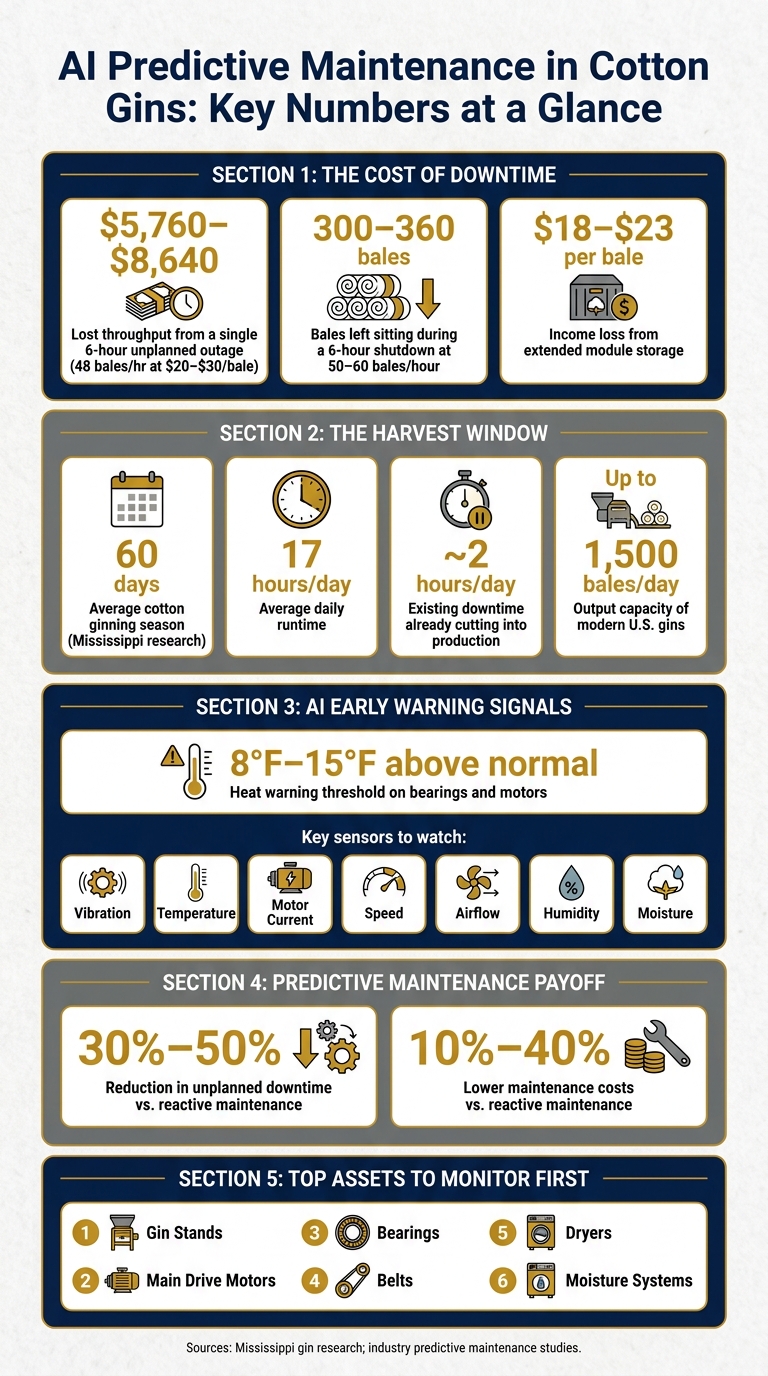
AI Predictive Maintenance in Cotton Gins: Key Numbers at a Glance
How AI Predictive Maintenance Transformed Heavy Manufacturing | Cognitive Market Research
sbb-itb-0e617ca
Why Downtime Is So Expensive During Harvest
Cotton ginning happens inside a narrow harvest window. In Mississippi, the season averaged 60 days, which means every lost hour hits hard. First, throughput drops. Then deliveries start slipping.
Modern U.S. gins can process up to 33,000 pounds of cotton per hour and as many as 1,500 bales per day. At a common rate of 50–60 bales per hour, a 6-hour unplanned outage can leave roughly 300–360 bales sitting still. That backlog doesn’t just look bad on paper. It adds labor pressure, shipping pressure, and catch-up costs. And in a connected gin line, one failed asset can choke the whole system.
How One Failed Asset Can Slow or Stop the Entire Line
A cotton gin works like a chain. If one key link breaks, the rest of the line feels it fast.
A failed gin stand cuts throughput at once - or shuts it down altogether in smaller operations. If a dryer goes down, incoming seed cotton with high moisture can’t be processed safely, so the line has to slow or stop. A seized bearing in a main drive motor can stop conveyors, cause cotton to back up, and force a full shutdown just to clear jams before work can restart.
The damage spreads beyond the machine itself. Trucks delivering modules end up waiting or getting rerouted. Shipping slots for finished bales get missed. Crews stay on the clock while production sits idle. And if modules stay in the yard too long, price cuts tied to quality can pile up fast. Extended module storage can reduce income by $18–$23 per bale.
Emergency Repairs Cost More Than Planned Maintenance
Mid-harvest failures are expensive in all the worst ways. When a bearing or motor fails, parts may need overnight shipping or same-day sourcing, which pushes costs above the part price alone. Labor costs can climb too, especially for after-hours repair work. If that failure damages nearby parts - like a seized bearing damaging a shaft or housing - the bill can jump far past the cost of a simple swap.
Here’s what that looks like in practice: a mid-sized gin running at 48 bales per hour loses 6 hours because of an unexpected dryer fan bearing failure at night. Using a cautious operating cost of $20–$30 per bale, that one outage can mean $5,760–$8,640 in direct lost throughput before you even add emergency labor, rush freight, or damage to nearby parts.
By comparison, a planned bearing replacement during a scheduled 2-hour stop - set off by an early AI alert - would cost far less. That gap is exactly what AI alerts are built to avoid.
Next, the focus shifts to the gin assets that AI should monitor first.
Gin Assets That Work Best With AI Monitoring
Gin stands, motors, bearings, belts, dryers, and moisture systems are the best places to start with AI monitoring. Why these first? Because they generate clear, measurable signals when something starts to go wrong. And when one of them fails, the whole gin line can stop. That’s why these assets are usually the first ones worth wiring with sensors.
Gin Stands, Motors, Belts, and Bearings
These components are the mechanical heart of a gin line, and they’re often where AI monitoring delivers payback the fastest. For gin stands and motors, the most useful signals include vibration amplitude, frequency spectra, motor current, temperature at the housing or windings, and torque or load when that data is available. Accelerometers mounted on bearing housings pick up high-frequency vibration early, often before bearing damage or alignment issues can be heard by operators.
An 8–15 °F increase above normal, especially when it shows up alongside rising vibration or new high-frequency peaks, usually points to lubrication loss or surface fatigue.
For motors, AI watches current draw, voltage, and power together with vibration data. If current stays higher than normal at a steady load, that can point to misalignment, coupling wear, or a bearing starting to fail.
Belts are a little harder to track directly, but the pattern still shows up in the data. Speed sensors and current readings from the driven motor usually tell the story. If belt speed falls behind or current jumps under load, AI can flag the need for a tension or pulley check.
One of the big advantages here is that AI learns what “normal” looks like for each machine. That helps it tell the difference between a plant-wide load increase during harvest and a fault developing in one stand.
Rotating equipment is often the easiest place to begin, but dryers and moisture controls also need that same early-warning approach.
Dryers and Moisture Systems
Dryers become risky when burners lose efficiency, fans stop moving enough air, or lint builds up on heat-transfer surfaces. AI monitors inlet and outlet air temperatures, airflow velocity, and humidity at several points in the drying section. If heat starts building unevenly across zones, or if exhaust temperatures run above normal for a given throughput, the system flags it. That usually leads to checks like cleaning burner nozzles, adjusting fuel-to-air ratios, or clearing lint from heat surfaces.
Moisture systems work best when product moisture is looked at alongside temperature, airflow, and load data. AI models trained on that mix can spot subtle drift that points to calibration issues, uneven feed, or early dryer performance loss before fiber quality takes a hit.
Sensor Types, Warning Signs, and Supported Assets: A Quick Reference Table
The table below shows which sensor types fit which gin assets, what warning signs they can surface, and the maintenance step they usually trigger.
| Sensor Type | Supported Gin Assets | Key Warning Signs | Typical Maintenance Response |
|---|---|---|---|
| Vibration (accelerometer) | Gin stands, motors, bearings, fans | Rising vibration; new frequency peaks | Inspect alignment and mounting; check bearing condition |
| Temperature (bearing/housing) | Bearings, motors, gearboxes | 8–15 °F rise above normal; upward trend at steady load | Check lubricant condition; regrease; plan bearing replacement if trend persists |
| Motor current / power meter | Main drive motors, conveyors | Current spikes at steady RPM; rising amps without load increase | Check for misalignment, coupling wear, or mechanical drag |
| Speed sensor | Belt drives, conveyors | Belt speed lagging drive speed; slip under load | Inspect belt tension, pulley wear, and alignment |
| Temperature + humidity (air) | Dryers, moisture systems | Uneven heat across zones; high exhaust temp; humidity drift | Clean burner nozzles; check fuel/air ratio; clear lint buildup |
| Moisture sensor (combined sensor data) | Moisture systems, dryer outlets | Moisture drift; inconsistent readings | Recalibrate sensors; check feed rate and dryer performance |
Start with the rotating assets that can shut down the line fastest - gin stands, main drive motors, and critical bearings. Then turn those sensor readings into alerts operators can use right away.
Predictive Maintenance Tools and How They Turn Data Into Alerts
Sensors don’t do much on their own. The software is what turns raw readings into something a maintenance team can act on.
Most AI monitoring platforms follow a pretty simple path: they collect data, clean it up, compare it against a baseline, spot drift, and send an alert. PLC and SCADA systems act as the data layer, scanning field sensors nonstop and exposing tags like motor current, shaft speed, bearing temperature, and run hours to the analytics platform through protocols such as OPC UA or Modbus. If the gin already records motor data in a PLC, start there.
This matters most on gin stands, motors, bearings, and dryers, where even small drift can shut down the line.
How Continuous Monitoring Converts Raw Readings Into Actionable Alerts
The system starts by learning what normal looks like during a stable harvest period. That baseline includes vibration patterns, temperature ranges, current draw, and moisture readings. After that, the AI watches for drift by looking at signals together before it pushes an alert.
That part is key. A rise in vibration by itself might not trigger anything. But if vibration climbs and bearing temperature goes up and current draw increases, the system is much more likely to flag it. That helps cut down on false alarms. Alerts are usually split into tiers - warning, alert, and critical - so the team knows whether to check the issue during the next slow window or stop the line right away.
When an alert goes out, it usually comes through SMS, email, or a mobile app dashboard. It includes the asset ID, severity level, likely cause, and a suggested next step, such as inspect bearing, check alignment, or verify lubrication. During harvest, that kind of detail saves time because nobody has room for guesswork.
Continuous Monitoring vs. Periodic Inspection: A Side-by-Side Comparison
The table below compares both approaches on the points that matter most during harvest.
| Dimension | Continuous Monitoring | Periodic Inspection |
|---|---|---|
| Data Frequency | Automated readings every few seconds to minutes, 24/7 | Manual checks on daily, weekly, or monthly schedules |
| Best Use Case | Critical assets whose failure stops or slows the line - gin stands, dryers, main motors | Non-critical equipment, visual condition checks, lubrication rounds |
| Main Limitation | Higher upfront cost; requires sensor coverage, network connectivity, and staff training | Human error, blind spots between rounds, limited ability to detect slow-developing trends |
| Value During Harvest | Earlier detection, fewer surprise shutdowns, smarter repair scheduling during low-throughput windows | Provides basic assurance but often cannot prevent failures that develop between inspection rounds |
Research often shows predictive maintenance programs reduce unplanned downtime by 30–50% compared with reactive maintenance in manufacturing and process operations. Once alerts start coming in, crews need a clear plan for what happens next.
How Gin Operators Can Use AI Alerts to Cut Repair Costs
Once alerts start coming in, the money-saving part depends on what happens next. An alert by itself doesn't save a dollar. Fast, calm follow-up does.
What to Do After an Alert Comes In
Treat every alert like a triage call, not an automatic maintenance order. Start by checking the signal before anyone rushes out. Open the trend data in the monitoring platform and see what the pattern looks like. Has the signal been climbing for hours or days? Or was it just one spike?
A steady rise in bearing temperature along with higher vibration is a real warning sign. A short spike during a known process change, like wet cotton hitting the dryer, is usually just noise.
Once the alert checks out, match the inspection to the fault type. That part matters. Different alerts usually point to different problems:
- Vibration anomalies often signal bearing wear, misalignment, mechanical looseness, or belt tension issues.
- Temperature trends usually point to lubrication problems, restricted airflow, or electrical overloading.
- Moisture alerts call for sensor calibration checks and a look for buildup or flow restrictions.
Each issue needs a different fix. Sending a technician with the right checklist is a lot better than sending someone out to guess.
After the inspection, create a detailed work order in your CMMS. Include the asset ID, the confirmed root cause, the parts needed, and a target completion date. The aim is simple: fix the issue during a planned stop, such as a shift change, a low-volume period, or a short scheduled stop, instead of scrambling in the middle of peak throughput.
Where to Start and How to Roll Out the System in Phases
Once your response process is clear, expand from the assets that carry the most risk. Start with the equipment that can shut down the line. Then roll out the system in phases.
Those rollout choices should come from a few plain factors: past breakdown frequency, repair cost, effect on product quality, and how easy the sensors are to install. In other words, begin where the pain is highest and the setup is most practical.
Use the first phase to set baselines during normal harvest conditions. Then track a few numbers that show whether the system is doing its job:
- how many alerts turned into confirmed faults
- how many repairs were planned instead of emergency jobs
- how many hours of unplanned downtime were avoided
Those numbers help make the case for expanding to belts, secondary motors, and moisture systems. They also connect each new step to one thing operators care about most during the season: protecting throughput.
Conclusion: Catch Problems Early to Protect Throughput and Repair Budgets
Studies show that predictive maintenance programs can reduce unplanned downtime by 30–50% and cut maintenance costs by 10–40% compared with reactive approaches. In a short harvest window, early alerts help protect uptime and avoid costly emergency repairs.
FAQs
How much can AI monitoring cost a gin to implement?
Implementing AI-powered predictive maintenance usually calls for an upfront investment of $50,000 to $500,000.
That price tag often includes:
- Sensors: $50,000 to $200,000
- Machine monitoring software: $30,000 to $150,000
- System integration: $20,000 to $100,000
- Employee training: $10,000 to $50,000
Yes, the starting cost can feel high. But the goal is pretty simple: cut unplanned downtime and lower maintenance spending over time.
Which machine should a gin monitor first?
Start with the equipment that matters most for uptime and day-to-day output. A simple risk and cost-benefit review can show which machines deserve attention first.
For many gins, that usually means big power users like gin stands, along with core mechanical parts such as shafts, bearings, and hydraulic systems. It makes sense to roll this out in phases. That way, managers can test the monitoring setup, see what works, fix what doesn’t, and then expand it with more confidence.
How do crews handle false AI alerts?
Crews deal with false AI alerts by keeping communication open between operators, technicians, and managers. That way, they can double-check system insights and make sure everyone stays on the same page.
It also helps to document findings, keep performance logs, and review maintenance plans on a regular basis. Those habits help monitoring strategies and predictive algorithms stay calibrated to the gin’s equipment.