Cotton diseases can quietly reduce yields, but advanced fungicides offer targeted solutions. Timing and proper application are key to maximizing their effectiveness. Here's a quick overview of what you need to know:
- What are advanced fungicides? These products target specific fungal processes while improving plant health. Examples include Revytek (multi-action protection) and ADEPIDYN (reservoir technology for longer-lasting effects).
- When to apply fungicides: Timing is critical. For foliar diseases like target spot, applications during the 1st to 6th week of bloom, especially around the 3rd week, show the best results.
- Identifying diseases: Common threats include target spot, areolate mildew, and cotton root rot. Accurate scouting is essential to avoid misdiagnosis and wasted treatments.
- Fungicide options: Products like Priaxor, Miravis Top, and Xyway offer varying modes of action and costs, allowing growers to match solutions to specific needs.
Precision in disease identification, timing, and fungicide selection is essential to protect yields effectively. Keep reading for detailed insights on disease management strategies, product comparisons, and application best practices.
Cotton Disease with Dr. Bob Kemerait
sbb-itb-0e617ca
Identifying Cotton Diseases That Need Fungicide Treatment
Pinpointing the right disease is a must when it comes to applying fungicides on cotton. Mistakes in identification can lead to delays, wasted resources, and, most importantly, lost yields. Below, you'll find a breakdown of common cotton diseases, their symptoms, risk factors, and the best times to apply fungicides.
Common Cotton Diseases and Their Symptoms
Cotton diseases generally fall into three main categories: seedling diseases, foliar diseases, and soilborne diseases. Here's what to watch for:
- Seedling diseases: Caused by Rhizoctonia, Fusarium, and Pythium, these diseases show up as delayed emergence, sparse plant stands, and lesions near the soil line. Roots often look soft and rotted or, alternatively, dry and shriveled.
- Target spot (Corynespora cassiicola): This foliar disease is a major threat, with the potential to reduce yields by more than 200 pounds of lint per acre. Look for brown lesions up to 1 inch wide with a bullseye-like pattern of concentric rings. It starts in the lower canopy and spreads upward, causing premature defoliation.
- Areolate mildew (Ramularia gossypii): Flip a leaf over to spot this disease. The underside will show a white, powdery growth, while the upper side reveals yellowing or dead tissue. Both areolate mildew and target spot have become more common in southeastern U.S. cotton fields over the past three decades.
- Cotton root rot (Phymatotrichopsis omnivora): This soilborne disease causes plants to wilt and die suddenly, with stems showing girdling at the soil line. Affected areas often form stable, circular patterns that reappear year after year, sometimes covering up to 40% of a field.
One critical reminder: Don't confuse fungal leaf spots with bacterial blight. Bacterial blight lesions are angular, following leaf veins, and appear water-soaked underneath. Fungicides are ineffective against bacterial pathogens, making accurate identification crucial.
Risk Factors That Lead to Disease Outbreaks
Certain conditions create the perfect storm for cotton diseases:
- Seedling diseases thrive in cool, wet soils with heavy clay, especially when seeds are planted early or deeper than 2 inches.
- Foliar diseases like target spot and areolate mildew are triggered by prolonged humidity above 85%, cloudy weather, and rainfall. High-yielding, irrigated fields are particularly vulnerable due to dense canopies that trap moisture.
- Cotton root rot tends to worsen in wet years, though the affected zones within a field remain relatively consistent over time.
When to Apply Fungicides
Timing is everything when it comes to fungicide applications. For foliar diseases, scouting should begin in the lower canopy during the first week of bloom, with lesions usually appearing 1–3 weeks later as the canopy closes.
"Research suggests that the best timing for a fungicide application is often at the third week of bloom." - Amanda Strayer-Scherer, Extension Plant Pathologist, Auburn University
For target spot, fungicides are most effective when applied during the 1st and 3rd weeks of bloom. If scouting isn't feasible, a preventative spray between the 3rd and 4th weeks of bloom is a reasonable alternative. However, once defoliation hits 25%–30%, fungicides lose much of their effectiveness.
Timing also has its limits. As Daisy Ahumada, Assistant Professor and Extension Field Crop Pathology Specialist at NC State University, explains:
"Fields that are beyond the 6th week of bloom, fully cutout with fairly mature bolls, and within ~4 weeks from defoliation, a fungicide application may not be warranted."
To simplify decision-making, here's a quick reference table:
| Disease | Optimal Timing | Decision Trigger |
|---|---|---|
| Target Spot | 1st to 6th week of bloom (peak: 3rd week) | First lesions visible or early signs of defoliation |
| Areolate Mildew | 3rd to 4th week of bloom | Lesions present + rain in the forecast |
| Seedling Diseases | At planting | Cool/wet forecast; clay soils; early planting |
| Cotton Root Rot | At planting (soil-applied) | Field history of infestation |
Accurate scouting, paired with strategic fungicide use, is an essential part of any effective disease management plan.
Advanced Fungicide Options and How to Use Them
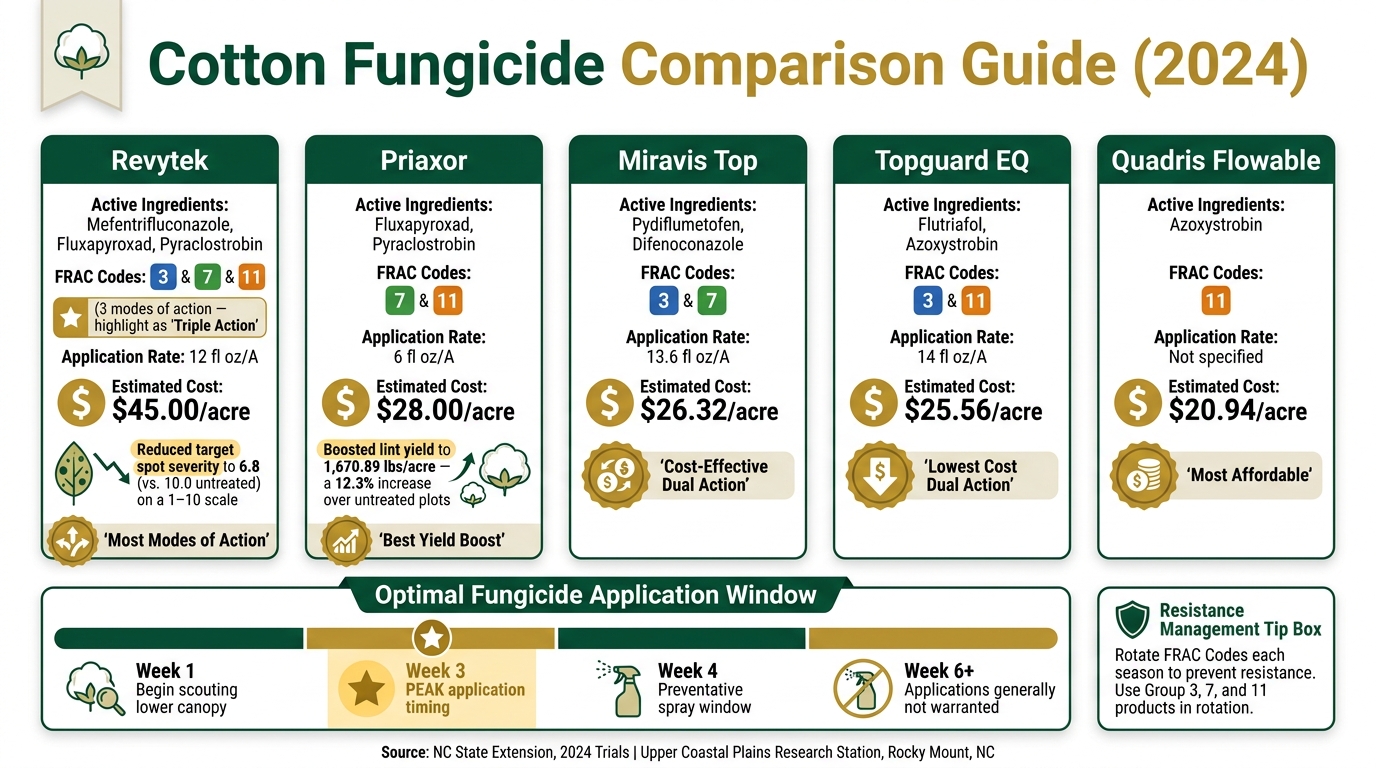
Cotton Fungicide Comparison: Top Products, Costs & FRAC Codes (2024)
Once you've identified the disease and determined the best timing, the next step is selecting a fungicide that aligns with the specific issue. Below, we’ll explore different fungicide options and how to apply them effectively for the best results.
Seed Treatments and In-Furrow Fungicides
The first line of defense against early-season soilborne pathogens includes seed treatments and in-furrow applications. For instance, Xyway (flutriafol, FRAC Group 3) is applied at planting and provides systemic protection throughout the season. Priced at around $35.00 per acre, this product is especially beneficial for fields with a history of soilborne diseases. Meanwhile, studies on azoxystrobin-based seed coatings, like Signum (boscalid + pyraclostrobin), have shown they can prevent root infections for up to 12 days.
New advancements, such as clay-based controlled-release formulations, aim to extend this protective window. As highlighted in the Journal of Cotton Research:
"The slow release of fungicide from a clay dispersed in the sowing strip allows continuous protection of the seedlings over time while preventing the loss of activity due to movement of the fungicide in soil."
Foliar Fungicides for Target Spot and Areolate Mildew
To tackle leaf diseases, foliar fungicides are the next step after seed and in-furrow treatments. Multi-mode-of-action premixes are now the standard, combining two or three FRAC codes to enhance effectiveness and delay resistance. Here’s a quick comparison of leading options tested in 2024 North Carolina trials:
| Fungicide | Active Ingredients | FRAC Codes | Rate (fl oz/A) | Est. Cost/Acre |
|---|---|---|---|---|
| Revytek | Mefentrifluconazole, Fluxapyroxad, Pyraclostrobin | 3, 7, & 11 | 12 | $45.00 |
| Priaxor | Fluxapyroxad, Pyraclostrobin | 7 & 11 | 6 | $28.00 |
| Miravis Top | Pydiflumetofen, Difenoconazole | 3 & 7 | 13.6 | $26.32 |
| Topguard EQ | Flutriafol, Azoxystrobin | 3 & 11 | 14 | $25.56 |
| Quadris Flowable | Azoxystrobin | 11 | - | $20.94 |
(Source: NC State Extension, 2024)
Trials at the Upper Coast Plains Research Station in Rocky Mount, NC, showed promising results. For example, Priaxor applied at 6 fl oz/A during the third week of bloom boosted lint yield to 1,670.89 lbs per acre - a 12.3% increase over untreated plots. Similarly, Revytek (12 fl oz/A) reduced target spot severity to 6.8 on a 1–10 scale, compared to 10.0 in untreated plots. As Daisy Ahumada from NC State University noted:
"Fungicides reduced the impact of target spot and areolate mildew in cotton by reducing defoliation. Less defoliation was significantly correlated to higher yields."
Fungicides for Soilborne Diseases and Site-Specific Use
After foliar treatments, targeted soil applications complete the management strategy. Diseases like cotton root rot and charcoal rot require specific approaches. Flutriafol-based products like Xyway remain a reliable choice for planting, but for charcoal rot, azoxystrobin applied via drip irrigation systems has proven effective. Research indicates this method can reduce charcoal rot incidence to 15%, compared to 30% in untreated fields.
For areas with well-mapped disease zones, such as the circular patches typical of cotton root rot, variable-rate application technology helps focus fungicide use where it’s most needed. This precision approach not only lowers input costs but also ensures high-risk areas receive adequate protection.
Best Practices for Applying Fungicides
Once you've identified the disease and selected the right fungicide, applying it correctly is the next crucial step to ensure it works effectively.
Start by reviewing the fungicide label carefully. It will provide details on approved application methods, timing, and any restrictions. This step ensures you’re using the product as intended and getting the best results.
Before applying, make sure to sanitize your equipment and boots using pressurized water. This helps prevent the spread of pathogens. Also, limit foot and equipment traffic in affected areas, especially when the soil is wet, to avoid transferring contaminated soil to other locations.
Sprayer calibration is another key factor. Pay attention to nozzle flow rate, ground speed, pressure, and spacing to achieve even coverage. For best results, use a nozzle and pressure combination that produces medium-sized droplets (250–350 µm). This size strikes a balance between effective canopy penetration and controlling drift. As Roberto N. Barbosa from LSU AgCenter explains:
"Proper nozzle setup and sprayer calibration are keys for a good product distribution in the canopy." – Roberto N. Barbosa, LSU AgCenter
If you’re using a carrier other than water, recalibrate your sprayer to account for differences in density. This adjustment ensures consistent application rates and helps the fungicide perform as intended.
Building Fungicides Into a Full Disease Management Plan
Fungicides work best when they're part of a larger, well-rounded strategy. They aren't a standalone solution but rather a piece of the puzzle. For disease to develop, three factors need to align: a pathogen, a vulnerable crop, and favorable weather conditions. Relying only on fungicides ignores these other critical elements.
Cultural Practices That Support Fungicide Performance
Cultural practices like crop rotation and residue management can significantly reduce disease pressure before fungicides even come into play. For example, rotating cotton with non-host crops like corn, grain sorghum, or peanuts disrupts the pathogen's life cycle and limits inoculum buildup. Here's how common rotation crops perform against specific cotton diseases:
| Disease | Corn | Grain Sorghum | Peanuts | Soybeans |
|---|---|---|---|---|
| Fusarium Wilt | Excellent | Excellent | Excellent | Good |
| Verticillium Wilt | Excellent | Excellent | Excellent | Good |
| Root-knot Nematode | Good | Good | Excellent | Poor |
| Reniform Nematode | Excellent | Excellent | Excellent | Poor |
| Bacterial Blight | Excellent | Excellent | Excellent | Excellent |
Table 1: Effectiveness of rotational crops against cotton diseases.
Post-harvest practices, like chopping and incorporating cotton stalks, can also reduce overwintering sites for pathogens and pest insects that spread viral diseases. Maintaining proper soil potassium levels is another key step - it not only supports overall plant health but also helps reduce the severity of wilt diseases. Additionally, canopy management using Plant Growth Regulators (PGRs) prevents excessive growth, improves airflow, and keeps canopy humidity in check. These measures collectively reduce the risk of boll rot and foliar diseases.
By adopting these practices, you create a strong foundation for making informed, data-driven decisions in disease management.
Using Local Data and Expert Guidance
Once cultural practices are in place, refine your approach with localized data and expert advice. Reviewing your field's history and consulting local agronomists can help you fine-tune fungicide applications. If you're unsure about symptoms, reach out to a diagnostic lab or local expert for clarification.
For selecting fungicides, the Cotton Pathologists Working Group (CPWG) offers efficacy ratings that are updated regularly, with the latest version available as of 2026. These ratings are based on extensive multi-year, multi-location testing conducted by experts from institutions such as the University of Georgia, Texas A&M, and Auburn University. Using these resources ensures you choose fungicides that address the specific disease pressures in your area effectively.
Conclusion and Key Takeaways
Advanced fungicides offer growers powerful tools, but their success hinges on proper timing, accurate disease identification, and strong agronomic practices. Timing matters most - for example, foliar applications targeting Target Spot are most effective during the first and third weeks of bloom. Missing this critical window could lead to yield losses. Recent trials highlight that well-timed foliar treatments can lead to significant yield improvements.
Equally important is correctly identifying the disease. Misdiagnosing symptoms can lead to using the wrong treatment, which wastes resources and fails to address the problem.
"Since many mid- to late-season production problems do not have an in-season control option, the only control measures available may be cultural or chemical options to reduce the occurrence of these diseases in the following cotton crop." - Bayer Crop Science
Beyond timing and diagnosis, resistance management is crucial. Rotating fungicides across different FRAC codes - such as using Group 3, 7, and 11 products - helps maintain their effectiveness over time while expanding disease control options. New innovations, like sepiolite-based slow-release azoxystrobin formulations, are also offering exciting early-season solutions. Semi-field trials have shown these products can reduce pathogen infections by up to 92% at 68 days post-sowing.
FAQs
Should I spray if I only see a few target spot lesions?
Applying a fungicide might make sense if target spot lesions are present in the lower canopy, the crop is within the first six weeks of bloom, and the yield outlook is strong. Target spot thrives and spreads quickly in extended wet conditions, making early scouting essential.
However, if defoliation reaches 25–30% or more, spraying is unlikely to be worth the cost. Also, make sure you’re dealing with target spot and not Stemphylium leaf spot, as fungicides won’t work against the latter. Proper identification is critical before taking action.
How can I distinguish target spot from bacterial blight before spraying?
To differentiate target spot from bacterial blight, pay close attention to the leaf symptoms and their location in the canopy.
- Target spot begins as brown, necrotic lesions in the lower canopy. These lesions often develop irregular concentric rings as they expand.
- Bacterial blight, on the other hand, presents as water-soaked spots that darken to black. These spots frequently follow leaf veins and may be surrounded by yellow halos.
It's worth noting that fungicides can control target spot, but they won't work against bacterial blight.
How do I rotate FRAC codes to avoid fungicide resistance?
To reduce the risk of fungicide resistance, it's crucial to avoid using products with the same FRAC code or mode of action repeatedly. Instead, rotate between fungicides with different FRAC codes during applications. Additionally, consider tank-mixing high-risk, site-specific fungicides with broad-spectrum, multi-site inhibitors (such as those in Group M). Always review product labels for application restrictions, as some high-risk fungicides have limits on how many times they can be applied consecutively in a single season.