Mills now buy cotton by numbers, not by broad grade names. If a gin wants better pricing and fewer claims, I’d focus on five things right away: HVI data on every bale, AFIS for hidden fiber defects, lint moisture near 6% to 7%, contamination checks, and PBI-linked bale records.
Here’s the short version: mills want cotton that runs the same way every day. That means strength, length, uniformity, micronaire, color, trash, and moisture all need to stay inside tight ranges. Even small shifts can hurt spinning. The article points to a few hard numbers: dropping moisture 1 percentage point below 5% is tied to about a 0.01-inch loss in staple length and about a 1-point drop in uniformity. Another trial found that moving lint moisture from 5.5% to 6.5% improved UHML by 0.25 mm, improved uniformity by 1%, and cut short fiber by 0.5%.
If I had to sum up what mills expect from a modern gin, it would be this:
- HVI for bale classing, sorting, and shipment building
- AFIS for short fiber, neps, fineness, and maturity checks
- Moisture sensing at intake, on the line, and at the press
- Contamination detection for plastic, twine, and other foreign matter
- Bale-by-bale traceability tied to USDA classing and PBI tags
The main point is simple: test early, sort tightly, and document every bale. That helps a gin make better process changes before fiber quality slips, match shipments to mill specs, and cut the risk of discounts, disputes, and lost orders.
| Tool | What I’d use it for | What mills get from it |
|---|---|---|
| HVI | Classing and lot formation | Bale-level spec data |
| AFIS | Finding hidden fiber defects | Fewer spinning surprises |
| Moisture sensors | Dryer and press control | More stable fiber and classing |
| Contamination detection | Removing foreign matter | Lower shipment risk |
| PBI-linked records | Traceability and lot matching | Better laydown planning |
If you want cotton to sell into tighter mill specs, this article comes down to one idea: data has to drive both gin settings and bale sales.
Mill Fiber Requirements and U.S. Classing Measurements
The Fiber Properties Mills Track Most Closely
Mills buy cotton for one main reason: they need it to run the same way, day after day, on set equipment and for set yarn counts. Each fiber trait has a target range. When cotton falls outside that range, efficiency drops and yarn quality tends to slip.
Strength is often the first thing buyers check. Most U.S. ring-spinning mills look for fiber strength in the 28–32 g/tex range. USDA classing breaks strength into clear groups: 23 g/tex or below is Weak, 29–30 g/tex is Strong, and 31 g/tex and above is Very Strong. If strength comes in low, mills usually have to slow spindle speeds, deal with more end-breaks, and spend more on piecing labor.
Upper Half Mean Length (UHML) and Length Uniformity Index (UI) are closely tied, and mills watch both. For standard upland cotton, many mills target UHML of 1.08–1.15 inches, though the exact need depends on yarn count. One Beltwide study found that a 1-point drop in UI was linked to a 0.5 g/tex drop in bundle strength, and that a 1% increase in short fiber was tied to about a 150-unit drop in ballooning factor. USDA classifies UI as Very High above 85%, High at 83–85%, Intermediate at 80–82%, and Low at 77–79%. In day-to-day buying, most mills draw the line at about 82–85% for standard yarns.
Micronaire gets a lot of attention because it affects dyeing and how the fiber runs in the mill. For upland cotton, the preferred range is 3.7–4.2. Cotton below that range tends to include more immature fiber, which can bump up nep counts and lead to shade variation in dyeing. On the other side, higher micronaire can make yarn feel harsher and can create more trouble in processing. Because of that, mills often write contracts around a tight micronaire band, such as 3.8–4.4, and apply discounts outside that window.
Color (Rd and +b) and trash content round out the quality picture. Lower Rd and lower +b readings point to duller fiber. That usually means more bleaching work and a higher risk of shade variation. Trash matters just as much. If trash levels are high or jump around from bale to bale, blow room and card cleaning points get overloaded. Then mills have to slow feed rates and pull more waste. That hits cost per pound of usable yarn, not just the raw cotton price.
How HVI-Based U.S. Classing Supports Buying and Selling
HVI turns mill targets into bale-level data that buyers can use. USDA AMS classes every bale of U.S. cotton, which gives the market one shared quality standard. A mill can compare a bale from West Texas with one from the Mississippi Delta on the same scale, with the same calibration standards and the same measurement rules.
That classing data includes UHML, reported in 32nds and 100ths of an inch, along with UI, strength in g/tex, micronaire, color grade based on Rd and +b readings, and trash percent area. Mills use that bale-level data when building bale laydowns so they can keep length, strength, micronaire, and color inside tight ranges for each yarn style. Put simply, they are not hunting for the single best bale. They want the most steady laydown.
In practice, buyers often start by screening offers through classing summaries that show average values and distribution ranges. If a lot misses the minimum for strength or falls outside the micronaire window, it may be rejected before anyone even pulls physical samples. When an offer passes that first screen, mills often ask for bale-by-bale HVI data so they can remove outliers that might throw off laydown consistency. That step cuts outlier risk and helps reduce shipment disputes. Many contracts also name USDA classing as the binding authority in quality disputes, with premiums and discounts tied to movement away from a base quality reference.
Mills also use SCI and predicted CSP to turn HVI data into a predicted spinning score. That score often shapes buying calls more than any single fiber trait by itself. HVI gives the base classing picture. AFIS and in-line sensors then pick up the finer defects that show up later in mill performance.
sbb-itb-0e617ca
Core Testing Technologies Used in Cotton Processing
Those mill specs only matter if a gin can measure them bale by bale.
HVI for Bale Classing, Sorting, and Lot Formation
HVI is the bale-level standard for classing and sorting U.S. cotton. It measures UHML, UI, strength, micronaire, color, and trash in one run. That gives gins a direct way to turn mill specs into day-to-day sorting calls.
HVI does its best work when gins sort bales into uniform lots before shipment. Mills often rely on composite scores such as the Spinning Consistency Index (SCI), which rolls several HVI properties into one per-bale value, to rank inventory and plan laydowns. In plain terms, it helps keep length, strength, micronaire, and color lined up across a laydown. That gives buyers a clearer sense of what will show up at the mill.
Still, HVI has limits. It gives bale averages, and averages can hide trouble. That’s where AFIS comes in.
AFIS for Short Fiber, Neps, Fineness, and Maturity
Where HVI reports bale averages, Advanced Fiber Information System (AFIS) testing looks at individual fibers. It measures short fiber content, neps per gram, average nep size, fineness, maturity ratio, and immature fiber content. AFIS also separates fiber neps from seed-coat neps. That matters because seed-coat neps are tied to visible specks in dyed fabrics and more yarn breaks.
This is the kind of problem that can sneak past HVI. A bale may post an acceptable UHML result on HVI but still carry high short fiber content that leads to more end-breaks in spinning. AFIS brings that issue to the surface before it turns into a mill complaint.
That information gives gins a better handle on operating choices. AFIS can guide decisions on opening and cleaning intensity, carding settings, and lot segregation for high-count or combed yarn production. In other words, it helps catch hidden defects before they start costing money downstream.
Moisture and contamination checks serve a different job: they help protect that same fiber quality after testing.
Moisture and Contamination Detection at Key Control Points
Moisture sensing shows up at three main points in the gin workflow: module intake, the processing line, and the bale press. Each point answers a different question.
- At intake, sensors flag cotton that is too wet before it enters the gin, which helps prevent microbial growth and color loss.
- On the line, inline sensors track moisture before and after drying so cotton doesn’t get overdried. Overdrying makes fibers more brittle and can shorten staple length.
- At the bale press, moisture checks confirm that samples fall within the accepted range, usually about 6.5% to 8.0%, to avoid overdrying and verify bale moisture before classing.
The National Cotton Council recommends keeping bale moisture at or below about 7.5% for sound storage and classing.
Contamination detection focuses on plastic film, polypropylene twine, oily residues, and other foreign matter that can end up in finished bales. Optical and sensor-based systems spot contaminated cotton by color and reflectance, then divert suspect material for manual cleaning or reprocessing. That step also creates a traceable record that can be checked during shipment review.
Taken together, moisture and contamination control help protect classing accuracy and shipment acceptance.
These readings then feed gin adjustments and bale records.
How Testing Data Improves Gin Decisions and Mill Confidence
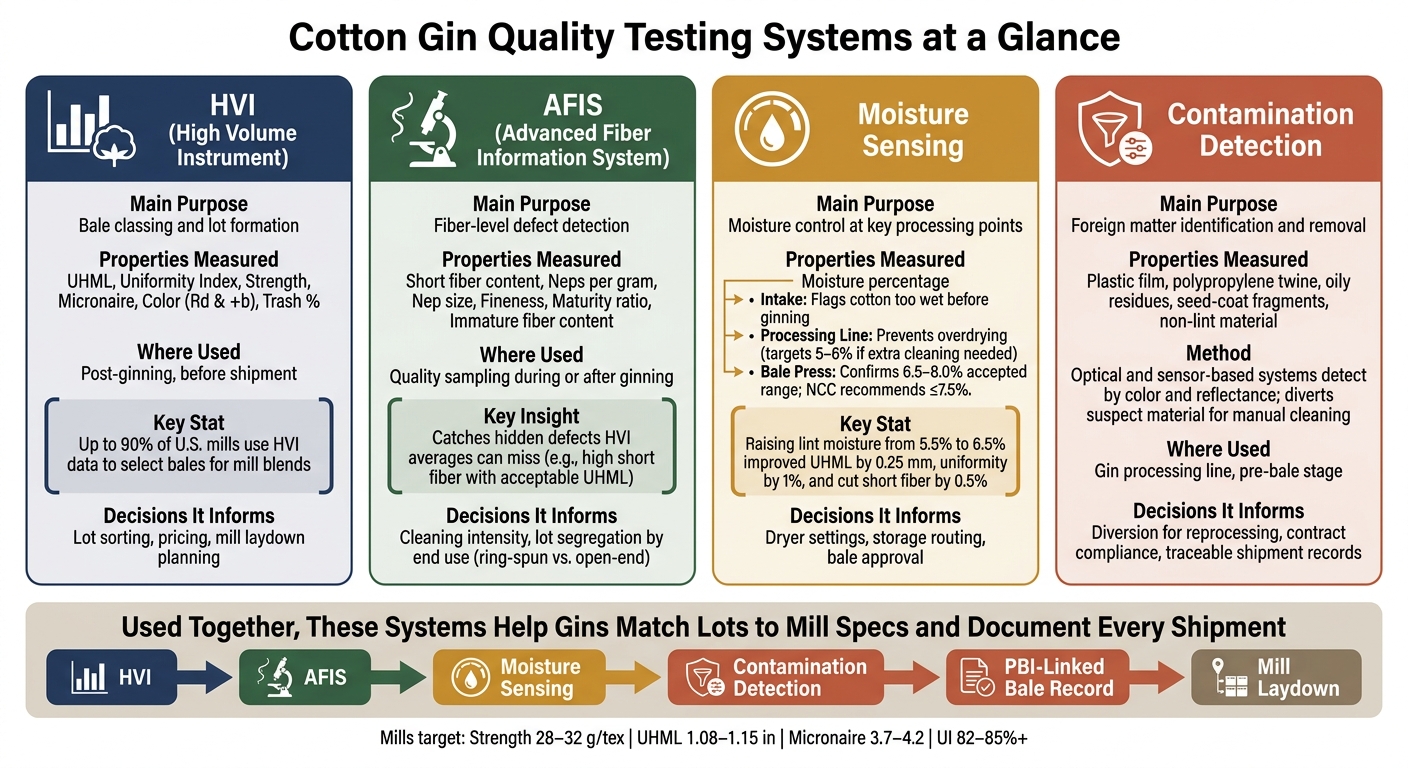
Cotton Gin Quality Testing Systems: HVI vs AFIS vs Moisture vs Contamination Detection
Using Test Results to Adjust Processing Before Quality Is Lost
Once classing data is available, the next step is straightforward: decide what the gin should change.
Test data only matters if it changes how the cotton is handled. HVI, AFIS, and moisture readings help gins catch quality loss before it gets pressed into the bale.
A good example is moisture. Keep lint moisture near 6% to 7%. If the cotton needs extra cleaning, dry only to 5% to 6% so the gin doesn't give up fiber length and create more short fiber. Moisture control trials found that moving lint moisture from 5.5% to 6.5% improved UHML by 0.25 mm, increased uniformity by 1%, and cut short fiber content by 0.5%.
After machine settings, the next checkpoint is bale grouping.
If AFIS short fiber and nep readings keep moving up across a run of bales, that's a sign the gin may need to back off lint cleaner passes or adjust saw speed and grid bar settings. Research shows that slower ginning rates improve HVI color, leaf grade, and trash area. AFIS results also show longer fibers and less short fiber at slower rates. In one gin process monitoring study, better moisture control and better turnout increased bale value by $17.50 per 480-lb bale.
HVI results for length, strength, uniformity, micronaire, color, and trash give gins a practical way to group bales into lots that fit mill needs. AFIS adds one more screen. Bales with higher short fiber or nep counts can go to open-end spinning customers, while lower-short-fiber lots can be held for ring-spun or fine-count uses. That kind of sorting cuts variation inside each shipment and gives mills a more predictable laydown.
Traceability, Bale-by-Bale Data Systems, and Shipment Alignment
Process control has to travel with the bale.
Every U.S. bale carries a Permanent Bale Identification (PBI) tag that links it to USDA classing results. When bale IDs are connected to HVI, AFIS, moisture, and contamination records in one system, mills can sort available inventory by the exact specs they want. That may mean strength above a set floor, micronaire inside a tight range, or short fiber index below a target. From there, they can build shipments whose statistical profile lines up with yarn needs. Up to 90% of U.S. mills use HVI data to choose bales for mill blends, often with tools such as Cotton Incorporated's Engineered Fiber Selection (EFS) and MILLNet software.
When a mill reports high end-breakage or shade variation in a certain lot, a gin with full bale records can trace the issue back to the exact bales, review the original test data, and check whether the cause was a fiber property, a handling problem, or lot mixing. That turns a broad complaint into something specific and easier to act on. Over time, that kind of visibility helps support repeat orders and long-term mill relationships.
HVI, AFIS, Moisture Sensing, and Contamination Detection: A Side-by-Side Look
The same test data also helps with sorting, lot building, and shipment checks.
| System | Main Purpose | Properties Measured | Where Used | Decisions It Informs |
|---|---|---|---|---|
| HVI | Bale classing and lot formation | UHML, UI, strength, micronaire, color, trash | Post-ginning, before shipment | Lot sorting, pricing, mill laydown planning |
| AFIS | Fiber-level defect detection | Short fiber content, neps, fineness, maturity ratio | Quality sampling during or after ginning | Cleaning intensity, lot segregation by end use |
| Moisture Sensing | Moisture control at key points | Moisture percentage | Feeder, dryer, press, and storage | Dryer settings, storage routing, bale approval |
| Contamination Detection | Foreign matter identification | Plastic, seed-coat fragments, and non-lint material | Gin processing line, pre-bale stage | Diversion for reprocessing, contract compliance |
Used together, these systems help gins match lots to mill specs and document each shipment.
Conclusion: The Testing Capabilities Mills Expect From Modern Cotton Processing
Mills buy based on documented fiber specs, not reputation. And with high-speed spinning, there’s almost no room for drift from bale to bale. If a gin can’t prove quality with data, it often loses orders or has to take a lower price.
That’s why HVI, AFIS, moisture sensing, contamination detection, and bale-level traceability are now just part of the job. They’re no longer optional add-ons. For gins, the priority is straightforward:
PBI-linked bale records let mills build laydowns, match shipments to spinning needs, and trace issues to specific bales.
Key Takeaways for Gins and Processors
Test the fiber traits mills actually price: length, strength, uniformity, micronaire, color, trash, and moisture. Use HVI on every bale. When you need a closer look at short fiber, neps, fineness, and maturity, use AFIS.
Keep moisture under control before pressing. Catch contamination early too. That helps protect classing results, storage performance, and market value.
Quality data should do two jobs at once: help run the gin better and help sell the cotton better. Bale-level records support lot pricing, shipment alignment, and stronger contracts. That kind of transparency cuts down on claims and helps mills stay confident in future purchases.
FAQs
Why isn’t HVI data alone enough for mills?
HVI is the standard for measuring key fiber properties like length, strength, and color. But for modern high-speed spinning, it doesn't give mills the full picture.
That's where tools like AFIS come in. They show more about fiber variation, short fiber content, and nep levels. And when the job is finding contaminants like plastics, mills need dedicated detection systems built for that purpose.
What moisture range best protects cotton fiber quality?
Lint moisture is best kept at 6% to 8%, and about 7% is often the sweet spot for fiber strength, length retention, and bale stability.
If moisture drops below 5%, lint can turn brittle and build up static. If it climbs past 8%, you can run into cleaning problems, discoloration, and mold risk.
For seed cotton storage, the right range is 8% to 12%. Once moisture goes above 12%, active drying is needed.
How does bale-by-bale traceability reduce mill claims?
Bale-by-bale traceability helps cut mill claims because it gives mills objective, verifiable data on fiber consistency and makes it easier to isolate contaminated material.
When moisture readings, contamination profiles, and other quality metrics are tied to individual bale IDs, gins get a clear record of each bale’s condition. That record helps teams make targeted processing adjustments. It also gives mills more confidence in the fiber they receive, which can reduce quality-related disputes.